Sea Change

MelvillesBiblesMy reading list is long, and it grows longer all the time. I read both fiction and non-fiction with equal avidity. Given that there are so many books I want to read, it is unusual to read entire books a second time (they should be kept for reference’s sake, of course). Two exceptions to the multiple reading trend have been, for me, the Bible and Moby-Dick. In reading Ilana Pardes’Melville’s Bibles, I discovered I’m not alone in according Melville nearly biblical status. As a book itself, Melville’s Bibles went on my reading list as soon as I learned of it. You see, Moby-Dick was added to my personal Deutero-Canon as soon as I closed its cover. Perhaps before. It was an assignment for a seminary biblical studies class on wisdom literature. My high school wasn’t one that required the novel, and all I knew about it previously was that it was a big book about whale hunting. I knew so little.

Pardes looks at Moby-Dick, and other literature, both by Melville and others, through the lenses of biblical characters. Of course there’s Ishmael. And Ahab. Melville, however, knew his Bible well, and to understand his work on a deeper level so must his reader. Job’s there. As is Jonah. Jeremiah, Elijah, Micaiah ben-Imlah, and even Rachel. Pardes takes these characters and shows how they appear, generally in Moby-Dick, spread across a variety of characters. More than one Ahab and Ishmael walk these decks. All the while, she notes, Melville himself wasn’t a typical “believer.” He struggled with the deity that he just couldn’t find. The end result is a compelling analysis of literature and human nature.

This brief study has a disproportionate number of insights. I frequently found myself stopping to ponder what I’d just read. Perhaps that’s to be expected in any book that brings two weighty canonical works together in such a gam. (If you can’t recall what a gam is, reading either Pardes or Moby-Dick will remind you.) Encountering Moby-Dick the first time was like finding a lost book of the Bible. I had no idea, however, at the depth of comparison. Pardes shows just how deep that ocean is. Melville’s well-thumbed, indeed, annotated Bible does play a role in all of this. Perhaps he didn’t intend all the connections readers like Pardes find, but that doesn’t make the connections tenuous. They’re clearly there. Canonical works are like that. Moby-Dick, indeed, is an iconic book and Pardes is a very capable Captain to guide a reader through it.


For Love of English

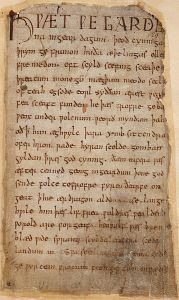
One of my most frequent imaginary dalliances is wondering what I would have done with my life if I hadn’t been raised religious. Like many young boys I found “exciting” jobs enticing—soldier, firefighter, explorer—but scientist also loomed large in my imaginary horizon. By the time I was a teen I was firmly ensconced in books. My upbringing meant that many of these books were religious in nature, and my concern with ultimate consequences meant religion was the only possible career track to make any sense. It certainly never made dollars. As someone who professionally looks backwards, I’ve found myself wondering if I shouldn’t have focused on English rather than Hebrew and Ugaritic as a career. After all, the Bible has been available in English for centuries now. Besides that, the canon is larger—from Beowulf to Bible and beyond. Reading is, after all, fundamental.

Beowulf, from Wikimedia Commons.

Beowulf, from Wikimedia Commons.

I only discovered BookRiot recently, and that through the mediation of my wife. For the writer of a blog I really don’t spend that much time online outside of work. I like real books, and being outdoors. Too much time staring at a screen brings me down. Nevertheless, BookRiot has stories that cause me to question my career choices from time to time. For instance, I have never knowingly heard of The Exeter Book. Dating to the tenth century, this medieval manuscript is among the earliest of English writings. Showing the interests of the monk who likely inscribed it, it has religiously themed material and riddles. As E. H. Kern’s post on BookRiot points out, The Exeter Book has inspired many later writers and has, through them, made its way into mainstream popular culture. Not bad for a book that I suspect many, like myself, have never heard of.

Old English has the same kind of draw as other ancient languages. Not nearly as dusty as ancient Semitic tongues, it contains the roots to the form of expression I find most familiar. I love looking back at the Old English of Beowulf and spotting the points where my native language has remained relatively unchanged over the centuries. Modern English even begrudgingly owes a considerable debt to the Bible of King James. Our language is our spiritual heritage. We have trouble expressing our deepest thoughts without it. Perhaps had BookRiot existed when I was young, I might have made a rather more informed decision about the direction of my career. Or, then again, religion might have found me nevertheless. From some things there is just no hiding.


Madness of Kings

The Roman Empire ruled the known world. Christianity owes much of its form and structure to the fact that the Romans expressed their rule in a military way and prized what they thought was order and fairness. While all of this was happening across the ocean, what are now ancient cedars had begun to grow in Roosevelt Grove, Washington. Having survived the many forest fires that sweep through this area of the northwest, these trees may be up to 2000–3000 years old with an average of about 800 years per tree. Impressed by such longevity, this year on the East Coast I’ve visited the two oldest trees in New Jersey (posts about them may be found in January and July of this year’s offerings). The Great Swamp Oak may be 700 years old, and the Basking Ridge Oak is over 600. The longest lived trees in the country, however, are out here in the west.

IMG_2890

The cedars of Roosevelt Grove aren’t the oldest. There are Bristlecone Pines further to the south that are twice again the age of these millennial trees. One survives from the days when writing itself was first being invented and has lived through most of human civilization. Wisely, its exact location has not been disclosed. We all know how, in a moment of foolishness, a single human being can easily destroy that which can’t be replaced. The story of the Bristlecone Pines is illustrative. A naturalist studying the trees took a core sample of the tree that, at that time, was the oldest living tree known. When his bit broke off in the tree the solution was to cut it down to retrieve the bit. Fortunately an even older tree was later discovered in the same forest and those who know where it is don’t say. It’s a form of collective madness that makes humans want to conquer. Romans and trees both stand witness.

A few miles south of Roosevelt Grove stands the Shoe Tree. For reasons unknown, decades ago campers began leaving shoes on this great conifer. Shoe trees actually exist in several locations around the country. This particular exemplar was a well-known local attraction. Shoes had been nailed to the trunk, or tied together and tossed high into the branches. Whimsical and illogical, it would have drove a Roman crazy. Then a few years back someone decided to set the tree on fire. Thinking the act had ended the joie de vivre, one unthinking person sought to change history. After the act of destruction, however, shoes were once again nailed to the now dead tree, and once again tossed into its lifeless branches. The tree next to it, I noticed, has started to acquire its own sets of footwear. If it outlasts the empires of today, there will be those of generations yet unimagined wondering about the madness that those who insist on conquering leave in their wake.


Opposites Distract

In the current political climate—and not just in the United States, as Brexit reminds us—opposites seem to be the order of the day. The middle ground seems to have fallen out as those frantic for turning back the clock to a day that never really ever existed make their voices louder and more strident. After seven millennia of progress, the apogee of mankind—and let’s be explicit that we mean rule by white men—was reached in “the greatest generation” and the happy days that followed in the 1950s. Those of us born to protest for an even greater idealism have, by our very nature, disrupted the smooth calm that fictitiously prevailed through the first half of the last century. In a new millennium the ghosts of the last century dictate policy. Would I have felt safer then?

The more I ponder this stark dualism, the more it seems that the origin is religious. In its most recent iteration that religion is branded as Christianity, but in actual fact the dualism goes much deeper than that. The adjective “Manichaean” has become popular with writers who discern a certain black and whiteness to our outlook. Mani wasn’t the first dualist in history. In fact, he was somewhat late to the game. We don’t know much about Zarathustra, or Zoroaster as the Greeks called him, but we do know that he set out to devise a new religion. His outlook was one that saw the world as opposites. For every good god there had to be a bad god. There was a struggle that would result in either going to a heaven or a hell. Just about every religion that has developed ever since has shared his conflicted outlook.

DSCN2077

As political pundits bellow more like hippopotami than elephants, trumpeting that those who are different are not to be trusted, we’ve come once again into a dualistic world. Pluralism and globalization are not without their critics. Technology, however, has ensured that they will continue apace. Some governments have tried to “switch off” the internet. Those on the other side of the Berlin Wall didn’t want the truth of what was happening on the other side to be known. They had invented a dualism that was protected with rifles and threats. The problem is things aren’t as simple as the Manichaeans would have us believe. Ours is a world of beautiful, glorious complexity. It takes religion, it seems, to make such a wonderful chaos into something far too simple to match reality.


Sky Gods

One of the unspoken prompts for writing Weathering the Psalms was the unscientific idea that God is somehow associated with the sky. To my mind this has more to say about what religion is beyond the recognition that Anu, El, Nut, and kin were primordial deities of the celestial sphere. We’re all drawn to the sky. One of the earliest fictional pieces that I polished had to do with our desire for the sky—it’s something we deeply crave but cannot control. We dream of flying. Although flight seems almost casual these days, it is anything but. We still refer to satellite photos as being “God’s eye view” of the earth, knowing full well that the ancient cosmology of the three-tiered universe was simply a misconstrued view of how nature really works. Still, we want to embrace the sky.

Perhaps the cruelest aspect of work in the commercial sphere is the prevalence of “workstations” with no outside views. I’ve held two jobs since leaving academia where my “cubicle” was/is in a windowless room. Cut off from the sky, I’m supposed to focus on the glowing screen in front of me as if that could ever inspire me like a mountain sunrise or the silent crescent of the moon gracefully arcing across the sky. It could be night or day, snowing, raining, or brilliant sunshine, and for eight hours of each day I would never know. We call it efficiency. I think back to that story I wrote as a child about wanting the sky. If there are gods anywhere, it’s up there.

DSCN6374

The perspective from above can change everything. On a small plane tour at 7000 feet, you can get a sense of what you’d never expect from the ground. Sharing the view of gods and angels, the land is laid out before you. “Distances,” our pilot says, “are very deceptive from up here.” Indeed, a few minutes aloft and it’s easy to forget what things looked like on the land. Pedestrian. Street-level. Quotidian life. Up here, isolated in a different way, I am seeing what the ancients could only imagine what the gods might see. For the moment I’m one with the sky. For the moment the world of everyday life is far away. That dark and gloomy cubicle no longer exists. In fact, from the sky I cannot see it in its windowless dungeon. We can’t own the sky. Being up here I start to suspect that neither can the gods.


Eve’s Apple

Rituals rely on unchanging circumstances. When we attended a grocery store that was not our usual one my ritual was challenged. First I have to confess (as is appropriate for a ritual): I am no foodie. Having grown up in humble circumstances where eating out was an unknown, eating in meant the basic food of the unsophisticated. Although college and subsequent years opened my appreciation for new, and sometimes exotic foods (before my vegetarian days I ate ostrich when taken for dinner on a job interview. I didn’t get the job and shortly became a vegetarian—some things just aren’t worth it) I’m still a pretty boring grazer. I take the same thing for lunch each day at work. I eat the same thing for breakfast every day—inspired by the Seventh Day Adventist predilection for cereal—and I imagine my wife finds grocery planning with a guy like me to be its own trial. I see the grocery bill and scream. I eat to live, and not vice-versa.

Eve

So we were in a different grocery store. I take the same fruit for lunch every day, but here my apple of choice was more expensive. I looked for something in the price-range that I feel is affordable for fruit. My eye fell on a variety of apple I’d never seen. It was called Eve. Apples are one of those staples that I’ve always appreciated. We still sometimes go apple picking in the autumn, but it’s difficult to eat them all up before they go bad. In the orchards they list the different apple varieties available for picking on any given weekend, and I had never seen an Eve apple. For my boring lunch (since I eat breakfast about 3:30 most days, by noon anything tastes good for breaking the second fast) I wondered if Eve would do. Would this be too exciting for work? I pondered the dilemma.

Although our culture is increasingly biblically illiterate, here was a breed of apple based on Genesis 3. The Bible, of course, does not name the fruit of the tree of knowledge, and the apple was likely chosen much later because of the similarity of its name in Latin to the word for evil. The image has, however, become iconic. Eve reaching for the apple is so well known that advertisers use it with abandon and nobody fails to get the reference. This story is deeply embedded within our culture. The Bible on the grocery store shelf. Still, I’m wondering—should I try something new? Thinking of the work week ahead, I’m tempted.


Monkey Puzzle

One of the unexpected consequences of Christian theology is the ongoing insistence in science that human beings are qualitatively different from other animals. Actually, it goes back to the Hebrew Bible and the concept of “the image of God.” As the absolute line between human and beast continues to blur (intelligence, tool use, language use—you name it) mainstream teaching has trouble admitting that our special differences aren’t that different. A Washington Post story by Darryl Fears describes how capuchin monkeys have been using tools to extract cashews from their toxic husks for at least 700 years. These monkeys use a two-rock system to get at cashews, which, in their natural state, are inedible. The surprise here is that this makes these monkeys denizens of the Stone Age and capable of teaching complex behavior to their offspring.

Animals watch parents to learn to eat—it might seem to be a simple idea. In reality it’s more complicated than that. As I watched a doe and fawn foraging the other day, it occurred to me that what we call “instinct” is a way of getting around admitting animal intelligence. Why would a newborn (“unconscious”) animal seek to feed, or flee from predators? We call it instinct, but what we really mean is a form of will, a desire to survive. This “will” pervades nature well below the human-animal divide. Plants strive to thrive, and exhibit a “will” to live. By just taking all this for granted and calling it “instinct” we’ve further cut ourselves off from the organic world of which we’re all a part.

Christian culture gave rise to scientific method. No doubt this is an embarrassing scenario for those who believe science should reduce all the wonder of being alive to mathematical equations. Can’t we just pretend that rationality was creeping in from the beginning? Aristotle was going that way wasn’t he? But his work was “lost,” only to be recovered by Muslims who saw the value of such logical thinking and Christians—in an over-simplified history—wanted to catch up. Meanwhile, in the Dark Ages monkeys were using an intricate system to extract tasty nuts from toxic casings without the benefit of any religion at all. The Stone Age, we easily forget, was the first recognizable step on the road to the technological world we inhabit today. And we continue to use an outmoded paradigm to understand our place in that world.

391px-Organ_grinder_with_monkey


Popular Eternity

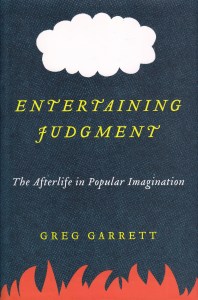
EntertainingJudgmentPopular culture, it seems to me, mediates reality. The media of various descriptions teach us what to think, and even if there is a religiously “orthodox” answer to questions, we will weigh it in the scales against what larger society says. This becomes clear in Greg Garrett’s Entertaining Judgment: The Afterlife in Popular Imagination. Garrett, a scholar of religion and popular culture, turns his attention to death in this book. More precisely, what happens after death. The usual suspects of ghosts, vampires, and zombies are here, but also the realms of Heaven, Hell, and for the Catholics in the house, Purgatory. All of these are seen through the various lenses of movies, television, song, comic books, regular books, and games. It’s fair to say that we’re a culture obsessed with death. But then again, what culture isn’t? It may be just that it comes across more charming when there’s a buck to be made at it.

What I found interesting is that although the Bible has little to say about Heaven or Hell (and nothing at all about Purgatory), each of these realms has developed a canonical script. Hell is hot and fiery, Heaven is cool and cloudy. Purgatory is gloomy, but beyond that comes in mild, medium, and hot varieties. We know these things from various teachings of our respective religions. In popular media, however, the script has been changing. We now have mild unpleasantness passing for Hell, if it lasts forever. Nobody needs to get burned. Heaven, meanwhile, can be just okay. It’s certainly better than the other place. Or the other two. We’ve overused our superlatives and have been left feeling like we’re on antidepressants.

Polls continue to tell us that many, if not most, Americans believe in literal Heavens and Hells. A point Garrett raises, however, is they may not mean by that what their clergy assert to be the case. Since near death experiences are controversial, nobody can say that they’ve actually been to either place, or the third. The exception to this rule is those who work in fiction—in whatever form. Since we can see their visions of the afterlife so clearly they have become the arbiters of eternity, with or without any religious training. In this day of marketplace religion and nones, Heaven and Hell seem to have become secular. The church may have introduced the ideas (actually, they seem to go back to the Zoroastrians, but I’m thinking of American culture) but the media have taken them over. We may be secular, but we still die. Entertaining Judgment might give you an idea of what to expect, depending on whose vision you buy.


Half-Way Holy

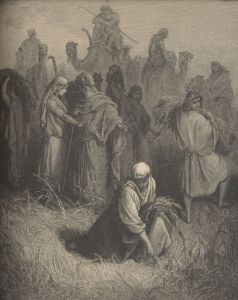
I’ve been reading about Ruth lately. Ruth doesn’t have a last name. She’s a character in the Bible. The book named after her is one of the shortest in the longest, Hebrew section of the Good Book. It’s a fairly gentle story, although it has a body count. Ruth, a Moabite, marries the son of an expatriate Israelite. This was in the days before the West Bank, but there was still some distrust there. Widowed Ruth moved to Israel with her equally widowed mother-in-law, and supported this non-traditional family by gleaning. Unlike modern civilization, shop-lifting (or field-lifting) by the poor was not a misdemeanor. In fact, the Bible insisted that it be allowed. It turns out that the field she’s been gleaning from belongs to a relative who eventually marries her via a tradition known as levirate law. Again, this is something current family values oppose, although it is commanded by the Almighty. Levirate law stated that if a man died childless, his younger brother had to take his wife until they had a child in the name of the dead brother. Creepy, but practical. A widow, in those days, had to have a child to support her.

Dore Ruth

I can’t recall when I learned this was called levirate law. I started reading the Bible before I was a teen, so I knew the story, although I didn’t understand the finer details. It was probably in the heading of some Bible translation that used the word “levirate” that I first encountered the term. I assumed it had something to do with the Levites. I mean, the words share the same first four letters, and Levites were all over the place in the Bible, even if they cross to the other side of the road. So it was that I went for decades with the idea that marrying your brother’s wife, at least temporarily, was because of the Levites. Nothing in the Bible said that Levites did this, and other than the jeans, I didn’t know any other Levi words.

Recently I learned that this is a false etymology. Levirate comes from a Latin root for “brother-in-law” and not from a Semitic root meaning “half-priest.” It may sound strange, but this was a genuine shock to me. I’d never told students that the word came from Levi, but I assumed that anyone could figure it out. After all, things that sound so very similar must belong together, right? Well, I admit to having been wrong here. The story of Ruth, however, is one of the true gems of the canon. Men play a minor role, and it is a woman who shows the way. It is a tale for our time. Family values, according to the Bible, aren’t always what they seem.


Prophetic Shaman

Lewis EcstaticDon’t complain. So I’m told. Work with the system (i.e., the privileged), do your part, and most of all, don’t complain. What would Jeremiah do? Or any of the prophets? It seems to me that prophets had the job of calling out where society had gone wrong and doing so with a healthy dose of complaint. If you don’t call out evil, it only grows. Prophets come to mind because I’ve just finished reading I. M. Lewis’ Ecstatic Religion: A Study of Shamanism and Spirit Possession. Spirit possession is chic, at least in the horror movie industry, but if you get beyond the stereotypes, you soon learn that inspired, or ecstatic, religion is largely based on good possession. The gods can temporarily inhabit the shaman, and, as Lewis points out, there is often an element of the underprivileged being those who are visited by the gods. Interestingly enough, indigenous cultures that feature shamans—or shaman-like practitioners—accept the rebuke of the gods, even when it may be a thinly veiled attempt to right an obvious wrong.

Shamanism is a bit of a misnomer. Not really a religion, but a set of spiritual practices originating among the Tungus of Siberia, shamanism is now conveniently applied to native peoples around the world. In our love of easy classification, we like to say this belief is similar to that belief, so they must be a type of religion. In fact, however, “religion” is much more integrated into the daily lives of indigenous peoples and specific beliefs vary widely. Nevertheless, we understand possession and shamanism, and we apply them as categories to try to make sense of it all. Lewis does so with an anthropologist’s eye, finally in the last chapter addressing the psychological questions. It is often claimed, for instance, that shamanism is a form of mental illness. What seems clear to me is that shamans are responsible for preventing injustice from getting too far established.

And that brings me back to prophets. Prophets, particularly among those who study the Bible, are often seen as religious authorities. It seems to me that prophets, as opposed to priests, grew out of the untamed concern for justice typically exhibited by shamans. Priests are establishment religionists. They support the government and the government supports them. Temples are built. Religion is regularized. Prophets, however, can come from anywhere. They are liminal figures, complaining, in God’s name, when injustice appears. They don’t support the status quo just because it makes people comfortable. In other words, complaint is often the only way to make the divine will known. They are the heirs of the shamans. One thing that’s pretty obvious—whether you live in Siberia, Israel, or America—shamans are still sorely needed.


Stations, Everyone

Station11There has been a movement, of late, among some sci-fi authors, to envision a more optimistic future. I have always been a fan of dystopias, myself. Perhaps it’s the working-class mentality backed up by being raised in poverty speaking, but sometimes I feel that collapse is more fair than progress. What passes for progress, anyway. Maybe I’m thinking this way because I just finished Emily St. John Mandel’s Station Eleven. This book has been on my radar for some time since it is one of the more hopeful dystopias out there. The story of a group among the very few who survive banding into a traveling troop of musicians and thespians is about the most hopeful outcome I can imagine. Not a day passes when I don’t feel the effacement of humanity that has been slowly taking place since I first became aware of the world. Sure, I do appreciate the strides made in medicine. Of this internet, which is the only place anyone ever really sees me, I’m less sanguine. It has its benefits, but even Mandel mentions the cell-phone zombies that are all too real and as omnipresent as an omnipotent deity used to be.

Station Eleven has, as many dystopias do, a religious sect that emerges after society collapses. This element of bleak futures is actually very accurate, I anticipate. We’re constantly being told by the “intellectuals” of the public variety that religion is for weak-minded dreamers with milquetoast aspirations for fantasy. The fact is the vast majority of people in the world are religious. The numbers are nowhere even near close. If a pandemic were to wipe out all but one percent (and hopefully it wouldn’t be the one percenters that survive) those who remain would, without doubt, turn to religion. People are easily led in this area of life. Mandel gives us The Prophet. His vision of the world is not helpful, but he has no trouble gathering a following. He’s also somewhat messianic: child of a single parent, raised in Israel, he comes to bring a sword to a nation already prostrate in the dust. This is powerful stuff.

Societies that try to rebuild themselves after traumas quite often rely on religion. This is hardly surprising as civilization itself began as religions coalesced into temples and their priesthoods. What is surprising is that so many intelligent people today can’t see just how important religion is to our species. As I suggested before, part of this is that religion defies simple definition. It’s easy to belittle “magical” thinking when it’s assumed religion has to do only with the supernatural. Religion, however, reaches into whatever we believe. Some ideas in modern cosmology, derived from physicists and their mathematics, can look sort of religious when viewed from a certain angle. As those who write dystopias know, religion is complex. It may lead to massive destruction. Chances are, however, that if there are any human beings left to crawl out of whatever pit we dig, they will do so with religious ideas in their heads. As usual, the writers have foreseen it.


Commander in Heaven

I pity the nation that doesn’t have divine founders. Origin myths help to orient our thoughts about where we belong in the order of things. Given enough time, any national founder will become a god. When a friend recently shared a blog post about Gogmagog, I had to dust a few cobwebs from my memory to place the mythic founding of Britain. During our years in Scotland my wife and I read about the heritage of the British Isles, according to bards before the Bard. Bede, Geoffrey, and the anonymous author(s) of the Mabinogion. Long before the Romans arrived on those islands, there had been gods, demons, and giants. The Medieval writers, of course, were drawing from the Bible. Gog and Magog are figures from Ezekiel, borrowed by Revelation. Sacred writ says enough about them only to make them mysterious. Their combined role in British myth makes one think they might be giants.

The founding of Israel, of course, is treated as history by many. I don’t mean the recent founding of the political state, but rather the biblical version of things. Moses leading the Israelites out of an oppressive Egypt, miraculously through divided waters. Foundation myths are that way. We can watch the process unfolding, even after just a few centuries. George Washington’s literal apotheosis is virtually certain. Even Alexander Hamilton experienced an unlikely resurrection when he was in danger of being removed from the ten-dollar bill. For nations to thrive this kind of transformation must take place.

6082318543_90e9752777_o

This is perhaps easier on states whose origins are lost in antiquity. There was nobody there to see the general fall off his horse or the commander in chief inhale. This was what folklorists call illud tempus, the time of events unlike those of today. Quotidian time has become profane—just look at the headlines if you don’t believe me. Those who are gods today are only those who make themselves so. We can see it happening all the time, if we pay attention. The implications should give us pause, when we consider those we think of as heroes or giants. Time makes gods. And it is just possible that we might be better off without a pantheon so terribly large.


Avoiding Ritual

IMG_0100

While on my current British kick—not really intentional, but sometimes life gives you limes—I thought I’d mention another piece sent to me by a friend. This one falls under BBC Earth, and it’s about “Why Ancient Brits threw out their most valuable possessions.” You can find the story by Amanda Ruggeri at the link. The basics are pretty simple: some people with a metal detector discovered what turned out to be a Bronze Age “hoard” in Lincolnshire. You have to understand that, in a way that makes me totally jealous, the United Kingdom has tonnes of ancient artefacts still undiscovered. While my wife and I lived there it wasn’t unusual to read about such finds in the newspaper. (Newspapers still existed then.) People had been smelting in the British Isles for a long time. The Phoenicians actually popped round the pub to get their tin—which can be one of the main ingredients for Bronze. What the article somewhat embarrassingly addresses is the nature of the hoard.

Hoards are where a large number of (usually metal) objects are discovered, after having been deliberately buried. These are not uncommon, what with Phoenicians, Romans, Angles, Saxons, Franks, Vikings, and others invading all the time. The issue that embarrasses is the “r word.” Ritual. While we don’t know the reason, the fact that people deliberately deep-sixed their valuables, routinely, suggests a ritual. As the article makes clear, professionals try to avoid the r word. Ironically, such deliberate burials, often with items purposefully broken, is also known from the ancient Levant, often predating the hoards of the prehistoric UK. Intentionally broken items—often of clay, and not infrequently depicting perhaps deities—were buried in biblical times. We don’t know why, but scholars suggest they could’ve been offerings. After all, breaking something potentially useful is an act of faith.

I’m not suggesting a direct connection here. I took a sound scholarly thrashing some years ago for suggesting a tale I heard on the streets of late twentieth-century Scotland had its origins in ancient Sumer (grad students are prone to such thinking). Still, it might not hurt anthropologists to cast a wider eye now and again. People had similar rit— well, let’s just say strange habits, in a land far away. Just cross the Channel and make a left. When it starts getting arid head south. The ancient world may have had more of an “internet” than we think. While that pathway may not always be marked by material remains, we now know ideas travel fast. Even something such as putting a daily post on a blog might become a ri—, strange habit.


Do the Twist

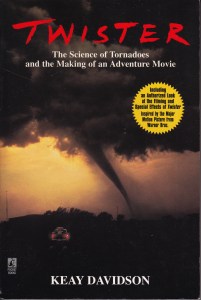
TwisterA used book sale is like a box of chocolates, if I may abscond with a simile that fits many scenarios. After all, you are there to buy books that others have discarded. Some of them show their age rather blatantly. Keay Davidson’s Twister: The Science of Tornadoes and the Making of an Adventure Movie is one such title. Those who know me well know of my fascination with weather—I wrote a little book on the subject based on that obsession. Although the weather informed and formed me long before I was ever near a tornado, these particular terrors were so exquisite that I couldn’t help but look. Although I grew up in Pennsylvania—not exactly tornado alley—one night when I was away from home a tornado swept by less than ten miles from where my family was. It toppled trees down one side of a hill and up another. It was eerie and uncanny and in many ways shook me out of the feeling that I never had to worry about them. Then when I went to Ann Arbor for a weekend with my fiancee the sky turned bronze. Rain was whipping past horizontally. Later we learned that a tornado had passed maybe four miles from where we were. Living in Illinois and Wisconsin, we experienced many tornado warnings. I never saw a tornado, but somehow thought I should.

It goes without saying that if I see a book on tornadoes that is reputable and cheap, I can’t pass it up. Davidson is a journalist whose work appears (as of the two decades ago when the book came out) in National Geographic. Some of you may not have been living in tornado alley twenty years ago, and therefore may not have felt the excitement that Twister, the movie, promised. By the time it came out I had already been thinking about Weathering the Psalms, at some level. I was a bit disappointed in the film itself, but it does mention that an F5 tornado is “the finger of God.” Davidson’s book picks up on this as well. At several points witnesses, and even scientists, lapse into divine language to describe tornadoes. One person even says that a tornado is an image of God, or that the storm is God. That’s a very natural way for people to think. The power of a Midwest storm has to be experienced to be believed.

The divine represents the highest echelon of language. The tornado fits because it is the most powerful wind on the planet. Concentrated, raging, and fickle. One can’t help but think: I was raised Protestant, what if the Catholics are right? Substitute any religion in either half of the equation. The weather simply does not do what we want it to do. It reminds us that humans can’t comprehend our own atmosphere that we so blithely pollute. The book may look dated—who remembers Twister anymore?—but it is a forceful reminder. When you need a metaphor for the most intense experience the weather will always be waiting.


Game of Thrones

IMG_2763I risk my already flagging street cred by admitting this, but I don’t watch Game of Thrones. In fact, I started to read the first book a couple years back and I just couldn’t get into it. Well, only 80 pages into it. The fault is, I’m entirely sure, my own. I lack some gene or enzyme that makes life without Game of Thrones impossible. Still, I have to admit curiosity. A story on the Washington Post, by Ishaan Tharoor, suggests “The ancient Persian god that may be at the heart of ‘Game of Thrones’” is Angra Mainyu, aka Ahriman. This managed to catch my attention. Zoroastrianism is a religion that seems to lie behind quite a bit of modern religious thought. Although dating Zarathustra, or Zoroaster, is notoriously difficult, concepts from his religious system show up in Hinduism—one of the earliest forms of religious expression about which we know a fair deal—as well as in Judaism and therefore Christianity and Islam. In fact, many of the ideas you may associate with the central tenets of Judeo-Christo-Islamic tradition may go back to Zarathustra.

One of the certainties about Zoroastrianism is that it was a dualistic religion. Good and evil are engaged in a constant struggle for control. The good god, Ahura Mazda (which sounds like a blend between Star Trek and a Japanese auto maker) struggles constantly against Angra Mainyu. Mazda’s website states that the car line is named after the deity (according to Wikipedia, I note, losing the last vestige of cred), pushing his reach even further east. With this incredible pedigree, it is no wonder that George R. R. Martin may have tapped into it. This kind of dualism is ripe for the picking.

My friend K. Marvin Bruce wrote a satire about the Persian gods, in fictional form, that was published a couple years back in Calliope, a small circulation literary journal. He told me he even won third place in a contest for it. The idea was that a disgruntled professor wanted to start the apocalypse (a Zoroastrian idea) by summoning Ahura Mazda and Angra Mainyu to earth to try to start a fight between the two. It was a fun story, but the point, if I may speak for my friend, is serious. Warring religions stand the best chance of beginning the end of times. We don’t even need the gods to do it, really. Although I don’t watch Game of Thrones, I can’t help wonder if Martin had the same idea in mind. If you want the answer to that, don’t ask me. I’m not even a hundred pages into it, and I don’t have triple play.