Playing Nicaea

Some professors are more creative than mine ever were. Not that there’s anything wrong with that. Even today “old school” means getting it done the arduous, nose-to-the-grindstone way. A friend of mine, however, is in Turkey where a class on social, political and religious relations has her involved in a role playing game (RPG in internet-speak) where the students take on the roles of the participants at the Council of Nicaea and argue the perspectives of those parties. What a great way to learn what minutiae set ablaze entire worlds! For those of you who don’t follow ecumenical councils, Nicaea was the big one. Depending on whom you trust, there were seven ecumenical councils that early Christians accepted, although others had gone their own direction before the first council (Nicaea) even began. Historians are now aware that Christianity was never a unified religion, just a varying number of winners and losers vying for who had the right to call themselves the true followers of Christ.
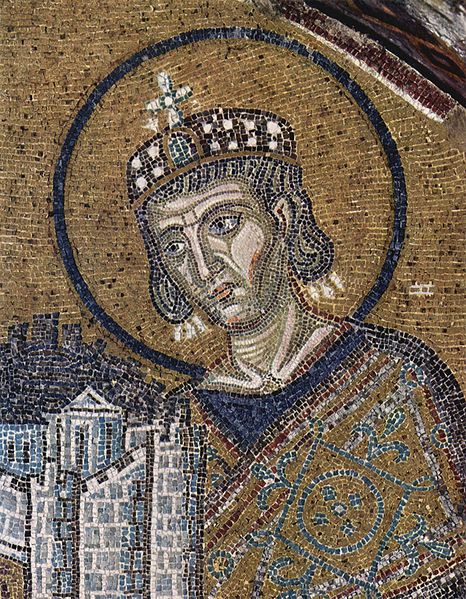
Constant Constantine keeps the halo.

Constant Constantine keeps the halo.

Nevertheless, the Council of Nicaea was one of the pivot-points on which all of history in the western world turns. Seem like a sweeping generalization? It is. But an honest one. Nicaea was the opportunity for the first Christian emperor, Constantine, to set in motion the swirling whirlpool of politics and religion that has never truly left the world ever since. Already before 325 C.E. there had been endless bickering about who Jesus really was, when Easter should be celebrated, which books belonged in the Bible (that most political of books), and who had authority over whom. The big question was really the relationship of Jesus to the Father, or, the first instance of “who’s your daddy?” Over questions like these, given history’s long view, thousands of people have died.

It’s not unusual to hear that the Council of Nicaea was the last time all Christians agreed on the major points. Many churches still recite the Nicaean Creed on a regular basis as a symbol of that unity. It is clear, however, already from the period of Paul’s letters (the earliest Christian literature) that differences of opinions had arisen among the first generation of disciples. Those we quaintly call Gnostics were among the earliest believers and they managed to survive, transmogrified, past all of the authoritative councils of the church. The very idea of ecclesiastical authority is one of power. Who has the might to make right? And it was a chance to be seen among the ecclesiastical elite. Nicaea left out, most famously, the Arians. And if the media is anything by which to judge contemporary Christianity, the majority of the Religious Right would fall into that camp as well. Recite with me now, “I believe in…”

Evolving Morals

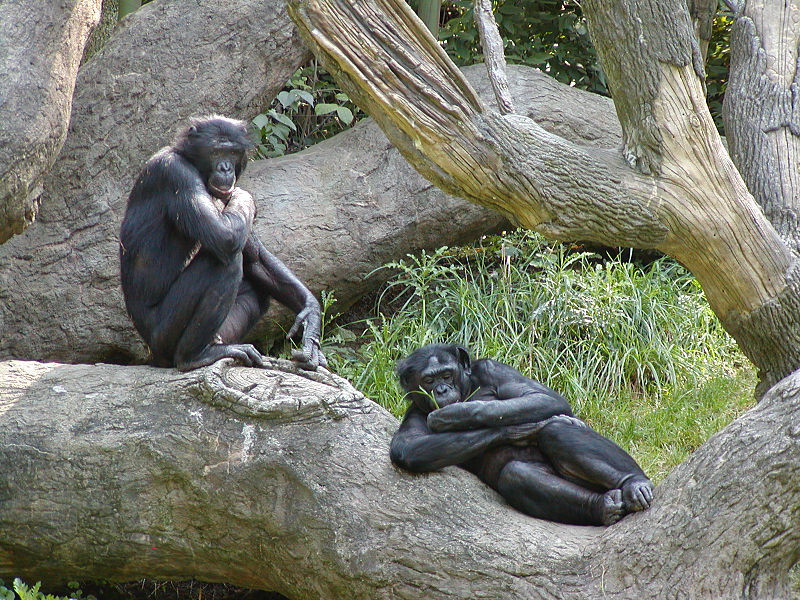
CNN recently interviewed Frans de Waal about his new book, The Bonobo and the Atheist: In Search of Humanism among the Primates. Of course the book immediately went on my “to read” list. I’ve followed de Waal’s non-technical work for years and I have come to trust his judgment. As director of part of Yerkes Primate Research Center, de Waal knows apes better than most of us know our neighbors. He has been exploring the origins of altruism and empathy in the great apes and has come to some amazing conclusions. His past work has shown that much of what we have attributed to special revelation has actually arisen in people through regular evolution. The apes, particularly the bonobos, but also chimpanzees, show startlingly human reactions to moral situations. In the interview, de Waal notes the implications for religion. In his opinion, morality predates religion since the former is seen in other primates while the latter is not.

As much as I trust de Waal’s judgment, the unanswered question remains: what exactly is religion? Animals display rudimentary religious behaviors, but in human-speak religion is often intertwined with belief. In watching a recent episode of Morgan Freeman’s Through the Wormhole—“Is There Life After Death?”—it was clear that while scientists tend to stand on the “no” side of this divide, in the end it comes down to a matter of belief. Not all religions, however, are tied to belief. Some religions assert that what you believe is not important, but rather, what you do. In such religions morality is much more like our primate kin’s version of religion. As Freeman points out, you really can’t know what another person believes. You can ask, but if you believe their response is always an open question. Here is the dilemma of religion as a matter of belief. Even Jesus putatively said, “by their fruits you will know them.” Morality here sounds like religion.

Frans de Waal suggests in his interview that morality differs from religion by being earlier in the evolutionary scale. If, however, religion evolved—which it surely did, as we can continue to observe its evolution today—it may be of a piece with morality. We object to suggesting animals have religion; this suggestion would knock humanity off its pedestal as the only species to which an incredibly human-like god revealed (as it is said) himself. What de Waal has gone beyond proving in his previous books is that much of what qualifies as religion is found among the great apes. De Waal doesn’t put it in those words, but as a lifelong student of religion I have observed the connections first-hand. A scientist may not feel qualified to define religion, just as a religionist is not qualified to correct a scientist. I eagerly await the chance to read The Bonobo and the Atheist, but I already know that I will find much of what de Waal writes to be beyond question, and we may all be much closer to the origins of religion than we realize. Even our great ape kin.

Michelangelo's muse? (Photo by Greg Hume)

Michelangelo’s muse? (Photo by Greg Hume)


Tell-Tale Hearts

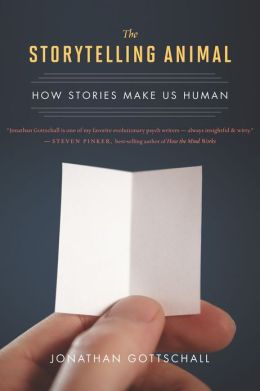
StorytellingAnimal As a sometime dabbler in the fictional arts, I was intrigued by Jonathan Gottschall’s The Storytelling Animal: How Stories Make us Human. I read the book because of my own fascination with fiction—it is a transcendent activity to read it, but more so to write it. I‘ve always wondered why. Gottschall, a fellow academic making a living as an adjunct instructor, is a lucid writer and a great storyteller. His book opens with the unusual fact that even the most logical and rational of humans are addicted to stories. Our brains work to spin unrelated events into narratives. Even while we sleep, our minds continue to tell fictitious accounts of weird adventures. To be human, Gottschall clearly demonstrates, is to be in love with stories.

In chapter 6, “The Moral of the Story,” Gottschall turns his attention to religions. That far into his book it is no surprise that we find religions are largely based on story. Those who’ve studied mythology plainly see the story-ridden origins of religions. Religions, after all, have nothing if not great explanatory value. They tell the tales of why we’re here—the technical name is “etiology,” stories of origins, but also tales of what the gods, the tao, or the force demand of us. Believers often take such fanciful narratives literally, missing the point of it all, the proverbial moral of the story. The story is the moral. We find the deepest truths in fiction.

Many of my friends are fiction writers. Most have never been published or struggle to find representation. None simply give up. The draw of narrative is as palpable as the need to eat or sleep, as strong as the urge for sex or recognition. It is far stronger than the desire for money since nothing material can substitute for our desire for stories. After a busy day we send our children off to bed with a nighttime tale. Many of us climb into bed with a book—the more fictional the better—to end our conscious hours each day. We dream our way through the night and spend our long days fabricating a narrative we call “my life.” Those of us who indulge in fiction are sometimes solitary individuals, but we crave the awareness that we are not alone. Others too, as Gottschall clearly proves, are alone with us. In fact, all humans are gathered around this campfire of the storyteller. Thank you, fiction, for coming to the rescue.


Bing Spring

Binghamton University is, like most institutions of higher education, home to many rituals. Back around a century ago, anthropologists were convinced that religions began as a set of inchoate rituals that coalesced into primitive belief systems. Although most anthropologists today see this as an overly simplistic analysis, I found a recent story on Binghamton’s website an example of a nascent religion. It has to do with placating, or perhaps defying, the weather gods.

Like most good rituals, Stepping on the Coat has a practical pedigree. According to Bing’s own archives, the ritual began the year that I was born. An undergrad that year, overwhelmed by an April snowstorm, removed his coat and stomped on it. The snow stopped. As befits a scientifically inclined institution, this was initially chalked up as coincidence, but the same result occurred again the next year. Stepping on the Coat seemed to be a cure for late season snowstorms. In this year of lazy, lingering winter, many people—some of them not even students—must be seeking a cure for unseasonable weather. Perhaps Binghamton University students a half-century ago stumbled (stamped?) upon the solution. In the whimsical tributes given on the BU magazine webpage, the sacred and the profane are never very far apart.

Binghamton in spring

Binghamton in spring

I have done considerable research on the weather and its sacral implications. Most of my research has never been published, but the overarching idea, I believe, is sound. Our human perceptions of the divine are focused on the sky. Nietzsche declared that God is dead, but that death only really occurred when we penetrated our atmosphere and landed on the moon. Even then, looking up, we saw only blackness beyond. Infinity hangs, like Damocles’ sword, above our heads. We may pollute our skies, we may shut them out with artificial walls and ceilings. We may even punch through them with rockets. But our gods are up there, somewhere. And they are the ones who dictate our weather. The human response is up to us. Do we sit inside and complain, or do we stomp the coat in defiance of an uncaring deity? Binghamton is a green university, so that even amid the burgeoning religion of coat-stepping, there is a real awareness that when the weather goes awry in this industrial era, we know where the blame truly lies. As humans, however, our religious inclinations will insist that we continue to step upon the coat and claim the whole earth as our prize.


When in Rome

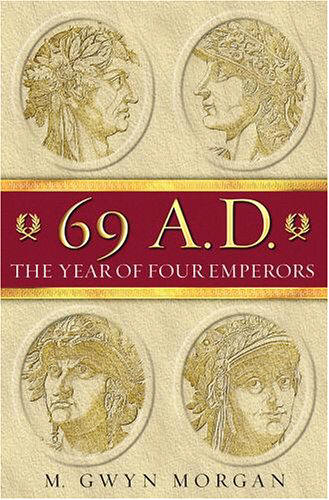
69ADMost biblical scholars know that the synoptic Gospels began to take their rough shape around 70 C.E. Many middle school children have heard stories of the Romans, in their bullying way, putting Christians in the arenas to be savaged by wild beasts. It would take a precocious child, or adult for that matter, to recognize that in 69 C.E., Rome went through four emperors. I found Gwyn Morgan’s 69 A.D.: The Year of Four Emperors quite informative, not having be a precocious child (or adult). The times I’ve taught New Testament courses I have found myself fascinated by the stern and stoic culture that the Romans constructed. Maybe it is because I see so much of our own society in it. Maybe it is because the New Testament is much easier to understand with a basic grasp of the early Roman Empire.

Early in his historical account, Morgan makes a salient point. I had to stop and consider the implications of it. Going over the sources for the reigns of Galba, Otho, Vitellius, and early Vespasian, mainly Tacitus, Morgan reveals the truth of history: it is story. Romans measured the value of an historian not only by getting the facts right; literary artistry was, in many respects, even more important than dry facts. What might this mean for the Gospels? Anyone who has actually read the Gospels knows they hold some obvious contradictions, some subtle, some not. In a culture that understands the Bible as “history,” in the modern sense, many believers kick their brains into overtime to harmonize discrepancies so that we can have, as Sergeant Friday would say, “just the facts.” But the Gospels, like Roman historians, are telling a story. There is some license here. After all, none of the writers were likely eyewitnesses of the events they describe.

The events of 69 also help to explain the frustrations that the Romans would so unkindly take out on the early Christians. The calm, logical world of reason and the force of law had repeatedly broken down (as they will), perhaps most spectacularly just as the Gospels were being written. Threats and fears of a total societal collapse whipped the Romans into a froth of intolerance. Those who threatened to rock the ship of state could be cast to the sharks, to adapt the metaphor. New religions with new gods don’t mix in a state where the old gods appear to have fled. Indeed, I couldn’t help but get the feeling, as I was reading about ancient history, that I was reading about things not so very long ago. Fear brings out religious conservatism in just about any society. The juxtaposition of the Gospels’ composition with Rome’s period of great stress might just be one of those metaphors that we can still use to explain how a rational civilization loses its grip on what’s really real. And that’s true in any age.


Dog-gone Belief

A recent book I read, I can’t remember precisely which one, suggested that one reason the average citizen has trouble with science is the fault of evolution. We evolved, at least some of us have, to rely on common sense. We trust appearances to intimate reality, and act accordingly. The problem is that science, almost in principio, informs us that things do not operate according to common sense, but according to laws that are inscrutable to most of us and involving math way beyond our limited ability. Even with a calculator. For example, the earth is spinning really, really fast and hurtling around the sun so quickly that I think I’m going to be sick. Really? Common sense tells me that I’m stationary, and my inner ear only gives me true peace when that is the case. QED, as my high school pre-calc teacher used to say. But it’s not the truth. We are spinning and jetting through space.

IMG

An article in Time magazine recently brought this disconnect home on a very poignant level. “The Mystery of Animal Grief,” by Jeffrey Kluger, explores the animal grieving process. Many species have been observed to react to the death of one of there own very much like humans do. Physical attitudes of bowed heads, actions that signal depression, and even rudimentary burials are all documented among animals. Some scientists disagree: reductionism declares that this is all appearance (like common sense), and if the professor on Gilligan’s Island taught us anything beyond building with coconuts and bamboo, it is that there is a rational explanation for everything. Animals grieving? It takes a human to do that. Well, actually, it takes a human to declare with such certainty that our animal cousins can’t feel like we do. Although our only current pet is a hermit crab—and perhaps many uninvited spiders—I grew up with dogs, cats, guinea pigs, and assorted other creatures. They express real affection. If they didn’t, I can’t think people would keep them.

I wondered, as I read Kluger’s article, when religion was going to come into the discussion. It wasn’t a long wait. Religion, he notes, is a human mechanism for coping with the finality of death. Dead is dead, after all. Animals can’t be religious, so they can’t experience the emotions we do. Or so science would mostly declare. I struggle with reality on a daily basis. My experience has taught me that things are not often what they seem, but sometimes my path lies in a direction diametrically opposed to that of Dr. Heisenberg. We are animals. Animals are part of our family. I’ve experienced people who show no emotion when their close associates are suffering. I’ve also experienced a dog that would cuddle up next to me and lick my face when I was sad, an encouraging look in his canine eyes. Animals are smart and empathetic. They have some understanding of death—it’s just common sense. I write this as I’m hurtling through space at 660,000 m.p.h. while spinning at a thousand miles an hour. If my reasoning seems suspect to you, consider the circumstances.


Bridge over Troubled

ReligionThe fundamental question of what counts as religion remains elusive. I read Robert Crawford’s What is Religion? hoping to find out. Crawford begins with the admirable assertion that in a pluralistic world all religions must learn to get along. Unfortunately, learning hasn’t always been one of religion’s strong suits. And we still don’t even know what religion is. As becomes clear within minutes of starting the book, consensus will be a stranger in this room. Nevertheless Crawford plows on, hoping against hope that comparison will reveal conformity. Religions aren’t really team players in that way.

Crawford keeps his focus on the “big six”: Judaism, Christianity, Islam, Hinduism, Buddhism, and Sikhism. Although these faiths contain the lion’s share of numbers, they in no way corner the market on religion. I wonder if Crawford’s net is really large enough. When trying to define religion, cutting corners gets you into trouble every time. No matter how we count it, religion is more than a matter of belief and broader than prescribed rituals. It must take seriously the attempts of even small knots of seekers in its preternatural accounting. Crawford sometimes gets bogged down in the details. Science plays a key role in his discussion but then the scope shifts to Christianity, a religion with more than its share of scientific troubles. Islam, for a while anyway, led the world in scientific thinking. What of Sikhs and science?

The more I read of What is Religion?, the more I got the feeling that all of these pieces don’t go to the same puzzle. Religions develop out of historical circumstances and needs. They, with a few exceptions, are not consciously devised by a bunch of eggheads shut up in ivory towers. Religions develop from people in difficult situations, whether physical or psychological. Think about it. If the Bible is to be believed Judaism grew out of slavery in Egypt (either that or Abraham’s childlessness). Christianity out of Roman oppression. Islam from Muhammad’s conviction that polytheism didn’t add up. Hinduism’s old enough to have lost its origins in deep antiquity, but Buddhism is clearly a reaction to pervasive suffering. Sikhism tried to steer between the clashes of Hinduism and Islam. We could go on, but I don’t wish to try your patience. I’m not suggesting I’ve finally done the impossible and defined religion. In fact, I may be suggesting the opposite. Religion encompasses many ways of being in the world. Crawford maybe got a start on the discussion, but it will go on as long as people have troubles.


Burnt Over

I find myself in Syracuse. Skirting the very edge of the Burnt Over District, Syracuse is only a short distant from Oneida, birthplace of one of the uniquely American religions to have been conceived in this area. Moving further west, several of the religions following the “Second Great Awakening” roared through the state, including the one that was to become the Mormon Church. Looking out over the rugged hills, I wonder what might be in this land that inspires such religiosity. Americans are known world-wide for their religious predilections, and back before the South took the privilege of doling out religious mandates, upstate New York was busy churning out new religions. Of course, this was in the days before the extreme urbanization of culture took hold. Individuals, often isolated from others and struggling to survive in a sometimes harsh climate (they are calling for snow this weekend, still), they turned to God in new and innovative ways.

There must be a point at which religion reaches satiety. How many religions does one nation need? Thus, revivalists found a tired population here in the Burnt Over District. How much energy does it take to build a new faith from scratch? Some flared brightly and burned out (like the Oneida Community), while others flourished to the point of putting forth presidential candidates (I need not say which new religion has offered us a candidate too wealthy to countenance). Something in the soil, perhaps. Something in the mountain air.

Scholars opine that the Second Great Awakening occurred in part, at least, in reaction to the skepticism that was surging through intellectual circles at the time. America has always been good for a backlash or two. While many thinkers were praising the accomplishments of intellect, Smiths and Noyeses were at home brewing up that new-time religion for which Americans thirst. We are great consumers of religion. In the early 1800s revival after revival spread through New York, as well as through the southern states. The south reacted by boosting the Methodist and Baptist populations. New York gave us new religions. Americans aren’t that choosey. In a pinch, just about any religion will do. I stand here in Syracuse, the mid-April snow drifting down about me and wonder what is about to awake in this skeptical age.

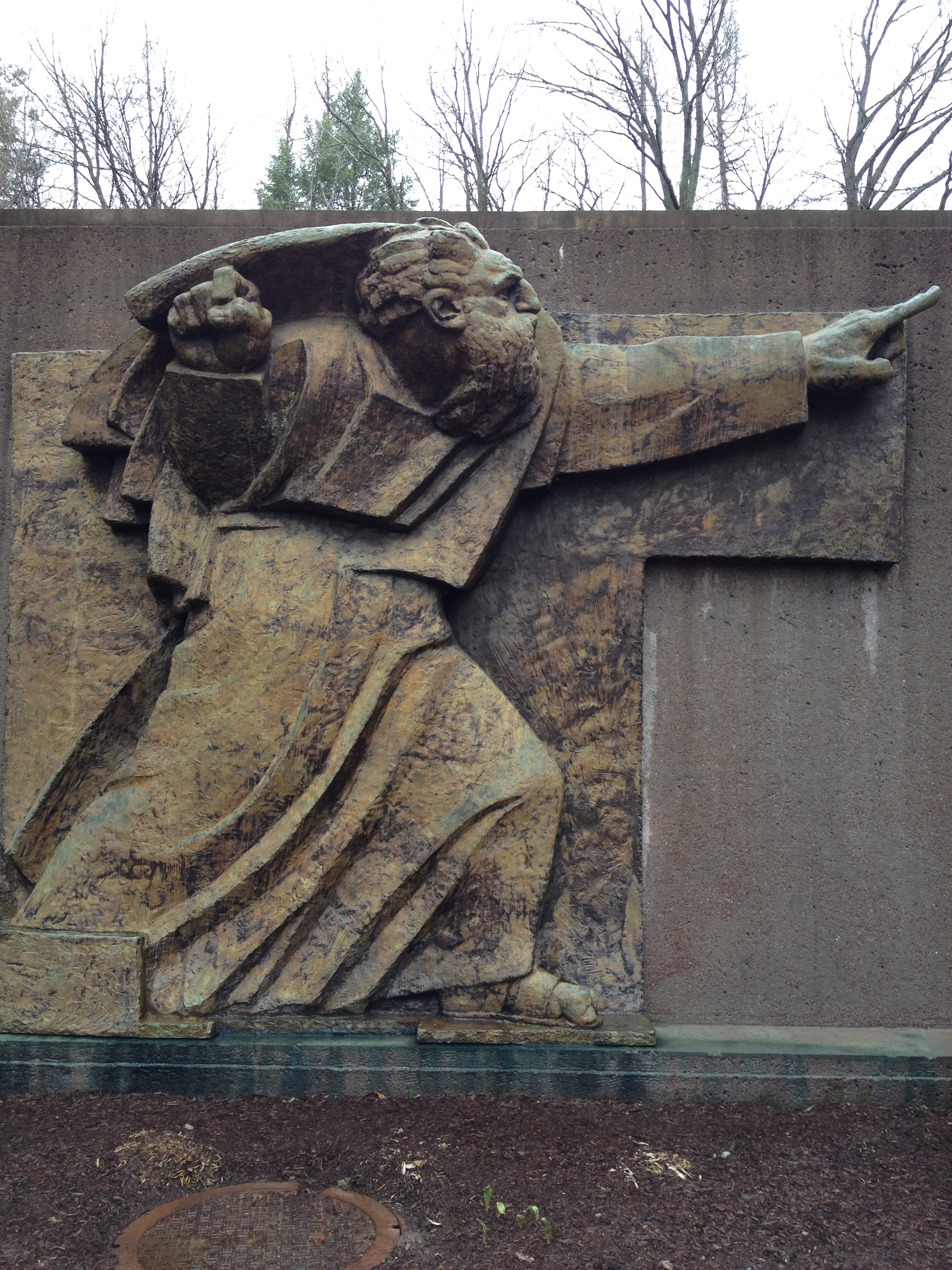
Moses starts a new religion

Moses starts a new religion


The Spice of Religion

BrakkeGnosticsI haven’t really forgotten about the Bible. It has been such an integral part of my life that I couldn’t escape it if I tried. Going into religious studies, however, I feared New Testament studies. You see, having gotten a taste of historical criticism with good old J, E, P, and D, I was afraid what might happen if I looked Q a little too closely in the face. We now know, however, that the New Testament was just as redacted as the “Old,” and that there wasn’t a single variety of Christianity, even in the first century. I just finished David Brakke’s The Gnostics: Myth, Ritual and Diversity in Early Christianity. Brakke admits right up front that some will see him as not being radical enough, but since middle-of-the-road is a comfortable place to be, I found his introduction in the realm of the little bear, just right. The old story, perhaps originating with Irenaeus of Lyon, is that Christianity began as a monolithic faith and then came along these spoil-sports like the Gnostics and soon nobody could keep the truth straight any more. This is, of course, an over-simplification.

Religions are constantly shifting. As Brakke points out, there was no definitive Christianity when Christianity was still Jewish. Paul never calls himself a Christian, and he was, by his own declaration, Jewish. His interpretation of Jesus varies greatly from that of the eponymous John, of Gospel and Epistle fame. No, there never was a single Christianity. Probably from the very beginning there were Gnostics too. And, again with Brakke, they would have supposed they were following what was to become Christianity as well. Same world, different worldviews. They were not sinister and plotting, any more than other varieties of Christians were sinister and plotting. They were trying to live out lives in accordance with what they thought life was all about.

It has become clear over the last several decades that Christianity never really did unify into a single belief system. Constantine certainly gave it his best shot, but Christianity had spread beyond the bounds of the Roman Empire already, and heterodoxy was rife. No account of Late Antiquity can be honest without noting all the fighting going on among true believers about who was a, well, true believer. Really. Tensions existed early between eastern and western brands of Christianity and schisms became as common as missals. Nobody was really able to put Christianity back together again. In fact, this Humpty Dumpty never was an uncracked egg. I’m afraid I’m taking liberties with Brakke here, but the basic truth remains. Christianity came in its own 57 varieties, most of which didn’t blend very well. The Gnostics come out looking pretty good. That is especially the case when the proto-orthodox start gathering stones. In such a case, it is perhaps time to read the Gnostic scriptures to get a little perspective.


Intelligence, Evolved

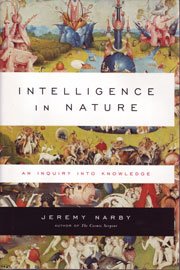
intelligenceinnatureAnyone who has looked into the eyes of a cat or dog can have little doubt that they think. What exactly they think is, of course, a matter of conjecture. I had been meaning to read Jeremy Narby’s Intelligence in Nature for a few years now. We are taught at a young age to eschew anthropomorphism—although our eschewers don’t use that word—as the childish way of perceiving the world. Animals don’t think because that’s reserved for people. We sit in the finest spots in the poshest corners of the animal kingdom and the sign says “No Dogs Allowed.” I never really outgrew this child-like belief because the minimal scientific evidence I’ve been able to infer supports the idea that like us, other animals think. Narby, an anthropologist, agrees. At least to a point. I don’t wish to make claims for Dr. Narby that he wouldn’t support, but he provides fascinating empirical evidence, “down” to the level of amebas and plants, that indicates intentionality. Nature is alive with thought.

As an anthropologist, Narby begins his consideration with the insights of shamans. Although scientists rarely countenance shamans, they are among the earliest of human religious specialists and they have long promoted the idea that humans are fully integrated into nature. We are not separate and above. From our brains to our bones, we are one with the natural world. If we think, should not animals think? Interestingly, this idea brings Narby into some of the same territory as Thomas Nagel; intelligence may be a cumulative process. Our brains’ ability to think may be the result of collecting together the thought processes of our fellow creatures to a point where our thinking becomes abstract. We’re told that dolphins and whales don’t think like us—they don’t build cities, do they? Maybe it’s because they didn’t evolve opposable thumbs. Maybe it’s because they’re smarter than we are.

There are, it seems, many thinkers on the outside of the hallowed confines of hard science that are chipping away at the strict materialist edifice. There can be no serious question that the empirical method explains much of what we experience in the universe. It has always amazed me, however, that we assume that humans are able to find the outer limits of existence with our limited senses. We know animals can see, hear, smell, taste, and maybe even feel in ways beyond our capabilities. Who’s to say that there isn’t other input well beyond our limited senses that we use to survive in this environment? After all, we didn’t evolve to know everything—we evolved to be able to thrive in our ecosystems. For that you don’t need all the answers—just enough to get by. If you doubt my reasoning here, I suggest you ask your dog or cat.


Infinite and Expanding

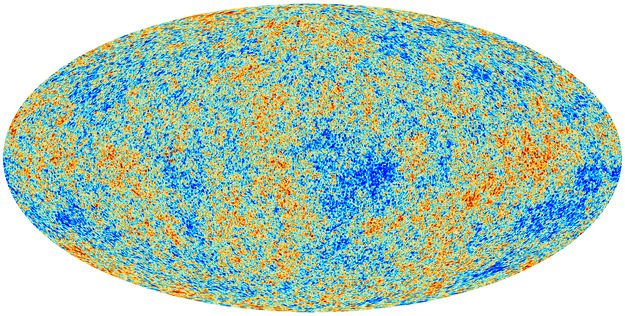
Show me the birth certificate. Whoa! It seems the universe padded the figures by about 80 million years. To you and me that’s 80 million years. To old universe, it’s merely the blink of a cosmic eye. The news has been humming with the results of the European Space Agency’s Planck Space Telescope picture of the microwave background radiation of the universe. From what I can see, the universe forgot to say cheese. Unless, of course, it’s swiss cheese. Further and further science confirms our big bang of a beginning, and, quite literally, it has been downhill from there.

PLANCK

Cosmology is the most theological of the sciences. I’m sure many cosmologists would demand to differ on that point, but the inexorable draw to find out how it all began had its humble origins in religious thought. The mythologies of the Sumerians, Babylonians, Egyptians, Israelites, among many, many others, explored options for how the universe (as they knew it) might have begun. The curiosity is deeply embedded in the human psyche—we want to know our origins. Physicists, of course, play by the rules. Astrophysicists use incredibly complex formulas that all point to a big bang that nobody has ever heard. The inevitable question is, however, what happened before that? Could it be there was no before? A time before time? It seems to me a religious question.

The Planck telescope tells us that our middle-aged universe also has more girth than it admitted previously. No surprises there, after all the theory of the universe’s growth is called “inflation.” I sympathize. All of this information is wonderful news on an intergalactic scale, but it hasn’t solved many of our problems out here in this corner of the cosmos. Reading the rest of the news headlines, after I wipe away the tears, I see that our universe really is showing its age. We are older than we thought, but are we wiser? Scientists are examining fossilized light with glee, but we still can’t figure out that if a guy loves another guy (or girl another girl) that it’s just another instance of what happens after the big bang. We can’t accept that our industrial greed has messed up the weather—has anybody been outside lately? We know that one percent control almost all the wealth and yet we buy lottery tickets and hope for the best. And these are only a few in a long series of echoes that can’t seem to allow some people to think clearly in this girth-challenged, more-than-ancient universe. It must be a religious issue after all.


Palming the Truth

For some today is Palm Sunday. For others it is not. And I’m not referring to those outside the Christian camp. For many Eastern Orthodox Christians, Lent is just beginning as others prepare to celebrate Easter. Such divisions in the priesthood of all believers. The message was brought home to me when a friend emailed me an article from Archon News headlined “For the first time since the Great Schism, Ecumenical Patriarch to attend Pope’s inaugural mass.” For those of you outside the thrill-a-millennium Catholic-Orthodox drama, it might help to know that about the middle of the eleventh century, Christianity experienced its first major schism. The issues were insignificant to all but those who had far too much time on their hands, but the list of grievances grew and festered for centuries until a clean-shaven Pope and heavily bearded Patriarch stopped inviting each other to one another’s parties. It seems that Pope Francis may be seeing the beginning of the end of that particular tiff.

Christianity is one of the most fragmented faiths in the world. Tens of thousands, yea, myriads of denominations exist. And if some of them got together and compared notes, I suspect they’d be shocked to learn that they are just the same as some of the others. Religious belief is deeply personal and highly individualistic. Belonging to a religious body is more a matter of commitment than it is a full agreement on every point—rather like a marriage, I suppose. The funny thing is people join religions that they like, suspecting that these copacetic beliefs will somehow save them from Hell. You can literally write your own ticket to Heaven, based on this system. No religion is right because all religions are right. And we wonder why people are eager to kill one another over matters of belief.

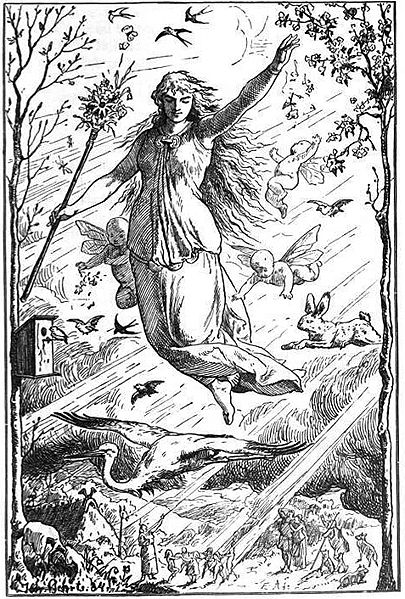
So, is it Palm Sunday or not? It depends entirely on your point of view. Roman Catholicism, followed by many Protestant groups, considers the first Sunday after the first full moon after the Vernal Equinox to be Easter. Never mind that all this equinox stuff smacks of its Pagan forebears—even Easter is named after the Germanic goddess Ostara. I can’t pretend to know how various Orthodox groups calculate their Easter, but the fact is that both dates can’t be right. Unless, of course, one of them is really a celebration of Ostara. Or maybe both are. And if it comes to a matter of debate, it will mean the birth of even more denominations.

Ostara laughs to see such sport

Ostara laughs to see such sport


Animal Mentalism

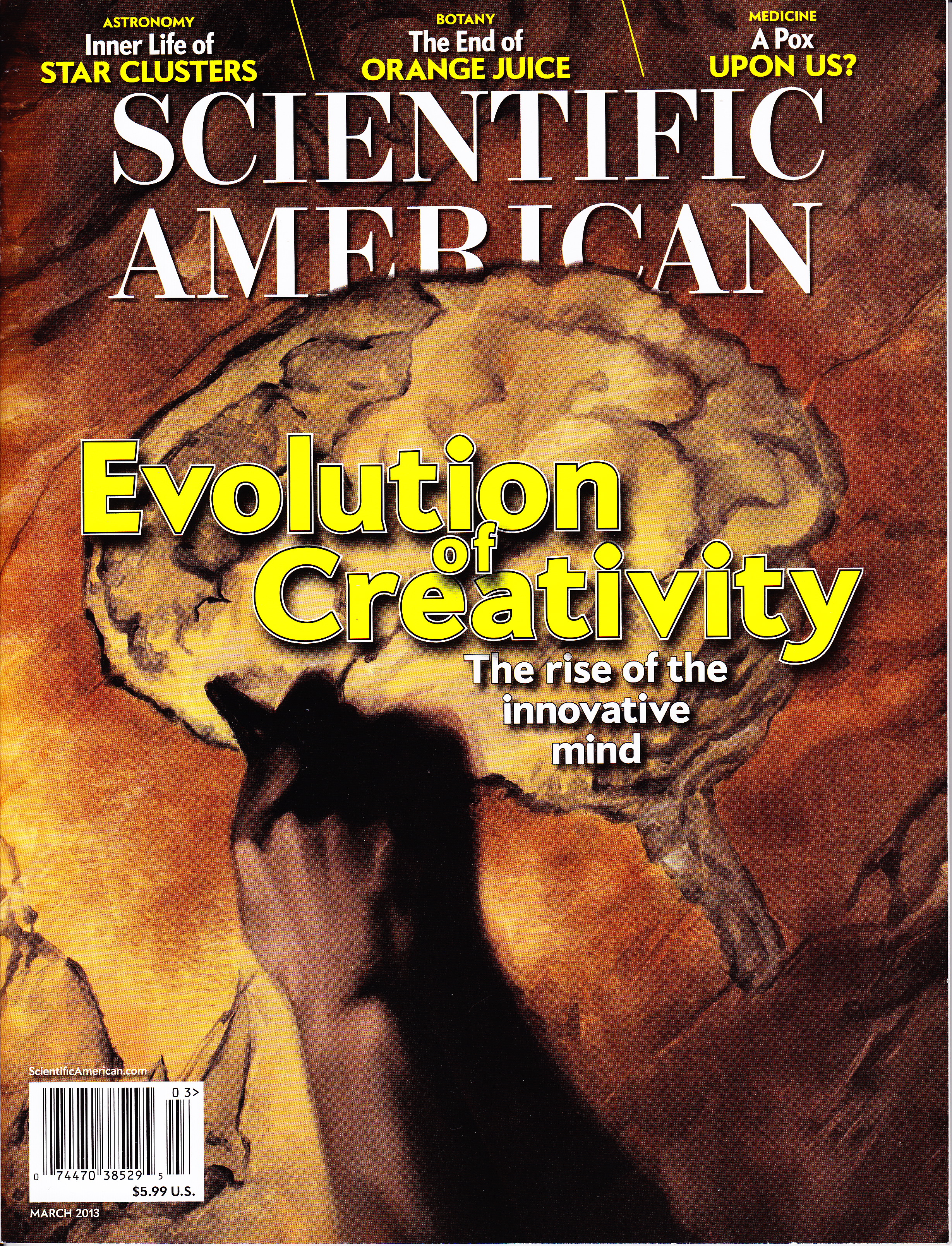
SciAmScience is how we know things. Most things, at least. One of the fundamental aspects of human life not yet grasped by the great empirical method is creativity. We generally have an idea how it works, but, like so much of human experience, it is difficult to describe precisely. When I saw this month’s Scientific American fronting with the headline “Evolution of Creativity”—two of my favorite topics—I knew I’d have to read it. The article by Heather Pringle zeroes in on the archaeology of very early human history. Before modern human, actually. I’d been telling students for years that the development of such traits as artistic representation, burial, music, and an awareness of some forces “out there” could be found tens of thousands of years ago. These, I suggested, marked the beginnings of religious sensibilities. I’d be willing to go even farther, however, and suggest that we share some of these traits with our fellow creatures. Religion may have a biological basis. That’s not where Pringle is going, however, and she addresses not religion, but creativity.

Pringle suggests that evidence for human technology—modest though it may be—stretches back further than the 40K epoch that seemed to house an explosion of human innovation. She shows how sophisticated knowledge of the environment and corresponding innovations were occurring 77,000 years ago, and even earlier. Some of it stretches back before Homo sapiens; stone weapons may be as early as Homo heidelbergensis and kindling fire as early as Homo erectus. Even our Australopithicene cousins seem to have been happily knapping stones two-and-a-half million years ago. The evidence, at the moment, seems to end there. I wonder, however, how far back cognitive development goes. We tend to underestimate the thinking abilities of animals, despite our constant surprise at how smart they seem to be. How very human! How very male, to assume that everything else is here for our use and pleasure.

Scientists often come upon with astonishment ideas that creative folks have been pondering for centuries. Science must be careful—that is one of its limitations. Creativity, the phenomenon Pringle explores, contains, in the words of Lyn Wadley’s team in Science, chemistry and alchemy. Creativity, like religion, isn’t afraid of magic. No doubt, some scientists will claim that true intelligence only begins with humanity. Looking at the way we treat each other, sometimes I doubt that it begins even there. If there is any hope for us, I would humbly suggest, it will come in the form of creativity. It is that very alchemy that keeps me coming back to science, and science will teach us, eventually, that animals are creative too. When we place ourselves among them, we will have created a world.


In Touch with History

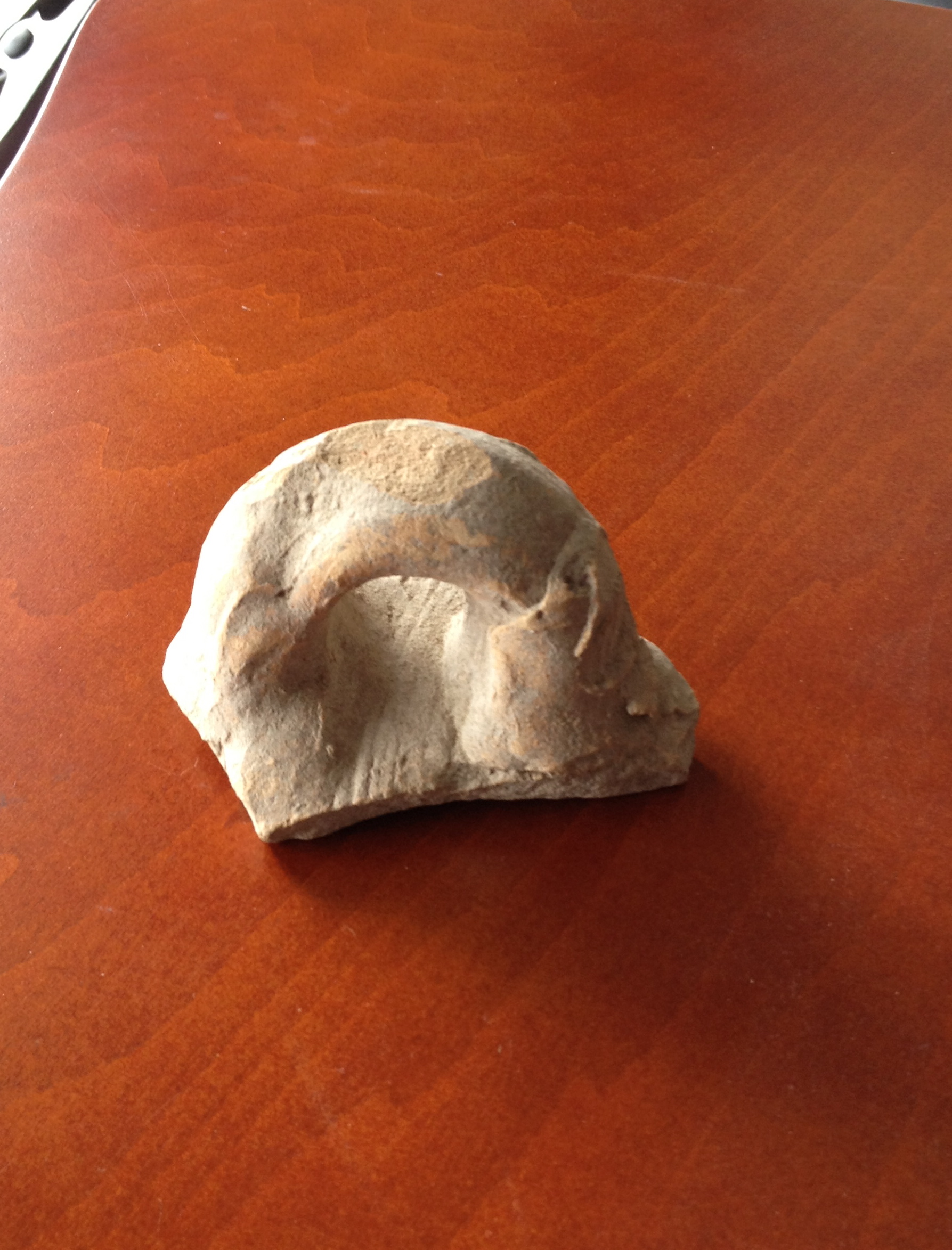
A friend recently sent me a package with a Roman jar handle from Caesarea Maritima. It’s not everyday that I receive 2000 year-old artifacts in the mail. Holding that ancient jar handle reminded me of my short stint as a wannabe archaeologist, not far from Caesarea at the site of Tel Dor. There’s no thrill like unearthing an artifact that has been buried for millennia, knowing that you are touching something a fellow human being dropped for the last time back in the days of the early Roman Empire. It is a humbling experience. In all probability the final touch was a heave into the dump, since clay jars are easily broken. But as I finger this ancient piece of useless junk, I can plainly make out how fingers like mine twisted the clay and pressed it on the jar body, much as I once did in art class, decades ago. I am connected with a stranger over the millennia by this simple bit of clay. We are united in an ancient family.

IMG_0555

Archaeology began as a biblical venture. Anyone who watches Raiders of the Lost Ark with archaeological sensibilities, after rolling their eyes (yes, it’s deserved) can’t help but realize a kernel of truth is buried here. Archaeologists don’t search for the ark, but it was religion that gave them the idea in the first place. Travel to the Middle East and begin digging up the places mentioned in the Bible. Those early archaeologists wanted to prove that the Bible story happened just as it was laid out. Only it didn’t. Archaeology soon began to reveal a more complicated picture. Jericho was uninhabited in Joshua’s day. And was there even a historical Joshua? What began as a charge to demonstrate that the Book of Books never gets it wrong transformed into a science with its immutable commitment to objectivity. And objects.

The desire for historical proof meets a deep need in people. We want to know what really happened. This simple jar handle before me tells a mute story of a person like most of us—never famous, never noticed in the noise of first century Palestine. Just some Jane or Joe throwing out the trash. That is the story of archaeology. That is the story of human life.

Every once in a while I ponder how insignificant we are. The vast majority of us will be remembered only a few years or decades beyond our demise. What will our artifacts say about us? One of the relics that will be found in the rubble of my life will be a Roman jar handle from an even earlier age. Long ago deemed junk by a person so different, but not so very different, from me. It was discarded two millennia ago. When it was found in the twentieth century it was a treasure. Thanks, Susan, for putting me in touch with history.


Popeless

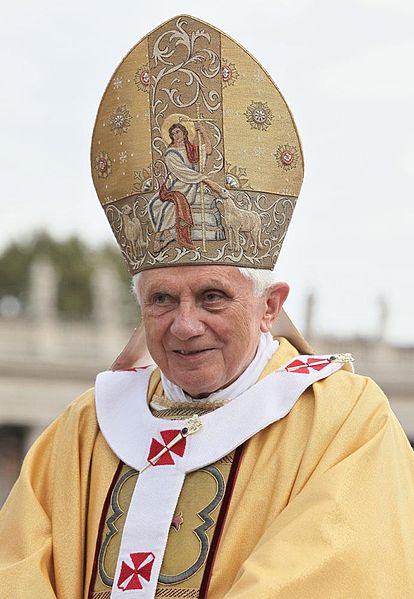
414px-Benedykt_XVI_(2010-10-17)_4 Pope Benedict XVI managed to catch many of us off-guard with his early retirement option. Not within living memory, or even very dusty, antiquated memory has a pope resigned. Such is the draw of power. Of course the founder and putative CEO of the organization stepped down at 33, or so the story goes, but after that the urge to stay on only grew. The papacy, some traditions claim, is as old as Christianity. Others suggest that the stresses and strains that eventually led to the primacy of Rome in the western church were much more intricate than that. Modern research has also indicated that one-size-fits-all Christianity really didn’t even exist from the beginning. Different groups claimed to be Christian but were labeled heretical by other groups. The Roman Catholic Church is still the single largest Christian denomination in the world, however, and that translates to quite a lot of weight.

According to the book of Acts, the first Christians were a communal lot, holding everything in common. Although we can’t call them communists, in a sense they were. It didn’t take long for that structure to break down, however. Before long it was obvious that leaders would emerge in the movement. At first they wouldn’t have been priests, but eventually that age-old designation came to describe what the clergy did. Worship became ceremony, and ritual requires expert leadership. Various religions have tried to break down the hierarchical structure of having one person over the others, but in this masculine world of CEOs and prestige, well, there’s only so much you can share.

What’s really striking is that no pope in 600 years has stepped down. There could’ve been many occasions. Presiding over about a sixth of the world’s population must be a heady experience, especially for a religious person. Already the speculation is thick on who the next pontiff might be. The fact that the faithful are already chomping at the bit shows something of the nature of the creature (one can’t very well say “beast” in such a context). The papacy has become a symbol in its own right, and even megachurches can’t hope to top their numbers. The Pentecostals, however, are racing to catch up. The two types of Christianity are about as far apart as possible while remaining under the same Lord. I suspect by the time the next pope vacates the office the religious landscape will be very different. Perhaps Benedict XVI is wise to call the game on his own terms.