Final Rites?

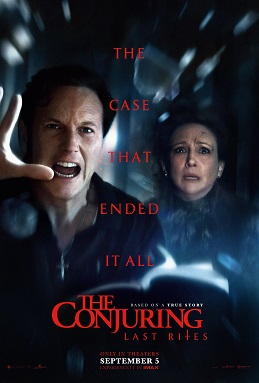
The Conjuring: Last Rites, aka The Conjuring 4, is more of the same.  Reusing tropes that have ceased to be scary, it draws Annabelle back into the story and sets up the possibility of future films by getting the Warrens’ daughter Judy involved.  It is kind of a downbeat to pick up the Smurl haunting since this is widely considered to have been a hoax.  And the movie pulls out all the stops.  Levitation, upside down crosses, and demonic faces suddenly appearing have all been done before.  The conceit that a demon is using ghosts to torment the Smurls is familiar from earlier films in the series.  The franchise, however, remains quite Protestant despite its Catholic trappings.  The somewhat heavy-handed suicide of Father Gordon once again demonstrates the lack of deep comprehension of how Catholicism operates.  It is meant to parallel the suicide that starts the movie, but really adds nothing to the plot beyond shock.

The film tries to do too much and loses any pathos among the Smurls because of the strong subplot, if not the main plot, of the threats against Ed and Judy Warren.  To do this they had to make the real life Judy much younger than she is in real life and cast the unnamed demon threatening the Smurls back to an attack on Lorraine, while pregnant with Judy, in the 1960s.  This allows for a Stranger Things aspect of the 1980s for the action.  It also strangely misrepresents Pennsylvania.  The script seems to presume West Pittston is near Pittsburgh (it’s not, but rather close to Scranton) and it shoots the location in England, obviously for cinematic reasons.

There’s a lot of insider knowledge presumed here—you need to know the fictionalized backstory the series has been building up over eight films.  This comes to a head in the revisiting of actors from the past Warren cases at Judy’s wedding.  Perrons, Hodgsons, and a Glatzel attend, valorizing the often controversial work of the Warrens.  (They were ejected from the Perron house and visited the Hodgsons for maybe part of a day.)  The other movies in the series tend to hang together better but the lack of deep understanding of Catholicism remains perhaps the largest hurdle.  Interestingly, at the box office this has been the highest performing film in the franchise so far.  Since the Conjuring universe is encroaching on 3 billion dollars (2.7 at the moment) gross profit, clearly it strikes a chord.  And there’s every reason to suppose, prequel or sequel, it’s not really the last rites after all.


If You Do

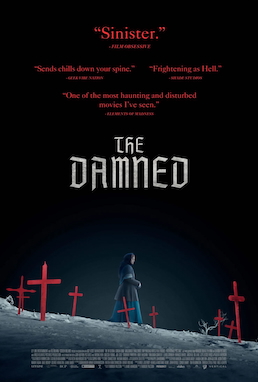
Folk horror is particularly open to religion.  The powerful Euro-horror film, The Damned, is nearly worthy of Robert Egger status.  Indeed, the movie reminded me of Egger’s work, so perhaps Thordur Palsson is his Icelandic incarnation.  Set in a fishing station in a remote arctic bay in the 1870s, the owner’s widow oversees the operations of six fishermen and the woman who cooks and keeps the house.  Her husband died at sea the previous year, and the fishing has been very poor, threatening their existence.  They need to eat their catches, as well as their bait, trying to stay alive until spring.  Eva, the young widow, sees a ship foundering on the distant, jagged rocks.  The men insist that if she orders them to help, their food supplies will quickly be depleted, and the rescue operation would put them all at risk.  Lured to the wreck by a food barrel that has washed ashore, they encounter more men than they can keep and have to fight them off of their small fishing boat, killing one in the process.

The helmsman of the boat falls overboard and drowns as the survivors try to climb aboard.  The small boat manages to escape, however.  Helga, the housekeeper, warns Eva of the draugr, a monster of Nordic folklore that is a kind of zombie.  If it gets into your head, she warns, it will led to death.  Skeptical of folktales, Eva begins to change her mind as her small group of companions begins dying off.  Helga disappears.  One of the men dies after being stopped from killing a companion.  Eva is now left with only four men.  One of the men insists they are paying for their sin, and begins erecting a large cross as an act of penitence.  After seeing a man in the mist, the new helmsman dies by suicide.  Now convinced the draugr is real, Eva leads an expedition to find and destroy it.  This leads to the death of yet another crew member.  The three remaining people decide to flee by night in the boat.  Eva, however, encounters the draugr in the cabin and destroys him by fire.  A spoiler follows.

The shocking end reveals that the draugr was actually a survivor of the shipwreck and his presence explains the “supernatural” events they believed the monster caused.  Eva, delusional, kills the man.  The story plays heavily on both the isolation of the fishing station and the guilt the characters all undergo after leaving their fellow sailors to die on the jagged rocks.  Their fear transforms fevers into deadly paranoia as they kill one another and themselves off.  This is set against the stunning arctic scenery of the fjord that houses the station in a stark winter landscape.  And the conflict between religious systems is right there on the surface and deep within the minds of those isolated, far from civilization.


Woodwork

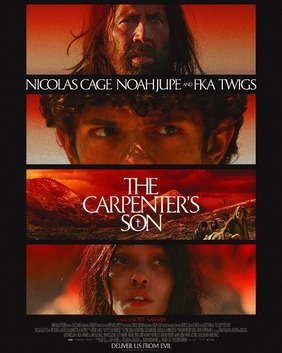
It’s not often that I get to see a new horror movie on opening day, but I managed to swing The Carpenter’s Son with a screener, courtesy of Horror Homeroom.  I’m not going to say much about the movie here, because you should go there to read my response—I’ll let you know when it appears.  But I should try to whet your appetite a bit.  Among those of us who read and write about horror and religion this was a much anticipated movie.  A horror movie about Jesus.  Such things have been done before, but this one is played straight with an interesting premise.  It’s based, loosely, on the Infancy Gospel of Thomas.  This isn’t to be confused with the Gospel of Thomas.  Early Christians, it seems, favored the doubter’s point of view.  The Infancy Gospel is the story of Jesus’ miracles between the ages of five and twelve.  Even among early Christians these accounts weren’t taken as gospel truth.  They make for an interesting movie, however.

I think about horror and religion quite a lot.  Since the late sixties the two appear together frequently and, according to many surveys, make for the scariest movies.  Religion deals with, not to sound too Tillichian, ultimate concerns.  In the human psyche you can’t get much larger than death and eternity.  These are the home turf of religion.  Of course, death can be handled in an entirely secular way, but there’s a reasons hospitals almost always have chapels in them.  Eternity may be slotted in cosmology, but what it means comes from religion.  Forever seems pretty ultimate to me.

One thing I didn’t give in my Horror Homeroom piece about The Carpenter’s Son is my thoughts as to whether it’s a good movie or not.  Did I like it?  To a certain degree, yes.  Although I’ve been impressed with Nicolas Cage in horror movies lately—he can really rise to the occasion—sometimes, as in The Wicker Man, he just becomes, well, Cagey.  This happens once in a while in The Carpenter’s Son too.  When he’s questioning Mary about where “the boy” came from, his voice gets the wheedling, whining, kind of mocking tone that doesn’t set him as his best.  Likewise, when he tries to instruct young Jesus in various ways, it seems far too modern to fit the palette of a period drama.  I watched it a couple of times to write the article and I have my doubts that I’ll watch it again.  I did think the portrayal of Satan was good, and appreciated some of the dialogue about evil.  It wasn’t my favorite horror movie in recent weeks, however, even though I saw it before it opened.


Banning Books

For many years I’ve celebrated Banned Books Week by reading a banned book.  What with Republicans wanting only white, hetero, history-denying titles approved, I’m pretty sure that most books I read are banned somewhere.  Banned books, of course, see sales bumps and benefit the publisher and author.  So instead of reading a noted banned book, this year I’ll hang out my shingle here with but shallow hopes that it will be read.  I’m pretty sure, any agents out there, that at least one of my novels would be a banned book.  Maybe all of them.  You see, in my fiction I’m not the mild-mannered, inoffensive person who blogs here everyday for free.  There’s a reason that I keep my pen name secret.  I’m pretty sure that most people who know me would be surprised, if not shocked, by what appears in my fiction.

Writing, you see, is where we express the ideas in our heads.  I may seem to yak about everything on this blog, but in reality, I’m quite guarded.  Many of the horror movies I discuss, for instance, have ideas or scenes that I simply leave unaddressed.  I’m trying not to offend anyone here.  (A friend of mine who does publish fiction mentioned recently that a significant other in her family suggested that her writing wasn’t controversial enough to be picked up by publishers.  I think there could be something to that.)  While my mother was alive, I took special care that she wouldn’t discover any of my fiction.  Now that she’s gone these two years, I still protect her name with my own nom de guerre.  I really don’t want to hurt anybody.  I do, however, need to express myself.

Some of my fiction is horror.  Some is just plain weird.  The novels are well written, I think, and I’m open to editing.  (Agents, I am an editor—I know how this game works!)  As long as we’re stuck in a morass of banning books, why not look at a writer who’s more controversial than you might believe?  I’ve been writing daily for going on half-a-century now.  Think about that.  Think about the sheer number of controversial thoughts one might have in that amount of time!  Add graphomania to the recipe, with just a squeeze of talent and you’ve got banned books to last a lifetime!  I’m not sure any of the books I’m currently reading (five actively, at this point) formally appear on a  banned list.  But if you want to find one that almost certainly will be, well, my shingle’s out there if you care to take a look.

A banned book, in some districts

Alien History

If aliens sat down to read earth history, they’d get the impression that we’re a very warlike species.  While, no doubt, this is true for a large part of history, I’d suggest that at least since 1900 it hasn’t been so much that the species is warlike, but that its leaders are.  As long as we have “shallow bastards” (to use Frank Turner’s phrase from “1933”) leading us, is it any wonder?  Even with current world leadership given a pass, looking back over the big ones of the last century, it was mentally unstable leaders with fragile egos that led to wars.  I’m sure some national resentment across borders certainly exists, but would people just go and kill those in the next town over, in the “modern” world, if their leaders didn’t tell them to?  Think of World War II, brought on by a madman.  Yes, Germany had grievances, but war wasn’t the only way to solve them.  And killing Jews did nothing to help anybody.

Or World War One.  The assassination of an Archduke need not have led to nations clashing with excessively deadly force.  Men with inflated egos and personal ambitions seem to have played a large role.  To any aliens reading this, some of us would like to take exception to this warlike generalization.  Human society is complex, and the jury is still out on whether democracy can really work when the electorate doesn’t bother to educate itself.  Or allow itself to be educated.  Still, my sense of my species is that we’ve managed to civilize ourselves out of being warlike, but we do have strong emotions that we need to learn to control.  Watching Washington flirt with war every day because of incompetence, well, dear aliens, we’re not all like that.

Image credit: NASA (public domain)

The world into which I was born seemed to be okay as far as national boundaries went.  Younger generations are raised to realize that colonialism was an evil, exploitive outlook.  There are those alive, unfortunately many of them in public office, who want to go back to acquiring more land.  And countries, sometimes artificially created (generally by Europeans), continue to break apart.  South Sudan became a country only in 2011, but Sudan appears to have been artificially held together by pressure from other nations.  I still don’t see why globalism and lack of war can’t coexist.  If nations had thinking persons in charge rather than macho men eager to show how big they are (aliens, this is a human fascination, I’ll grant you), we might well be able to live in peace.  If you want to take them back to your planet, you are most welcome to do so.


Preying

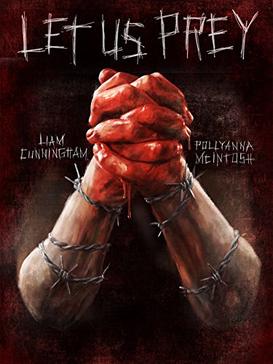
Several aspects of Let Us Prey don’t make a whole lot of sense.  The police in this small Scottish town are all corrupt, at best.  And when push comes to shove, they choose to murder one another.  For some reason the sergeant wraps himself in barbed wire as he tries to bring the wrath of God onto his subordinate officers.  The night starts out with four prisoners being locked up and only one survives.  He’s shown emerging from the sea, with ravens, at the start of the movie and he’s never really explained.  He’s there to collect the souls of sinners and he seems to be able to control other people.  The whole thing turns into a bloodbath before it’s over.  In other words, it lacks the subtlety of much Euro-horror that I’ve watched.  One thing it does have, though, is plenty of use of the Bible.

I suppose with a title like Let Us Prey such a development shouldn’t be unexpected.  Rachel is a new constable in the police station.  The story begins with the stranger, Six—the number of his jail cell—nearly being hit by a car.  Or having been hit.  The teenage driver is arrested and finds a pedophile teacher already in the lock-up.  Two other police officers, after having sex in their patrol car, find the stranger and bring him in.  The local doctor examines him but when the doctor attacks him, he’s arrested as well.  Finally, Six is locked in.  It’s discovered that the doctor had murdered his family earlier in the evening, and the reckless driver had earlier hit and killed a classmate while out driving.  The pedophile kills himself and the two other police officers murder the doctor.  Then the sergeant, who’s a serial killer, comes back to kill everyone left alive.  Six and Rachel survive and Six reveals that he’s collecting wicked souls and invites Rachel to join him.

The Bible quotations (some not accurate) all come in the context of retribution.  The sinners are to be punished.  Rachel, however, escaped a childhood abduction and seems to bear no burden of sin.  The other police—who had all decided Rachel should die—end up dead themselves.  A gritty, supernatural police story, this film suggests a larger backstory without providing a lot for viewers to go on.  The openly Christian sergeant wears a cross, drinks when he drives, and kills his homosexual lovers.  Is there perhaps a message that the movie’s trying to convey?


Eyes Have It

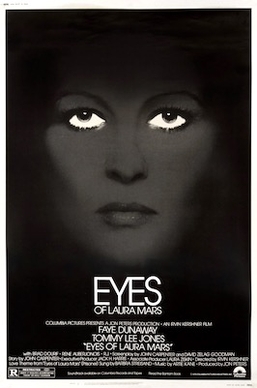
Seeing things from another person’s eyes is perhaps the most important social trait our species has.  We can empathize because we see someone else’s suffering.  It’s a shame to see this breaking down in real time.  Nevertheless, in the case of Laura Mars it may have saved her life.  The Eyes of Laura Mars is a psychological horror film about a controversial photographer (Mars), who suddenly sees things through the eyes of a killer.  The movie is a whodunit, keeping viewers guessing who it is that’s stabbing the eyes out of those Laura works with and cares about.  It’s not a great movie, despite the fact that it was written by John Carpenter.  Both this film and Carpenter’s Halloween were released in 1978.  Eyes is often considered a photo-slasher and Halloween was, of course, a full-blown slasher.  The former was Carpenter’s first major motion picture, while the latter was his first as director.

Screenshot

I’m about to spoil the ending, I fear, so please be warned.  Before I do, however, I will say that the film isn’t bad, even if it isn’t that good.  I had guessed the villain reasonably in advance of the reveal, but the movie did keep me second-guessing my conclusions.  The speculative element of Mars’ ability makes this a supernatural horror film, but one which seems relatively believable.  And the Bible is quoted in it, making it eligible for a Holy Sequel.  The characters—a high society artist and a New York City cop—aren’t terribly religious, but John Neville, the detective, moralizes about Mars’ work at a publicity event.  Okay, so here comes the spoiler.

After floating several possible murderers—a couple members of Mars’ crew are hinted at, as is her ex-husband—it turns out that the detective has dissociative identity disorder and although he and Laura have fallen in love, the moralizing part of his personality is a killer.  He provides Laura with a gun and tells her to shoot the man who comes after her.  When he finally does, he begs her to do it.  The twist ending, at this remove from the original, may be guessed ahead of time, but there is still quite a lot of tension in the story.  The murderer falling in love with his intended victim is a reversal of the more common lover-turned-murderer trope.  It’s not a bad freshman try on the part of John Carpenter, but when his directorial debut came out two months later, his ability in the horror genre was more fully in view.


Play Time

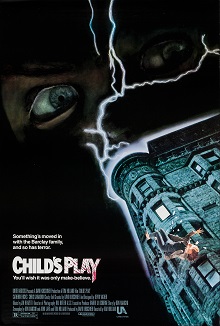
Of course I’ve seen Child’s Play before—what kind of poser do you think I am?  But that was back before I started blogging.  After writing a post about Puppet Master, I thought I should watch it again because it didn’t really strike me as memorable the first time around.  Probably the reason for that is I knew the basics of the story before I saw the movie and, like zombies, possessed dolls are a little hard to buy into.  Still, on this second viewing I was a bit more impressed.  The idea of the monster that won’t stop coming is a scary one, and I’d forgotten just how much Chucky had to be dismembered before being stopped.  And there are some legitimately scary scenes, despite unanswered questions.  In case you’re not familiar: criminal Charles Lee Ray is shot to death in a toy store, but not before transferring his soul, through voodoo, into a Good Guy doll.  This doll is bought on the black market by a widow who can’t afford one, for her son’s birthday.

Chucky befriends the boy but starts taking revenge on those who’ve wronged him, including the police officer called to investigate his first murder.  The officer happens to be the one that shot Ray at the beginning of the film.  Nobody believes that the doll is alive until it attacks them personally.  Nobody, that is, except Andy, the six-year-old owner of Chucky.  (Although it isn’t cited as such, I have to wonder if Toy Story’s Andy wasn’t actually based on this one; that’s not the official story, but still…)  Child’s Play wasn’t the first horror film to portray an animated doll, but it was perhaps the most influential.  Chucky went on to become a repeat slasher villain with wide recognition.

I’d completely forgotten the appropriation of voodoo as the animating force behind Chucky.  Of course, that leads to the very obvious weirdness of a doll using a voodoo doll to kill someone.  To modern sensitivities, the use of Vodou feels inappropriate, but this was in the eighties, and other religions were fair game for horror.  In fact, religion was fair game.  Without it, no animated Chucky, and no threat to Andy and his mother.  Religion and horror have played together from the very beginning.  The possession aspect also ties into religion and there have been no end of possessed dolls since Chucky first lunged out the screen with his knife.  It was a good play date, it turns out.


City Children

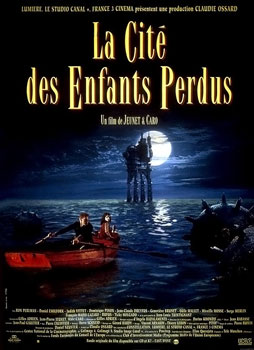
Some movies are very difficult, if not impossible to classify.  City of Lost Children is one.  One label that seems to have stuck is steampunk, and I think that’s accurate.  A touch confusing, not least because it’s in French, it is visually stunning.  So, the lost children are kidnapped by a kind of mad scientist who cannot dream.  He takes the children’s dreams (with pre-echoes of Inception).  The initial dream sequence of multiple Santa Clauses could be horror—much of the film is unnerving, as well as disorienting.  This mad scientist is attended by a set of clones, a tiny wife, and a brain in a fish-tank.  Meanwhile, thieving orphans, controlled by women who are conjoined twins, steal valuables.  A circus strongman, One, sets out to find his kidnapped “little brother,” and finds the orphans.  He helps them on one job but one of the lead orphans, Miette, takes pity on him and tries to assist in finding his brother.

The brother is in the hands of the mad scientist.  Miette is nearly drowned but saved by an amnesiac submarine pilot.  She leaves to fine One, whom the twins tried to kidnap.  One and Miette team up once again to rescue “little brother.”  They find the mad scientist’s lair, but the submarine pilot is about to blow it up.  One and the children escape, but at the last minute the submarine pilot regains his memory and realizes that he was the creator of the mad scientist and clones, but he is blown up along with the lab.  Accompanying this there are striking visuals in a world that is a cross between Existenz and The Matrix, but with steampunk overtones.  I suspect multiple viewings may be needed to get it, but the cinematography would make that a pleasure.

The cyclopses (did I mention them?) are the religious part of this world.  They believe in the plucking out of eyes in order to see.  This they do with eyes from the scientist and the cyclopses, in turn, capture the children for him.  Their religion is violent but somewhat biblical.  Although this is an alternate universe, it’s one where such features as religion might cross over.  Often religion is neglected in world-building, even though it comes naturally to our species.  It’s easy to get lost in this kaleidoscopic world.  Even so, you come to care for One and Miette and the value of loyalty.  Funny, creepy, confusing, and emotional, City of Lost Children is a movie that has to be seen to be believed.


Folk Kill

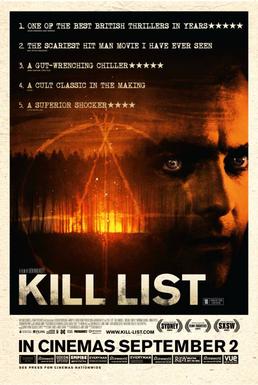
Kill List is a movie that I wish came with some interpretative material.  It’s a touch hard to follow.  The basic idea is that Jay and Gal are Army buds who take a job as hit men.  Jay is married, but not exactly happily.  Gal’s girlfriend leaves him early on.  It seems that Shel, Jay’s wife, knows what he does for a living but seems strangely unconcerned.  Jay is recognized by his victims, but he doesn’t know why.  He becomes insanely brutal on the second of their third jobs, torturing his victim before killing him and then going after his accomplices (not on the eponymous kill list).  At this point Gal and Jay want out of the deal but their unnamed employer won’t release them.  Jay is presented as a man traumatized by a past military action.  He fights frequently with Shel but is very devoted to their son.  Spoilers follow.

The last job is a hit on a member of parliament.  The MP, however, is in a folk religion group that requires human sacrifice.  Jay begins shooting them but he and Gal are outnumbered.  Gal is killed and Jay is subdued.  He then has to fight a hunchback in front of the masked believers.  He frees the knife and kills the hunchback only to discover it is his wife with their son attached to her back.  A rather bleak ending for a rather bleak film.  Kill List is generally considered folk horror.  That is to say that fear derives from both the landscape (less rural in this example) and from the native religion of the non-Christian traditions.  What exactly this religion is is never specified, and it seems that, unbeknownst to himself, Jay is a pretty major player in it.

Perhaps not surprising for a film titled Kill List, this is quite a violent movie.  The somewhat constant fighting of Jay and Shel is unnerving in its own right, and Jay’s berserker-like attacks are also disturbing.  There is a religious element involved, however, beyond paganism.  The first victim on the hit list is a priest.  The reason’s not explained, but the expected religious imagery is there.  This is never tied in with the folk religion exposed at the end.  Although effective as a horror film, it leaves quite a few questions unanswered.  That being said, this Euro-horror is one that I’m unlikely to go back to.  I’m not even sure who made the recommendation to me in the first place.  Folk horror is a fascinating genre and this movie has been compared to The Wicker Man in that regard.  Only in the latter case the plot was easy enough to understand.


Zoning In

Born Jewish, and Unitarian by choice, Rod Serling believed in the inherent worth and dignity of all human beings.  Like many people, even Serling believed that season four of The Twilight Zone, which went to an hour format from the usual half, didn’t really work.  Nevertheless, the fourth episode of that season,“He’s Alive,” really should be required watching of every person in the United States.  This episode was written by Serling and it focuses on a young American fascist who’s having trouble gaining a following.  A shadowy figure then reads to him from what sounds exactly like Trump’s playbook, and soon decent people are raging along with him about foreigners and those who are different.  When the shadowy figure is finally revealed, we’re not surprised to learn it is Hitler.

The young man obeys without question, and soon it looks like he could be elected.  He has one of his best friends killed as a martyr to the cause.  He murders an old Jewish man who has cared for him since his youth.  He declares himself made of steel, with no feelings.  And when he ends up dead (everyone knows how Hitler’s career culminated), the spirit of Hitler rises from his body as Serling warns that wherever hatred exists, Hitler still lives.  Now this episode aired in 1963 but it could’ve been 2016, or 2024.  Prescient people, like Rod Serling, knew that mob thinking could be easily exploited.  Even in the first segment after the introduction the instructions are laid out.  Play on people’s fear of those who are different.  No matter how good things may be, people will be unsatisfied.  Add any power-hungry individual and you’ve got the recipe for a fascist overtaking.

The episode made me wonder if we could ever become a just society.  Ironically, that which calls itself “Christianity” these days stands in the way.  In its day, The Twilight Zone was amazingly influential.  It had a great impact on what was to follow and it’s still regularly referred to, even by those who’ve never seen an episode.  If only we’d pay attention to its message.  I’ve been making my way through the entire series, slowly, over the years.  Now and again an episode will really hit home.  I have to admit that I was physically squirming during “He’s Alive.”  It’s not that it is the greatest episode of the series, but its message is extremely timely.  The requirement for a better world is simple, but seemingly impossible to reach.  Treat others as you wish to be treated.


Fighting over Chocolate

It’s really a teen movie, The Chocolate War is.  That may be the sweet spot for dark academia.  I’m maybe a bit old for such things, but being old tends to mean remembering how it was.  Not exactly how it was, though.  Chocolate War takes place in a Catholic boys school, Trinity by name.  Perpetually underfunded, the students have to sell chocolate (now we’re in territory I recall—remember me, Gertrude?) to help keep it running.  Meanwhile, the Vigils, a secret society, have a considerable amount of pull on campus.  Led by a prescient and overly mature boy for his age, Archie, the Vigils assign select students difficult tasks in a kind of high school hazing.  Jerry, a freshman whose mother recently died, is assigned to refuse to sell chocolates for ten days.  He then decides (for reasons never explained) not to sell them at all.

The refusal leads to a financial crisis for the school.  The Vigils try to force Jerry to sell, engaging in harassment tactics.  Nothing works.  Then Archie coerces him into a “boxing” assembly where students pay to have their specific punches thrown by one of the boys (a bully or Jerry) at the other, who simply has to take it.  Before the match begins, Archie, the Vigils’ leader, is tricked into taking the bully’s place.  Jerry, who’s on the football team, knocks him out, sending some teeth flying (probably why the film got an R rating).  In the end, Archie is demoted, but Jerry realizes that with his refusal to comply, he led to the result he was protesting against (the harassment and boxing match led to selling all the chocolate despite his refusal to participate).

Dated, yes (1988), Dead Poets Society, no.  Still, there’s much to ponder here.  Bullying—used by very high offices in this land—seems to be a growing problem.  And yes, when you get a bunch of adolescent boys together, trouble can arise.  It’s believable.  Although considered a flop, critics were kinder than the box office.  There are dark messages to decode here.  The price of nonconformity—an issue that doesn’t disappear with adulthood—and, perhaps looming larger, its effectiveness.  The teacher temporarily running the school, Brother Leon, is part of the problem, as is often the case in dark academia.  He’s not evil, however.  The film places the abuse of power on Archie, although he doesn’t condone violence.  Ultimately violence is used to unseat him.  With the result that the system (Trinity) prevails nonetheless.  Worth considering.


X-Rayed

If you’re of a certain age, you’ll remember the comic book ads for x-ray specs.  That’s the idea behind a Roger Corman film that Stephen King thought one of the scariest he’d seen.  X, subtitled The Man with X-Ray Eyes, came out in 1963.  Not to be confused with the X of the modern trilogy, this X follows a Doctor Xavier who develops a formula that allows him to see inside people so that he can accurately diagnose and cure them.  This formula may affect his sanity, however, and he kills a friend who is trying to take the ability from him.  A wanted man, he finds a carnival barker who exploits his gift as a trick.  It was a bit jarring to see Don Rickles in a horror movie, but stranger things have happened.  In the midst of this exploitation, an old friend finds him and drives him to safety.

Then to Las Vegas, where his sight allows him to win unabated.  When the police are called he steals a car and increasingly sees through the fabric of the universe.  He stumbles into a road-side revival where the preacher encourages him to take Matthew 5 literally and he does so as the congregation chants “pluck it out!”  What makes this final scene so arresting, apart from qualifying it for Holy Sequel, is that before the minister tells him to mutilate himself, the doctor says he sees through the darkness to the eye that “sees us all.”  He sees God.  The minister interprets this as the Devil, confusing the most elemental entities that exist one for the other.

The movie has some lighthearted moments, some even apart from Don Rickles.  When the doctor begins to see through everybody’s clothes, it’s presented in a humorous way.  But for the most part, the film is played straight and it manages to raise some serious issues for those who think through the implications.  Our senses evolved to help us survive.  Accessing abilities beyond that is a catalyst for disaster.  Indeed, Dr. Xavier early on notes that he’s approaching godhood because of this newly won ability.  It also means that an individual might know too much.  It seems that at the end he does.  The movie is remarkable even today in several ways.  Technology has made special effects more believable, but the human side of this story remains unaltered.  A doctor wanting to help patients becomes more of a monster than a man, in some respects.  And perhaps the most remarkable aspect is that this is a serious horror film made by Roger Corman for AIP. Scary even to a young Stephen King.


The Valley

Juneteenth seemed a good day to get to Valley Forge.  With all the nonsense going on in the White House, we need to be reminded what this country was founded on and for.  I like to think that we weren’t the only ones there yesterday for that reason.  In fact, in the gift shop I found a book titled America’s Last King.  By the time we left it was sold out.  Like many Americans, I suppose, I only had a vague idea why Valley Forge was important for our young country.  We took a tour that helped explain it.  A tour that some in Washington ought be be required to take.  Valley Forge was a winter encampment—the third in the War of Independence.  George Washington had just suffered two defeats and the British had taken Philadelphia.  His poorly provisioned army set up winter headquarters in this strategically secure hill country.  Inadequately clothed, barely fed, many dying, they planned how to keep their efforts to survive alive.

What happened that winter of 1777–1778 at Valley Forge that kept the United States alive depended on two things, both brought by immigrants.  Let me say that again, in case ICE is having trouble hearing—immigrants saved America.  The young country was in very real danger of defeat.  What turned the tide was an alliance with France (the name Lafayette still looms large here in the east) and the help of Baron Friedrich von Steuben, a Prussian.  Without these foreigners, America would never have survived to become great.  Oh, and Mr. Kennedy, Washington ordered vaccinations at Valley Forge to prevent so many of his troops from dying from small pox, an inconvenient truth.  What emerged from Valley Forge that winter was a more organized, healthier United States Army that would go on to defeat the British so that we could be free two and a half centuries later.

I needed Valley Forge.  Although it was a hot day and the roads are paved, I needed to be reminded what it felt like to be proud to be an American.  Juneteenth is to commemorate the end of slavery.  History shows that many in Washington’s army were of African descent.  It seems that DC has forgotten what America is and what we were fighting for all those many years ago.  It wasn’t to exclude those who were different.  No, it was to pull together to survive.  Our would-be king spends his idle days planning military parades in his honor.  The US Army was born in Valley Forge.  And as an American with ancestors here from Washington’s day on, I really needed that visit to remind me of how America became great.


Hunting Vampires

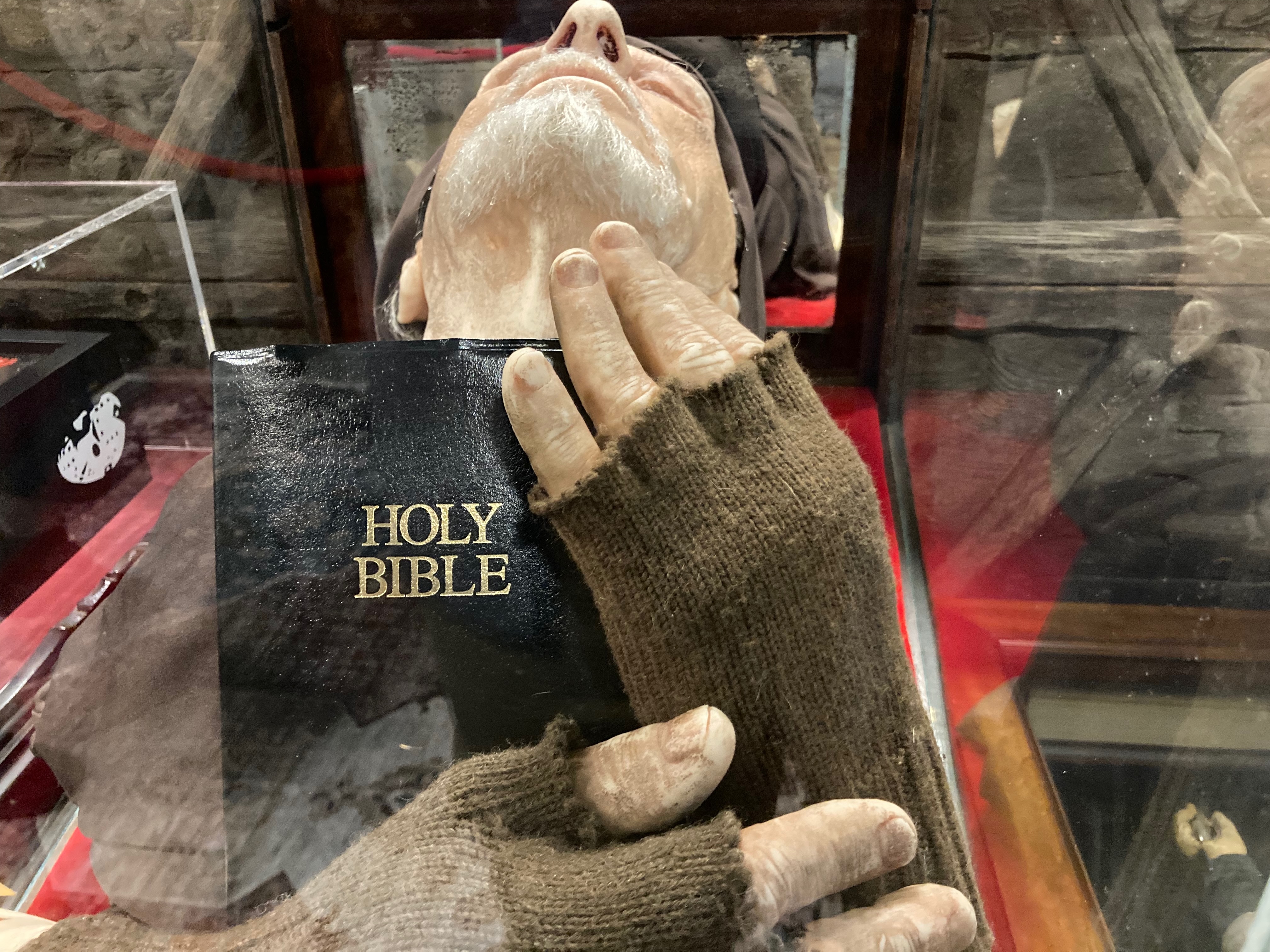
Many years ago some friends took us to the Mercer Museum in Doylestown, Pennsylvania.  Bucks County is one of those places where oddities persist, and I was very impressed by the fact that the museum had an actual vampire-hunting kit.  Now this was before the days of sophisticated cell-phone cameras and my snapshot, through glass, wasn’t very good.  There was no way to know, at the time, that a few years later Vampa: Vampire and Paranormal Museum would open up just a few miles down the road.  And that the latter would have a whole room full of actual vampire-hunting equipment (advertised as “Largest collection of vampire killing items ever in one location”).  A very real fear of vampires existed in Europe up until the technologies of the last century showed that humans don’t need the undead to create fear.  In any case, many chests of vampire-banishing implements line the first room.

And stakes.  As my wife noted, in the movies they just grab a stake and mallet and get to work.  These were stakes made by craftsmen.  Many of them intricately carved, and, one suspects, officially blessed.  Matching sets of stakes and mallets seem like they were for display, rather like some firearm collectors these days proudly show off their guns.  The odd thing, to my mind, is that most of these artifacts weren’t medieval, but from the early modern period.  The earliest I saw was from the seventeenth century.  I had to remind myself that Europe was undergoing a very real vampire scare the decades before Bram Stoker wrote Dracula.  John Polidori, Lord Byron’s associate, had written a vampire novel in the early nineteenth century, well before Stoker’s 1897 classic.

Vampire maces were of a higher magnitude.  The spiked mace, with crucifix, shown here, is an impressive piece of woodworking, as well as enough to make any vampire think twice before biting any necks in this house.  The idea of the Prince of Peace adorning such an instrument of violence encapsulates the contradiction of being human.  And the depths of our fears.  This museum is a testimony of our collective phobias.  Few people in this electronic age really believe in physical, supernatural, vampires.  There are people who do, of course, but most of us are so entranced by our phones as to completely miss a bat flitting through the room, let alone a full-fledged undead monster with fangs.  The fact is, over the centuries many people did gather what was needed to protect themselves from vampires in chests and cabinets, all in the name of fear.  

One final note: one of the vampire hunting kits was owned by Michael Jackson.  As the sign (with a typo) notes, the Jehovah’s Witnesses (to which both he and Prince belonged) convinced him not to give it as a gift.  Belief, it seems, persists even into the late twentieth century.