Seasonal Viewing

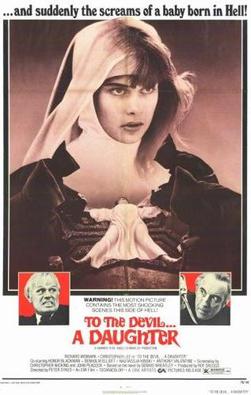
Any movie that begins with an excommunication ought to be good.  Especially with its list of stars you’d think To the Devil a Daughter might’ve turned out better.  Still, it is a good example of religion and horror mingling together.  I’ve never read any Dennis Wheatley novels, but reputedly he didn’t like this film adaptation of his book.  It certainly has a convoluted plot.  So an excommunicated priest has started a new religion that worships Ashtaroth.  He has to baptize a child, now 18 (three-times-six, don’t you see), with the blood of the demon so that she can become his (Ashtaroth’s) avatar.  This is apparently the eponymous daughter to the Devil.  She was baptized initially by her mother’s blood at her birth.

The girl’s father, who survived her birth—unlike his wife—has decided at the last moment to save his daughter.  He appears to be independently wealthy yet he talks an author of occult books into doing the saving for him.  The girl, it turns out, is a nun in this satanic religious order and is only too willing to do what she can to serve “our Lord.”  The way that all of this plays out is confusing and Byzantine, but it does raise a serious question: what if a child is reared in a bad religion?  (And there are some.)  Who has the right to decide if a religion is good or bad?  Children are easily indoctrinated and not too many question the faith in which they were raised.  Yes, we all think the religion we believe is the right one.  The problem is everyone else thinks the same thing.

One of the things this movie got right is that the “heretics” are portrayed as sincerely believing that their religion is for the improvement of the world.  Calling themselves Children of the Lord, they believe Ashtaroth is good.  And a good lord wants what is best for the world, right?  This is the dilemma of exclusive religions that teach only their own outlook can possibly be the correct one.  Otherwise you have to give adherents a choice and another religion may be more appealing.  Or worse, they may reason out that if you’re given a choice that means your own religion is also merely one of many.  Historically religions have gotten around this by valorizing true believers who never question anything.  To the Devil a Daughter isn’t a great movie.  It’s not even a very good one.  Nevertheless, it raises some questions that lie, of course, in the details.


The Panel

More than one person pointed it out to me, so I guess I must be getting a (small) reputation.  During one of my campus editorial visits I stopped into the center for Religion and American Culture at that venerable institution known as IUPUI—Indiana University Purdue University Indianapolis.  I was immediately impressed and, of course, since I’m no longer in academia I’ve realized that the impact of religion on culture is my real interest in it.  What was pointed out to me, however, was an episode of their “Religion and” series.  This one was held via Zoom and has been posted here, so if you, like me, work, or are just finding out about it, can still see it.  I encourage that behavior.  This particular panel was “Religion and Horror.”

As the word “panel” indicates, it was a moderated group discussion.  The panelists were Douglas E. Cowan of the University of Waterloo, Erika Engstrom of the University of Kentucky School of Journalism and Media, and W. Scott Poole of the College of Charleston.  The moderator was Melissa Borja of the University of Michigan.  What a great way to spend an October afternoon!  It is also good to know that I’m not the only one who’s noticed that religion and horror are similar and even address similar needs.  I’ve read books by Cowan and Poole and have even met the former a couple of times.  No longer a university employee, I largely work in insolation, so it’s great to hear conversation about the kinds of things in my head once in a while.  A number of refrains became obvious during this all-too-brief discussion.

We’ve been conditioned to think of religion as inherently good.  In general, we’ve also been conditioned to think of horror as inherently bad.  As with most black-and-white categories, both of these things get some key points wrong.  Religions, like everything else, have histories.  Those who study those histories learn that much of what’s passed along to believers is intended to make them into repeat, paying customers.  Try teaching in a seminary for a few years and then attempt to dispute that.  And, the panelists pointed out, horror is also a product, intended to sell.  This explains the endless parade of, for example, Halloween movies.  Just when you think you’ve purchased the last one you’ll ever need to buy there’s another.  There was so much squeezed into that one hour that I was glad I was taking notes.  But then, it was a recording—you can see it too, and I urge you to do so.


Monster Gods

“I would go to Catholic Church and the saints made no sense.  But Frankenstein made sense, The Wolfman made sense, The Creature from the Black Lagoon made sense.  So I chose that as my religion.”  Famed writer/director Guillermo del Toro said these words.  They’re not exactly gospel but they do demonstrate the connection between religion and horror that is only now beginning to be explored.  Del Toro and I are of the same generation, and some of us in that time frame found meaning in the monsters we saw as kids.  They were coping techniques for living in an uncertain and difficult world.  A world with hellfire on Sundays and often hell for the rest of the week.  Fears of bullies and alcoholic fathers and lack of money.  Fears of an unknown infraction sending you to eternal torment, even if you didn’t know or mean it.

Image credit: Manuel Bartual, Creative Commons Attribution 2.0 Generic license, via Wikimedia Commons

I didn’t choose horror as my religion.  I didn’t grow up Catholic like del Toro either.  I haven’t seen all of his movies, but he does evince a kind of religious devotion to his monsters.  Pan’s Labyrinth was distinctly disturbing.  Pacific Rim was intense.  Crimson Peak is one it’s about time I watched again.  The Shape of Water offered a lovable monster.  Many of these films don’t follow standard horror tropes.  They’re thoughtful, emotive, and often wrenching.  These are, of course, traits shared in common with religion.  I suspect my own attempts to articulate this would benefit from conversation with someone like del Toro.  There’s no doubt that monsters give me the sense of Rudolf Otto’s mysterium tremendum et fascinans.

Religion and horror share a common ancestor.  Fear is an emotion that we apparently share with all sentient beings.  How we deal with it differs.  While a bunny will run away a rattlesnake will strike.  Horror is a way of dealing with fear.  So is religion.  We can’t avoid fear because, honestly, there’s much to be afraid of.  Many choose to believe their clergy, taught by people like me, and assume religion has all the answers.  Others, like del Toro, seek wisdom elsewhere.  When the credits roll at the end, you know it was all just a show.  When you walk out of the church, synagogue, or mosque, you know daily life awaits with its peaks and valleys.  Some may substitute one for the other, while others require the support of both.  And both, as odd as it may seem, can be addressed with conviction.  If you don’t believe me, just ask Guillermo del Toro.


Former Education

Like most people I don’t have time to sit around thinking much about college.  Once in a while you’re forced into it, however.  This time it was by an NPR article.  I attended Grove City College for a few reasons: it was a Christian school close to home, it wasn’t expensive, and, perhaps most of all, I knew campus because the Western Pennsylvania Conference of the United Methodist Church held its annual conference there.  I’d been several times during high school.  It didn’t hurt that I was a Fundamentalist at the time.  Grove City was a college of the Presbyterian Church and I loved having debates about predestination with professors who actually believed in it.  At the same time, I was encouraged to think things through, which liberal arts colleges are known for promoting. Is it now “conservative arts?”

Photo credit: The enlightenment at English Wikipedia

The NPR story my wife sent me was about how Critical Race Theory is disputed at my alma mater (sic).  I noticed in the article that Grove City is no longer affiliated with the Presbyterian Church.  It’s become much more right wing than that.  At the same time they ask me for money on a regular basis.  What made them think they had to go hard right?  Are they still educating students or are they indoctrinating them?  It reminded me of a sermon I heard at yet another conservative school I was associated with: Nashotah House Episcopal Seminary (or at least it was then).  The priest made an entire sermon about how it was right to be conservative, as if no matter what the issues there was some creed to get behind in staying behind.  As if virtue exists in never admitting you were wrong.

I suspect that my failure to attain a full-time academic position at a reputable school was because of what looks like a conservative outlook, despite the evidence of this blog.  Yes, I grew up Fundamentalist—you grow up the way you were raised.  Hopefully, however, you start thinking after that.  And experiencing.  And yes, using critical thought.  There comes a time when “because I told you so” just doesn’t cut it anymore.  For many of us that’s when we go to college.  If it’s a good one you’ll be encouraged to debate with your professors.  Not one of them has all the answers, I can assure you.  Education is, by its very nature, progressive.  We learn and we continue to learn.  We don’t stand still and say the 1950s was when God reigned on earth.  It wasn’t.  And it wasn’t any time before that either.  Now we know that Critical Race Theory should be taught.  We know Black Lives Matter.  What I personally don’t know is what became of a college that was once conservative, but at the same time, believed in education.


Past Knowing

It’s like watching a fall in a movie in slow motion.  You know you can’t really stop it, as much as you’d like to.  We see the collective world pieces moving into place for a third world war and thinking people worldwide are wondering why countries such as Italy and Sweden are electing hard right candidates.  Especially when Russia is invading countries at will.  I’m no politician and I resent having to be drawn into political topics, but at times you just have to say something.  Even if it won’t change anything.  Parts of the Bible are like that—witnesses simply wanting it to be noted.  Something seen, something said.

My family wasn’t political as I was growing up.  They pretty much just voted Republican, being in a rather Pennsyltuckyish county.  When I was nearing voting age I asked my mother about the political parties.  We’d learned about hawks and doves in school, and having been taught that Republicans tended to be those who started wars I wondered why Christians voted for them.  She really didn’t have an answer for me and I later came to realize that as a certain segment of Protestantism is actively attempting to bring about the second coming, this fits the plan.  One way to do so is by initiating wars—environmental degradation is another—because they believe it’s all going to end soon anyway.  Although Jesus advocated for peace, they choose war, ironically, to bring Jesus back.  That was the start of my journey to the Democratic party.  War serves no purpose.

In democracies worldwide right-wing parties are propagandizing heavily to urge nationalism.  Separatism.  Fear of the stranger.  Many in Russia believe Putin’s rhetoric that Ukraine is a dangerous threat to the largest country in the world.  China, the largest country in terms of population, feels threatened by the small island nation of Taiwan.  Borders around much of India are disputed.  The control of resources, in thrall to capitalism, makes people want to close borders and watch out for their own.  At least their own that are members of their party.  From my perspective it’s difficult to see a peaceful way out of this.  Even the world’s oldest democracy falls prey to the propaganda of a known swindler.  Human society is complex.  We have enough resources to meet the needs of all except the greedy, but it’s the greedy who run for office.  We have, it seems, forgotten the last century entirely.

Photo credit: Remember, public domain via Wikimedia Commons

Fictional Truth

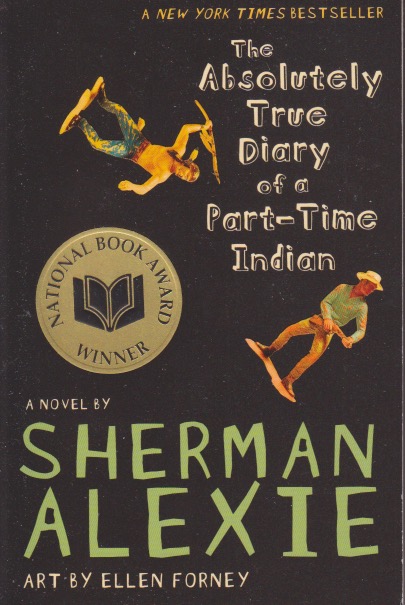
In honor of Banned Book Week I read Sherman Alexie’s The Absolutely True Diary of a Part-Time Indian.  Funny and poignant, it tells the story of Arnold Spirit Junior, a Spokane tribe boy on the reservation.  Born with a disability, he nevertheless overcomes adversity to become both a good student and excellent basketball player.  I suppose you’d classify this as young adult literature since the protagonist is a teen and many of the issues are those of kids in that age group.  Although it’s funny, and the illustrations underscore this, there’s a realism that account for various people wishing to ban it.  First of all, it reminds readers that white men put Indians on reservations and, despite our national guilt about this, we still refuse to do anything to try to lift them out of poverty.  And, like most boys his age, Junior likes to talk about sex once in a while.

Fiction can be the most nonfictional form of writing.  Junior describes the realities of reservation life.  Alcoholism, poverty, and violence are part of his everyday experience.  He attends far more funerals than his white counterparts.  This particular point gave me pause.  A New York Times article that appeared pointed out, statistically, that American Indians had much higher death rates from Covid than many other demographics.  It was like the genocidal introduction of European diseases during the “age of discovery.”  I suppose people would’ve grown curious and explored their world, regardless of the distorted Christian belief that they were to take it over.  At least we could’ve treated those we met with respect, as equals.

I think about the missionary mandate quite a lot.  Based on an undying literalism, it became an excuse for behaviors explicitly condemned by Scripture itself.  There’s a real danger when conviction comes with guns.  At least modern-day missionaries try to help those they’re attempting to convert with hospitals and medical care.  Still, that doesn’t help the American Indians.  They still struggle and our policies still ignore their problems.  Their plight stands in the way of capitalistic exploitation.  And when an Indian writes a fun book, honest about the experience of his people white critics begin to raise their voices to ban it.  How do we think the situation of the Indians will ever improve if we refuse to listen?  And what better time to get people to listen but when they’re young enough not to have been corrupted by our system of entrenched unfair treatment?


Things that Appear

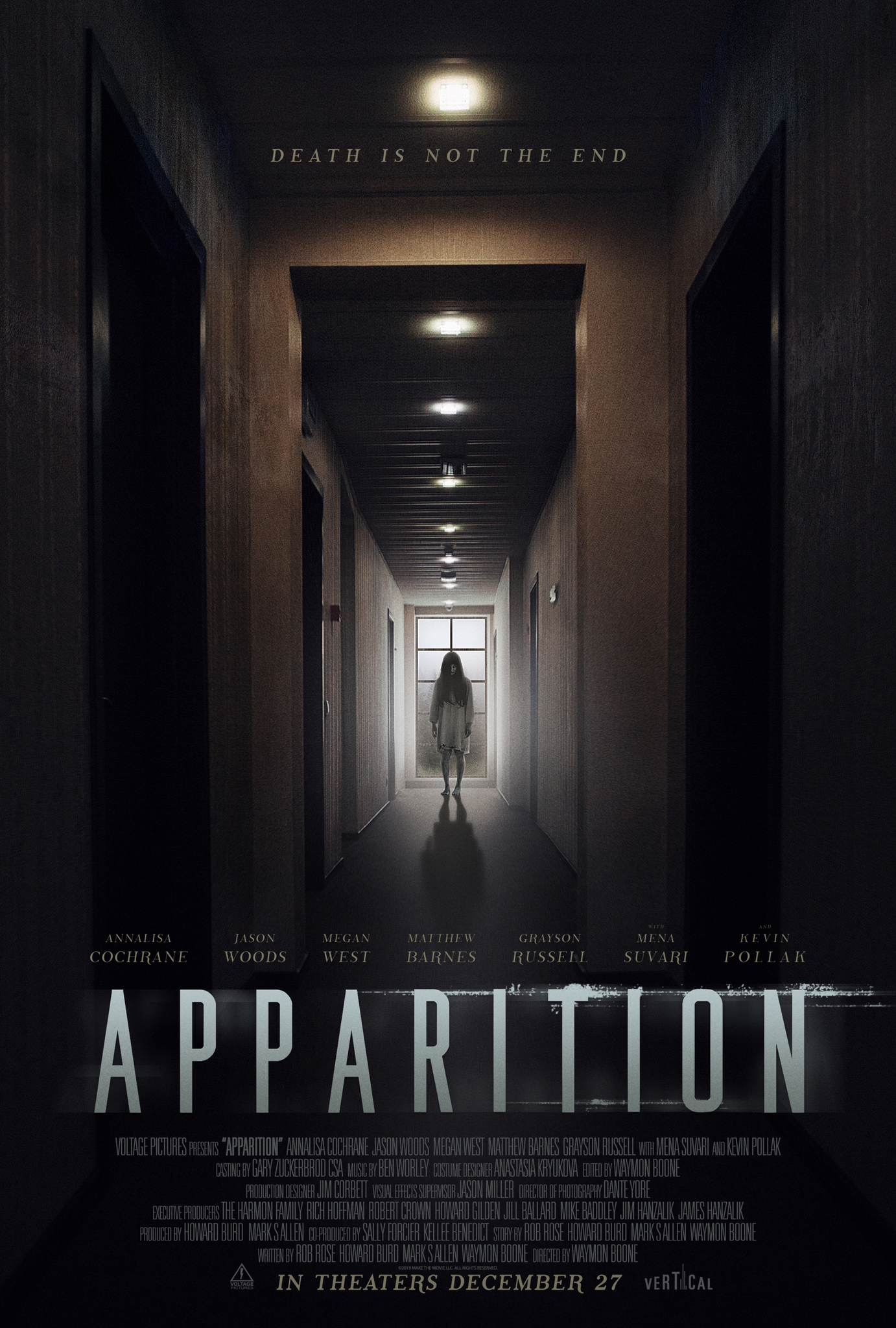
As a movie, Apparition fails on many levels.  One way that it passes is being free on Amazon Prime, which is how I found it.  The trick with Prime, of course, is that really good movies tend to be available for a limited time, keeping you on the website.  Time is money, after all.  I was drawn into Apparition from the “based on real events” tagline, even though I should know better.  It was a hot, sleepy weekend afternoon, and I’m not a good napper.  I’m not going to worry too much about spoilers here, so if you’re into penance, you might want to wait until after you’ve seen it.  Set at the real life Preston School of Industry—a boy’s correctional institution in California—the boys are tortured and sometimes murdered by the warden and guards.  This is one of the few real-life parts: a housekeeper at the facility was murdered in an unsolved crime at the site.

Fast-forward two decades.  The former warden (the place has been closed), is hosting the lavish rehearsal dinner for his son’s wedding.  The son is unloved (his father is a sociopath, after all), and doesn’t treat his fiancée very well.  Meanwhile a younger son is a nerd who’s developed an app called Apparition.  Through some unexplained technological wizardry, it allows the user to connect to the dead.  Another couple, son and daughter of two of the former prison guards, decide to try it and discover that it works.  When the bride gives it a try it leads the five young people to the Preston School.  There various ghost-hunter startles are used as the ghosts of the murdered boys take their revenge on the offspring of the warden and guards.  The bride discovers her father was a “good cop” and that’s why she wasn’t killed.  The younger son is actually the son of the murdered housekeeper, another of his father’s dark secrets.  The parents come and get what’s due to them.

What makes this unremarkable film (and very little comment has been given on it) worth discussing here is that during the opening credits a Bible is shown open to Exodus.  The verse called out is 20.5: “Thou shalt not bow down thyself to them, nor serve them: for I the Lord thy God am a jealous God, visiting the iniquity of the fathers upon the children unto the third and fourth generation of them that hate me.”  This isn’t referenced per se in the film, but the warden does suggest the school is a righteous place.  That’s a fairly brief reward for watching, but I hate to waste even a lazy weekend afternoon when it’s too hot to work outdoors.


Headlines

I see many headlines in a day.  One from Book Riot caught my attention with its linked story on BoingBoing.  This particular story is poignant and points to the ridiculous polarization politicians are stoking to play for our votes.  (I swear, politicians should be made into their own country so they can ruin their own lives without affecting the rest of us.)  This headline deals with the remarkable person George Dawson.  The son of a farmer, and descendant of slaves, Dawson made a living as a laborer in Texas.  His life was probably no more noteworthy than those of many other working-class individuals, but Dawson had a story to tell.  Illiterate, he learned to read at the age of 98—let that sink in.  At two years shy of a century he decided to improve his life.  He subsequently wrote a memoir, Life Is So Good.  So far, so good.

For reading, not banning!

His story was so inspirational that the Carroll Independent School District named a middle school for him.  He became a adult “poster child” for literacy.  Now, here’s where the headline comes in.  The very school that is named after him is trying to ban his book.  As part of the reactionary Republican response to race relations, politicians—local and national—are trying to rewrite American history so the white guy is always right.  Always good.  Always Christian.  Always moral.  It doesn’t matter how many times he cheats on his wife and his taxes, he is the paragon of virtue and respectability.  To suggest that he promoted slavery and treated Black people as property and beat and lynched and left them in poverty, well, that’s just too powerful of a pill to swallow.

Banned Book Week begins this month, on the 18th.  Every year I try to read a banned or challenged book in honor of the occasion.  Censorship has been on the playlist of fascists from the beginning.  Propaganda works.  All you need to do is use emotional appeal to short-circuit the rational faculties and then laugh all the way to the bank.  Slavery?  What’s slavery?  Do you mean to suggest that white men used slaves?  Poppycock.  We have always been as upright with the same moral rectitude as the Donald.  And the Ronald.  And all white men who stand under the big R.  Pay no attention to the Black man who learned to read at an age when most of us are dead.  Is that such a big deal?  What need do you have to read when Fox News can provide all the (mis)information you need?


Like Sheep

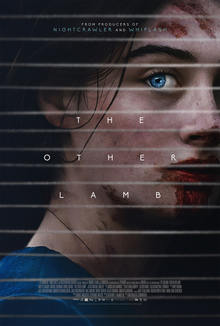
Since horror grew up in the late 1960s, religion has become a favorite theme in the genre.  Although religion had been in horror from the beginning, Rosemary’s Baby marked a definite sea change.  More and more religion has been moving from a subsidiary theme to the main vehicle of horror.  Małgorzata Szumowska’s The Other Lamb is a case in point.  “Shepherd” is the leader of a separatist religion that consists only of women.  The premise itself is creepy enough, but it becomes clear that Shepherd—the group literally has a flock of sheep—physically abuses the women.  They are divided into two groups: sisters and wives.  When unexplained things happen, Shepherd gives prophetic pronouncements.  His followers are expected to accept everything he says on blind faith.  Many religions do this by proclaiming faith against evidence a virtue.

One thing that I’ve emphasized in various presentations I’ve done is that Christianity, and perhaps all religions, work because believers are great followers.  While Shepherd uses biblical-sounding language, there are no Bibles in the film.  There are recognizably Christian themes, but the doctrine isn’t familiar.  Part of the reason, obviously, is that Christianity has a negative view of sex and Shepherd treats his flock as his harem.  The women follow because he “rescued” them from worse situations and their communal life is better.  Only it’s not.  When a woman director stands behind such a film, there’s clearly a message being sent about male privilege.  Any system set up with male superiority will lead to abuse.  When Shepherd’s enclave in the woods is discovered, they must move.  He instructs the women that they are going to find Eden.

Throughout, the movie is more creepy than scary in the traditional sense.  There are no jump-startles, but the situation makes you sense that something’s not right.  The women, acclimated to this lifestyle, many of them for years, know no other way of being or even where to go.  They have no vehicles.  Forced to move, they walk—Shepherd carries nothing while the women backpack out supplies.  Once Eden, on the shore of a lake, is reached, Shepherd baptizes the sisters and drowns the wives so the younger women can take their place.  You get the sense throughout that this movie is a parable.  Men like to take the privilege of determining women’s fates without understanding women’s needs.  This new kind of horror is insightful and symbolic.  There is no final girl when women band together.  The Other Lamb deserves wider exposure than it’s had.  It’s a good example of what religion can do to those who simply follow.


From Russia

A New York Times headline recently caught my eye.  “Russia opened a murder investigation into a car blast near Moscow.”  I wondered how a country that’s an aggressor at war, killing civilians in Ukraine every day, would be interested in something so petty as murder.  Then I saw the rest of the headline: “that killed the daughter of an influential ally of President Vladimir Putin.”  So there it is—some lives are more valuable than others.  Don’t get me wrong—I’m saddened by this (and any) murder.  And the use of violence to get what one wants is unethical.  Justice in this world, however, is based on unequal standards.  The supporters of Putins and Trumps matter more than any other people.  Death should not effect them the same way it effects civilians being missiled and shot.

Throughout all this we might wonder where the voice of the church is.  Churches, as institutions interested in power, are political players even when there’s no state religion.  The Patriarch of the Russian Orthodox Church supports Putin implicitly.  With the power of Russia, the power of the church rises.  A few thousand dead civilians, well, let God sort them out.  Churches become corrupt when they become politically powerful.  Politics is one of the most polluting things humans can do.  Long ago Lord Acton put it this way: “All power tends to corrupt; absolute power corrupts absolutely.”  Churches got into power-brokering in the fourth century and we’ve seen the results ever since.  It’s not just Christianity, however; Islam makes it political and yes, even Buddhism and Hinduism incite violence when they become politicized.  A religious body that takes its mythology too seriously becomes dangerous when it tastes political power.  The world has many mythological figures.

What really took my breath away, however, is how many state resources will be devoted to finding and prosecuting those who killed one government supporter—we must find and punish those responsible—while thousands lie dead with the Russian government as their killers.  Other nations are just as guilty of course, but there’s a karmic imbalance when that nation is an aggressor in war.  Would you have ever expected a fair trial in Nazi Germany?  Does not unprovoked war make a mockery of the very concept of justice itself?  Justice, of course, means fair treatment.  For all.  She’s pictured as wearing a blindfold, after all.  She’s perhaps one of those mythical figures as well.


The Roll of Churches

I really don’t have time to follow any social media religiously, generally glancing at a page and perhaps scrolling down an inch or two when I have a moment.  I tend to glance at headlines, often pre-selected for me by a non-human intelligence, I expect.  Nextdoor dot com occasionally has a story that looks important to read, because it’s local.  Recently a poster from Bethlehem noted meeting a homeless person and was asking virtual neighbors where to turn for help (for the homeless person).  The answers weren’t surprising but reminded me of something I recently heard elsewhere—this is where churches still have a chance to shine.  While I’m tired of all the doctrinal and theological nonsense that arises from those who didn’t pay close enough attention in seminary, I do lament the plight of our churches.

Society has been too Republican for too long to care for those who can’t make it in an uber-capitalist environment.  Those with mental illnesses turned out when Reagan-era “reforms” “improved” our system for handling them.  Those who, through no fault of their own, can’t hold down a job.  Those who just happened to end up on the wrong side of a wave and find that a new wave breaks over them before they can properly take a fresh breath.  As the most affluent nation in the world, each homeless person is a reminder of the terrible price we pay for living within a system that rewards greed far above anything else.  Churches do have their problems—I’ve experienced many of them firsthand—but they often feel an obligation to take care of the sick, the homeless, the elderly.  Those not of value to a capitalist system because they don’t “contribute.”

When I commuted to Manhattan my bus arrived early.  I often saw the many homeless sleeping on the street as I made my way across Midtown.  Many days I wished I had an extra peanut butter sandwich with me so that I could give them something.  Anything.  Churches that aren’t caught up bickering about whose genitals belong where, or whether females are equal to males, often turn their sights to those who need help.  These churches are supported by the donations of members (for which said members can claim a tax break).  These are members who care for those they’ve never met, simply because they are human and in need.  Churches themselves are now facing difficult times and, unless they support Republican causes, can be assured they won’t receive a government bail out.  Compassion may be a dying species.


Scary Cosmology

In many ways a harrowing book, A Cosmology of Monsters, by Shaun Hamill, is a real achievement.  A monster story, it’s less a story about monsters than it is about people—which, upon thinking it over, is generally the case.  This story is about the suffering people undergo, sometimes simply for being who they are.  Hamill gets his hooks in early and drags you through this wonderful, terrible story.  Even now that I’ve finished it I’m not quite sure what to make of it.  What’s it about?  Maybe I can try to give you a few signposts and pointers.  To find out more you’ll need to read it and check my work.

The Turner family, through no fault of its own, has been living under a strange kind of curse.  It involves monsters, from what is probably another dimension, kidnapping and enslaving them.  The Turners aren’t alone in this.  Others who’ve been suffering from various causes are also targeted and treated.  Perhaps this is partially a parable on suffering and depression.  The Turner family faces death, missing children, forbidden love, and regret.  They run a local haunted house around Halloween, which the father’s regular job finances.  They do it for fun and it’s free.  It keeps them going when a terrible diagnosis is given.  Stressed financially and emotionally, they barely manage to stay together.  Noah, the narrator and only son, checks out the competition, including a Christian Hell House.  There he meets the girl he’ll eventually marry.  But the monsters don’t stop coming.  He befriends one.

An intricately interwoven story, you might call this horror but you would probably be closer to the truth with literary fiction.  There are uncomfortable facts about families.  Things we tend to overlook or ignore in order to keep society running smoothly.  These kinds of issues are brought out into the open here and mixed in with monsters.  On both the human and monster sides, the emotionally wrenching ideas have to do with relationships.  Noah, who was born just as his father was dying, establishes relationships both with his family and a monster.  As the story progresses over the years, his wife is added to this complex of relationships and they all end up, in a way, competing.  Decisions have to be made and someone you love must lose.  This novel makes monsters and humans the objects of the reader’s sympathy.  What’s more, it works.  I hope I haven’t given too many spoilers here, because this is quite an accomplishment, and well worth a reader’s time.


Burdens

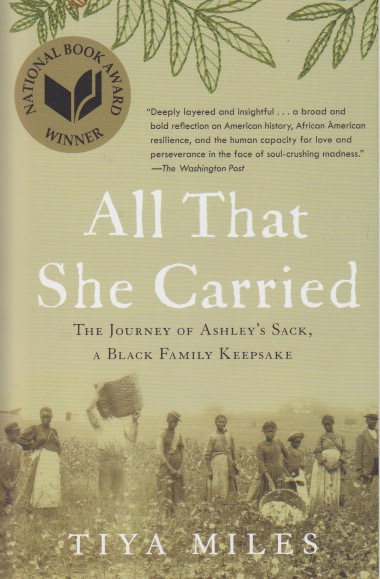
Listening is very important.  Sometimes there’s nothing really to say but “I hear you.”  This kept occurring to me during All That She Carried: The Journey of Ashley’s Sack, A Black Family Keepsake.  Tiya Miles is a history professor, and she helpfully includes an afterword telling how she came upon the topic for this book.  Ashley’s sack is just that, a sack.  On it, the owner, a female descendent of enslaved African-Americans, stitched a short inscription about the history of the sack, how her grandmother had given it to her mother when the latter was a child under ten, sold away from her mother in South Carolina.  This isn’t an easy book to read.  I have difficulty being faced with what “religious” “white” folks did to Blacks and justified themselves that people can be bought and sold.  Listen, I told myself, just listen.

Those who would deny that any of this ever happened need to learn to listen.  In order to capitalize on the resources this country offered, our ancestors engaged in morally reprehensible acts.  And the cruelty didn’t end with the shipping and the selling.  The treatment of unfree Black people itself was a crime, and their white captors knew full well what they were doing.  Preventing their slaves from having nice things while they themselves lived in luxury.  Beating, raping, and murdering when they didn’t get their way.  Selling their own offspring born of slaves to make a profit.  All the while claiming to be good Christians.  It’s often this part that I have trouble understanding.  Even a literalistic reading gives no license for treating other human beings this way.  Only money does that.

The style of history in this book isn’t that to which many of us are accustomed.  At the point of raising mental critiques I repeated, “You must learn to listen.”  Those who have made the rules showed themselves to be corrupt, and they must be willing to consider alternative ways of telling a story.  Miles makes the point that the history of unfree Blacks was largely erased, leaving the possibilities for histories and heritages slim; if the regular rules are themselves oppressive then it may be time to listen to those of others.  It seems impossible in the age of the world-wide web and all that it implies that we live on a planet where people repeatedly deny their sins while clutching their Bibles in their fists.  We need to learn to listen.


Remember the Doorway

I’m glad it has a name.  And I’m also, relievedly, glad it’s normal.  The Doorway Effect.  I’m sure it’s happened to you.  You walk into a room and immediately forget what you came in for.  I’ve been afraid of some early onset of something because I’ve noticed it more and more, but it turns out that this is a normal brain function.  A recent article by Jessica Estrada explains that our brains are constantly framing.  A large part of that framing has to do with our physical location.  When you step through a doorway that framing changes and some of the residue (what I came in here for) might easily get left in your previous location.  In other words, it seems to be an effect of humans making different rooms for different purposes.  Our thought lingers in the place it was first born.

Photo by Filip Kominik on Unsplash

Our brains are fascinating organs.  Every time I read about how children’s brains form, I wish I’d studied psychology instead of religion.  How we could help our children if we understood what their brains just aren’t capable of doing just yet!  How many spankings could have been avoided if parents understood brain development?  Beating someone doesn’t teach anything.  Instead, we might try to learn how minds use brains.  Young boys can be quite reckless.  One of the reasons?  Their brains haven’t developed enough yet to think through the consequences of their actions.  Yes, they can push limits for other reasons, but their thinking simply doesn’t yet involve adult caution that (hopefully) comes with a developing brain.  One of the real consequences of this, for which I’ll volunteer as a poster child, is religion.

Children’s brains are not developed enough to accept and comprehend religious thinking until they’re about 12.  We’ve known this for many decades now.  And yet, the theology of parents means they try to convince their children of religious truths before their brains are developed enough to sort it out.  Look at Congress and the Supreme Court to see the results of this.  Most people never seriously question their religion.  For many it was instilled in them as children, before their brains could properly process it.  The rest of the country pays for it with laws then enact.  We’ve known about this for decades and have decided that studying religion is a waste of time.  But I digress.  Now I forget what I started to say when I began this post.


Conflicting Lifestyles

Sleep patterns often don’t fit with work patterns.  The reason I wake up so early is that for years I had to do it to get to Manhattan.  For work.  Since ending the commuting lifestyle four years ago, I haven’t been able to adjust back to normal, whatever that may be.  During a recent heatwave weekend, when it wasn’t really conducive to be doing yard work, I suggested to my wife that we watch The Godfather on Sunday afternoon.  Somehow I thought it was only two hours, but it is actually much closer to three.  Now this Coppola film is considered one of the greatest movies of all time and I have literally wanted to see it since 1972.  There were no VCRs in those days and life has been, well, busy since college days.

It is a powerful movie, even today.  I knew the basic plot and I started to read (I can’t recall if I finished it) the novel in the early seventies.  All I know is that I sat engrossed as the temperatures tempted 100 degrees outside.  Because I awake so early Sunday afternoons are often sleepy times for me, but I don’t nap.  Napping leads to long nights and I awake early no matter what.  The movie doesn’t allow for a lapse of interest.  One of the scenes that had the most impact is when Michael is attending the baptism of his godson and the priest asks him if he renounces Satan intercut with scenes of his hitman killing his rival family bosses.  The religious nature of the violence in the story is perhaps one of its most shocking elements, even today.

That night it was still hot, and all the water that I drank during the day made itself rather urgently felt around 2 a.m.  The trick to the late night bathroom run is to keep your mind shut off.  Although The Godfather ended nearly twelve hours earlier, it crept back into my head, keeping me awake after that.  Of course, I had a full day of work—there are no allowances for aging in this thing of ours called capitalism—ahead.  The thing is, when else do we find three consecutive hours to catch up with a cultural landmark but a Sunday afternoon?  Are you supposed to take a vacation day to do it?  I have no regrets about having watched the movie—it was like an offer I couldn’t refuse.  It’s just the rest of life that, well, simply won’t compromise.