Just the Fax

Like most people I have a cell phone.  If I use it to take a picture, I can send that photo any number of places with a tap, swipe, and tap.  It works that way with scanned documents as well.  Using a hand-held phone, I can scan important papers, convert them to PDFs, and send them via email, text, “AirDrop” (whatever that is), Facebook, Twitter, Instagram—you name it.  Except fax.  That I cannot do.  The other day a company wanted me to send them a document by fax.  Within seconds I had scanned it with my phone and was ready to send it, but instead experienced electronic constipation.  The company had no email; it had to come by fax.

Now, like most reasonably modern people, we have no fax machine at home.  We still have some in the office in New York, but they are clunky, noisy, and seldom actually work.  The technology to receive documents has improved beyond the photostatic smear that facsimiles represent.  I worked for a company where the warehouse insisted on orders by fax.  You’d fax them the order and wait for the phone to ring.  They couldn’t read the fax and you had to tell them what it said.  Well, this particular company I was dealing with wanted a fax.  I downloaded two or three “free” fax apps.  They suspiciously wanted my credit card info.  Besides, if you send more than one page they wanted at least ten bucks for a “package” deal.  I had to send a three-page document.  I checked to see if my laptop could do it.  The manufacturer’s website said it could, but the menu option it told me about didn’t appear.  Who insists on faxes any more?

This is the dilemma of mixed technologies.  It’s like those movies where the streets of some exotic city are filled with rickshaws, cars, bicycles, and pedestrians.  The fax, in this analogy, is the pedestrian.  My mother doesn’t have email, let alone the capability to text (or fax).  Ours is a telephone relationship.  Yet in my hand I hold a device that can send this document anywhere in the world with a tap, swipe, and tap.  I recall my first trip to Jerusalem where hand-drawn carts, cars, and yes, camels, shared the streets.  This was in the days before the internet.  To contact home even by telephone was cumbersome and costly.  Yet somehow we survived.  I’d arranged the trip utilizing a travel agency and funded it by a letter-writing campaign.  The Ektachrome slides I took are now a pain to look at because technology has so improved our lives.  Unless, of course, you need to send a fax.  Delivery by camel can at least be arranged via the internet.


Slow to Travel

A family friend recently died.  I was in New York City when I received the news, and I mused how recent a phenomenon this speed of information is.  The news wasn’t necessarily a shock—this friend had been experiencing failing health, he was a close friend of my grandfather—but for some reason Samuel F. B. Morse came to mind.  The story goes that Morse invented the telegraph because of his experience of being away from home when his wife died.  By the time he received the news and was able to get home by the conveyance of the day, she’s already been buried.  He set his inventive mind to improving the speed of communication over a distance.  In these days of receiving texts mere seconds after something momentous happens, it’s difficult to imagine that for the vast majority of human existence, personal news traveled slowly.

Feeling in a reflective mood I recalled how when I was in college I wrote letters home.  Yes, the telephone existed by then—don’t be so cynical!—but long distance bore a cost and college students find ways to save their money for girlfriends or spending a weekend in Pittsburgh.  News traveled more slowly.  Back before Morse, the swiftest option was the letter.  The death of a friend might take days or weeks to reach those close.  Distance in time, as well as space, may not have lessened the shock, but the immediacy of a text wasn’t there.  The death had occurred days or weeks ago.  There was nothing left to do but grieve and get on with life.  Like Samuel Morse—perhaps the only point of comparison between us—I was unable to get away immediately.  New York City isn’t easy to escape quickly.

We move swiftly and slowly at the same time.  I know news moments from the event, but this physical mass I inhabit is sluggish takes some time to get around.  Manhattan’s an island, and although it’s not Styx we’re crossing, the Hudson creates barriers enough.  Now my journey includes crossing the entire state of New Jersey before I can even reach home.  Were I to drive back to my original home, it would add another five hours at least in the car.  Sometimes I wonder if the immediacy of knowing is a blessing or a curse.  The shock is immediate and visceral.  But like an injection, the sharpness is quickly over and the dull ache sets in.  Our family friend had been suffering for some time.  Now he’s at peace.  I like to think he’s with my granddad, and that the two of them together won’t judge me too harshly for moving so slowly.


Paranormal Pilgrimages

Although the Allegheny Mountains are hardly the Rockies—they’re much older and gentler on the eye—they harbor many tourist locations.  Even before my daughter attended Binghamton University, I’d been drawn to the natural beauty of upstate New York.  Prior to when college changed everything, we used to take two family car trips a year, predictably on Memorial and Labor day weekends, when the weather wasn’t extreme and you had a day off work to put on a few miles.  One year we decided to go to Sam’s Point Preserve (actually part of Minnewaska State Park) near Cragsmoor, New York.  It features panoramic views, a few ice caves, and, as we learned, huckleberries.  What my innocent family didn’t suspect is that I’d been inspired to this location suggestion by the proximity of Pine Bush.

A friend just pointed me to an article on Smithsonian.com by my colleague Joseph Laycock.  Titled “A Search for Mysteries and Monsters in Small Town America,” Laycock’s article discusses how monster pilgrimages share features with nascent religion.  People report strange encounters with all kinds of creatures and objects, and science routinely dismisses them.  Odd encounters, however, leave lasting impressions—you probably remember the weird things that have happened to you better than the ordinary—and many towns establish festivals or businesses associated with these paranormal events.  Laycock has a solid record of publishing academic books on such things and this article was a fun and thoughtful piece.  But what has it to do with Pine Bush?

Although it’s now been removed from the town’s Wikipedia page, in the mid 1980s through the ‘90s Pine Bush was one of the UFO hot spots of America.  Almost nightly sightings were recorded, and the paranormal pilgrims grew so intense that local police began enforcing parking violations on rural roads where people had come to see something extraordinary.  By the time we got to Pine Bush, however, the phenomena had faded.  There was still a UFO café, but no sign of the pilgrims.  I can’t stay up too late any more, so if something flew overhead that night, I wasn’t awake to see it.  Like Dr. Laycock, I travel to such places with a sense of wonder.  I may not see anything, but something strange passed this way and I want to be where it happened.  This is the dynamic of pilgrimage.  Nearly all religions recognize the validity of the practice.  It has long been my contention, frequently spelled out on this blog, that monsters are religious creatures.  They bring the supernatural back to a dull, capitalist, materialistic world.  And for that we should be grateful.   Even if it’s a little strange.


Unnatural Connections

The last time we moved internet service was just becoming an issue.  When we first came to our Somerville apartment we had dial-up.  Do you believe it?  Shortly after that FIOS came to town and we decided to give it a try, but at a fairly low speed.  We’ve always tried to be responsible with money and I naturally balk at paying for something as intangible and amorphous as “internet connectivity.”  I guess I’m a naive realist after all.  In any case, one of the top priorities in moving to our new place was getting internet set up.  Even before electricity or gas or water.  It has become THE utility.  The place to pay the bills for all the other utilities.  And since I’m now telecommuting, the umbilical cord that connects me to work.

I don’t mean to sound all grandpa-ish on you, but just twelve years ago we struggled for any connection at all.  We had one computer (and one work laptop) and only the desktop had internet access.  Many of the arcane pieces of hardware found in the attic were from attempts to get us onto the net more efficiently.  We even had to draw up a contract for who could use the computer and for how long since all of us wanted that magic window onto the virtual world.  Now, like most households, we have wifi and high speed access.  When we’re not at the computer, we have our smart phones at hand.  The strangest thing about all of this is that now that we’ve got constant connection, our nation has become as polarized as it has ever been.  Perhaps we see a little too much of each other?  Or too little?

The web has connected us to those we like.  Walking down the street it’s rare to find someone not staring at their phone, ignoring all living beings around him or her.  We’ve been able to filter out those we don’t like.  Those who have different points of view.  The net shows us that we aren’t alone, and even those with extreme views can find plenty of compatriots in cyberspace.  There’s a reason we used to be told not to discuss religion or politics.  Now we know everybody else’s business.

There was a time when moving meant going to where the jobs are.  Especially in academia.  Colleges and universities exist in set locations.  In space-time.  Telecommuting isn’t an option (although even that’s happening in some cases now).  Moving these days means weighing your internet access options.  Satellite is just too slow and unreliable.  Who would’ve imagined, for those of us born just after Sputnik went up, that now even space-based connections just aren’t advanced enough?  Cyberspace has become more infinite than outer space.  And I still prefer pencil and paper.


Behind the Scenes

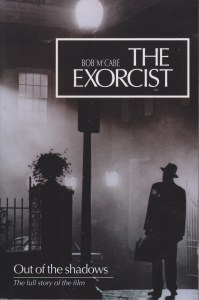
Although I confess to being a horror aficionado, it took many years before I could convince myself to watch The Exorcist. I finally saw it in the mid-20-aughts, and have watched it many times since. It’s a movie that I discuss in Holy Horror, and it will star in Nightmares with the Bible as well. Although younger people often don’t experience the movie as scary—certainly the increasing trust in science and growth of secularity contribute to this—there is a sincerity about it that earns it its deserved place in the pantheon of horror. Bob McCabe surely counts as a fan for his The Exorcist: Out of the Shadows. Sub-subtitled The Full Story of the Film, this book is a gallimaufry of anecdotes, interviews, and facts about the movie and even its sequels. It’s like of like a sustained reaction shot.

The book doesn’t lack insight and McCabe is surely right that this was one of the most influential movies of the early 1970s. It has become a frame of reference on its own and it has defined, in large measure, what people believe about demonic possession. One of the quotes from McCabe’s treatment however, uses the phrase “metaphysical unknown” to explain why the film retains its power to scare, and there’s a great deal of wisdom in that assessment. Fear of the unknown, of course, is prime real estate for horror, and one of the most interesting things about demons is how little the Bible, or other ancient texts, really says (or say) about them. They are an embodiment of the unknown that can take over a person and make her somebody else. But it’s that metaphysical that’s really scary.

As we continue into a time of less and less that remains unclaimed by scientific theory, those metaphysical unknowns continue to lurk and to frighten. Maybe it’s the concept of the metaphysical itself that scares—can there really be something larger, more intelligent than us? The human psyche bruises easily, and we don’t like to be reminded that we lack the control we suppose we have each day. The metaphysical challenges all that. Since it refuses to submit to empirical verification, it remains unknown. A great many people interpret this as the same as not believing in it. Every once in a while, however, a powerful statement such as The Exorcist comes along. Few people thought about demons before William Peter Blatty’s novel and subsequent film. Then the world was full of them again. Requests for exorcisms are on the rise, and the metaphysical unknown haunts us now as much as it ever has.


Faithism

Religion, in general, has come upon hard times. Many proponents of science and secularism point disparagingly toward what is, in all likelihood, one of religion’s strengths: its utter diversity. The fact is all people are believers. No amount of denial will change that. Whether the belief is in science or magic, we all take things as true, based on our outlook. My wife recently forwarded me a story about Faithism from the New York Times. A religion built around the Oahspe Bible, written about the same time as the Book of Mormon, Faithism very nearly went extinct before undergoing a modest revival in the present day. Instead of casting aspersions on it, a far better approach is to consider the basic, underlying human element to the movement.

Faithism was based on a book written by a dentist, a one John Ballou Newbrough. Although I’d never hear of Newbrough before, I can make a safe assumption about him—he was struggling with trying to understand a supernatural that can’t be measured or tested. This same element applies to scientists. Measurables have to leave at least a physical trace. Millennia ago, religions were already claiming that outside this mortal coil there was an entire realm that we could experience with our feelings but which would never offer any physical confirmation. There’s a pretty obvious difference between the living and the dead (at least to most people). Since nothing measurable changes at human death, it must be something incorporeal. Scientists begin to shake their heads here, but even they must face it some day.

The other takeaway from Faithism is that spiritual writings, like tiny particulate matter in clouds, can lead to the coalescence of something larger. Orally based religions, such as Zoroastrianism, seldom survive long. (Zoroastrianism, however, had very compelling ideas.) Written texts, once believed to be inspired, will naturally grow like a pearl over a grit of sand. The factuality of the text doesn’t matter, as long as it is the object of belief. When it rains, it pours. Some architects of new religious movements, such as L. Ron Hubbard, perhaps implicitly know that. While his science fiction may not have been inspired, his religious texts were. Unlike Scientology, science requires objective measures of what it considers reality. The title of Faithism, however, makes a trenchant point—it is belief in faith, like fear of fear itself, that makes religion. While historically few have believed in Faithism, even atheists have faith in what they don’t believe.


Evangelical Angst

Unless you know what it’s like to face life with no real prospects beyond making it to Heaven when you die, you can’t understand evangelical angst. That last phrase might seem odd to you. Aren’t evangelicals uber-smiley, happy people angry over the way society’s going? Yes and no. Many of them were raised (or converted into) a faith that holds out no hope for this world and that constantly reinforces the idea that what we like is bad. Having grown up in that world, I knew what it was like to be hoodwinked by an evangelist. I can’t remember the guy’s name, but he was famous. He came to my small town and packed a local Methodist Church. During his rambling, long sermon, he had us afraid for Hell burning under our feet. Grateful that we’d just managed to avoid it, he announced there would be three collections that night: the first was your normal tithe. The second time the plates came around you were to empty your pockets and purses of all change. The third time, you were to contribute to his private jet. If you gave over a thousand dollars your name would be inscribed on a plaque inside.

Almost as if nothing has changed in the decades since then, a Washington Post story expresses amazement that evangelist Jesse Duplantis is asking his followers for a fourth private jet. Uncomprehending, the world doesn’t show much curiosity as to why otherwise intelligent people would give to what is so obviously a scam. Or why such people would vote for Trump. The academic world doesn’t understand evangelical angst. As I sat in that audience that night, a poor kid from a poverty-level family, I fervently wished I had more money to give. Until he asked for his plane. My young doubts crept in, for I had more angst than most other evangelicals I knew. Was this really the Gospel?

Later I saw him on television. His personal mansion had literal streets of gold. Jesus, he said, wanted us to get ready for Heaven right here on earth. Did this turn his followers against him? Decidedly not. In fact, he may have believed it himself. You see, neuroscientists have learned that our brains have the evolved capacity to hold and dismiss reason simultaneously, for strong emotional stimuli. Sex, for example, or music. Or religion. These can motivate people beyond the realm of logic, and they often do. Evangelical angst says you’re not buying a scam artist a jet to spread the Gospel, it says your trying to avoid Hell. Rational or not. And that, it seems to me, is more than adequate ground for evangelical angst.


Driving Truth

One of the problems with driving is that you can’t get pictures of billboards. Well, given the way people drive around here, I suspect that may not always be true. Nevertheless, I always think of billboards as trying to sell something. There’s sometimes fairly easy to shut out, but in long stretches of otherwise uninteresting road you fall into their trap. Now having grown up in western Pennsylvania, we always thought the people out east—Philadelphia was the largest city in the state, after all—were more sophisticated. It is around here, however, that I often see billboards selling evangelical Christianity. If you put out your wares, you’ve got something to sell. Money to make.

As I was traveling that stretch of somewhat plain highway 33 between Stroudsburg and Easton I noticed a billboard reading “In the beginning God created the heavens and the earth.” To shore up its academic credentials the billboard footnoted Genesis 1:1. An inspirational sunrise, if I recall, shown over the Bible. Of to the left—of course to the left!—was a small “no circle” and inside the famous skeletal progression from ape to human. The message was “no evolution.” The more I pondered this, the more strange it became. Most Americans are well aware that billboards aren’t exactly the locus of truth. They are gimmicks to try to get you into the store. Like the one a few miles down that advertises the world’s largest humidor; even those with no interest in tobacco might feel just a touch curious what such a place might look like. Why would you take your most intimate personal beliefs and put them on a billboard? Does that make evolution any less likely?

A strange perception has lately taken over this country. The idea that an individual’s wants equate with the truth. Shout it loud enough and it has to be true. Billboards would never stretch the truth, would they? Is that image enlarged to show texture or what? And wouldn’t a better choice of anti-evolution rhetoric have been Genesis 2? That’s where God makes Adam from lowly dirt. Yes, Genesis 1 gives us the dramatic six-day creation, but Genesis 2 manages to say it all happened in one day—isn’t that more in keeping with capitalistic ideals? Greater efficiency leads to greater profits, after all. And profits, we all know, are the real purpose behind billboards for any product under the sun.


Crafting Magic

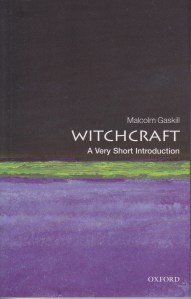
There’s a disingenuousness about an extremely wealthy white man claiming he’s the victim of a “witch hunt.” Such super-slurring devalues the many thousands of lives lost in actual witch hunts, most of them female. Regular readers of this blog know that I’ve long been fascinated by witches, and since I have so little time, Very Short Introductions are appealing. Malcolm Gaskill’s such introduction on Witchcraft is a surprisingly sensitive book that manages to touch on many important aspects of those who spend time thinking. The relationship between religion and science, for example. Witches force that question in various ways. The main takeaway, however, is another that the witch-in-chief would do well to take to heart—we must learn from history. History may be the key to human survival.

Gaskill has an unnerving balance when it comes to witch hunts. In places his attempts at objectivity can appear a little cold—history has demonstrated that the numbers of people killed in Europe’s witch madness aren’t as high as often claimed. Still, the loss of over 100,000 lives to propitiate our collective fears is tragic. This little book crams a lot of information in and it carries an appropriately warning tone. We don’t really understand what witches are, and we do still live in a world where hunts for them take place. Our psychies, ever so rational, crave magic. Societies from earliest times feared as well as desired it. Our belief in witches, and witchcraft, betrays quite a lot of what it means to be human.

This quick study isn’t all about witch hunts, though. It also explores the world of witchcraft, both in ancient and modern times. From Mesopotamian diviners to Wiccans, “the craft” has always been with us and is believed in by a surprisingly large number of people in industrialized societies. Magic, of course, generally leads to unexpected results. And the metaphor of its power over our imagination is forgotten at a terrible price. As Gaskill makes clear, the “witch” can be a stand-in for the other—the other religion, the other nationality, the other we fear and, now with government sanction, drive out or destroy. There is no magic to a wealthy man buying the presidency of the nation. There is, however, a culpability, a reckoning, if you will, that must attend abuses of this metaphor. The GOP has become a party of familiars in this compact with the Devil, it seems. That’s just a metaphor. But then again, metaphors can sometimes truly be magic.


Of Gears and Gods

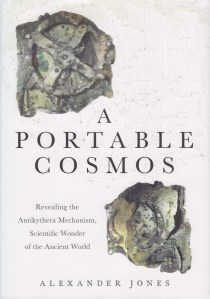
We develop pictures in our minds of the kinds of things that belong together in different eras. Dinosaurs, for example, don’t belong with our own species, no matter how much we may occasionally wish it were so. Horseless carriages don’t populate the seventeenth century and complex machines, we tend to think, didn’t really come about until medieval Europe (and then they were often used for torture). Our view of the world is, of course, one of comfort with the certainties of history. That’s why the Antikythera Mechanism is such a fascinating artifact. A very sophisticated device with gear trains and cranks and dials, it astonishes those who first encounter it in that it was made before the Common Era somewhere in the sway of ancient Greece. It is, in essence, a kind of computer. Long before Joseph met Mary.

Alexander Jones’ A Portable Cosmos: Revealing the Antikythera Mechanism, Scientific Wonder of the Ancient World is a pretty thorough introduction to the device, including the mechanics of how it works as well as how astronomy works. You see, the Antikythera Mechanism was designed to demonstrate the relative motion of the planets, including the sun and moon. For a device in the geocentric world of ancient Greece, that’s pretty remarkable. It predicted eclipses and showed the phases of the moon. It also makes me ponder the fact that most ancient people considered the planets deities. Long before Newton, then, some were recognizing that even the gods could be made to work according to a crank and gears.

Science and religion coexisted peacefully in those days. Although only one such device has been discovered, it’s virtually certain that more existed. Gods and gears both had a place in such a world. Along the centuries, however, the idea grew that if gears worked, we no longer required a deity. Occam’s razor has its uses, to be sure, but it can shave a little too closely from time to time, nicking delicate flesh. The idea that one side only can be right—and since we can see with our eyes that science works—tends to favor the mechanistic universe. There’s no disputing that science makes our lives easier and that its method is self-correcting and generally effective. The hands that cranked that ancient geared device, however, likely belonged to a believer in gods. Such belief didn’t prevent progress, but then some kind of Fundamentalists killed Socrates for his own form of heresy. Perhaps the true answer lies in balance. It may also be the most difficult of principles, scientific or otherwise, to achieve.


Measuring Immeasurables

Are demons getting more active, or are people just believing in them more? Quite apart from what’s happening in the District of Columbia, there’s been a surge of requests for exorcisms. This is according to a WBUR story my wife sent me. I’ve been researching demons for a few years now. Initially my concern was avoiding Hell (something I’d still like to do), but as an adult trained in rationalism, I wondered why people still believed in them. Trying to keep an open mind, I read accounts. Yes, misperception is possible. Alternative interpretations. But still…

Fundamentalists say that demons have to exist because Jesus said so. Historically speaking, people have recognized demons from the earliest writing cultures and probably before. What they thought demons were differed pretty wildly from place to place. A good case has been made that demonic possession, as we recognize it today, became popular after The Exorcist. William Peter Blatty researched the topic, and most of what he uses for Regan MacNeil’s symptoms came from medieval accounts. Although some of the descriptions are somewhat extreme, the actions themselves aren’t new to either movie or novel. In other words, according to the eyewitness accounts we have, such things do happen. And when they do, who ya’ gonna call?

Exorcists were mostly extinct by the 1960s. A decade later, after the movie’s release, reports began to increase in number. Malachi Martin’s Hostage to the Devil, which I reviewed here some time ago, was a bestseller. It reinforced the idea planted by Blatty. And the number of exorcism requests hasn’t started going down yet. Are there more demons about, or are we all imagining things? It’s a question not easily answered.

The fact is science can’t measure phenomena that don’t consist of matter or energy. Occam’s razor shaves away the whiskers of the spiritual. Perhaps nature intended for us to be a bit hairier. Spirit is something that has always resisted science and its metrics. We know it when we see it in someone. Or perhaps when it impacts a person’s actions or motivations. It doesn’t impact a scale. It has no visible spectrum. Conventional wisdom says if you can’t see it, hear it, or otherwise sense it, it must not be there. We know this to be shortsighted thinking, however. “There are more things in heaven and earth,” Shakespeare wrote, and we would do well to pay the bard his due. Are there demons? I can’t say. I do know that people have been asking for the services of exorcists more and more. For that there is ample evidence.


Lazing Around

I was a science nerd as a kid. Well, at least I had a real soft spot for charismatic megafauna, but who doesn’t? We had those cheap, plastic figurines of dinosaurs that we incongruously mixed with our mammoths and cavemen—wait, no. We weren’t allowed cavemen because people didn’t evolve. Nevertheless, we didn’t see any problem putting glyptotherium in combat with t-rex. Pleistocene or Triassic didn’t matter—they weren’t here now. Extinction is the great equalizer. One of the figurines that always intrigued me was the giant ground sloth. I mean, here was a creature bigger than it needed to be. Not hurting anybody, it just wanted to eat leaves and laze around. A lifestyle that sounds attractive to this day.

Photo credit: Postdlf, from Wikimedia Commons

Human beings, in a process that is still continuing, wiped out animals bigger than themselves. The story is poignantly told in footprints discovered in White Sands National Monument. A Washington Post piece by Ben Guarino tells how paleontologists discovered a human footprint embedded in that of a giant sloth. Reading the story I couldn’t help but wonder if this was the very last one in existence. What if we’d uncovered the story of extinction in real time? Sloths, apart from being named after a mortal sin, never harmed anybody unprovoked. Simple vegetarians—principally vegans, apart from the occasional accidental bug, actually—they were the ultimate victims of human greed. It is virtually certain that we drove them extinct just like we did the dodo and the fiscally conservative Republican. Not exactly fast food, sloths couldn’t really outrun us, and like good Trumpists, we took advantage of their weakness to our own gain.

Or loss. There are no giant sloths left. We’ll never thrill to the sight of a living eucladoceros, or wonder at chalicotheres roaming the savanna. We’ll never run for our lives from an African bear otter (the mind reels). Our world becomes poorer for our presence, it seems. We moved from huddling in fear in our caves out to take on the beasts with our technology. Once we cottoned onto the concept, we refined it until we could drop an elephant with the single pull of a trigger. Our destruction of megafauna continues at an alarming and accelerating rate. Evolution does have quite an imagination, after all. Like human beings, it can take sins and make them larger than life. And “thou shalt not kill,” we say, applies only to our species.


Candles vs Demons

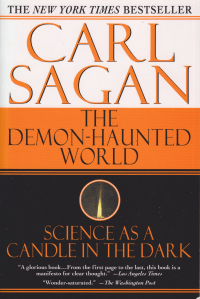
Among scientists who write Carl Sagan has always struck me as one of the more open minded. Dedicated to the scientific method, he nonetheless admits that there are some things scientists don’t know. The last time I was in Ithaca, therefore, I picked up a copy of his tour de force, The Demon-Haunted World: Science as a Candle in the Dark. I wasn’t really sure what to expect—I’ve been researching demons and I supposed they would be addressed in his book, since they feature in the title. Although that is indeed the case, the book is a collection of essays vindicating in various ways the practice and teaching of science. It is quite a scary book. It was also Sagan’s final book published in his lifetime.

Reading this just after Gabriele Amorth’s An Exorcist Explains Demons, noteworthy for its credulousness, The Demon-Haunted World was like whiplash into reality. Back into the realm of observable facts and testable hypotheses, it was indeed like a candle in the dark. Sagan admits that science can’t speak definitively on the supernatural—something that sets him apart from other science writers—but that doesn’t mean we shouldn’t apply scientific thinking anywhere it’s appropriate. And that includes the universe of politics. Published some two decades before the rise of Trump, the book is surprisingly prophetic when it points to the possibility of the rise of fascism in a nation that distrusts science. Indeed, the book shows Sagan clearly worried that an authoritarian, totalitarian government was on the rise. It’s almost preternatural in its accuracy.

The tome is large enough to dissuade a full summary within the word-limits I set for myself on these daily posts, but I can say that this book is necessary now more than ever. Sagan was a celebrity in his lifetime, a “rock star” scientist. Even so he worried about the deplorable state of science understanding among political leaders he met. For many years America has been mired in conservative causes that distrust science implicitly. Another strain that runs throughout this book is the need for education. Not only has America catered to anti-science groups, it has fallen behind much of the rest of the world in science education. Those who claim to make America great again can’t see that their very tactics have made our nation fall behind the rest of the world when it comes to education, across the board. Surely Sagan was right that a good grounding in scientific thinking is the equivalent of lighting a candle. As for the rest of the country it has been getting darker and darker, and our “leaders” have no idea even how to strike a match.


Heavenly Questions

A lot can happen when you’re in a coma. Or nothing at all. I haven’t read Kevin and Alex Malarkey’s account of the latter’s trip to Heaven during a coma, and it looks like I never shall. A story by Kyle Swenson in The Washington Post explains how Alex Malarkey, now that he is no longer a minor, is suing Tyndale House over the publication of his Near Death Experience (NDE), penned by his father. The story, according to the Post, was a fabrication. Alex awoke from his coma recalling nothing, but Kevin knew a good thing when he saw it and wrote an account of the young boy going to Heaven. Alex says it never happened. The Boy Who Came Back from Heaven is now being pulled and pulped as a hoax.

NDEs are real (even if one didn’t happen in this case), but what they actually are is a matter of debate. The mainstream interpretation is that they are the last gasps of consciousness before a brain dies, temporarily. These often comforting thoughts can be quite similar in very different contexts and sometimes include the formerly deceased knowing details that they couldn’t possibly have witnessed in real life. Scientists willing to buck convention explore these episodes less with the intention of proving Heaven is true than with probing the idea that souls are real. That consciousness somehow continues. That life may, after all, be eternal. Since there are no scientific apparatus in the afterlife, there’s no way to measure or quantify such events. This leads most scientists to conclude that these are merely dying thoughts, or, as in the Malarkey case, hoaxes.

Ever since Raymond Moody’s Life after Life, confessional publishers—particularly of the evangelical brand—have promoted such stories. Religion and science, while not necessarily the cats and dogs they’re presented as being, don’t often coalesce around a common nucleus. Part of the problem is that spiritual events are beyond the reach of the scientific method since no laboratory conditions exist to test them. A number of scientists and medical doctors attest the reality of NDEs, but these occur in human consciousness—a realm of which we know little. Religious publishers know a good story when they see one since the doubts cast by science have to be regularly dispelled. The problem is the money such stories attracts also allures those seeking the fiduciary comforts of this material world. In this case, it seems, if you didn’t have the experience yourself you could capitalize on someone who did. Or didn’t. Those eager for proof are always willing to buy and sell the story.


Ouch! Ouch!

The cold and flu season seems to have had an extended life this year, what with snow still falling in April and yet another week of cooler weather in the forecast. Although there’s no cure for the common cold, we do have the ability to prevent many maladies with a vaccine. Under eight years of Republican governance, New Jersey had become quite friendly to those who don’t want their kids vaccinated, despite being the most densely populated state in the union. The reason many objectors give? “It’s against my religion.” There was a massive outcry recently when a bill was approved that requires religious objectors to state what their religion is and what exact tenet of that religion vaccination actually violates. The statements of those opposed show that religion was largely being used as an excuse by those who didn’t want their children inoculated. Confirmation class has a purpose after all.

Social responsibility, of course, reaches beyond the home. In fact, it begins as soon as we open the door. Add to that the fact that most people can’t describe the basic beliefs of their own religion accurately and you have a real case for contagion. When you sign up to join a religion—what a capitalistic idea!—you generally go through training classes to let you know what you’re publicly proclaiming you believe. Given that religion deals with everlasting consequences, you might think most people would pay close attention, embedding the facts deeply. That, however, often isn’t the case. Beliefs are handed down like family heirlooms, or are gleaned from watching television (usually Fox). One’s religion is useful for making excuses, but people hate to be challenged on this point.

In the right’s continuing war on social responsibility, they’ve been pumping the media full of anti-vaccine fear. Vaccines, they’ll aver, use human embryos. Any other other form of conspiracy theory can be used to turn hoi polloi against them. Our society was built into what it is by as many people as possible agreeing that when it comes to the good of all, individual prejudices sometimes have to be overlooked. It’s natural enough for parents to be concerned for the wellbeing of their children. It’s sadly ironic when their “religion” tells them that the most basic protections are somehow evil. Who can help but to think of Abraham holding the knife above a bound Isaac on the altar? That is, if they happen to be of a certain religion, and if they paid attention during their version of confirmation class.