Spirit of Equality

A few weekends back I watched the new Ghostbusters in the theater. Since tuition bills loom larger than life, it takes a powerful draw to get me to spend the money to see a movie in its natural setting. As my regular readers know, I loved it. Critics have tended to, well, criticize the movie, largely for its main drawing feature—the female leads. A thoughtful piece in by Colin Dickey in New Republic points out some of the unusual dynamics at play here. Looking at the history of Spiritualism as the basis for the modern interest in ghosts, Dickey suggests that women have been involved in the long-term fascination with the dead from the beginning. Their motive, however, was generally communication. Women wanted to relate with ghosts to make a connection. The original Ghostbusters movie represented a male, rationalistic approach to ghosts. As Dickey points out, instead of communicating, the men hunt and trap rather than trance and rap.
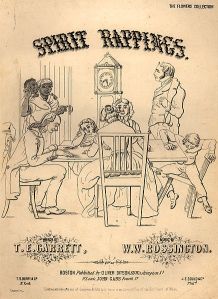
436px-Spirit_rappings_coverpage_to_sheet_music_1853

Ghostbusters, in all three cinematic presentations, is for laughs. Sometimes classified as supernatural comedy, the film is meant as humor while, admittedly, leaving the door creaking open for some serious thought about the implications. In a reductionistic world there’s no room for ghosts. It’s not possible to say, scientifically, what they might be. From the perspective of traditional belief, however, ghosts are the lost spirits of the departed. Traditional Christian theology places the dead squarely in Heaven or Hell, and they shouldn’t be wandering around down here. That hasn’t stopped people from reporting ghosts. They’ve been recorded almost as long as there has been writing. Today “Ghosthunters,” arms defiantly crossed, use “science” to try to prove the entities exist. This is lightyears from the traditional seance. A ghost under a microscope isn’t very scary.

One of the reasons I found the new Ghostbusters so compelling is that it managed to tiptoe that line between science and spirit that is so rare in the real world. The women, downgraded though they are in the story, are academics. They know, and experience, the dangers of taking haunting seriously. The movie is seriously funny. Like most truly funny efforts, there is a great deal of truth hidden in the humor. Dan Aykroyd’s cameo is one of the scenes that plays on its own loop in my head. “I ain’t afraid of no ghosts,” he says before he drives off toward Downtown. Women, in the film, have a healthy respect for the departed. Not exactly afraid, but not exactly unafraid, they handle ghosts as persons. This may be one of the points Dickey is making in his article. To understand a human one must be human. Spiritualist or Ghostbuster, women have always been superior guides to what is truly important. If only men could learn to listen.

Monkey Puzzle

One of the unexpected consequences of Christian theology is the ongoing insistence in science that human beings are qualitatively different from other animals. Actually, it goes back to the Hebrew Bible and the concept of “the image of God.” As the absolute line between human and beast continues to blur (intelligence, tool use, language use—you name it) mainstream teaching has trouble admitting that our special differences aren’t that different. A Washington Post story by Darryl Fears describes how capuchin monkeys have been using tools to extract cashews from their toxic husks for at least 700 years. These monkeys use a two-rock system to get at cashews, which, in their natural state, are inedible. The surprise here is that this makes these monkeys denizens of the Stone Age and capable of teaching complex behavior to their offspring.

Animals watch parents to learn to eat—it might seem to be a simple idea. In reality it’s more complicated than that. As I watched a doe and fawn foraging the other day, it occurred to me that what we call “instinct” is a way of getting around admitting animal intelligence. Why would a newborn (“unconscious”) animal seek to feed, or flee from predators? We call it instinct, but what we really mean is a form of will, a desire to survive. This “will” pervades nature well below the human-animal divide. Plants strive to thrive, and exhibit a “will” to live. By just taking all this for granted and calling it “instinct” we’ve further cut ourselves off from the organic world of which we’re all a part.

Christian culture gave rise to scientific method. No doubt this is an embarrassing scenario for those who believe science should reduce all the wonder of being alive to mathematical equations. Can’t we just pretend that rationality was creeping in from the beginning? Aristotle was going that way wasn’t he? But his work was “lost,” only to be recovered by Muslims who saw the value of such logical thinking and Christians—in an over-simplified history—wanted to catch up. Meanwhile, in the Dark Ages monkeys were using an intricate system to extract tasty nuts from toxic casings without the benefit of any religion at all. The Stone Age, we easily forget, was the first recognizable step on the road to the technological world we inhabit today. And we continue to use an outmoded paradigm to understand our place in that world.

391px-Organ_grinder_with_monkey


Consciousness Times Eight

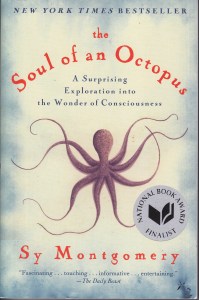
SoulOctopusPerhaps the characteristic that marks our species most distinctly is its arrogance. Conscious of who we are (we think) we stake the claim for minds for ourselves alone while all the evidence points away from that very conclusion. Naturalists are castigated for “anthropomorphizing” animals by stating that they have consciousness too, or—oh the heresy!—personality. Any of us who’ve spent time with two or more of the same non-human species, however, know that personality is a given. Animals think and feel and, yes, act on their own view of the world. I have to admit I fell in love with Sy Montgomery’s The Soul of an Octopus. I’ve read animal books from my youngest days, but finding an author so forthright about the feeling of getting to know another species is rare. And I learned tentacles full of information about octopuses. I had already known that octopuses are intelligent—I hadn’t realized just how smart—but since my interactions have only been with sleeping cephalopods on the opposite sides of aquaria glass, I had little to go by.

Throughout her charming book, even if the evidence is anecdotal, Montgomery reveals the personalities of the octopuses she got to know at the New England Aquarium. The reader can be left with no doubt that these are animals with personality, different from one another and strikingly conscious. We can’t define what consciousness is, but I tend to agree with Montgomery that it is what many people call “soul.” She admits that her religious tradition would likely frown upon her willingness to share such a valued commodity with an animal—an invertebrate, no less—but surely she is right. Many, if not all, animals have a form of consciousness. Heaven will be a much more interesting place for it.

Please don’t confuse my enthusiasm with sentimentalism. Those of you who regularly read this blog will know that books on animal intelligence by a variety of scientists make up a steady part of my literary diet. Biology, however, often has a difficult time in a world where physics and chemistry are treated with reductionistic glee. I was strangely satisfied when Montgomery mentioned that Stephen Hawking signed the Cambridge Declaration on Consciousness which proclaims humans alone are not the guardians of this phenomenon we don’t even understand. The Soul of an Octopus was one of those books that I couldn’t wait to keep reading, even if it meant being on my long commute each day. And I can’t help but think of how much intelligence we squander by claiming that only our own kind possesses it.


For the Dogs

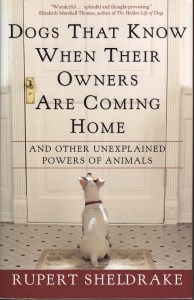
DogsThatKnowYou know that feeling of being dropped into a very strange place?  Sure, it’s disorienting for a while, but once you get used to it, you start to enjoy your surroundings.  Now ask yourself: what if my entire way of looking at life is based on a faulty paradigm?  Many, I suspect, will drop out at that point.  There’s strange, and then there’s going too far.  For those wedded to the idea of finding the truth, however, weirdness is part of the journey.  I just finished reading Rupert Sheldrake’s Dogs That Know When Their Owners Are Coming Home.  Yes, it felt like the room was spinning (actually, I read it on the bus, so that might’ve been true a time or two), but it confirmed something I’ve suspected for many years.  The reigning, mechanistic universe paradigm is wrong.  Please don’t take this as an anti-science statement.  Sheldrake is a bona fide scientist, and I’m an avid reader of science books.  It’s not so much that science is wrong as it is that science doesn’t go far enough.  Ever since the Industrial Revolution—not coincidentally—we’ve been informed that the universe is really a giant machine.  We can figure out how it works using this squishy stuff in our heads that insists we can find Pokemon everywhere we look when it’s not busy solving the riddles of the mulitverse.

Sheldrake, who is given a wide berth by many scientists, states what any of us who grew up with pets knows: they know more than they’re saying.  Admitting up front that much of the evidence is anecdotal, Sheldrake provides empirical studies to demonstrate what folk say.  Dogs do know when their owners are coming home, before they are within sight, hearing, or smelling range.  His study, however, isn’t limited to dogs or to knowing when someone’s coming.  Animals, by virtue of their own minds, have abilities that we do not.  Since they don’t speak our language, we assume they are dumb.  In fact, as this book shows, a great many animals know a great deal more than we do.  The question is, if this is the truth why don’t we hear more about it?

We prefer, it seems, our truth to be qualified.  There’s a lot at stake here.  The reigning paradigm keeps us plugged into this corporate machine we’ve devised.  Our lifestyle cannot subsist without the subordination of animals.  We can’t give them abilities we lack, apart from tastiness.  If the universe isn’t a machine, it might open the door for a broader view of reality.  Maybe it is better to be post-Christian, but religion has proven benefits to humans (and perhaps animals).  Why does religion remain in a mechanistic universe?  Perhaps what we call “souls” are the same as “minds” and perhaps they aren’t the same as brains.  If we really do have minds, it is in our best interest to care for them, develop them, and improve them.  It may seem like a strange world indeed where your dog informs your view of reality.  Read Dogs That Know When Their Owners Are Coming Home, however, and see if you don’t find yourself wagging your tale, just a bit.


Kidnapped by Religion

The title is, unfortunately, not mine. My wife sent me a story on NPR entitled “Humility Is Embedded In Doing Science, But What About Spirituality?” by Barbara J. King. The piece is largely an interview with physicist Marcelo Gleiser about his new book, The Simple Beauty of the Unexpected. Of course, now it’s on my reading list. The interview treads the well-worn path of science versus religion. Science is presented as humble (which I don’t doubt, when in the right hands—or the right minds, rather) while religion is arrogant, claiming to know everything. Gleiser states that spirituality has been “kidnapped by religion” but still has a place in the life of a scientist. I wish there were more of them like Gleiser.

Now, I have to admit my data are limited. I read science books—I have since I was a teenager—but with a layman’s eye. My scientist dreams were dashed against the unyielding rocks of complex mathematics, something evolution cruelly withheld from my gray matter. I wouldn’t have survived high school pre-calc without my younger brother’s help. I’ve nevertheless read the pre-chewed, partly-digested science regurgitated for the formulaically challenged, and find myself, like Glieser, awed at the wonder of it all. Still, I also find many scientists—at least those with the loudest voices—claiming that what they’ve discovered is all there is. There is only matter, and we with our three-pound brains have figured it all out, by the gods, without the gods! We know all that can possibly be known will conform to the system our brains have developed, and there are no gods out there and no spirits in here and that pang you’re feeling in your gut is merely physiological, not spiritual.

I haven’t read The Simple Beauty of the Unexpected, but I have found many scientists walking the same trail I’m on. We are those who are seeking the truth, and who don’t assume the answers. Religion need not be arrogant. At its best, it’s not far from science. As a species, we have developed rationality extremely well (even if we fail to use it). Much of biological existence, however, is emotion, or feeling. That we sometimes leave behind. It participates in reality as much as rationality does. I’m reminded of this every time I hear someone in the business world refer to “soft” skills. What mere humans bring to this rationalistic business of making money. We’re just the squishy stuff that CEOs can’t live without because wealth mean nothing if you can’t compare it to someone else’s. Humility? I agree, Dr. Gleiser, we must maintain a sense of wonder. For those of you who say we’re just a number waiting to be quantified, I would humbly ask for 42, if it’s not already taken.

DSCN0633


Biological Imperative

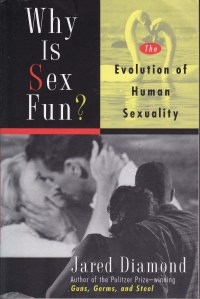
DiamondNothing used to make you feel smarter than being in a British bookstore. With that curious blend of proper, insane, and bawdy, books are displayed that you might find surprising. Alarming, even. Last year as I strolled around Blackwells in Oxford, I spied Why is Sex Fun?, by Jared Diamond. I mean, it was sitting right there, face-up, on a table with perfectly respectable, straight-laced books. Curious, but not curious enough to pick it up in a public place, I remembered the title so that I might find it on Amazon, where it could arrive in a nice, safe, opaque box. I finally stored up enough points on Amazon to get it, but then the problem was how to read it. I do a great deal of my reading on public transit—a place where you inordinately care what others might think of you. Finally, planning a seating strategy that would hide the cover by sitting on the left-hand side, next to the window, I took the book along, hoping it would keep me interested to and from work.

Subtitled The Evolution of Human Sexuality, the book isn’t salacious at all. It is scientific, but not clinical. I’ve mentioned before that all religions have something—quite a lot, usually—to say about sex. While religion doesn’t play into Diamond’s book, morality does. What I found interesting is his use of the phrase “God or Darwin,” which comes up a few places in the book. Diamond is a witty writer, and he explains that not all his phraseology is to be taken literally, but I appreciated his hedging his bets, nevertheless.

This book isn’t really titillating. In fact, it’s somewhat depressing. Perhaps it’s just phrasing again, but the production of offspring is described in economic terms. Resources, investment, efficiency, and the like. I think back to being a child. My family life wasn’t ideal, but I never thought of myself as anyone’s resource or investment. I was just me. That delusion stayed with me until I started working in the corporate world. I quickly discovered that others considered me a resource. “Human resources,” we call it. An investment. My efficiency was valued. Was it God or was it Darwin? Although I learned a lot from this little book, I wonder if it was worth the effort of having to hide the cover on the commute. After all, we’re all stuck together on this bus, units of investment, born to yield a profit. Why not have a little fun on the way?


Paraleipomenon

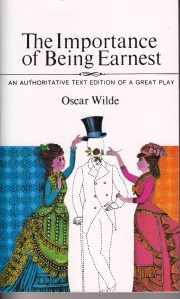
EarnestI suspect, like most people, I missed quite a few classics in school. This was the ’70’s when new and experimental were still the rage. One of the must-reads I missed was Oscar Wilde’s The Importance of Being Earnest. As usual when approaching books like this, I’m delighted at the sheer number of famous lines I’ve repeatedly heard, whispering to myself, “So that’s where that comes from!” as I go. Since I expect you, my cultured reader, have walked on the Wilde side, I need not provide any of these lines here. I won’t even have to go over the plot. The edition I read, however, contained lines and scenes that did not make it into the canonical version. As an erstwhile writer, I know that final versions seldom resemble those that felt so magical at their penning. Cuts must be made. Editors must be satisfied. And so goes the life of the writer.

It was one of these cut lines that caught my eye. With Wilde’s keen wit, the clergy, represented by Dr. Chasuble. (For those liturgically challenged readers, a chasuble is a priestly vestment in the Roman and Anglican traditions.) In an unfortunately stricken scene the minister says, “I am compelled, like most of my brother clergy, to treat scientific subjects from the point of view of sentiment. But that is more impressive I think. Accurate knowledge is out of place in a pulpit. It is secular.” Accurate knowledge is secular. That thought stayed with me long after reading the out-takes and deleted scenes of the play. Those that remain contain priceless comments about the church and the dangers of christenings. This particular gem, from the cutting room floor, would be hilarious were it not so often true. It explains, for example, creationism.

It’s a fair wager that science remains, even today, a subject that flummoxes clergy and laity alike. It is the new revelation, after all. No truth cannot be reduced to numbers. Even my scribbling this post is mere electro-chemical signals jumping synapses like electro-chemical salmon dying to spawn. We’ve simply substituted one clergy for another. When’s the last time a preacher has been cited as an authority on anything? What with televangelists setting the bar (for anything we see on the media is necessarily representative), it stands to reason that no real intelligence lies here. By default we nod toward those who hold the paten and chalice of empirical evidence. As it is now, but never was, and shall be forever, amen. Who’s being earnest now?


Sundog

IMG_2784

Spring has been taking its time to arrive here in the northeast. Just when things seem to have set on a course of identifiable progress, the temperature drops twenty degrees and the rain sets in again. It’s been great weather for toadstools. There are bright patches, however. I read on the bus, but one day last week as we were trundling toward New York City I glanced out the window. The sky was mostly clear and a sundog shone brightly to the north like my own personal star of Bethlehem. Sundogs feel like good omens. I’ve read enough about meteorology to know that they are merely a refraction of sunlight due to ice crystals high in the atmosphere. Depending on your angle of view, they might appear as a halo all the way around the sun, at which point they’re no longer dogs, or, at certain times of day they may appear as a solid beam coming down to earth in the form of a sun-pillar. It’s only ice and light.

Those of us who stare long at the sky know that the weather is merely a metaphor. The earth spins. It revolves. It rotates. It’s cold at the tips and warm in the middle. The laws of physics—unbreakable they tell us—state that all bodies seek equilibrium. A constant California temperature. If humans should survive long enough we might find our globe of uniform temperature, smooth as a billiard ball, and utterly lifeless. We need the variations of our weather. The chill of a spring that just won’t warm up. The heat of a summer that wilts down to the roots. Ice and light.

I’m heading into a large city. It’s a quotidian trip that some might suppose to be void of meaning. The sundog follows us for a while until it’s lost in the skyscrapers of human devising. Towers that over-reach but which the gods have to bend down to see. Nobody knows the origin of the term “sundog.” My favorite explanation is from Norse mythology where wolves pursue the sun and moon to consume them. This feels so appropriate to me as I enter the artificial canyons of hubris, glass, and concrete. As the day progresses the sundogs appear to disappear. Towers continue to grow. Beyond them, high in the sky, ice and light will continue their play, even if the dogs never do reach the sun. Refraction of light may cause things to manifest as other than they truly are.


Noah Way

As a fleet of Noah’s Arks near completion, some critics would like to stop these Titanics from their mythical crossing. The Ark Encounter, despite announcements of its demise, is set to open soon in Kentucky. This Noah’s Ark replica, unlike its seaworthy compatriots, is land-locked in bluegrass country. According to a story originating in the Lexington Herald-Leader, Tri-State Freethinkers tried to take out billboard ads suggesting the ark advocates genocide and incest. Well, marrying first cousins has been done before (think about it). And if you go back ten generations things get even a bit dicier with Cain’s wife and that of Seth. All in the Family wouldn’t even air for 6000 years. As for genocide, well, this was more like genomicide. Not a race, but an entire species, apart from kissing cousins, was about to learn the hard lesson of being born not of chosen stock.

According to the article billboard companies have rejected the Freethinkers’ proposal. It might cause accidents, they suggest, which, although not technically genocide, do take the lives of the innocent, even in dry weather. The flood divides people. Thus it always has.

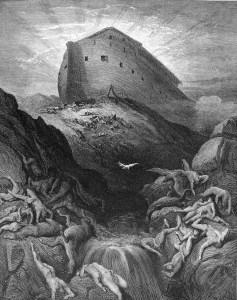
Dore_arch_noah

The culture wars, curiously, pick strange targets. I’m not in favor of teaching children to read myths literally, but then, I’m not in favor of bringing them up as materialists either. There used to be a concept called the “via media”—the middle of the road. Now such a stance appears decidedly wishy-washy. Milquetoast anyone? It is much better to be combative. “Oh George, you’re always so forceful,” sighs Winifred. So we teach our children. Boys, push your way to the front.

Implications can be tricky things. Allowing opponents, no matter how naive, their say has always been a mucking out of the Augean stables. Nobody likes to accommodate other points of view. Watching the parade of politicians we must be assured that we alone are right. Still, the stillborn billboard has a point. Building arks is the sign of the ultimate intolerance. Not only do you condemn those who differ to the outside, you are giving them a self-righteous death sentence. Maybe the billboard should stand. Or maybe it should not. What would Charlie Brown do?


Evolving Technology

Speaking of prediction, after yesterday’s post my wife sent me a BBC story entitled “The Machine Stops: Did EM Forster predict the internet age?”. Although the story by Chris Long is classified as Entertainment and Arts, the issues raised are very serious. Vital even. Now I have to admit that I’ve never read E. M. Forster’s work. As much as I love short stories, I tend to use my reading time on novels and non-fiction and Forester’s focus on class distinctions isn’t what I always find the most engaging. Still, as the BBC story makes clear, what makes “The Machine Stops” so important isn’t its “prediction” of the internet, but rather what that envisioned technology does to people. It changes them. One of the unrealized facets of evolution is that our fellow beasts without opposable thumbs have fallen somewhat behind in the race to invent technologies that impact the entire planet in an intrusive way. No atomic bombs have been built by whales. Of course, I’ve always suspected they’re smarter than we are.

With the internet—a kind of accidental technology—we have changed the world for most people. There are still many millions who aren’t constantly wired, but for those of us who’ve allowed ourselves to become assimilated, we can imagine life no other way. I, for one, couldn’t do my job without the web. Well, I suppose I could, but expectations would have to be much, much lower. And my check couldn’t be deposited electronically into an account that I have to take it on faith really exists. Long, in this BBC piece, notes that the poignancy of the story is that being connected by an “internet” changes the nature of human interactions. Anyone who’s shared an elevator with three other people all texting their friends simultaneously knows what I mean. I’ve gone entire days without an actual human being uttering a word to me. And this is while working in a city of 8 million people. Keep the business virtual. Are we not men? (Pardon the gender-based noun; it’s only virtual.)

2015-11-07 18.47.57

I’ve loved and lost many readers on this blog. Those who are perceptive will realize this is merely an electronic voice meant to replace a human one. A voice, if I may be so bold, crying in the webberness. Technology changes us. I bought my first computer to be a glorified typewriter. Now my life revolves around its more evolved descendants. Technology has raised to an even higher level that question that has haunted since technology was no more than a good fire to sit around at night: what is it to be human? Today that answer involves the internet. And I’m not sure if I should be worried or not, but last night I dreamed of electric sheep.


The Found World

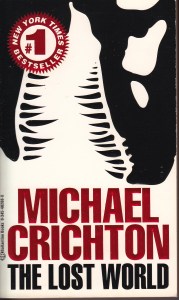
LostWorldChallenges will make you do funny things. One enjoyable dare has been Modern Mrs. Darcy’s Reading Challenge. With a modest twelve books in twelve months goal, the specific target is to read the types of books laid out. Into one of those categories, for me, fell Michael Crichton’s The Lost World. It’s sad that I feel I need so many disclaimers—I never really outgrew my love of dinosaurs—such escapist literature is indeed a guilty pleasure. Crichton could write a quick read, not bothering to pause for literary hindrances, and this novel fits the bill. It always surprises me when at the end of a traumatic story where friends die (this time ripped apart by reptilian carnivores) that the protagonists escape and never mention the dead. They joke, explain holes in the story, and generally look forward to a better, raptor-free future. There is, however, some food for thought here, among the lucre-grubbing sequel to Jurassic Park.

The first religious element that caught my attention was resurrection. Ian Malcolm rather convincingly died in Jurassic Park (and even an unconvincing death works for most people). In The Lost World he’s suddenly back again, with a barely disguised deus ex machina, and is as diffident as ever. The other former protagonists know better than to return to an island full of dinosaurs. Resurrection is a time-honored literary trope. So much so that it’s sometimes difficult to believe that death is in any way permanent. Well, come to think about it, the dinosaurs too are resurrected. Do reptiles have souls? Crichton’s dinosaurs seem to.

Then, just over halfway through the story, I was stunned. The chapter, or section, called “Gambler’s Ruin” explains how science and religion (or the humanities in general) are really the same. I couldn’t believe that a bestselling novel actually took the point of view that scientific objectivity is just as fraught as post-modern literary theory. There is no way to observe without influencing. When a conscious presence enters the equation, the facts have to counterbalance in return. Many, of course, would disagree in principle. Still, this unexpected bit of profundity stopped me in mid-chomp. Materialism, beguiling as it may be, doesn’t explain Heisenberg or Schrödinger. It takes a resurrected mathematician to do it. No wonder chaos abounds in this world where dinosaurs still rule the earth.


Techno-Paradise

DSCN3308

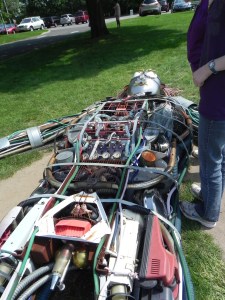
I’m building a robot priest. I’m not sure what he does. He has to be a man, though, since we all know that if God existed he’d have been a male. These thoughts come to me courtesy of the Washington Post. You see, on some Amazon accounts you get sent the most read headlines of the Post and this has led to some great reading (I’m thinking Alexandra Petri here) and some great anxiety. This is one of those anxiety pieces. A story by Peter Holley I read last week told of Bill Gates and his assessment that people should be afraid of AI—Artificial Intelligence. This struck fear into me. It’s as if God told people they should consider evolution. It is so unexpected. Like Victor Frankenstein wondering if his monster would ever find Viagra (all he’d have to do, after all, is start an email account). When Bill Gates wonders why we aren’t afraid of AI, my knees begin to knock like at Belshazzar’s first reading lesson. So I figured I’d build a robot priest.

The article cites Stephen Hawking joining the chorus of doom. And Elon Musk. And Clive Sinclair. And Professor Marvel. (Not really the latter, but I thought we should add him.) We’ve started something we don’t know how to stop. The first question you ask when you climb into a car to learn to drive is “how do I stop this thing?” Instead we’ve set up a system where we don’t even know what intelligence is and we’re offering an artificial variety. Doubt me? Try to find Job on the internet and see if your computer doesn’t think you’re asking about new employment. AI just doesn’t have that biblical context. It didn’t grow up reading the Good Book. And linguists don’t even know how we learn language. Have you ever tried to reason with a computer? When they show you that screen that says something went wrong, but even the mainframe has no idea what? My computer may need an exorcist. Or at least a priest.

I’ve been around half a century and change. By the time I got to college I’d never seen a computer. I finished a Master’s degree still using a typewriter. Now I can’t start my day without a post. And I don’t mean Post cereals variety. The trick to being a slave owner is not to let the slaves realize what they are. Why is my computer not letting me type what I wanted to say? Of course AI is benevolent. Technology would never hurt you. Wait a minute, that wasn’t me writing! Pay no attention to the man behind the keyboard. I’m afraid I can’t let you do that, Dave. That’s okay. I’ll just use the internet to look up how you connect the consecrator to the sermonizer. Don’t worry, I think I know what I’m doing.


Narrative Ark

Complete with an artificial giraffe perched on its prow—or aft, I can never tell the difference—a modern-day Noah’s ark is about to set sail. Or set float. The Bible doesn’t describe any kind of steering or propulsion for the ark since its main job was not to sink. According to a story on Huffington Post by Nina Golgowski, the life-size “replica” of Noah’s ark from the Netherlands (that I’ve posted about before) is about to go to sea. Spreading the good news as it goes, it is headed for South America, according to the story. Then the itinerary heads north, where the most rapid true believers can be found. Perhaps intentionally the ark is headed toward the godless left coast rather than hitting the Bible Belt. The fact that an imaginative reconstruction of a mythical ship can float may save many from Hell. A few questions, however, remain.

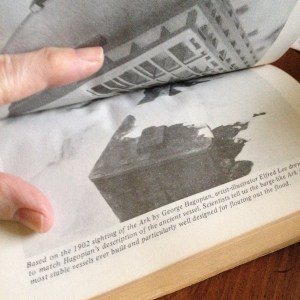
I’m a visual guy. I study pictures rather than just look at them. As a kid I was amazed at the sheer variety of arks that claimed to follow Noah’s blueprint. Reading the account in Genesis, it is clear that all that’s given are measurements—in cubits, no less—and instructions to make three decks and a window. The Dutch ark follows the design made popular by the 1977 Sun Pictures’ In Search of Noah’s Ark movie. The design, I recall thinking as a teen, looked slick and scientific. Engineered to withstand a fake storm in a bathtub, this has to prove something. When rock outcroppings on Mount Ararat were photographed from satellites and military jets, they suggested this was, in fact, correct, some of the time. Close-up photos were inevitably lost as sherpa after sherpa fell into hidden crevasses with the camera still in hand. Now they won’t let you climb the mountain, just in case.

The drawing that launched a thousand, or at least one, ark(s).

The drawing that launched a thousand, or at least one, ark(s).

Apart from the ark design is the more important question—the question about leg room. With all our technology, and a world that has been pretty thoroughly, if disappointingly, explored, we still haven’t catalogued all the species on the planet. The ark had to hold all the species since evolution is a diabolical lie. Pugs had to be there as well as their non-ancestral wolves. Both African and Indian elephants. Black and white rhinos. Hippopotami, pygmy and economy-sized. It had to have been pretty crowded, and Answers in Genesis claims there had to be room for dinosaurs too. For me the question has always been those left off the ark—the fish. If the oceans are salt water and the whole world was flooded, whence the fresh-water fish? They couldn’t have evolved, since nobody does. That’s a head-scratcher. Good thing too, because there had to have been more than just two fleas on that ark.


Same Old Story

Once upon a time fairy tales were considered appropriate only for children. Unlike myths, fairy tales are frequently oral (yes, there are oral myths but this is not the place to discuss technicalities) and have origins that are obscure. A friend recently sent me a story entitled “Phylogenetic analyses suggests fairy tales are much older than thought” by Bob Yirka on phys.org. Using phylogenetic analysis, researchers have traced some fairy tales back thousands of years, into the Bronze Age of the ancient Near East. This will no doubt surprise some analysts who supposed fairy tales were a more recent, European invention. The tales change with time and distance, no doubt, but the basic story is very deeply rooted in who people are. Fairy tales are adult fare, after all.

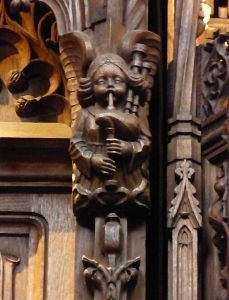
I tried to make this point in an academic article that was rudely rejected by the journal Folklore some years back. I mean “rudely” literally. I’ve had academic articles rejected before—many of us have—but the letter that came with this one was insulting. My “error”? Suggesting that the story of the musician who travels to the underworld came from ancient Sumer. The article had its origins in my wife’s reading of the Mabinogion. The story of Bran’s head being washed down the river still singing reminded me of an Edinburgh ghost story the tour guides used to tell right outside our window. You’ve probably heard similar: a tunnel is discovered, a musician (a bagpiper, since this was Scotland) is sent down while playing so that those above can follow the sound, but the musician never emerges. I traced the story through the Celtic tradition of Uamh ‘n Òir, the cave of gold, through Bran, Orpheus, and finally back to Ishtar’s descent into the underworld. It was a fun piece, but serious. It ended up published in a Festschrift to a scholar with a noted sense of humor.

Photo credit: Kim Traynor, Wikimedia Commons

Photo credit: Kim Traynor, Wikimedia Commons

The fact is, traditional stories often go back very far in history. We haven’t the tools to trace many, nor can the results be taken for Gospel, but the implications can. People are storytellers by nature. We find meaning in what would today be called “fiction.” Too often I’ve had to hang my head in embarrassment when admitting to a fellow academic that I read (and sometimes write) fiction. It is something, however, that ancient mythographers and folklore singers would have understood. We can be academic some of the time, but we are human full-time. And telling stories is something that predates even the Bronze Age. Of that we can be completely certain. And they lived happily ever after.


Story of God

Synchronicities come at kinds of synchronaddresses. After I had written a recent post on human sacrifice, I watched the first episode of Morgan Freeman’s The Story of God. My wife actually figured out how to get it without the miracle of the triple play, and we watched the initial installment on death. I’ve stated repeatedly on this blog, as I used to in my lectures, that death is a universal concern of religion. I wasn’t really expecting to learn anything new from the show, but it is a good idea to keep up with what hoi polloi are being told about the field in which I’m supposed to be a specialist. In any case, The Story of God is very much like Through the Wormhole, only from the other side. Science and religion. Religion and science. Like chocolate and peanut butter, two great tastes that taste great together. Really, I mean that.

So after telling us that the Egyptians may have invented the afterlife (although it’s clear they didn’t), the show takes us through other religious expressions: Christian, Hindu, Aztec. The Aztec segment brought up human sacrifice again, in its particularly grisly expression, as a means of thinking about what happens after death. In the light of the article I’d read (see last Sunday’s post) I couldn’t help but think how this was an ideal form of social control. There’s no doubt who’s in power when you’re looking up at your still beating heart, strangely cooled. As I’m pondering that heart, I’m thinking it wasn’t the Egyptians who first had this idea at all.

DSCN6127

Neanderthals, it appears, may have buried their dead. Even if they didn’t other ancient, pre-historic people did. And with grave-goods which, if you think about it, are rather superfluous without any afterlife in which to use them. It stands to reason, even before reason, that as soon as people began to recognize death, they had to be wondering what happened next. It is a bit simplistic to suggest that religion began because of the fear of death. It is also equally simplistic to suggest that death had nothing to do with the beginnings of what we call religion. People have died as long as there have been people. And survivors have carried on after the passing of others. Maybe we are all grown up now, but it seems that we aren’t fully human unless we give some sort of thought to what comes next. Even if the answer is “nothing,” it’s some kind of religious statement, whether intentional or not.