Making a Monster

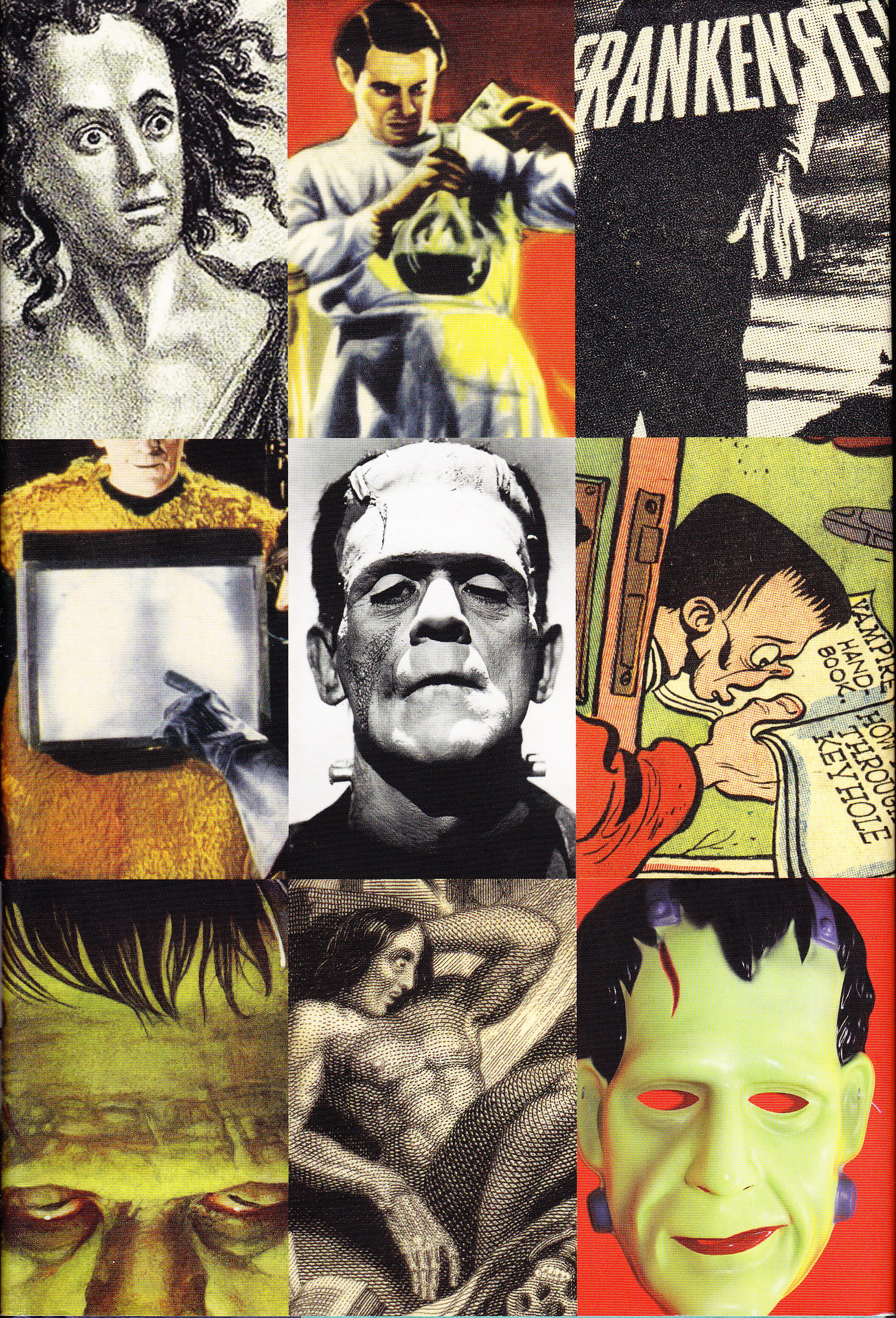
I was maybe six or seven when Frankenstein’s monster charged us. My mother, brothers, and I were part of a small crowd at Niagara Falls, where we had gone to visit relatives, when we found ourselves in the monster’s path. We were among of a knot of tourists, and plate glass separated us from the great roaring beast, posted to draw visitors to one of the many plastic tourist attractions around the famous falls. Each time the monster charged, we all screamed, knowing full well he could never break through that glass. As a member of the Monster Boomer generation (although on the tail end of the boomer part), the monster that disturbed me the most has always been Frankenstein’s monster. I’m not sure whether that was natural squeamishness, or if it was that as children my brothers and I tried to divide things up evenly and I ended up with the vampire while one of my brothers claimed possession of “Frankenstein.” Certainly when I grew old enough to read the book, it only added to my discomfort. The concept of Frankenstein’s monster was old enough to have lost its scary edge, but the story was very sad. The monster was not evil, but lonely.
HitchcockFrank

Sarah Tyler Hitchcock’s Frankenstein: A Cultural History revealed a new angle on the monster. A thoroughly fascinating anthropological approach to one of the more modern constellations in the night-time sky of fear, what became immediately obvious in this book is just how religious a monster Frankenstein’s creature is. Many of us think of “playing God” as a recent phenomenon. Mary Wollstonecraft Godwin (Shelley)’s Frankenstein was published in 1818 with just that concept in mind. Mary Shelley, barely twenty when the book was published, had tapped into one of the most vital of religious topics—what it means to make life. Hitchcock’s treatment of the subject covers the conception of the monster, the book and its history, the plays and movies based on the story, and Frankenstein’s monster’s reception into popular culture. At every step of the way, religious issues are raised. Mary, in her birth of an immaculate creature, gave the world theological conundrums through which we’re still sorting nearly two centuries later.

Often on this blog I maintain that monsters and religion are cut from the same cloth. Hitchcock provides a compendium of supporting evidence in her compelling book. Even down to the contemporary debates of scientists over genetic engineering and cloning, the story of Frankenstein and the overstepping of ethical boundaries comes up again and again in scientific literature. I couldn’t help but to think how this reflects the current acrimony between the materialists and the dualists among the intelligentsia: is the forging ahead with manipulation of life simply an experiment we must undertake or is it really an ethical (read “spiritual”) issue after all? Mary Shelley was not so strident as her erstwhile husband Percy was regarding the necessity of atheism. Her monster seemed to be raising that question in terms profoundly theological for a girl not yet of seminary age. Sarah Tyler Hitchcock has done us a great favor by producing a history that stitches religion, culture, and science together into a beast that we still haven’t learned to control.

Deep Religion

Bosnia-Herzegovina is a nation well acquainted with disruption. The tangled history of the Balkans and the misplaced zealotry of political machinery has left this part of the world to rely on faith more than many others. So when a sinkhole suddenly opened up in Sanica, locals began to look for explanations beyond the scientific. Sinkholes are reminiscent of biblical-type punishment. They are relatively unpredictable even in our high-tech era, and they are just a bit eerie. Fear of falling is, psychologists tell us, one of the deepest phobias embedded from our youngest days. It can translate to acrophobia in some adults, but even those who don’t fear high places still shy away from an abrupt edge that appears below our feet. A story by Amel Emric on NBC narrates the responses of some villagers to the growing pit that is already fifty meters wide by thirty meters deep. The hole appeared under a pond shortly after the death of the owner who claimed that he would take everything when he went. The locals wonder whether he absconded with his pond and took it to the afterlife where, I hear, the fishing is choice.

The beliefs of the average citizen flummox the religious specialists. Perhaps it’s because religions have to struggle so hard for any kind of respectability that folk beliefs are simply labeled “superstitions,” but it is what hoi polloi believe that constitutes the main body of religion. One might counter, “but that’s not what really happened”—surely a ghost did not drain a lake and replace it with a perfectly natural sinkhole. Then again, quantum mechanics also tells us that what looks like reality isn’t really what it appears to be either. It may be that a ghost stealing a lake is a lot more plausible than a scientific explanation sometimes.

In a completely unrelated story, my relatives recently gave me an opinion piece from the Des Moines Register. A reader signed as N. W. Iowa Mystic wrote: “Budgets go astray, schedules get out of kilter, plans fail. Why? They are all graven images and the Second Commandment says, ‘Thou shalt not make unto thee any graven images.’ Laugh if you will, but that explanation is as good as any.” I had to stop to ponder in what way a budget was a graven image (I likely would not recognize an actual budget if I saw one). Or a schedule, or a plan. Who am I to say that they are not, however? My definition of “graven” may not match yours. I might consider the name of Job’s friends common knowledge, but for others they have fallen into that sinkhole of multiple bits of useless information. I’m not laughing at our mystic friend. I’m pretty certain that the earth has some very deep holes lurking just beneath the surface.

Sink hole or graven image?

Sink hole or graven image?


Explained Away

The premise seems sound. Although science tends to indicate that God is not necessary to explain anything, religion itself may still be useful. In a nutshell, that’s the basis of Alain de Button’s TED talk, “Atheism 2.0.” We don’t need to believe in God to find religion a useful paradigm. There’s so much more to being human than being simply analytical. De Button begins from the premise that there is no god, but that religion teaches us many useful lessons. It is a fascinating concept. I’ve had de Button’s book on the topic on my reading list for some months now, but like so many pressed for time, I find it simpler to watch a 20-minute TED talk than to read an entire book. It is refreshing to see someone on TED not simply dismissing religion. My friends in the STEM community often recommend TED talks, and they usually leave me feeling small and insignificant. Now I can at least show my face.

A deep irony pervades this condescension to religion. Scientific study of the past (known by the collective term archaeology) has recently given strong indication that the religious impulse is what led to civilization itself. The mysterious site of Gobekli Tepe, as I’ve mentioned before, seems to reveal that even before high antiquity what drew people together was the emergence of religious belief. Religion leads to culture, and culture leads to science. Science rejects religion and what happens to culture? Just take a look around. I’m still a naive man with working class values. In the course of my business travels I’ve often ended up in what might be considered the sketchiest kinds of neighborhoods. The suburbs keep moving further out. What happens when we run out of space? God only kn— wait, that’s a forbidden premise. Materialism only knows.

De Button’s talk is fascinating in that he doesn’t simply dismiss religion. Like most non-specialists, he focuses on the accidentals that reveal something savvy religionists have always known—there’s a healthy dose of psychology in any religion. Call it neuroscience, or call it truth. Religions have something to teach us. Civilization, it seems, began because of religion. De Button is clearly correct that we need not believe the minutia of religious doctrine to get something out of it. Atheism is not always evil nor is piety always above moral suspicion. Being human, we can’t help but wonder what is really real, however. Religions claim to know, as do some sciences. Little can be said beyond the fact that none of us know. Of course, TED will ask some of us to speak to the issue and the rest of us should just sit still and pay attention. To be noticed is to be an expert.

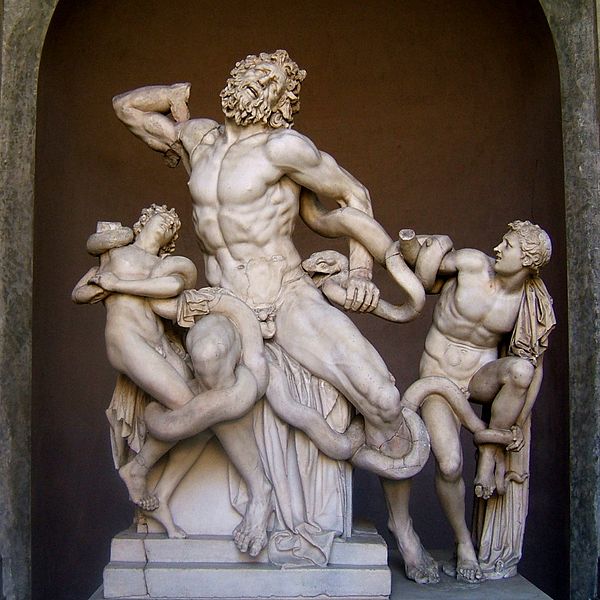
The eternal struggle (photo credit JuanMa, Wikipedia)

The eternal struggle (photo credit JuanMa, Wikipedia)


Reach Out and

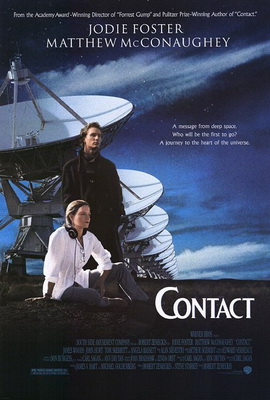
Contact_ver2Carl Sagan, one of the great proponents of the idea that earthlings have never been visited by aliens, wrote a novel entitled Contact. I haven’t finished reading it yet, but many years ago, on a long plane ride, I caught part of the movie version—most of it without the sound on, as I recall. While the ideas have been brewing for about a decade, I’ve been meaning to get around to watching the film. It is a bit of a slow-starter, but I finally sat down to watch it, with sound. While the movie ultimately remains agnostic—with a Twilight Zonish twist at the end—about whether the contact is truly alien or not, one aspect leaves no room for doubt: the movie is really about the relationship between religion and science. Eleanor Arroway cannot raise faith in anything but science, especially since her father’s premature death. Although she has a brief affair with Palmer Joss, a theological journalist, she just can’t believe what her senses don’t confirm.

Once the alien signal is announced, the response of the populace is overwhelmingly religious. One sect in particular seems to channel its faith into the hatred of science, and even Palmer, now an advisor to the president, questions whether science alone can really help humanity to progress. He is the one who nails shut the coffin of Dr. Arroway’s hopes of going to Vega to see the aliens. The reason: she doesn’t believe in God, and therefore is not qualified to represent the human race. Ah, the cruel irony of it all. When she finally does get a chance to visit space, the results are both Freudian and religious. She finds her father in a place like heaven, but her beloved science makes no record of her journey. At a congressional hearing she is made to admit that she believes in what happened without proof. Science is now standing on faith while the religious look smugly on.

Despite the pacing, Contact is an enjoyable movie. In many ways it hasn’t aged much since its 1997 release. Science and religion are still at loggerheads in some camps, and we are no closer to the stars than we were a decade and three-quarters ago. Reading books on the nexus of religion and science, one often gets the impression that the two are inevitably foes. Much of it goes back to a principle that recurs throughout Contact—Occam’s razor. The idea that the simplest explanation is the best does not seem to serve science (or religion) well. Although it works most of the time, it is because, as a friend recently said, we are willing to sweep the stuff that doesn’t fit off the table. Contact showed Occam’s razor with its indiscriminate cutting. Both the religious and the scientific end up bloody when it’s all over (metaphorically speaking, of course). It seems what religion and science really need is indeed contact.


Nothing Unusual

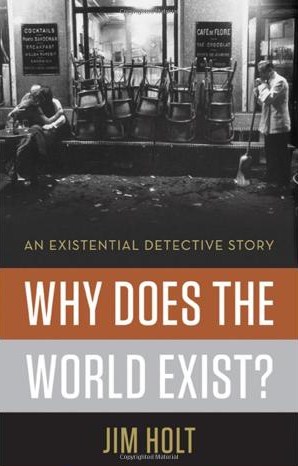
WhyDoestheWorldExist“Is this a world?” Ranger Tom asks seriously, “And if it is, am I in it?” On the lips—or fingertips—of some, this set of questions appears profound. Although I’m not technically a philosopher, I find it impossible to walk by a book with the title Why Does the World Exist? and not pick it up. I am not familiar with Jim Holt’s other work—I engage a little too heavily with books to spend much time with magazines—but the question of the title is one I’ve often pondered. It is right up there with “Why can some people get published and others can’t?” Holt is, however, on a serious quest. Not surprisingly, religion features prominently in the discussion. For the usual existential reasons, including a couple of significant deaths in the family, Holt asks perhaps the most basic of all questions and engages a number of prominent philosophers on the issue. Why is there something rather than nothing? For some in the western world such a question appears a non-starter, because our culture is biblically suffused. Whether we want to admit it or not, our social ocean veritably bobs with the basic belief that God created the world, end of story. We don’t need to ponder it, we just have to accept it. For those who look deeper, however, the answers aren’t that easy.

Holt goes through some serious computation in various forms of logic to try to arrive at a schematic demonstrating that the world is a surprising place. Not trained in such rigorous logic, I was interested to notice how the language occasionally slipped from “world” or “universe” to “reality.” Reality is perhaps the slipperiest concept of them all. Many simply accept their own experience as real, a position known as “naive realism.” Others probe somewhat deeper, seeking to verify reality. How do we know what is really real? It is, however, a different question than the existence of the world. Reality has the distinct ability to haunt with its half-answered questions and surfeit of ambiguity. Every time I wake from a dream I ask myself what is really real.

Once the divine is removed from the equation, why the world is here becomes a much more complex issue. Holt engages the new atheists as well as the neo-orthodox. It turns out that God may not help as much as we generally assume: whence God? Or, in its more childlike version, where did God come from? Once brute fact is ruled out, this becomes a tangled problem indeed. Faced with an endless regression, logic quails. Perhaps, however, we have reached the limits of rationality—even Einsteinian physics breaks down at the Big Bang. No matter what scientists or philosophers may tell us, we will always wonder, “and before that, what?” I put Holt’s book down with a sense that I’d spent a few pleasant hours considering the possibilities, but I still wonder, with Ranger Tom, if this is a world. And if it is, am I in it?


I See Only Nothing

Once considered to be bad omens, comets are becoming a fad for those who can take their eyes off the screen for a few moments to look at the sky. Comet ISON (C/2012 S1), apart from falling trippingly from the tongue, is apparently now visible with the naked eye. I’ve been looking forward to this comet since at least January, although living just to the west of New York City complicates viewing possibilities quite a bit. You see, although I am now an urbanite, I’m really a rural rube at heart. I grew up in a town of less than 1000, and was born in a town of less than 15000. I attended college in a small town and my first teaching job was in a rural setting in Wisconsin. Apart from the fact that I’m now convinced people have very little control over their own destinies, I have preferred to live in places where I can see the night-time sky. Perhaps it was my love of science fiction as a child, but for whatever reason, space has always captured my imagination. I used to drag my brother out on frigid nights to look at the stars, and even tried to teach myself the azimuth coordinate system to document precisely where I’d seen something. I took astronomy classes in high school and in college. In middle school I did an intensive report on comets that saved my science grade that year.

Hyakutake, 1996.  My first comet.

Hyakutake, 1996. My first comet.

Comet ISON, however, has been refusing to behave as it was projected that it might. Although it could still turn into a very bright sky-show, so far it has been difficult to spot, and, at least for my location, at inconvenient hours of the day. Much to the chagrin of creationists, ISON is 4.6 billion years old, although it is just getting out for it’s first tour of the solar system. Part of the Oort cloud region, Comet ISON is probably a piece of a never-formed planet out past Neptune that decided to take its first cosmic stroll about a million years ago. It’s had a date with the sun since that time. The scientific jury’s still out as to whether ISON will go out with a blaze of glory after its close encounter with our sun and if it will come back around again to wow generations of our distant progeny (presuming we survive that long). For me it will be a matter of seeing if the clouds ever break in the east at 4 a.m. so that I can actually get a glimpse of the sky.

Hale-Bopp, 1997; a little over-exposed--one of the hazards of amateur photography with film.

Hale-Bopp, 1997; a little over-exposed–one of the hazards of amateur photography with film.

Comets were once thought to be heralds of the gods. Like other variable objects in an otherwise pretty predictable night-time sky, they can be either very bright or very dim (even invisible, for all practical purposes). When Halley’s Comet came around in 1986 I was living in Boston and couldn’t see the heavenly visitor. In 1996 Hyakutake buzzed earth, I stood in wonder in the woods of Wisconsin, photographing my first comet. A year later when Hale-Bopp blazed through the sky, I was out with my camera trying to capture it on film (a medium, I understand, that is about as old as Comet ISON). Were these visitors bad omens? One comet may have been decidedly devastating for our dinosaur friends, while some speculate that life on earth was seeded by a comet (making it a kind of secular god, I suppose). I’m only convinced that we have no control over our fate as I stand outside at 4 a.m. yet again, only to find clouds in the east and a comet in my heart.


Alien Bears

“And if there’s life on other planets, I’m sure that he must know, and has been there once already, and died to save their souls.” Larry Norman, one of the original Jesus Freaks, may not have been the deepest theologian, but his words come to mind as I see scientists reluctantly admitting that maybe life on earth is not so unique after all. It’s been in the news that Kepler Space Telescope’s data have been indicating that other planets like earth may be quite common. It has always amazed me that people have been so reluctant to let go of the notion that we are the only spark of intelligence in this vast, vast, cold, and dark universe. We seem to need to think we’re special. Religions generally indicate that the gods made us for some purpose or another, some love us, some are indifferent, others may be hostile. But generally, we’re unique. The Mormons have for years taught that there is life out there, but mainstream Christianity has generally been agin it, mainly owing to the crucifixion. Larry Norman, the original Christian rock artist, speculated that cosmic history repeated itself: if Jesus died for us, well then, he must’ve done the favor for them too.

Once Edwin Hubble stepped away from the telescope, stuck his famous pipe in his mouth, and said “huh,” I would’ve thought other scientists might’ve considered, like H. G. Wells, that “they” were out there looking back at us. Why this reluctance to suppose that we’re not alone? The story in the Washington Post cites the typical reason: the Goldilocks effect. Scientists, perhaps unwittingly influenced by the anthropic principle, have supposed other planets, if they existed, were either too hot or too cold to support life. We, like Goldilocks, happened to inhabit the only planet among the billions of galaxies of billions of stars, that got it just right. More like God-ilocks. The idea derives from Genesis where, it is strongly implied, we are the only ones. Religion influences culture, whether materialists want to admit it or not. The earth-only bias is inherently religious.

Who's looking back at Hubble?

Who’s looking back at Hubble?

Astronomers will gradually come around to the idea that there are other planets like ours. It will likely take decades, perhaps centuries, before they will commonly admit that life forms like ours are out there walking around. Eventually they may decide that there’s something to UFOs after all. Meanwhile, various New Religious Movements have already hitched rides on those flying saucers and they will be laughing once the rest of us catch up. We tend, under the influence of those who claim religion is always Bronze Age drivel, to forget that religion often leads the way to new territory. When the little green men and women land, we’ll find that many religions have beat science to the punchline. I’m not so sure, however, that the aliens will know who Jesus is. After all, this chair’s too hard, and this one’s too soft.


A Theistic Nation

That’s a dill-pickillial of a peccadillo, if you’ll pardon my Ned Flanderism. I’m referring to the issue of the Supreme Court dealing with public prayer. Again. In a recent Chicago Tribune story, prayer before town board meetings in Greece, New York have led to accusations of violation of citizens’ rights. In a similar, but unrelated, situation, a friend asked me what I thought about religious symbols on public property. He asked the basic question that if atheism relies on no symbols, isn’t the absence of symbolism tacit approval of atheism. These issues are very difficult to resolve for a number of reasons. The first non-partisan elephant in the room is the fact that we do not have an acceptable definition of religion. Universities shy away from hiring specialists in religion and we, as a society, and, more restrictively, as an academy, can’t agree on what religion is. Is atheism a religious belief system? Some would argue that it is, and that it shouldn’t be the default stance—that would favor one religion. From what neuroscience seems to tell us, atheists aren’t born, they’re made. Religion, of some description, is normal human thinking.

A further issue involves both symbols and prayers. A symbol means nothing without interpretation. As I told my friend, unintentional crosses are ubiquitous. You might have to look a bit harder to find unintentional stars of David or yin-yangs, but I’m certain they exist. Without the Christian eye, however, those unintentional crosses are just architectural features or natural spaces between corners. The same applies to prayer. If I decide to speak, it is a matter of interpretation whether my words are prayers, a guy talking to himself, or, increasingly, somebody chatting on their blue tooth phone as they walk past a church. Intention, a specific aspect of interpretation, certainly plays into the sometimes coercive power of a symbol or a prayer. Do those Ten Commandments on the courthouse lawn just represent a nice piece of art, or do they bear an intended message? Do intended messages not attempt to persuade others that they are true?

Smart folk like Supreme Court justices have difficulty with this issue every time. I’m not surprised. We don’t know how to quantify religion, even though most of us are pretty sure of it when we see it. Some would argue that many eastern religions are in fact philosophies. Some would claim that atheism is the opposite of religion. Atheism is not so very far from some strains of Buddhism, however. And like it or not, people are all subject to belief. We seem to like forging ahead in the darkness on this issue. State universities hide their religious studies programs like embarrassing warts. What rational person would want to waste time studying such superstition? The Supreme Court of the United States, I might point out, just for one.

Religion or not?

Religion or not?


Vampire Science

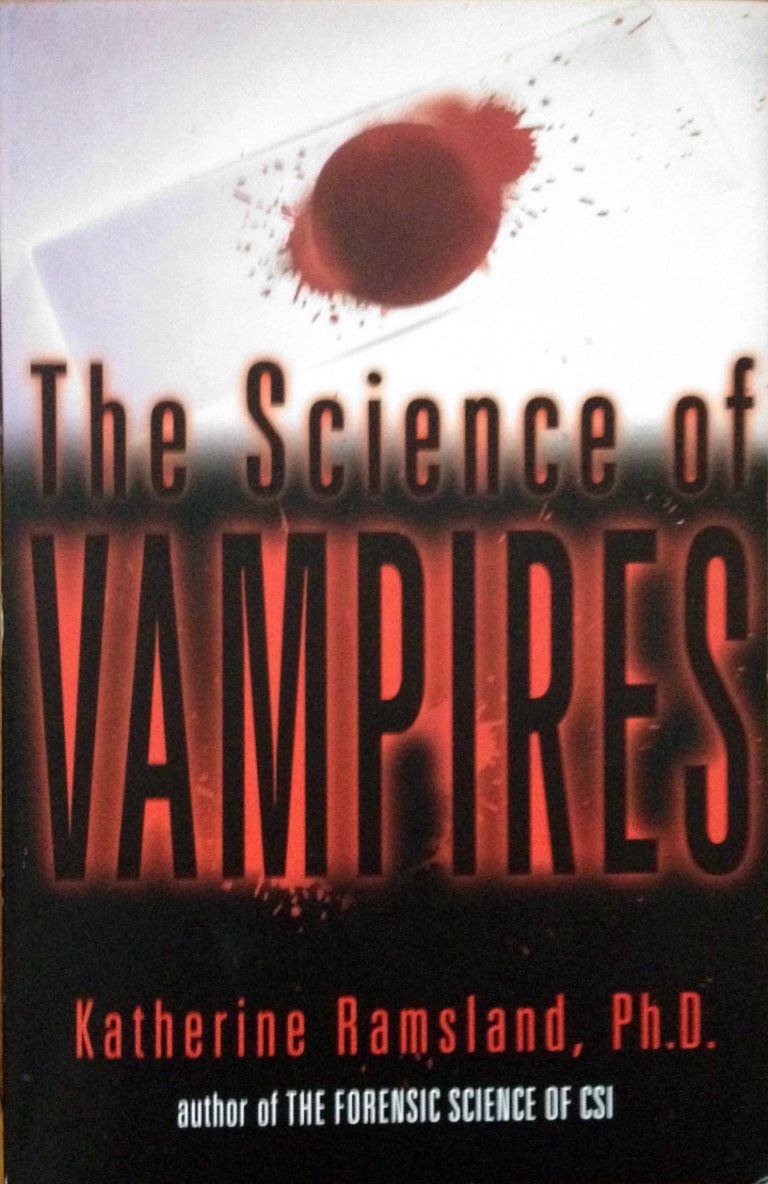
ScienceOfVampiresHow is one to take a book that combines science and vampires? That was the thought going through my head as I stood in Borders during the sad process of their going out of business sales, Katherine Ramstand’s The Science of Vampires in my hand. I knew already that I would buy the book—how could I not?—but I wasn’t sure whether it had been placed in non-fiction by accident or not. Ironically, I began reading the book on the day I was ultimately informed that my position had been made redundant. Vampires have been much on my mind since then. For several days I couldn’t concentrate enough to read, which is a kind of vampiristic encounter in its own right, in my case. Now that I’ve finished Ramstand’s study, I’m still not sure what to make of it.

Holding a Ph.D. in Philosophy from Rutgers University, Ramstand knows the fields of forensics and the supernatural surprisingly well. The Science of Vampires does indeed address the mythic creatures from a forensic perspective. The lore of the vampire is thoroughly examined and subjected to scientific scrutiny. Surprising results sometime arise. The book also contains its share of very disturbing material, more along the forensics than the fictional vampire side. I put it down woozily more than once. Yet, I found considerable insight here. Ramstand, although not focusing on the religious element, readily acknowledges the deeply religious nature of the vampire concept. She tends to focus on the scientific, rather than the spiritual, but she does have a telling interview with a professional counselor with a theological background. She quotes him as stating that he vampire is the disenfranchised among us—the pariahs of society: the homeless, people of color, those of differing sexual orientations, the working poor, the unemployed. Okay, I’ll admit that I added that last one to the list. I do, however, understand the point.

While supernatural powers may not create vampires, our society does. There are those who drain others of their resources, and there are those who are cast out. Both, in this post-modern world, might be considered vampires. At times Ramstand almost had me believing that Dracula might be more than fiction. As I read accounts of the horrors some people remorselessly perpetrate against other human beings, it seems that a vampire might be the lesser of two evils sometimes. As a symbol, both religious and secular, the vampire has proven to be irreplaceable. Hopefully some day we may outlive our use for those who prey on others.


The Devil’s Dues

Belief, no matter how inscrutable, must be taken seriously. Although we frequently prefer to privilege that which we “know,” belief is one of our main motivators. Strangely, many who reach a certain level of education begin to denigrate belief as if it were an embarrassing indication of improper brain functioning. Belief is, however, all we really have. A case of this was recently shown in an interview with Justice Antonin Scalia. A piece in CNN Opinion by Rebecca Buckwalter-Poza discusses an interview of Justice Scalia by Jennifer Senior where the topic of the devil arose. Buckwalter-Poza, as she makes clear, is no fan of Scalia, but when Senior began to treat the Justice’s belief in the devil with a condescending kind of incredulity Buckwalter-Poza called time-out. We need to take his belief seriously. Could such a powerful man really believe in a mythological figure? Yes. Belief will do that to you. Just the same, Senior’s non-acceptance of the devil is equally a matter of belief.

The devil is a problematic figure. Despite the certainty with which a recent demonology lecture treated the subject, the devil is scarcely present in the Bible. Indeed, he is somewhat a late addition, cobbled together from Zoroastrian beliefs and fragments of ancient mythology. The Hebrew Bible mentions the devil not once. By the time of the Gospels he has become a fixture representing an anti-God figure, clearly derived from the influence of the Magi (not necessarily the three riding on camel-back that first Christmas Eve). The devil was a convenient excuse for evil in a world where an omnipotent deity was believed to be entirely good. The devil is an escape-clause. Evil can exist in such a world and not be God’s fault. The idea stuck.

Today, sophisticated materialists (which is what some forms of science urge us all to be) have dismissed belief in anything not composed of atoms, electrons, quarks, or strings. Or, more recently, dark matter. The rest is all illusion. Sometimes the sophisticated don’t realize that other intelligent, sophisticated individuals don’t share their worldview. Materialism can’t be proven, and every true scientist knows that any theory is the best explanation given what we know at the moment. It is contingent. Science has a fantastic track record for explaining the physical world. Little in my experience has given me cause to doubt its efficacy. Still, I suspect that there is more to this universe than material. I have trouble supposing that some of that non-material universe is a horned, goat-footed, evil man with a tail and my worst interests at heart, but I can see how someone might believe that. Belief works that way. As much as we might want to eject it from the game, it will always be on the first string throughout the season.

IMG_1070


A Dog’s (Inner) Life

Last week’s Sunday Review in the New York Times included a piece tucked under Opinion entitled “Dogs Are People, Too.” Gregory Berns, the article’s author, a professor at Emory University, describes how he trained his dog to enter and remain still inside an MRI machine long enough to scan brain activity. The results, repeated on other trained dogs, indicated that dogs share the same level of sentience as a human child. Berns’ conclusion: dogs are persons. I tend to agree. Although I’m no longer a pet “owner,” I grew up with dogs (and cats, birds, reptiles, and hamsters). There was never any question in my mind that our dogs could think. The also shared emotions with people—as Holmes would say, it’s elementary. Obvious. Staring at you with puppy-dog-brown-eyes-right-in-the-face obvious. Science, however, has always had an uneasy relationship with consciousness, the ghost in the machine. Dogs, many declare, are just machines. They salivate at the sound of a bell, for goodness sake!

Berns, however, has found the holy grail of scientific proof. The brain scan is accepted as a measure of human conscious activity. It is difficult enough to lure a human into an MRI and have her or him hold still. Dogs, however, are smart. They can be trained to do this too. Berns has succeeded and now has evidence that the emotional centers in dogs’ brains respond much like human brains. If they are emotional beings, as many of us knew all along, they are persons. Berns points out that this has legal implications. We make laws about unborn humans, but we treat fully alive canines like, well, dogs. Consciousness is part of the animal, and perhaps even the plant world. That stands to reason, if not scientific proof.

Christianity is largely responsible for advocating the concept of human superiority. We are, after all, made in the image of God. The Bible tells me so. Although scientists tend to abandon the Bible, they retain the myth of human superiority. Some concepts are just too convenient to relinquish, even in a rational world. We assume, since animals don’t talk the way that people do, that they are not thinking creatures. Even scientists appear afraid, at times, to take on the immaterial concept of thought. If the materialistic view is correct, thoughts are only electrochemical signals. Only this, and nothing more. As time nears to get dressed for work, I’d like to send my electrochemical signals out to get the paper. If I do the paper will still be on the lawn when I get home at the end of the day. I’ll have to fetch my own slippers, I guess.

Need I say more?

Need I say more?


The Tell-Tale Telegraph

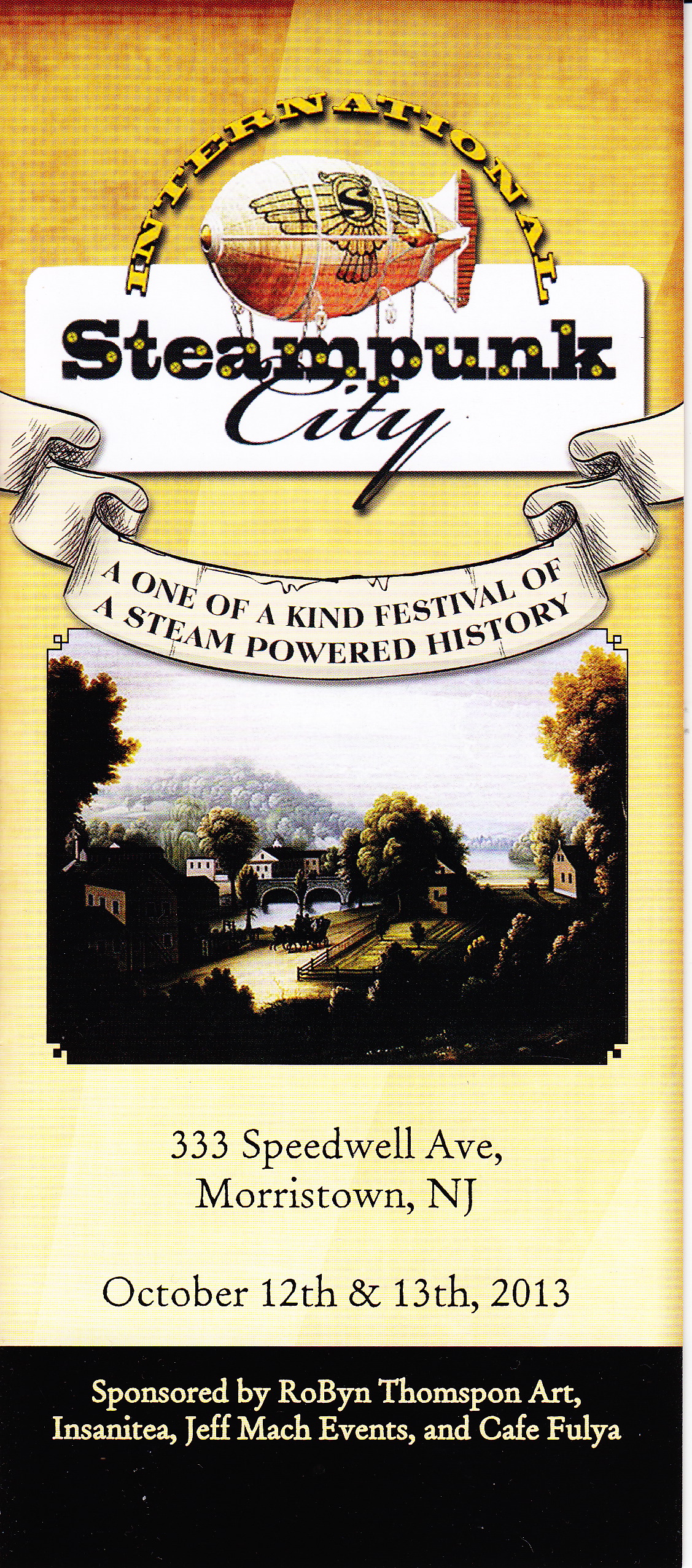
Steampunk CityThere’s a guy next to me with a robotic arm. Women with lace umbrellas and aviator googles walk by on the arms of Victorian gentlemen with walking sticks. A couple have an effervescing water-cooled device on their backpacks. I must be in Steampunk City. The forecast had predicted rain, but it is a beautiful October day in Speedwell, New Jersey. Steampunk City, an event dreamed up by Jeff Mach to make money for local museums, draws in a good crowd of the garishly bedecked, causing my wife and me to feel desperately underdressed. I’ve read my share of steampunk fiction, and I am really thrilled to see so many people taking an interest in such a literary event. I did wonder, however, what demonology had to do with it. Kevin Meares of Delaware Valley Demonology Research is giving a talk on demons, and it’s interesting to notice how the light laughter of customers from the booths outside wafts through the door where stories of possession are being told.

It is difficult to listen to Mr. Meares and believe that he hasn’t seen some pretty strange things. A practicing demonologist rather than the armchair variety, he has accompanied priests on exorcisms and is utterly convinced of the reality of the entities. When asked where demons come from, he relies on the Bible and Bible lore. Either they are fallen angels, remnants of a prior creation (thus the discrepancy between Genesis 1 and 2), or the offspring of the Nephilim of Genesis 6. Whatever they are, he has seen them in the dark, and people have died because of their activity. Being somewhat of a skeptic, I still find myself a little creeped out, kind of wishing I was outside with the laughing, costumed fiction readers.

Steampunk is often about alternate realities. A world where technology developed in the fog of steam rather than the neat circuitry of electricity. Speedwell, ironically, (and probably intentionally) is where the telegraph was invented and first demonstrated. It is a key site in the Industrial Revolution, the development that made the modern world what it is with smart phones, air-light laptops, and iCloud. I’m in the basement of an historic building having my rational worldview threatened by stories of demons. Although I’m wearing my nonplused face, I know that things will be different in the middle of the night. I’ve got brass gears in my pockets and supernatural entities in my head. I’ve met a watch maker outside who translates Aramaic manuscripts. What hath God wrought indeed, Mr. Morse? Yes, I’m in an alternate universe, and I may decide not to come back to the work-a-day one after all.


Cave In

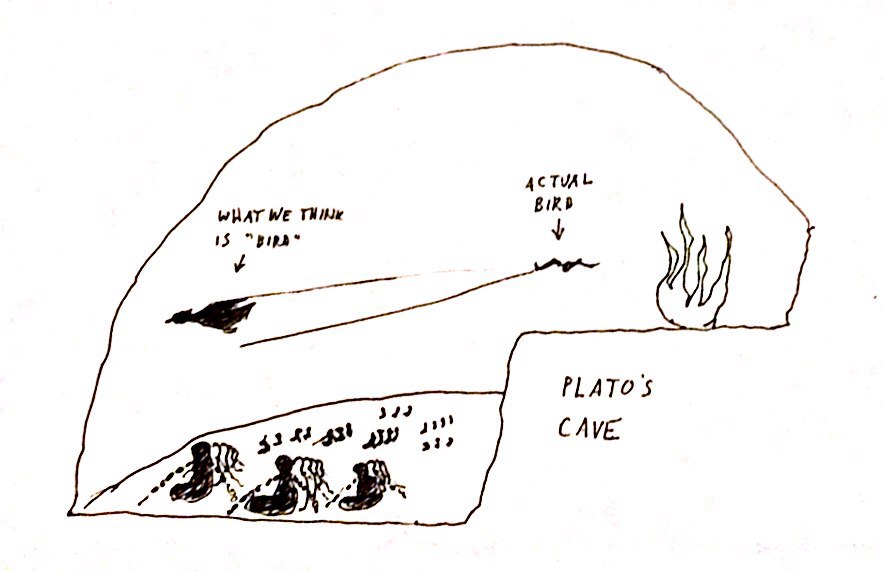
The conversation began, as conversations often do, with Plato’s allegory of the cave. The nature of reality was the topic of a chat I had with a very intelligent undergrad the other day. Plato believed in a realm of ideal forms. What we experience in life is not the actual forms themselves, but a reflection of them sufficient to alert us to what it is we encounter. Humans are sitting, as it were, in a cave. We are chained so that we face the inside wall of the cave and can’t look around. Behind us there is a fire and the ideal forms pass between the fire and people, throwing their shadows on the wall. Not having ever been outside the cave, we suppose the shadows are reality. We are, however, deceived. This led, naturally enough, to a discussion of Aristotle’s counter-argument that the “essence,” or entelechy, of things is something inherently within it. No need for an alternate realm of reality. And so, I asked, what is reality? What is truth?

PlatosCave

My young interlocutor said that reality is what we perceive. It is different for every person, and therefore there are a multitude of realities. Truth is simply the term we apply to our experience of reality. I began to feel as old as Plato. When I was young I believed, not exactly in a realm of ideal forms, but in a universe that contained abstracts. Abstract concepts objectively existed, and in a kind of neo-Platonism, we recognized them when we encountered them. Love, for instance. We may not be able to define it precisely (although materialists claim it is just a pretense to get sex), but we sure know it when we feel it. Or consciousness. What is it? No one reading this doubts, however, that it exists. And truth. I had always assumed that there was Truth with a capital T, objectively floating around out there. Perhaps, if the undergrad is right, there are multiple truths around. We chose the one that fits our experience of reality. Q.E.D.

C.Q.D.! C.Q.D.! Worldviews are in the process of changing. I tend to think the internet has democratized truth. Religions have tended to play their trump card—revelation—at this point. The unambiguous input from the divine should end all questions. But it only requires a moment’s reflection to realize that there are multiple religions and multiple revelations. Which one are we to believe? Some scientists claim there is no need for philosophy, religion, or the humanities. Objective facts, however, are interpreted subjectively. To privilege one reality above others is a kind of intellectual fascism. Perhaps my reality is different. We all sit in the same cave watching the same shadows play in front of us. We then decide what is real. Perhaps we need to get outside for a breath of fresh air. Even Plato knew, however, that that is against the rules.


Do You Mind?

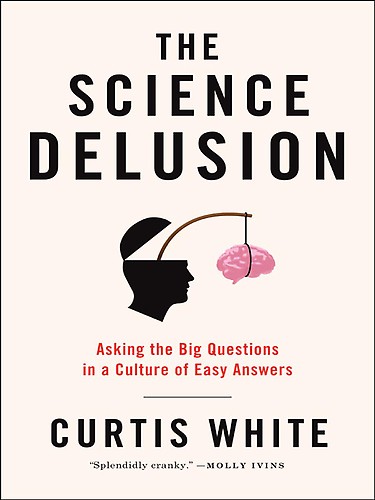
TheScienceDelusionSeems a lot of people are deluded these days. I know I am. Still, every great once in a while I read a book that helps me cope with the morass of everyday life in a way so profound that I feel elated. At least until I get to work. One of those books I cannot commend highly enough. Curtis White’s The Science Delusion: Asking the Big Questions in a Culture of Easy Answers is epiphanic. Not your typical (generally faith-based) objection to the New Atheist phenomenon, White asks more fundamental, and indeed, logical, questions. And he’s incredibly fun to read. Starting with the conundrum that often goes unspoken, White demonstrates that even the scientists among the New Atheists ascribe to immaterial value judgments without thinking through the implications. Having jettisoned religion, philosophy—the whole of the humanities, in general, as pointless, non-empirical window-dressing, even the greatest lights still claim their tenets. As White illustrates, stars cannot be beautiful without a concept of beauty. Beauty cannot be quantified, and is therefore beyond the empirical method. One could say it’s in the eye of the beholder, but science is uncomfortable with metaphors as well.

Materialism, often in league with politics and power-mongers, fails to account for much of human experience. The real danger, as White demonstrates, is when society simply accepts it because it comes from a white lab-coat. White, along with most of non-materialists, is not anti-science. Science clearly describes, in a pretty close approximation, the physical world we know. At least in the New Atheist camp, however, it doesn’t stop there. The take-no-survivors attitude causes problems because it is hoisted on its own petard of logic. The mind that is attempting to puzzle out science is immaterial. Mind does not equal brain. The cause and the result are easily confused. Flush with neuroscience’s success of describing the brain, we assume that science can also explain things as inexplicable as the nature of light, quantum mechanics, black holes, or the Tea Party.

White is not shy of talking about the elephant in the room. Consciousness is not a material phenomenon. If you are reading this, you know what I’m talking about. We are self-aware creatures. So seem to be some other primates, cetaceans, and corvids. If our minds could be quantified a lot of psychologist’s couches would be empty. Chemicals may affect the working of our brains and influence the performance of our minds, but when they wear off, it is still yourself staring back from the mirror the morning after. Those of us who spend our lives pursuing the humanities generally don’t try to take over science. It is very good at what it does. The world as we experience it—even the use of the word “experience” itself—is, however, more than physical. Even the New Atheists dream, and hope, and love. No matter what they may say, there is an inherent beauty in that.


Crowing Up

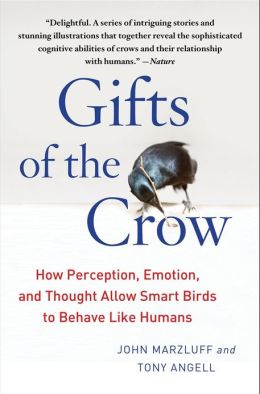
GiftsOfTheCrow Whether we climb up or down the evolutionary scale, one factor remains constant—our human sense of superiority. Despite the castigation of biblical-era thinking in the eyes of many scientists, few are willing to relinquish that Genesis-bestowed sense of being the pinnacle of nature. We know the universe is vast, but we assume we’re the best and brightest in it. Climbing down the ladder a bit, we like to distance ourselves from our fellow creatures because of our superior mental capacity. That is why I am so engrossed by scientists who explore animal intelligence. We find we are not so different after all. Gifts of the Crow: How Perception, Emotion, and Thought Allow Smart Birds to Behave Like Humans, by John Marzluff and Tony Angell is such a book.

If you’re like most people in this electronic age, you probably haven’t given much thought to corvids. Corvids are the members of the crow family: ravens, jays, magpies, and, of course, crows. Scientists have long known that these birds are exceptionally intelligent, and Marzluff and Angell have written a spell-binding little book that shows a remarkable level of intellect among the birds. Documented cases of tool making and use, conscientious interaction, and perhaps even language, have occurred among the corvids. We try to shoo them from our crops with “scarecrows” and we poison them en masse when they become “pests,” but when we take the time to understand them, we find that we may be far darker than the crows.

Not that Gifts of the Crow is all that easy-going. There is plenty of brain physiognomy and quite a bit about brain chemistry here as well. Knowing that not all of us are scientists, though, Marzluff and Angell include a generous portion of narrative description of what corvids have been observed to accomplish. For three days in a row I climbed off the bus stunned, scanning the skies for crows, just to see for myself. In this suburban jungle outside the New York City metropolitan area, crows aren’t so abundant as they were when I lived in the Midwest. They will, however, serve to remind me, when I see one, that our privileged place in nature has more to do with our thumbs than with our intelligence. When I saw a solitary crow atop a tree during a neighborhood stroll after finishing the book, I stopped, smiled, and bowed. Nature belongs to each and every creature, and there sat one intelligent enough to appreciate it.