Christian Horror

Following the lead of a friend (I don’t regularly read Christianity Today on my own), I found “How Horror Uncovers Our ‘Holy’ Hypocrisy,” by Sara Kyoungah White.  It seems that some evangelical Christians have begun to notice the popularity of horror movies.  This isn’t the same as condoning, of course, and this article took me back to the writing of Holy Horror.  One of the reasons for the book was that, at the time, few people (very few) were exploring religion and horror.  Web searches inevitably brought up the question “is it okay for Christians [subtext, “evangelicals”] to watch horror?”.  Since that time I’ve been exploring why the connection of horror and religion is so appealing.  If you’re a daily reader here, no doubt you’ve noticed it before.  I read on, noting that White has a difficult time finding anything redeeming in horror, apart from trying to stretch it to cover the usual evangelical concerns.

Photo by Stefano Pollio on Unsplash

Some of us, however, are seeking a kind of holy grail—an articulation of how horror contributes positively to spirituality.  That it does is beyond question.  The real puzzle is why.  It might help if we had a better definition of spirituality.  What exactly do we mean by that?  Even some of my Unitarian friends are put off by the word.  Still, it’s part of the human make-up.  You might call it “mind,” “psyche,” “personality,” “spirit,” “consciousness,” or “soul”—or any of a host of other words—but there’s something about people that makes us reflect on realities outside ourselves.  Some of do it with a great deal of awareness that we are undertaking such a quest.  Others may seldom or never think of it consciously.  We all do it, however.  We don’t all use horror to help us think through, or experience it.

I have long used movies for therapy.  It’s only been in the last several years that I’ve begun to notice that horror puts me into a spiritual frame of mind more than other movies tend to.  White notes “nearly every one of the top horror movies of all time deal with some kind of Christian theme or portray a Christian character.”  Some of us have noticed that in the course of our exploration of the genre.  Of course, that depends on how we decide on “the top horror movies of all time.”  The list she cites is the ever-shifting IMDb “Top 50 Horror Movies” list, which has far too many recent films on it.  Still, her claim holds if you go back to the classics and move forward.  There’s definitely a connection there, and, I suspect, it has nothing to do with the showcasing of our sins.


America the Religious

One of the truths that doctoral work teaches you is that if you look closely at something, minute differences appear.  Those interested in historical subjects write up syntheses that cover over many of these minute differences until somewhat of a false impression might occur.  Consider Puritan New England.  The image is a familiar one to the American imagination.  Rigid, pious, fearful church-goers predominated.  Stern, often acerbic, ministers were voices of authority.  But in actual fact, maybe a third of those eligible to be so in Puritan New England were church members.  Many lived in remote locations and used folk traditions (what the church would condemn as “witchcraft”) to meet their spiritual needs.  This was DIY religion.  And yet, the overall picture is of an uptight, strict, Calvinistic world.  That’s only part of the story.

Controlling the narrative is a powerful thing.  For example, the religious right has often flouted the idea that America was very religious from the beginning.  The “falling away” from the church is only the result of modernism.  Before that, they claim, pretty much everybody was religious.  This is patently untrue.  But if the narrative is believed, it becomes powerful.  Historians face a dilemma here.  Not every single little detail can be written about anything.  If you read a history of, say, the United States, do you think everything is in those thousand pages?  No, not by a long shot.  Entire books written about a single individual don’t cover everything.  The temptation is to present an approximation that covers the general trends.  Those of us who study religious history have an extra hurdle—what people say they believe and what they actually believe might be quite different.

Demographic studies that show only a third of New Englanders were church members indicates that two-thirds of the story remained untold.  The city on a hill may have been an ideal, but most of the people lived in the valley.  People prefer a happy story, of course.  That’s natural enough.  When we look for facts sometimes the story can grow a little confused.  Shrink that history of the US down to a single state and it’s still unwieldy.  Even a single city.  Choices have to be made and approaches have to be decided.  What really happened?  You can bet your bottom dollar that it was a lot more complex than any history book indicates.  People prefer mythological national narratives to naturalistic ones.  When we buy into simple materialism we often mistake our mythic past for a factual one.


Seminary Daze

It’s surprisingly easy to throw away an expensive career that once held much promise.  It really involves just a two steps: spend thousands of dollars earning a Ph.D. in religious studies, and take a job in a seminary.  It’s disheartening to watch colleagues going through this as seminaries contract, then close.  I know how it feels personally.  You’re suddenly aware that your years and years of training have made you practically unemployable.  If you do find a job it won’t pay as well.  Chances are you won’t enjoy it either.  Having taught in a seminary will mark you in academia as one of those “uncritical believers,” and, well, nobody wants to touch one of those.  While I would’ve taken a regular seminary job after my doctorate, my wife remembers me lying awake at night asking “Am I cutting off my career if I take a job at Nashotah House?”  The answer: yes.

I’ve been watching colleagues have their worlds torn apart as seminaries try to figure out how to stay open when institutional churches are dying.  Megachurches don’t require a seminary degree to run—natural grifters do it quite well with no advanced education, thank you.  But mainstream churches have been losing members, and therefore financial support, for years now.  And seminaries supply a commodity no longer in demand.  This may have been a trend when I started out back in the eighties.  If so, nobody told me about it.  I walked into this career naive and came out jaded and cynical.  My motives were to help other people.  It’s getting harder and harder to find jobs where you do that any more.  At least while being able to keep body and soul together.

Thing is, it takes years to earn the degrees you need to teach in a seminary. You have to think ahead.  When I started out, trends suggested a huge glut of jobs in the teaching market.  That never panned out, of course, as human predictions seldom do, and the decline in jobs has been pretty steady over the past thirty years.  Back in the eighties seminaries were doing okay.  Growing, even.  I do hope it didn’t have anything to do with me, but I hit this surprisingly fragile market at just the wrong time.  After having been overboard without a life preserver myself, it pains me to watch colleagues facing the same fate themselves.  Religion hasn’t disappeared—it’s simply taken on new forms.  Those forms don’t require seminary. Those of us who followed the rules on how to teach religious studies, however, somehow find ourselves in disposable careers.


Curious Valley

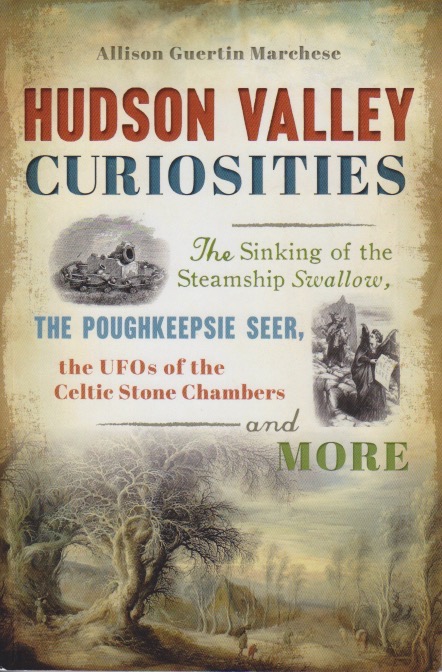
Another of my guilty pleasure reading categories is local history, written by locals.  As a genre these books may not always go back to primary sources, and they may get a fact or two wrong, but still they’re endlessly fascinating and I always learn something (which is the point of reading, after all).  I enjoyed Allison Guertin Marchese’s rambles along the Hudson Valley.  I’d encountered some of these tidbits before, but most of them were new to me and show just how interesting a place this particular river valley is.  Living in a strange world is so much more beguiling than a prosaic, predictable place.  Still, you’ve got to accept that anything can happen.  Unlike many such books, Hudson Valley Curiosities does not focus on paranormal, although ghosts and UFOs turn up a time or two.

Since this region is about 145 miles from end to end, the book divides it into lower, middle, and upper regions and gives about equal time to each.  The curiosities range from mastodons to prohibition busters, from shipwrecks to Shakers.  I’d never made the connection with the Shakers and the Hudson Valley before.  While the Shaking Quakers had their origins in England, they eventually migrated to the New World, settling in the northern end of the Hudson Valley.  The book points out that they were noted inventors, living by their own means as they did, they came up with their own solutions to problems.  Another aspect of these curios is the number of them that involved women who took on the cause of women’s rights.  The first female candidate for President of the United States, Victoria Woodhull, is discussed, as is Deborah Sampson, the woman who dressed as a man to fight in the Revolutionary War.

Marchese provides a helpful bibliography as well.  As someone trained in historical method, I like to go back to the sources.  Of course, that means assessing both publisher and author, and taking into account what passed for facts at the time.  History is an endlessly fascinating enterprise.  Many historians, however, leave out the controversial or questionable materials that a local historian is inclined to leave in.  That’s what makes books like this such a guilty pleasure.  Who doesn’t like to look behind the curtain now and again and see what’s happening out of the public eye?  And it’s helpful to keep in mind that by far the most of history takes place far from the headlines.  That’s where real life happens, no matter how strange.  And it’s a guilty pleasure to read about it from a local who finds, gathers, and preserves the stories.


Devil Talk

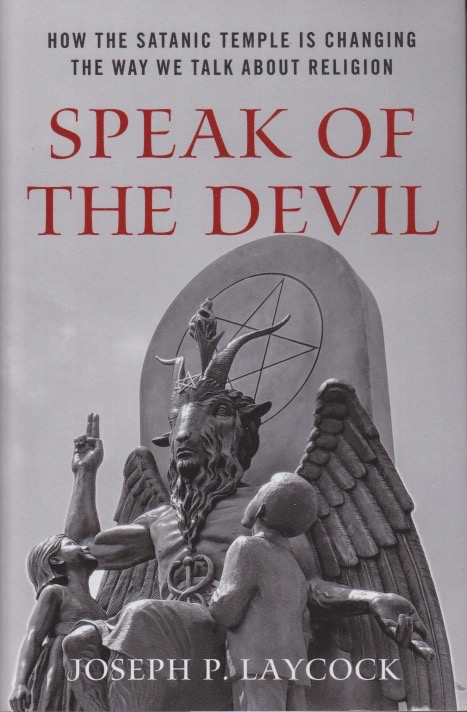
Around here, an after-school Satanic Temple club, prompted by an after-school evangelical club, led to a lawsuit where our tax dollars are being wasted.  Many local people wondered what was going on and I knew I had a book on my shelf that would help to answer that but I had to find the time to read it.  Joseph P. Laycock has been writing fascinating books for a few years now.  I picked up his Speak of the Devil: How the Satanic Temple Is Changing the Way We Talk about Religion just after it was published, but it always takes some time for me to get to books that I know I’ll have to spend time with.  I was right about spending time—there’s a lot packed in here that requires some thought.  I was vaguely aware of what the Satanic Temple is but had difficulty distinguishing it from the Church of Satan.  (I have a book on the latter, but it’s quite big and I haven’t found the time for it yet either.)  Laycock spells it out clearly.

The book begins by discussing how the Satanic Temple entered public consciousness in 2013.  Yes, it’s only been about a decade.  If you think it’s more than that, you may be confusing it with Anton LaVey’s Church of Satan.  They are different organizations.  One thing they have in common is that neither promotes belief in a literal Satan.  Both also rely on shock tactics to get their point across.  The Satanic Temple is a socially conscious organization that reacts to provocations of conservative Christian groups to try to establish their brand of Christianity as the officially sanctioned state religion.  And the evangelical groups have been making in-roads for years.  Playing the innocence card, “We’re just mainstream America saying what everyone’s thinking,” they put religious monuments in public spaces, start public meetings with Christian prayers, and receive state funding for their programs.  Often unchallenged.

Laycock’s not discussing evangelicals, but rather how the Satanic Temple arose in response to efforts to establish one form of Christianity as state sponsored.  There’s a ton of information in this book.  Among the many takeaways for me was the discussion of how good and evil are determined.  This is obviously directly relevant when Satan is involved, especially since the Devil is a post-biblical development.  The Satanic Temple, which doesn’t teach that there’s a literal Devil, attempts to counter the standard narrative by doing good deeds in the name of humanism.  You might be able to guess the conservative Christian response to that.  If you can’t, this book will help to spell it out for you.


Mystical

I would never have experienced Tibetan singing bowls were it not for a family member’s cancer diagnosis.  Something you quickly learn is that many resources are available to help you cope.  One of those local to this area was/is Tibetan singing bowls.  I had no idea what to expect, but as a lifelong explorer of religion, I had gathered that the session would likely involve ways of thinking more common in East Asian cultures.  I was taken, however, on a spiritual journey.  In a darkened room with twenty-to-thirty cancer survivors, on our backs on the floor, we experienced sound.  Now, my musical training and ability are quite limited.  I could not identify most of the instruments (I kept my eyes closed), apart from the singing bowls which I had heard in other, western religious contexts as well.  I’ve had mystical experiences before, but I don’t know you well enough to tell you all about them.

Photo by Magic Bowls on Unsplash

The first thing I noticed this time was the color blotches in my closed eyes.  Everyone sees those kinds of things, but as the sounds increased the colors began to range outside their usual purple into whites and yellows.  It was almost like a segment from Fantasia.  The colors then began to take shape, some forming into flowers.  I knew my imagining mind had taken hold when images began to appear.  Although it was my usual bedtime by this point, I was fully cognizant of being awake.  There was no real storyline, but I was conscious of losing my sense of individuality and becoming part of the greater whole, which is what being a being on a small planet is all about.  As the sound meditation wound down, I realized that it had been many years since I’d put myself into such an environment.  It took some time to reorient myself.  When we arrived at home I was, paradoxically, too relaxed to fall asleep.

One of my college professors warned me against mysticism.  Mystical experiences are rare, in my life anyway, but unforgettable.  If you live long enough and pay the right kind of attention, however, you can find them.  They leave you with a profound sense of hope.  I’m not about to go off and join a Buddhist monastery, but Thomas Merton reminds us that Buddhism and Christianity are perfectly compatible.  This particular college professor was afraid, I surmise, that spiritual experience might outstrip dogged devotion to a single book.  Mysticism can take you to places that convince you what passes for reality is not all that’s real.  Being with lovely people who’ve had to face cancer is a spiritual experience in its own right.  Why shut out the light inside?


Pagan Fear

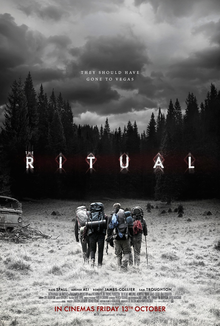
We still fear pagans.  Religion and horror are often tied up together, but when it comes to monsters we trust Catholics and fear pagans.  Of course, when Startefacts recommended The Ritual it was in the context of five pagan horror movies you should see.  I’d seen three of the others, so The Ritual seemed the next logical step.  Four friends are hiking through Sweden to honor the wishes of a fifth friend killed during a robbery.  When one of the them injures his knee, they decide to take a shortcut through the forest where a combination of the Blair Witch Project and Midsommar and Antlers takes place.  After finding a freshly gutted elk in a tree, they take shelter in an abandoned cabin surrounded by runic signs on the trees.  Soon they’re being hunted by a huge creature they can’t see clearly.

The final two are captured by a pagan group that worships one of the Jötnar—the monster that’s been hunting them.  The final boy escapes by getting out of the forest, where the Jötunn can’t go.  The choice of a Germanic monster is a bit different, and the creature design is fascinating.  Jötnar apparently straddle the line between gods and monsters, being a kind of frost giant.  The pagan group sees it as a deity that keeps them safe in return for sacrifices.  Given the number of bodies in the trees, other hikers had decided the shortcut was worth taking in the past.  But still, the pagans are cast as the bad guys.  This is in spite of the fact that the friend whose death started the whole thing was killed in England.

The religious convictions of the English robbers aren’t made clear, but they were raised in a Christian context and are every bit as brutal as the pagans.  In fact, the pagans, although they sacrifice strangers, do try to talk kindly to them (at least if they have the mark of the Jötunn on them).  Not just the pagans are savages.  At least they have a moral reason for what they’re doing, in their own minds.  The criminals are in it only for themselves.  We still fear those of other religions, although they’ve come to their beliefs in a way similar to how we’ve come to ours.  Whether born into it or converted, believers generally come to their conclusions honestly.  In the world of the film, this Jötunn is real.  And, until the end, it protects those who worship it.  So yes, this is a pagan horror film, but it makes the viewer wonder whence the horror really comes.


The Ology

It’s good to refresh yourself once in a while.  I attended a Calvinist college and my doctoral program was in the context of an institution strongly influenced by Calvinism.  I took courses based on Calvinistic theology.  Jon Balserak’s Calvinism: A Very Short Introduction was really a refresher for me and I have to admit that it sparked a pretty strong reaction.  For one thing, many Calvinists unthinkingly accept the tradition in which they were raised.  (Call it indoctrination, literally.  This is true of most religions.)  Those I know seldom believe what Calvinism teaches, for it presents God as a monster. (This is me, not Balserak, and I mean this in the kindest possible way.)  You see, doctrinally Calvinists have to accept Scripture literally and if you do that you come up with all kinds of contradictions.  (The amount of special pleading is mind-boggling.)  The way the Calvinists landed on this was that God created us for his glory, which will be shown in predestining large numbers of people to Hell.  These people can do nothing to change that since God doesn’t really love them.  What would Jesus say?

I argued quite a lot with professors at Grove City College.  I was raised a Fundamentalist, but of the free will stripe.  The Methodist Church, which I eventually joined, was not Calvinistic in outlook.  (Neither are Lutherans or many others.)  Still, Calvinism has unduly influenced American culture—I wish the book would’ve focused more on this.  We are, culturally, heirs of Calvinism.  This little book points out one obvious way this is so, namely, the separation of church and state.  There are many other features that could be pointed out, but the book aims to be universal and this is therefore not a theme.

The book approaches Calvinism theologically.  There’s quite a lot of “shop talk” here that I imagine might put off those who don’t really care to know who said what about a particular point of doctrine.  Balserak points out that Calvinism is complex and there is no one way of looking at everything, but there are clearly some non-negotiables.  These non-negotiables are precisely what prevented me from ever trying Calvinism on for size.  I’ve moved through various religious outlooks on my journey that is geared toward finding the truth.  Calvinism never tempted me, nor did it ever seem to make sense.  It was as if the tradition accepted that Zwingli and Calvin and company had gotten the basics all correct and every act of theology since then involves a casuistry to prove the early teachings correct.  Why not question things?  Well, I guess they’re predestined not too.


Baptist to the Future

Setting aside their smartphones and MAGA hats for a moment, the Southern Baptist Convention voted to exclude women pastors this week.  The photos seem to show a rather dour delegate pool that seems ready to head to the apothecary for some leeches to take care of this headache.  The conservative mind is a curious place.  I can understand wanting to slow change down—it is moving at a scary pace, leaving many of us concerned and confused.  Yet the idea that nothing has changed in two millennia isn’t only demonstrably wrong, it’s something that history demonstrates is a relatively recent, and reactionary, idea.  The fundamentalist brand of religion that elevates the Bible to godhood has only been around for about a century.  It’s a reaction to a hundred-year-old modernism that, in spite of all the evidence, closes its eyes.

Fear is natural enough.  Some of us actually watch horror movies voluntarily, after all.  But when fear overtly drives your religion isn’t it time to stop and ask what you’re doing?  The Southern Baptist Convention ejected its largest church, Saddleback, which had achieved national influence under Rick Warren.  According to the New York Times, Warren himself addressed the Convention citing none other than Billy Graham in his defense of women pastors.  The convention overwhelmingly voted to excise its most successful church for fear of that dreaded slippery slope of liberalism.  We’re fixated at some sexual level, it seems, and afraid of what might happen if we admit that even as AI is taking over our world, things may have changed.  At least a little.

The Bible is a sacred document with a context.  That context was patriarchal and it held considerable sway for about two millennia.  Power is difficult to relinquish.  When you get to call all the shots you don’t want to be reminded that those shots are wounding and killing innocent people.  “It was just better that way,” people think, ignoring the very Bible they worship.  It’s a point of view I understand, having grown up in it.  I remember reading with the juvenile furrowed brow of some tender twenty years how C. S. Lewis simply couldn’t see how women could be priests.  And then noticed how Baptists and other Protestants embraced Lewis although they condemned his idolatrous Anglicanism.  Sometimes it’s difficult to believe we’re actually in the twenty-first century with AI knocking at the door.  And we still can’t get over women wanting to be in the pulpit.

What would Roger Williams say?

A Theory

Do you remember that crazy college professor you had?  Chances are there was more than one.  As a late friend used to say, that’s why we pay good money to go to college.  I have an idea, perhaps even a theory, that the neurodiverse used to be largely institutionalized.  And I don’t mean in mental hospitals or “insane asylums.”  I mean in two well-respected social institutions: the university and the church.  Before you can object to the latter, consider that ministers, and before them priests, derived from shamans.  Nobody would doubt that shamans think differently than most people.  So, my theory is that when neurodiverse people came along in capitalist societies, they were shunted toward jobs in higher education and religion.  Out of sight to most people most of the time.  Then capitalism grew.

Both the church and the university became businesses.  Again, if you doubt me about churches, get to know a few bishops.  You’ll soon see.  In higher education, business people were hired as deans and presidents.  Not knowing how to handle their neurodiverse employee pool, they began hiring more “normal” people.  Those who, with no real insight or ambition, figure teaching is a cushy job.  It pays well, and it’s respectable.  But to do the job right you might just have to be neurodiverse.  Now, I don’t have the means to test my theory, but I suspect if you surveyed students over time as they graduated, you’d find fewer and fewer crazy professors.  As my departed friend would likely have said, they’re not getting their money’s worth.

Money doesn’t compromise.  Many people are driven by it without ever asking themselves why.  Do they want to be able to build private rockets to take them to Mars when capitalism finally destroys this planet?  Do they want private jets and the endless headaches of having to worry about getting even more money?  Studies tend to show that wealthy people are far from the happiest on the planet.  In fact, many of them are privately miserable.  They don’t have to work, true, but what do they think about?  Deeply.  I’ve never been driven by money.  I would like a bit more than I’ve been able to manage with my background and specialization.  Enough not to have sleepless nights over whether we can afford to fix the roof.  And still buy books.  It may be crazy to still read like a professor when I’m no longer in the guild.  I like to think I’m participating in a very old tradition.


The Idea of Scripture

Although the academic field of biblical studies is slowly dying—this is something I wrote about a long while back on this blog—the Bible and its kin nevertheless continue to shape and control society.  I was recently reading that Islam takes quite a different view of the Qur’an than Christianity does of the Bible.  It’s also clear that Judaism has yet another way of looking at Scripture.  What underlies these Abrahamic faiths is, however, the idea of sacred texts.  They don’t have to be understood, let alone read, in order to alter perceptions of reality.  The idea that God wrote a book, combined with the idea that God doesn’t show Godself or intervene in the world for good in any obvious way, has transferred a kind of godhood onto sacred scripture.

People desire the second coming because of a deep-seated need for God to part the clouds and demonstrate that their way of looking at things is the correct way.  It may be influenced by Scripture or politics or a favorite news channel, but the result is the same—they want divine intervention and since it’s not forthcoming, their sacred texts become the rallying point around which they gather.  Like many people I’m puzzled how a man like Trump, known for his proud womanizing and lack of care for anyone other than himself, came to be seen as a messiah.  Perhaps the key is that moment he gassed American citizens for a photo op holding up a Bible he never reads.  How this comes to be interpreted as a kind of divine moment only makes sense when we realize it’s the idea of Scripture that becomes the reality of many.

I’ve read through the Bible many times.  I have to confess that trying to get through the Qur’an is a struggle for me, but I suspect quite a lot of that is cultural.  I’ve read a few other sacred texts over the years, and have found some wisdom in all of them.  It’s when they become divinities in their own rights that society begins to pay the price.  If a non-interventionist God remains invisible, that identity will be transferred to the divine surrogate—Scripture.  People will coalesce around the idol they can see rather than the invisible one they can’t, right Elijah?  These sacred books have survived partially because they contain old wisdom, and old wisdom is often better than new knowledge.  But they also survive because they have become, in some sense, gods.


Der Golem

The golem is a monster of fascination.  It has been the subject of movies from quite an early period.  The earliest, now mostly lost, seems to have been Paul Wegener’s Der Golem (1915).  This film became the first of a trilogy, with the second (also lost) being, The Golem and the Dancing Girl (also originally titled in German, 1917).  The third film mostly survives and is therefore often called The Golem, based on the fact that it is the one we can still see.  Der Golem: wie er in die Welt kam (The Golem: How He Came into the World, 1920) is considered a must-see early horror film, although that designation comes from the fact of there being a monster.  It’s not scary.  It is, after all, a silent film.

Having watched some recent examples of Jewish horror I realized that I’d missed this one and set out to rectify the situation.  This film is actually the prequel to the other two, with Wegener’s golem having already established a cinematic presence.  I wasn’t sure what to expect from the story, but I supposed that it would be the oppressed Jews creating a golem to protect them and that it would eventually go berserk, as soulless people generally do.  It may have helped to have seen the two missing films, I suspect.  This golem is made to protect the Jews, but the edict against them is cancelled by the fact that the golem exists.  The emperor is impressed with the Jewish magic and allows the Jews to remain in their ghetto.  The golem, however, develops feelings for Rabbi Loew’s daughter, which is an interesting twist.

The rabbi does lose control of his creation, and it refused to allow him to deactivate him by removing the secret word revealed by Astaroth, under a star on his chest.  A little girl outside the ghetto, picked up by the golem, playfully pulls off the star and saves the day.  This really isn’t Jewish horror, at least not in the sense of more recent films.  It’s not very close to the Jewish golem legend and saving the Jewish community is left up to a gentile girl.  The ending clearly inspired James Whale’s Frankenstein some eleven years later, but the messaging of the film is pretty much what you might expect for a non-Jew trying to tell a Jewish story.  The fact that a demon is involved in bringing the golem to life puts us into a more Christianized view of things.  Still, this historic film, which is just over an hour in length, started something that has grown more sophisticated as Jewish horror started to come into its own.


Kenyan Mourning

We ignore religion at our peril.  I may be a voice crying in the wilderness here, but just because church numbers are declining it doesn’t mean religion still can’t motivate.  And in large numbers.  A New York Times story tells how 179 Kenyans starved themselves to death because their preacher told them they’d meet Jesus that way.  It’s amazing how many demons pose as angels of light, even if well-meaning.  All it takes is to hold up a Bible.  People are religious by nature and they tend to believe what they’re told.  Jonestown and Waco taught us nothing about religion.  Universities continue to hack away at its study, declaring it no longer of importance.  Meanwhile useless deaths still occur because of something that “doesn’t matter.”  Religion is so easily weaponized you’d think the Pentagon might want to get in on the action.

How am I to read without an interpreter?

Our world is increasingly secular but that may not mean what it seems to.  Belief, whether in traditional religions or not, is still belief.  We may believe we know certain things, but knowledge is a lot rarer than we often suppose.  Religion evolved—co-evolved, more accurately—with our species.  We need it, even if its gods have lost their divine luster.  And if we don’t have people who can teach us about it without resorting to mere metrics we may be on our way to perdition.  You see, here in America we tend to be a pretty literalist bunch.  I don’t know what it is about our culture, but we’re uncomfortable with metaphor.  Even so we believe in all kinds of things and then deny that we do.

My mind keeps going back to those Kenyans who, trustfully believing, starved themselves to death.  No doubt the introduction of the Bible, without proper instruction, into their culture, meant that such interpretations would eventually arise.  Perhaps inevitably.  Religious thinking isn’t a bad thing, but taking sacred texts from thousands of years ago as roadmaps for today is.  We so want answers in black and white—we want someone to tell us that life isn’t this complex and that “it’s all really quite simple.”  But it’s not.  Religion does help us get through this complex world.  Even though he was a Transcendentalist, Henry David Thoreau tried the monastic approach.  It works for a while, but if we all did it there’d be untold suffering in the world.  In other words, there’s no easy answer.  There never likely will be.  Until such a time as that, we should be studying religion more, not less.  And trying to make lives better, not worse.


Lilith Be Gone?

One of those questions it isn’t politic to ask is “Are you Jewish?”  I get asked that once in a while but mainly by Jews.  I’m not Jewish but some people tell me I look like I am.  In any case, as a Bible editor at an academic press, the question of someone’s ethnic affiliation sometimes comes up.  The dilemma is that we can’t ask that.  And it is very difficult to know the answer if someone doesn’t tell you.  The reason that this is on my mind is that I recently watched John R. Leonetti’s horror film Lullaby.  The film was one of at least two that came out with that title in 2022.  And since it deals with Jewish themes, that question naturally comes to mind: is the director, or are the writers, Jewish?  I suspect, from the way all of this plays out that the answer is “No.” Or, if they are, they didn’t do their homework.

Lullaby is a Lilith story.  A young couple—she’s Jewish, he’s a convert for her—have a newborn.  The woman’s sister has sent to them, among other things, a book in Hebrew that contains a Lilith-summoning lullaby.  Lilith shows up and steals the baby but a tattooed rabbi gives the husband some Jewish rituals to combat Lilith.  Apart from the spurious etymology of “lullaby” as “Lilith be gone,” this rabbi doesn’t seem convincing.  His Hebrew handwriting looks as if he might be a first-year student.  And keeping a menorah lit all night is supposed to keep a demon at bay?  Not only that, his assistant can be bribed to regain the cursed book.  All of this begins to look like a gentile trying to direct a horror film in a religion he doesn’t understand.

Religion and horror go naturally together.  I’ve written several posts about Jewish horror that really works.  In those instances, it’s clear that the writers and directors understand what Judaism is.  The solution here is that the convert husband must “really believe” in order to conquer Lilith.  The rabbi tells him to have faith.  The thing is, Judaism isn’t a religion based on having faith—Christianity is.  And taking that aspect of Christianity and using it to try to make other religions faith-based is one of the most common mistakes of those who don’t study religions professionally.  Horror works well with religion when those doing it actually understand the religion they’re trying to portray.  When they don’t, it can end up looking like appropriation of the worst kind.  I watched the movie because it was about Lilith.  What I found was a basic misunderstanding of how religions work.


Golem Events

Public domain, via Wikimedia Commons

It doesn’t have a title yet.  At least not one that’s announced.  Still, when a friend pointed out this article that Daniel Handler, better known as Lemony Snicket, is writing a horror film about a golem, I sat up straight in my chair.  Since I don’t tend to dwell on children’s topics here, it may not be obvious that I was a real fan of A Series of Unfortunate Events, by Lemony Snicket, back when they came out.  Alerted to this series by a cousin who was my daughter’s age, we made this bed-time reading for a few years.  Handler, in the early days, did a pretty good job of keeping his identity secret.  He’s written some adult fiction, and those of us who write know that readers want more of the same thing from a writer—if you want to survive you do what they ask.

I’m a very eclectic reader—that may be one reason I don’t have many followers on this blog.  People like the same thing time and again.  (I’ve always been suspicious of genres.  One of the reasons, I suspect, that my students found my lectures interesting is that I drew from my eclectic reading, but that’s ancient history now.)  In any case, A Series of Unfortunate Events was formative in my own writing.  The movie remains one of the most gothic available, but it pales next to the novels.  Yes, they’re written for young readers, but they’re also very well written for young readers.  I discovered Snicket, or Handler, was Jewish when he wrote The Latke Who Couldn’t Stop Screaming.  And now he’s turned his attention to one of my favorite monsters.  The golem has been part of horror from the earliest days of the genre (that word!).

Paul Wegener and Henrik Galeen’s The Golem, part of a trilogy, came out in 1915.  Before the Universal monsters.  Even before Nosferatu.  The legend of the golem—which may have inspired Frankenstein—has a long history.  While not biblical, the golem does go back many centuries.  Unfortunately these early horror films are lost, or mostly lost.  The Golem and the Dancing Girl, from 1917, is a lost comedy horror.  The third film, The Golem, How He Came into the World, from 1920, survives and is sometimes called “The Golem.”  I wrote earlier about the excellent 2018 film The Golem by Doron and Yoav Paz, sensitive to Jewish issues in the seventeenth century.  This sub-genre of golem movies may be starting to come into its own.  It remains to be seen what Handler will do with it, but if his previous work is anything to go by, we may be in for a real treat.