Fictional Facts

“If you want truth,” Indiana Jones famously said, you need to go to philosophy class. The sad fact is most people have little practical training when it comes to such issues as discerning truth. Some time ago I read an article about how fake news travels faster and is more deeply believed than actual truth. I suspect that’s because the truth is hard. The age-old trope used to be a wizened elder sitting atop a mountain in the lotus position. A lifetime of thinking through the labyrinthian corridors of wishful belief to get to what is finally and unassailably true. Our president, with the full complicity of the Republican Party, is out to dismantle the concept of truth once and for all.

Indiana Jones was contrasting facts to truth in this scene from The Final Crusade. The idea was that facts sometimes make you question truth. In GOP University, however, facts have alternatives. He who bellows the loudest is the harbinger of truth. Never mind that still small voice that comes after the raging wind. The voice that can stop a fiery prophet in his tracks—a man who could raise the dead, for crying out loud—but even his successor called Herod a FOX. In the culture of the shrug, who really cares? Finding the truth is so much navel-gazing. There are real enemies to bomb and somebody has some money that I can take away and claim as my own. To do so we can make up facts as we go along and lies will see us through. With the Evangelical seal of approval.

Even with rumors of a fifth film swirling, I miss Indiana Jones. In his formative days fascists were the enemies, even of the Republicans. Although he was showing his age in Crystal Skull, Jones still couldn’t countenance oppressive regimes. Scientific studies show people would rather believe fake news. We’re hopelessly prone to fantasy, I guess. Even as I volunteered on the archaeological dig at Tel Dor, although I had little money a fedora was required. There was a difference, however. I knew I really wasn’t Indiana Jones. I was digging for facts so solid that they could be held in my hand. Unlike Dr. Jones’ students, I did go down the hall to Dr. Trammel’s philosophy class. Surrounded by the young Republicans of Grove City College, none of us doubted that truth was spelled with a capital T. Now Truth is apparently an artifact buried in the sand, awaiting a hapless archaeologist to bring it to light. Amid all the forgeries that non-specialists can’t tell apart.


Day of Memorials

I admit that I’m as guilty as the next guy of thinking of holidays primarily as a day off work. A boon from the gods of capitalism so that we can come back to the job rejuvenated and more productive than ever. It doesn’t matter the occasion—I don’t have time for things like haircuts and dentist appointments with the usual round of early to rise, early to work. Holidays become islands of blessed respite in an endless ocean of labor for the man. So I wanted to take a moment to reflect on Memorial Day. Memorial Day is a time to remember those who have died—grandfather, grandmother, America. We take a moment to consider what we have lost. Then it’s back to business as usual.

My father was a veteran. He died many years ago now and I don’t write much about him because I really didn’t know him at all. That doesn’t mean I didn’t want to please him. Any boy wants to make dad proud. I tried the hard work route, and even gave Boy Scouts a try. The things of my youth have been slowly dying. Democracy is merely the latest victim. I shouldn’t be surprised—when it no longer becomes profitable, even the least offensive system of government can be bought and revamped to fit the needs of the greedy. Never mind the will of the masses. They’re the ones who lie under the gravestones for which today stands. No one can be rich without great numbers of poor against which to measure himself. Remember that; it’s Memorial Day.

Since Memorial Day doesn’t lend itself to commodification—let’s face it, outside Halloween death’s a downer—we can make it a day of sales. While you’re earning money without working, why not spend some of it? We seem to have lost the gist of holidays. Those who’ve died in vain believed in a democracy that their heirs have thrown away in scorn. If that for which we say we believe has become moribund, it appropriately becomes the focus of Memorial Day. My grandparents lie buried far from here. They were Evangelicals who wouldn’t recognize their faith reflected in those who still cling to the brand. I remember grandma sending money to Oral Roberts. She didn’t live to see him claim God would take him unless he had even more money. Now we hear the same thing from Pennsylvania Avenue. And tomorrow we all go back to work.


Crafting Magic

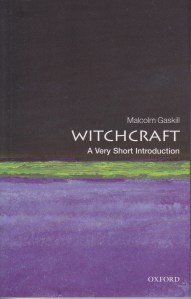
There’s a disingenuousness about an extremely wealthy white man claiming he’s the victim of a “witch hunt.” Such super-slurring devalues the many thousands of lives lost in actual witch hunts, most of them female. Regular readers of this blog know that I’ve long been fascinated by witches, and since I have so little time, Very Short Introductions are appealing. Malcolm Gaskill’s such introduction on Witchcraft is a surprisingly sensitive book that manages to touch on many important aspects of those who spend time thinking. The relationship between religion and science, for example. Witches force that question in various ways. The main takeaway, however, is another that the witch-in-chief would do well to take to heart—we must learn from history. History may be the key to human survival.

Gaskill has an unnerving balance when it comes to witch hunts. In places his attempts at objectivity can appear a little cold—history has demonstrated that the numbers of people killed in Europe’s witch madness aren’t as high as often claimed. Still, the loss of over 100,000 lives to propitiate our collective fears is tragic. This little book crams a lot of information in and it carries an appropriately warning tone. We don’t really understand what witches are, and we do still live in a world where hunts for them take place. Our psychies, ever so rational, crave magic. Societies from earliest times feared as well as desired it. Our belief in witches, and witchcraft, betrays quite a lot of what it means to be human.

This quick study isn’t all about witch hunts, though. It also explores the world of witchcraft, both in ancient and modern times. From Mesopotamian diviners to Wiccans, “the craft” has always been with us and is believed in by a surprisingly large number of people in industrialized societies. Magic, of course, generally leads to unexpected results. And the metaphor of its power over our imagination is forgotten at a terrible price. As Gaskill makes clear, the “witch” can be a stand-in for the other—the other religion, the other nationality, the other we fear and, now with government sanction, drive out or destroy. There is no magic to a wealthy man buying the presidency of the nation. There is, however, a culpability, a reckoning, if you will, that must attend abuses of this metaphor. The GOP has become a party of familiars in this compact with the Devil, it seems. That’s just a metaphor. But then again, metaphors can sometimes truly be magic.


Ask an Evangelical

News stories this year have plowed up a frequently repeated question: what’s an Evangelical? This was the subtext to a Washington Post story that declared “Half of evangelicals support Israel because they believe it is important for fulfilling end-times prophecy,” as if it’s news. The media’s a little shy, I get it. Those of us who grew up Evangelical could have told them that at least 40 years ago. As a child I knew that Israel had to be fully restored for Jesus to return. Politics, we thought, were holding God hostage. You see, if the Bible says something, and it’s infallible, then even the Almighty has to obey it. And some parts seem to indicate that Israel has to be restored—interpreted a certain way—before Jesus gets his invitation back.

This Evangelical support isn’t because they love the Jews. No, no. Let’s not get personal about this. It’s because the second coming isn’t coming until the pieces are laid out in order. The Bible’s like a crystal ball, only it’s holy. It can predict the future with great precision. You can be sure someone like Trump is in there someplace, maybe in the passage where an ass speaks. In the 1970s it was Nixon. The wonderful thing about prophecy is that it’s made with interchangeable parts. As Millenniarians know, if you get your year wrong never apologize. Simply recalculate and keep preaching as if nothing happened. The Almighty is a forgiving God. At least to those He likes.

Intellectuals seem to think Evangelicalism is contagious. Well, to be fair, historically it has been. That was the whole point of camp meetings. Most Evangelicals aren’t too shy to tell you what they believe. In fact, their reading of the Bible sort of insists that they do. If you’re too bashful, many of those in the academy (or even formerly so) started out in their ranks. Rare is the biblical scholar who decided on that field of study purely based on intellectual curiosity. There was likely a method to their madness. Yes, of course Evangelicals support any politician who moves the embassy to Jerusalem. Tis a consummation devoutly to be wished. The divine heels have been dragging for a couple of millennia now, so it’s time to get this show on the road. All you have to do is ask an Evangelical. They’re not hard to find; in fact, they seem to be everywhere these days.


Taming Shakespeare

It hardly seemed credible, from what I heard in high school, that anyone would read Shakespeare if it weren’t required. I’m not completely naive, but I do wonder if we insist on introducing kids to the Bard before they’re ready for him. The real stumbling block is the unfamiliar words from the Elizabethan period. With enough regular reading they’re less of an obstacle to adults. Or should be. Or not to be. In any case, one of this year’s reading challenge books required that I read The Taming of the Shrew. I’d never read it before and kind of shied away from it because of the chauvinistic theme—Katherine has to be “tamed” by Petruchio so that her poor, sweet sister Bianca can be married. The overall theme is biblical—Rachel can’t be wed before Leah, so Laban declares. The play’s a comedy at the expense of women.

Those who know Shakespeare better than I question whether the playwright’s motives were as undeveloped as all that, but it is in keeping with the time. That’s not to excuse such patriarchal thinking, but we can’t rightfully blame people for thinking in the terms of their time. Yes, we now realize (except on Pennsylvania Avenue) that women and men deserve equal treatment. We are all human beings and should be treated as such, not as if one gender were somehow more important or better than another. In the Tudor Era, however, that idea had not yet caught on. The Taming of the Shrew contains clues as to why.

Perhaps the most reviled part of the play is Katherine’s closing speech as to why women should be subjected to men. Her reasoning is distinctly biblical. Indeed, the edition of the play I was reading took pains to point out the biblical allusions in the speech—primarily to letters of the New Testament. The fear, unaccountably real after all these centuries, is that we might go back to such thinking. The Bible, after all, doesn’t change much. The most conservative of society still read it in the King James, although the Bible Shakespeare’s contemporaries knew best was the Geneva translation. And, like the schoolchild reading Shakespeare, such conservatives need a little help with the language since words have changed their usages over time. They also may need some assistance realizing that not only words evolve, but so does our understanding of what it means to human. It’s not women who need to be tamed, Mr. Shakespeare. No, it’s quite the opposite.


Belly Fires

A friend recently sent me a story from Smithsonian.com about how Evangelicalism arose partially in reaction to protests against the Vietnam War. Not that they were protesting it, but rather other mainline Protestants protesting drove evangelicals further to the right. Having grown up evangelical, I think I understand their strange reasoning fairly well. It was illustrated, for example, in a meeting of the Nashotah House board of trustees. Now, confidentiality rules—which I support—prevent me from providing details, but as you can imagine board meetings involved differences of opinion. I was a faculty representative (voice, but no vote), and I had a point to make. Being Episcopalian I politely and calmly raised my hand. At the same table one of the student representatives (voice, but no vote) was waving his arm like he had to find the nearest restroom, and quick. The chair called on him, ignoring my learned gesture. “He has a fire in the belly,” the chair said, “let’s listen to him.”

A fire in the belly. Not exactly an empirical—or even rational—reason to select one comment above another in my opinion. It was outward and dramatic gesticulation that caught the chair’s attention. Cooler considerations could be easily ignored. Nashotah House wasn’t exactly Evangelical. It was conservative, to be sure. What this episode taught me, however, is that society responds to those with bellies strangely warmed. Mainstream Protestants, for the most part, want comfortable faith experiences. Reason, after all, suggests decorum. Over 90 percent of the many, many mainline sermons I’ve witnessed have been staid and calm. Back in John Wesley’s day enthusiasm was an actionable offense in ecclesiastical eyes. Was the fire in the heart, or in the belly?

A little to the right…
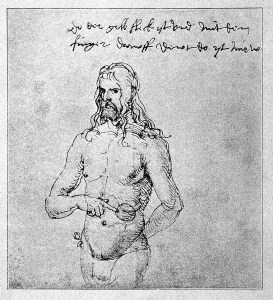
L0006082 Self Portrait of Albrecht Durer
Credit: Wellcome Library, London. Wellcome Images
images@wellcome.ac.uk
http://wellcomeimages.org
Self Portrait of Albrecht Durer.
Finger pointing to left side of torso.
By: Albrecht DurerPublished: –
Copyrighted work available under Creative Commons Attribution only licence CC BY 4.0 http://creativecommons.org/licenses/by/4.0/

So, what does this have to do with the Smithsonian story? Evangelicalism is driven not by the head but by the midriff. John Wesley’s conversion account was famous for his statement that his heart was “strangely warmed.” An inveterate doubter of his own salvation, Wesley needed to be certain. His thermo-cardiac episode helped to comfort him in the face of the lapping waves of the lake of fire at his feet. Having been evangelical once upon a time, I think I understand this constant Wesleyan concern. The fear of Hell is never easily overcome. The Greek word for strong emotion can be translated “to feel it in the bowels.” Examined more rationally, we know what moving bowels lead to. We see it every day as Evangelicals drive all three branches of government. The fire in the belly wins over cooler heads every time.


Secularcist

It should be fairly obvious that I’ve been researching demons lately. In the current political climate, it feels like a natural thing to do. Where there are demons, there are also exorcists. Many times those who write books on their experience in this realm will lapse into something along the lines of, “If there are demons, then Catholicism has to be true. All of it.” Or something like that. I have to admit that reading the better written accounts makes me start to think that way. R. H. Stavis’ Sister of Darkness: The Chronicles of a Modern Exorcist is another approach altogether. A secular exorcist, Rachel Stavis doesn’t use the time-worn rituals of movie fame. And her book offers an interesting rationale for her exorcisms—she sees entities.

I have often wondered if “growing up” isn’t largely teaching ourselves to discount what we perceive as children. I’m sure I’m not the only kid who was told there are no such things as monsters but didn’t fully internalize that “fact.” Besides, some things are worse than monsters. In any case, Stavis states that she sees entities and it’s clear from the book that she does indeed believe this. This isn’t for show. She describes various types of demons and how she learned to exorcize them. It’s a fascinating account. Her explanations won’t convince everyone, and her answers of where demons come from remain somewhat vague, but her clients swear by her methods. And she’s upfront about wanting her work to increase the good in the world by banishing evil.

I know many Christians who’d be ready to stone a pagan even for such a good deed as exorcizing a demon. Stavis doesn’t belittle any religion, however, and leans a bit toward Wicca herself. As I read I imagined what a reader convinced of the rectitude of one and only one religions would say. Only Jesus can drive out demons? (Judaism had, and still has exorcists, as do some sects of Islam.) Since a demon is a Christian monster, only a Christian can drive it out? One of the more interesting facts of the history of exorcism is that it was, in the Middle Ages, sometimes an interfaith exercise. The three major religions represented in Europe (the Abrahamic triad) recognized that any of the three could drive out demons. Each welcomed the help of the others. We’ve gone backwards since then. We haven’t again yet reached the stage where we realize that anyone doing good is on the side of good. Even demons, it seems, are conservative these days.


Creating Afterlife

Once upon a time I wrote a book on commuting. It never got beyond my laptop, but I often wonder if it was simply premature. Some stories from public transit can be quite amusing. A few weeks ago I posted on how a woman spoke up after our bus missed it’s turn off the highway and made us all late for work that day. No matter what you think of developers and speculators, one thing we can say for certain is they lack imagination. If you’ve driven this stretch of highway 22 you know that the exits look very much alike. Early in my commuting days a young woman took the empty seat next to me on the way home and asked where we were. “I miss my stop because they all look alike to me,” she explained. She had a point.

So one morning last week I was in my usual seat, reading along, when the driver—new to our route—missed his turn off the highway. The same woman (for we are mostly regulars at this forsaken hour of the morning; if this doesn’t ring a bell search this blog for “commuting”) said, “No need to turn back, they have another bus coming.” I was pleasantly surprised at the learning that had taken place since the last time. I am, however, old enough to remember Greyhound commercials and their slogan, “Take the bus and leave the driving to us.” I also thought of those passengers waiting like evangelicals for the second coming for a bus that would never show up. Our gain in time was their loss. Such are the dynamics of life in a universe not built on the principle of fairness.

The bus can be a microcosm of the moral universe. Evangelists, for example, believe all people must have the opportunity to catch this express bus to Heaven. The bus that comes after the express makes more stops, somewhat like Catholic Purgatory, increasing the suffering for a while, but ultimately making the goal. Missing the bus completely are the Hell-bound for which some claim we must turn back while others insist we press on; there will be another bus. In this case, the same passenger insisted that we help those left behind just a few weeks ago. This led to lengthening of her own stay in Purgatory, so when it happened again she decided those waiting were simply too hard to reach. Or maybe she’d come to believe in predestination. Perhaps it was on some ancient bus that ideas of the afterlife emerged. Experience teaches that much depends on factors beyond your personal control.


Russian Passions

Dmitri didn’t do it; guilty anyway. That’s it in six words. I have to confess my tolerance for really long novels isn’t what it used to be. Blame it on being a child raised by television—every thirty minutes I’m ready for something new. I first read Fyodor Dostoyevsky’s classic The Brothers Karamazov when I was in seminary. Seminarians are an odd breed, and many of them relished the deep, ponderous novels with profound things to say about humankind. The Brothers Karamazov is such a novel. When you’re a student, reading’s part of the job description. As a writer Dostoyevsky gets away with things that’d lead to you failing composition class these days. Speeches that stretch on for chapters, characters taking 100 pages to die, and children talking like adults. It’s a heady mix.

I’ll have to admit that I remembered very little of the story from my last reading. I knew Fyodor Karamazov got killed. I couldn’t remember by whom. All the buzz in seminary was about the famous Grand Inquisitor scene. That’s the part where the Grand Inquisitor interrogates Christ and finds him wanting in the eyes of the church. So daring. So deep! And so early in the book. As I made my way through many heavy-lidded pages, with some dismay I realized that after I’d read the high point of the book I still had 457 pages to go, none of which I remembered from my reading three decades ago. I don’t mean to disparage the classic—I noted and underline several passages as I read. The blame is entirely on me. Still, the endless gloom of personal guilt that hangs on every character, even Alexei—whom Dostoyevsky states outright is his hero—become overbearing at times. This is a nation battened down by Christianity.

Often I’ve expressed the idea that we force children to read great novels before they’re ready to do so, ruining the classics for them for life. I first read Moby-Dick in seminary and I’ve read it several times since. It seems nobody’s really ready for Melville before their twenties. What is the age for Dostoyevsky? I think I comprehended more this time through. There were ideas here that, had I more time, I would likely have enjoyed lingering over. If life were so kind as to allow us the leisure to digest huge books I have no doubt that we would all be wiser, if not more satisfied. Fyodor Karamazov is dead. Alexei is cheered by the school boys. This long journey has itself been the goal.


For Mothers’ Sake

We try to be practical for Mother’s Day. I take my wife out to eat every year, but since we both work and Monday always comes earlier than we expect, we usually go on Saturday. It’s kind of a moveable feast for us. The patriarchalist nightmare of the past two years in this country makes it all the more important to celebrate our mothers. Our nation needs to be reminded that without women none of us would be here. When my wife chose an Afghan restaurant I didn’t shirk, although I had to admit I wouldn’t have considered cuisine from Afghanistan if the choice were mine. It would never have crossed my mind. The restaurant was nicely appointed, and busy. One the walls were posters with photos of the mountainous country and its people, stamped with the words “Free Afghanistan.” I realized Mother’s Day is about liberation.

New Jersey, apart from being the most densely populated state, is also the most diverse. Ethnic food here takes on a depth that leaves our days in Champaign-Urbana in the dust. I’d never even heard of an Ethiopian restaurant, let alone eaten in one, before moving here. And each of these diverse countries represented by their food has a story, often involving oppression. Mother’s children everywhere want to be free. The only reason they aren’t is that bullies exist in every language. You can’t go into the swamp any more without being overwhelmed by them. Such men—and they tend to be male—want to assert their control over others. They forget, it seems, that they have mothers.

I struggled to find a way to classify the food I was eating. Years of Euro-centric training led me to place it between the “Middle East” and “Far East,” which, skewed as it is, reflects that Afghanistan falls along the silk road from China to Turkey. Elements of West Asia blend with those of East Asia on my plate. There’s no war here—simply a harmony of tastes that should remind us that we’re all human. We all have the same need for sustenance and we all have mothers. If we thought of the fact that when we harm another we harm that person’s mother, we’d be appropriately ashamed of oppressing anyone. We would come to realize that the secret to being civilized human beings lies in honoring all our mothers.


Spiritual Walls

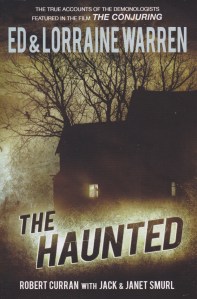
I often ponder what a difference walls make. Perhaps our ancient, cave-dwelling DNA just runs away with imaginations, but walls make us feel safe. Most of the time. As I was reading the ensemble-written The Haunted, by Robert Curran, Ed and Lorraine Warren, and Jack and Janet Smurl, the concept of walls showed its other face. In the mid-to late-1980s, the Smurls lived in a haunted house. The West Pittston duplex in Pennsylvania was also home to their four daughter’s and Jack’s parents. And the entity that harassed them there was deemed a demon. It’s easy to be skeptical about such accounts—no physical proof exists, after all, and proving anything is pretty near impossible anyway. Although I wasn’t aware of it at the time, apparently this become quite a media event. It’s easy to question the whole thing. Then I think about walls.

Although there are public haunted buildings, I often wonder about specific residences that foster claims of haunting. If spirits are, well, spiritual beings that can pass through walls, why would they stay in a house? In the case of the demon that everyone in the family saw, what does it mean to see physically a being that has no physical reality? And when the priest exorcised their house, why did they look to see where the incorporeal being might be hiding? It seems that the demon needed walls too.

Human beings are natural actors. We behave differently at home than we do in public. We act differently with friends than with strangers. Even closer to home, we act more natural with our families than we do even with friends. Beneath all these layers of pretending, most of us still act differently when we’re alone. That’s where walls come in. Although knowing someone’s in the next room might temper our behavior, the family unit within its walls is one intimate collective. What was happening within the walls of the Smurl household three decades ago? Any recounting will involve retelling. Interpretation. And we all know what a difference walls can make. The neighbors, according too this book, could hear demonic screams. Some even experienced invasions of their own during the height of the haunting. Books like this have a way of drawing you in, opening windows and doors through the walls into someone else’s life. What actually happens to them, however, is something we’ll only learn when walls begin to talk.


Call It What You Will

I didn’t even know the House of Representatives had a chaplain. Then Paul Ryan fired him. I wondered once again if evangelicals were interested in religion at all. We all have labels we’d like to claim but lack of legitimacy prevents us from keeping them. My secret wannabe title is rock star, but given that I can’t sing and can’t play any instruments, I have trouble retaining it. Evangelicals, however, have no challengers. They are so flexible they’d make Proteus blush. Such theological promiscuity, traditional religion teaches, will have its comeuppance. If 45 has accomplished nothing else, he’s forced the religious right to show its true, secular colors. Of all the great ironies of the situation none is greater than the fact that “nones” of whatever description hold up the weightier matters of morality better than those most vocal about their faith. Evangelicals, however, control the narrative and claim to do so with God’s own authority. They have few challengers.

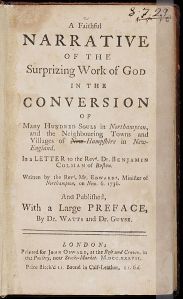
Source: Beinecke Rare Book & Manuscript Library, Yale University via Wikimedia Commons

Then, mere days latter, Rev. Patrick J. Conroy was reinstated by the whiplash GOP. Did somebody warn the religious right that “religious” was part of their name? “Hypocrisy” comes from a Greek root meaning to play a theatrical part. As my stepfather used to tell us, “do as I say, not as I do.” He was a secular man, so his hypocrisy could be overlooked. Noble, even, at times. When those who stake their entire identity on WWJD promote, vocally and enthusiastically, an unrepentant candidate for sinner of the year, you’ve got to wonder if even hypocrisy has lost its punch. How can you reason with people who refuse to reason? We used to lock them away in asylums. Now we throw them into the swamp.

Double standards are the new normal, I guess. Nobody really paid any heed when the fall of the towering televangelists showed, decades ago, that the idol they proclaimed as true religion was rotten to the core. Oh, they made the headlines for a while, but their tumble did nothing to dissuade their true followers. Evangelicals control their own narrative. For many decades now higher education and the media have pretty much ignored religion as a force for social change. Once upon a time Evangelicalism meant change based on ideals that more or less fit the recorded words of the carpenter from Nazareth. Now that its inspiration is the ninth circle below, those who have access to the funds of higher education prefer to put their money elsewhere. Why study something that threatens democracy on a daily basis? Why bother trying to understand Evangelicals? Call it what you will—there’s no way to object to anyone claiming whatever name they want. I should know; I’m a rock star, after all.


Christian Nationalism

Apparently we’ve forgotten the Second World War. In our touch-screen, never-have-to-get-off-the-couch culture of convenience, we’ve completely disregarded the millions that, yes, died in vain. You see, Christian Nationalism is on the rise, according to a story my wife sent me from the Huffington Post. About as much an aberration from literal “Christianity” as you can get, this movement believes America’s success is tied to its role as a Christian nation. Such believers, if they can even see that such rhetoric leads to war, don’t care. For the fact is that the economy of China is poised to pass, if it hasn’t already done so, the economy of what used to be United States. Call it Confucian Nationalism, but I have the feeling that when two giants try to get into the same compartment things tend to get unpleasant.

Serious thinking is a natural resource of which America has clearly run out. Easy answers, empty of content—junk food of the mind—are easily tweeted out from a personality that declares his own opinions truth. Everything else is fake news. Evangelicals, it’s sorely obvious, need to read The Analects. Don’t claim that its obscure; I’ve read the Bible. If you think you can figure Paul out, well, that’s what I’d call “fake news.” Oh, and by the way, Paul was anything but a nationalist. For all his faults, he knew that Christianity is nothing if it’s tied to nationhood.

Instead we puff out our chests and, ignoring the Bible on this very proverb, become the blind following the blind. If God has a plan he’d better reveal it to his 45th prophet soon because there are some enormous gulfs in the road and he insists on walking without a cane. American exceptionalism is built on the backs of the poor and helpless. They are also the ones most easily swayed by its perverse rhetoric. Nations must separate themselves from their religious beliefs. We’ve seen what happens when incompatible religions become the identifying factors of countries. As long ago as the 1970s I’d learned that nationalism was a powerful force for evil. I hadn’t been alive during the Second World War, but the world into which I’d been born was entangled in Vietnam. We were halfway around the world playing the bully, but it was because of capitalism, not Christianity. The end result, however, was the same. Unimaginable human suffering. Death, pain, and sorrow. And we’ve decided that the Prince of Peace wants us to head down that road again. “Vanity,” I hear Qohelet whisper.


Good Book Gone Bad

The Bible is a book of horror. This isn’t the main point in Holy Horror, but the fact is terror is never far from the surface in the Good Book. My days as a young scholar of the Bible were defined by the works of feminist scholars. One of the influential books of that generation was Texts of Terror by Phyllis Trible. Not hiding behind a masculine orthodoxy, she looked at how various biblical stories appeared from the eyes of female readers. There is indeed terror everywhere. The evils of slavery condemn that hideous loss of agency when one human being becomes considered the property of another. Women, before the feminist movement began, were taught that the Good Book demands this perverted social structure. They are indeed, in the eyes of its patriarchal world, property.

Important as this realization is, the terrors of Scripture go deeper. Even overlooking the genocides—the numbers make it difficult to take in the horrors of the individuals classed as faceless victims—there are multiple accounts of gruesome murders and violence in the Bible. Wars were an annual expectation. Diplomacy was often considered religious compromise. “Us verses them” mentality led to constant conflict. When it came to executing one another, the denizens of the Good Book could be quite inventive. No doubt women and foreigners were poorly treated on a daily basis, but when left to their own devices with divine voices in their heads, the men of Holy Writ knew how to terrorize one another quite effectively.

Even after the message of Jesus of Nazareth, which included love and care and compassion, the Bible goes on to close with the violent visions of Revelation. Perhaps it’s not appreciated so much in the present day, but the Apocalypse had a difficult time making it into the Good Book. Unfortunately the reasons weren’t that it was a book of horror, but the very fact that its status was debated should give us pause when hiding behind the rhetoric of a canon with its door slammed shut. The Bible contains some high, soaring words of noble thoughts and divine consolation. God can be an empathetic lover. With its status, in toto, as a book of divine revelation we have to pay serious attention to the fact of its participation in the genre of horror. Much of this is in the backstory of the films I discuss in Holy Horror. Others may have already explored this dynamic of Scripture, but it’s often a Good Book gone bad.


Defining Evangelicals

Like most Americans I have trouble getting over the button-down image of Evangelicals that has now become so distinctive. In reality Evangelicalism has nothing to do with Jesus, but it comes down to basically two things: a conservative haircut and belief in the superiority of males. The latter point is made by Rodney Hessinger and Kristen Toby in an opinion piece on Cleveland.com. Asking the question that’s on all logical minds—how can Evangelicals stand by a president who credibly cheated on his wife just after their child was born?—they come to the conclusion that patriarchy trumps all forms of righteousness. I know this from sad personal experience. The Bible, Evangelicals claim, gives men the headship of the household. They may sin, yes, but even with that their lordship must remain intact. That is the non-negotiable fact of Evangelicalism.

I was a teenage Evangelical. I grew up in a household where my mother refused to divorce her alcoholic husband because it was against Evangelical teaching. Sexual sins were well nigh unforgivable. In fact, adultery, of which 45 has credibly been accused, was a death-penalty offense according to the Good Book. About the only thing worse than sexual sins way lying. I can’t believe I’m getting old school on Evangelicalism, but I have to say Fundamentalism isn’t what it used to be. In college I knew people who believed we should reinstitute stoning for adultery. Instead we now use it as an excuse to elect unqualified presidents. And yes, we’d like to keep the brand, thank you. Commandments have now become negotiable.

Our society is very sick. Unlike the narrative Evangelicals weave, the illness is within them. Divorce rates are higher among Evangelicals than among atheists. Evangelicals are more likely to own guns than Unitarians. Evangelicals will lie more readily than any agnostic. Some of the more extreme want to reintroduce slavery. Through it all they claim to follow the Bible. Their support of Trump has given the lie to what they claim as a religious faith. Even Jesus, meek and mild, had harsh words to say about adultery. This is something you just don’t do. Promise your faith to one woman until a porn star comes to play at your resort—I don’t recall that being in Scripture anywhere. Evangelicalism hasn’t lost its soul, it’s lost its mind. Given what they’re doing in his name, Jesus must be rolling over in his grave.