Zombie Wars

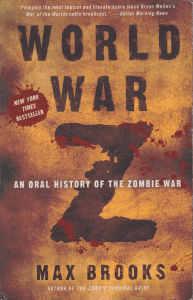
I suppose, rationally considered, most monsters can’t possibly exist. Maybe that’s the psychological relief required to enjoy the movies made about them. We can imagine the thrill, but we know we’re safe once we leave the theater. Culturally, monsters fight for supremacy. The early 2000s belonged to the vampire. They were everywhere. I once heard a literary agent advise wannabe authors to write on vampires since the publishing industry was showing no signs of slowing down on them. Then came the zombies. They’re still with us. World War Z came to my attention as a movie, but as one I never saw. I’ve watched many zombie films and none has lived up to the status of the spectacle that launched the genre, George Romero’s Night of the Living Dead. It remains a classic to this day. Still, I was curious and so I read Max Brooks’ World War Z: An Oral History of the Zombie War.

Let alone the chapter after chapter of tough-talking, cool-sounding reminiscers, I have trouble buying zombies. Yes, I get the scare factor, but maybe I’ve read too much science even to visualize myself into a fantasy world where a creature with no digestive system would be driven to eat. It just makes no sense. Human bodies can function with missing parts, of course, but without the integration of muscles, ligaments, digestion, and brain, it seems difficult to accept that they’d keep coming after you when they’ve been decaying for years. It’s all I can do to get out of bed most mornings, even as a healthy, living body. Analysts, I know, talk about zombies as metaphors, but with over 300 pages of stories in no way believable, I had to wonder about the limits of credulity. Maybe Carl Sagan was right after all.

I hope I’m not unsophisticated enough not to realize that the real point in Brooks’ novel is how the surviving humans treat each other. There is a moral to the story. We develop new and “better” weapons to kill one another. We’re smart enough to have world peace and prosperity, but wars are constantly erupting. We have a nation with many brilliant people and yet we elect a Trump. Self-destruction, it seems, is written into our genes. We consume one another. Even when the enemy is completely imaginary we find ways of believing. So I read World War Z, appreciating the irony. I still can’t get over, however, the trope that all you need is a human brain to want to destroy others.


Indie Bookstore Day

Although a year can seem like a long sentence, holidays are the punctuation marks that help us make sense of and organize it. Ordinary time, such as time at work, or commuting, can be endlessly tedious. Holidays, some personal, some local, others national or international, help us break up the time. Give us something to look forward to. My pity goes out to those religions that recognize no holidays and face time with a grim, Presbyterian determination to get to judgment day. The rest of us like to celebrate once in a while. So what’s today? It’s Independent Bookstore Day! Anyone who reads more than a post or two on this blog knows that I’m a lover of books. I first started taking solace in reading when things were difficult in my younger years, and reading has never let me down. In fact, I’ve often told myself that I could put up with just about any job as long as I could write.

It’s because of being in publishing that I learned about Independent Bookstore Day. Yes, it’s a promotional holiday, but it’s also a genuine celebration. As the outside world daily reminds us, those of us who read are a minority. The realistic author knows that the reading public is a small fraction of the whole. The number of people, percentage-wise, who spend their money on books is minuscule compared to those who fling their lucre elsewhere. But those of us who read appreciate the depth and reflection of each other. We may read different things, but we read. And that’s why I don’t mind going to an indie bookstore today and buying something.

One of the simple pleasures in life—call it a punctuation mark, a comma maybe—is being surrounded by unfamiliar books. Oh, I often worry what happens when we decide to move; we have lots of books at home. The last time the movers actually complained in our hearing that we had too many boxes of books. Talk about me at the bar afterwards, but don’t castigate my simple pleasures to my face, please. Books are the rare opportunity to commune with others on a deep level. How often have you put down a book and felt that you knew the author? Their soul was revealed in their writing and you had touched it. Just being in a bookstore is cause for celebration. If you have no plans for today, why not make your way to your local indie? Stand up and be counted as the literate resistance. It’s our silent Bastille Day, after all.


Kakistocracy

While in seminary I had the interesting job of teaching a visually impaired student Greek. This wasn’t an arbitrary choice on the part of my professors since, as an undergraduate I had exhausted the Greek curriculum at Grove City College and my fourth year the professor suggested I teach the course to the second years. This was, however, strictly koiné—I’ve always been from the lower class echelons. Trying to figure out how to explain a dead language to a student who couldn’t see required some creativity. At that point in my life ministry loomed as a career and it was still fairly easy to learn new languages. I was studying Hebrew at the time with the inimitable William Holladay at Andover Newton Theological Seminary, both of which are now gone.

I recently ran across a story in the Washington Post that utilized an unfamiliar word based on Greek: kakistocracy. It seems that the present administration has officials scrambling for new words to describe the depths to which our government is willing to sink. There’s an old saying: “the Greeks have a word for it”—I suspect the ancients would be shocked to see this particular word emerging again after centuries of progress. The translation of kakistocracy is quite logical for those with some Hellenistic training; it means “rule by the worst.” The sad thing is that democracy has come to this. Anyone with a fragment of a brain stem could see that 45 didn’t win the election in any sense but an electoral college one—giving us a new direction to sling the related word “kaka” around. It was the fact that those privileged to vote simply didn’t get around to it. As it was, the “incumbent” lost by three million votes. Nobody, however, is willing to do anything about it. It’s kaka.

If the swamp has been drained, it’s been to become a cesspool. With complete disregard for decency, decorum, and democracy, the directives issuing from the potty mouth on Pennsylvania Avenue demonstrate just how diabolical government can become. The sad thing is, the Greeks already had a word for it. One thing we know about our species is that we like to repeat our worst moments over and over again. Even worse, we seem to be proud of it. So as the kakistocracy grows to include porn stars, genital grabbing, and treasonous relations with foreign nations, the world looks in wonder and concludes people like George Washington and Thomas Jefferson had gotten it wrong after all. At least the student I was tutoring, although she couldn’t see, wanted to learn to read. And that made all the difference.


Candles vs Demons

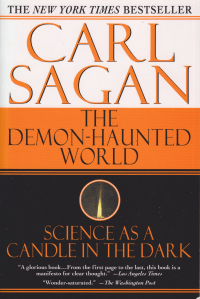
Among scientists who write Carl Sagan has always struck me as one of the more open minded. Dedicated to the scientific method, he nonetheless admits that there are some things scientists don’t know. The last time I was in Ithaca, therefore, I picked up a copy of his tour de force, The Demon-Haunted World: Science as a Candle in the Dark. I wasn’t really sure what to expect—I’ve been researching demons and I supposed they would be addressed in his book, since they feature in the title. Although that is indeed the case, the book is a collection of essays vindicating in various ways the practice and teaching of science. It is quite a scary book. It was also Sagan’s final book published in his lifetime.

Reading this just after Gabriele Amorth’s An Exorcist Explains Demons, noteworthy for its credulousness, The Demon-Haunted World was like whiplash into reality. Back into the realm of observable facts and testable hypotheses, it was indeed like a candle in the dark. Sagan admits that science can’t speak definitively on the supernatural—something that sets him apart from other science writers—but that doesn’t mean we shouldn’t apply scientific thinking anywhere it’s appropriate. And that includes the universe of politics. Published some two decades before the rise of Trump, the book is surprisingly prophetic when it points to the possibility of the rise of fascism in a nation that distrusts science. Indeed, the book shows Sagan clearly worried that an authoritarian, totalitarian government was on the rise. It’s almost preternatural in its accuracy.

The tome is large enough to dissuade a full summary within the word-limits I set for myself on these daily posts, but I can say that this book is necessary now more than ever. Sagan was a celebrity in his lifetime, a “rock star” scientist. Even so he worried about the deplorable state of science understanding among political leaders he met. For many years America has been mired in conservative causes that distrust science implicitly. Another strain that runs throughout this book is the need for education. Not only has America catered to anti-science groups, it has fallen behind much of the rest of the world in science education. Those who claim to make America great again can’t see that their very tactics have made our nation fall behind the rest of the world when it comes to education, across the board. Surely Sagan was right that a good grounding in scientific thinking is the equivalent of lighting a candle. As for the rest of the country it has been getting darker and darker, and our “leaders” have no idea even how to strike a match.


A Parable

Once upon a time, in a land far, far away, there was a holiday known as Earth Day. Now, Earth Day was a poor holiday. She didn’t prostitute herself to commercialism, she wasn’t attached to any religion, and people didn’t even get the day off work. Still, she was an optimistic holiday. One of her prophets was a woman named Rachel Carson. A science writer who could see that our rampant greed and fatal shortsightedness were leading to environmental catastrophe, Carson wrote books of warning. People began to take heed. An ecology movement was born. New concepts like “sustainability” and “stewardship” and “moderation” became part of national consciousness. Other nations joined in. Earth Day was born. She was a happy child.

But there were demons in this land. Huddled in filthy holes in the ground, these demons cared only for owning as much of the earth as they could. They wanted to heat the planet so much that Earth Day couldn’t survive. They would drown her in the waters of her melted ice caps—her very tears. These demons couldn’t do it alone. They lived in the dark and since they cared for no one else, they had to find a Devil among them. A Devil who could quote Scripture. Such a Devil, they reasoned, would make the followers of the dead God join them. The followers of the dead God were like sheep without a shepherd. And the demons had all the money in the world. So they decided to kill Earth Day. Nobody would stop them.

With Earth Day gone, the weather went wild. Winds constantly blew. Hurricanes of new and intense savagery emerged year after year. The demons laughed, for when the people’s things were destroyed they would have to buy replacements. The demons would become even richer. The followers of the dead God clapped their hands in glee. But the demons and their Devil didn’t know that Earth Day couldn’t die. They did as they pleased, taking what they wanted from the what they supposed was her corpse. Then the weather, Earth Day’s dearest friend, began to do what it would in its rage. The demons awaited summer when they might feel hot again, but summer only comes after Earth Day. Oblivious, they lived their lives of plunder and greed until the followers of the dead God were all gone and they had no one left from whom to steal. Rejoicing in their acquisition of all the earth, they failed to notice the storm. Earth Day was returning and all their wealth could not save them.


Ouch! Ouch!

The cold and flu season seems to have had an extended life this year, what with snow still falling in April and yet another week of cooler weather in the forecast. Although there’s no cure for the common cold, we do have the ability to prevent many maladies with a vaccine. Under eight years of Republican governance, New Jersey had become quite friendly to those who don’t want their kids vaccinated, despite being the most densely populated state in the union. The reason many objectors give? “It’s against my religion.” There was a massive outcry recently when a bill was approved that requires religious objectors to state what their religion is and what exact tenet of that religion vaccination actually violates. The statements of those opposed show that religion was largely being used as an excuse by those who didn’t want their children inoculated. Confirmation class has a purpose after all.

Social responsibility, of course, reaches beyond the home. In fact, it begins as soon as we open the door. Add to that the fact that most people can’t describe the basic beliefs of their own religion accurately and you have a real case for contagion. When you sign up to join a religion—what a capitalistic idea!—you generally go through training classes to let you know what you’re publicly proclaiming you believe. Given that religion deals with everlasting consequences, you might think most people would pay close attention, embedding the facts deeply. That, however, often isn’t the case. Beliefs are handed down like family heirlooms, or are gleaned from watching television (usually Fox). One’s religion is useful for making excuses, but people hate to be challenged on this point.

In the right’s continuing war on social responsibility, they’ve been pumping the media full of anti-vaccine fear. Vaccines, they’ll aver, use human embryos. Any other other form of conspiracy theory can be used to turn hoi polloi against them. Our society was built into what it is by as many people as possible agreeing that when it comes to the good of all, individual prejudices sometimes have to be overlooked. It’s natural enough for parents to be concerned for the wellbeing of their children. It’s sadly ironic when their “religion” tells them that the most basic protections are somehow evil. Who can help but to think of Abraham holding the knife above a bound Isaac on the altar? That is, if they happen to be of a certain religion, and if they paid attention during their version of confirmation class.


Private Browsing

Montclair, New Jersey, is a diverting place. At least it is for me. I used to teach—strictly as an adjunct of course—at Montclair State University. And like many other diverting towns, Montclair has multiple bookstores. On the occasions my wife has to spend a Saturday working in Montclair I often accompany her. If the weather is decent I can walk to both bookstores and have a leisurely browse. Since anything leisurely is rare these days, I eagerly anticipate such trips. Typically I’ll sit in my wife’s work place counting off the minutes until I can leave to get to the Montclair Book Center just as it opens. Used bookstores are a bit like archaeology—you never know what you’ll find, and some of the treasures may be unique. I often have the store mostly to myself, for private browsing.

This time, however, I had another task to accomplish first, before I could go to the first bookstore. By the time I arrived, it had been open for over an hour and there were, surprisingly, plenty of people there. We’re accustomed to hearing that people no longer care for books. While it’s true they won’t bring in the numbers of, say, those wanting the latest video game, it’s also true that on a pleasant Saturday morning an independent bookstore can be a crowded place. It warmed my heart to see so many readers out. And they weren’t all old like me. Younger people talking about the merits of this or that author, browsing in the sections I frequently haunt. Although I found none of the books on my list, I still had that blessed feeling you have when you discover you’re not really alone.

The other store, Watchung Booksellers, is a couple miles to the north, at least by the walking route I use. A small indie, it typically has what modern-day people might be expected to be interested in. I arrived to find it crowded as well. I’ve been there a number of times in the past and usually there are two or three others browsing. This time it was actually a little difficult to get around the small space. Seeing children there made me especially glad. A crowded bookstore is a sign of hope. As we struggle against the forces of ignorance and hatred that seem to have gripped the privileged classes, Saturdays at bookstores doing brisk business are an indication that the future may correct such ill-informed sentiments. Bookstores are termometers of national health, and seeing them busy made my Saturday. It’s worth getting up early just to spend such a day in Montclair.


Canadian Care

Amazon, probably not purely out of kindness, gives some customers access to the most read stories in the Washington Post. Apart from talking to my wife, this is about the only way I learn about what’s happening in the world (mine is a small world after all). I have no idea what Amazon’s metrics are for determining which stories to share, but I was amazed at one focusing on doctors in Canada. The story also appeared in Newsweek and other media sources. Unlike many medical professionals, these Canadian physicians are petitioning the government for lower salaries. They say they already have enough money and other healthcare workers aren’t being paid adequately. Why not share when you have extra? I’ve always thought Canada was far ahead of its southern neighbor in the ethics department, and this about clinches it.

Don’t get me wrong—I’m grateful for doctors. (You should see how much money I give them!) Nobody wants to go through life with this or that hurting or aching all the time. Most of the doctors I’ve met have been kind and descent people. Seldom as strapped for cash as I am, but then my doctorate is in a more intellectual field; serves me right. What really becomes a star in my personal firmament is that somewhere in this world enamored of capitalism, a privileged class has said, “this isn’t right.” Economists have been warning us for years that unbridled capitalism isn’t sustainable, but that falls on deaf ears in this country. Maybe our political leaders should see an otolaryngologist? Maybe they’ve got some wax build-up in there.

Doctors work hard. They have long hours and have to put up with smelly and messy situations. There’s a reason we have to pay so much to compel them to look where the rest of us are told to avert our eyes. At the same time, every other major developed nation in the world has some form of socialized medicine—it is a basic human right. Everywhere but here. If you drive through New Jersey you can’t help but be taken by the palatial campuses of the pharmaceutical companies that call this state home. There’s gold in them thar hills. As I gaze at them from the highway, my thoughts are driving across the border to a land that’s both affluent and caring. When’s the last time we heard an American entrepreneur say, “I’ve got enough—give the rest to someone else”? When too much is never enough, that’s something it’s going to take a Canadian doctor to treat, I fear.


Woodland Creatures

Maybe I watch too many zombie movies, but the story of zombie raccoons was just too good to pass up. A story by Marwa Eltagouri in the Washington Post described a spate of recent “zombie raccoon” incidents in eastern Ohio, not far from where I grew up. While the likely explanation is distemper, one of the behaviors of these raccoons stands out—they walk on two feet. Since I also enjoy the occasional non-fiction book by Linda Godfrey—who’s made a name writing about anomalous animals in North America, particularly bipedal dogs, or wolves—I found this aspect of the raccoons particularly interesting. That’s the thing, you see. Bipedalism suggests other human-like traits. Think great apes. Or penguins. (Although birds are generally bipedal, they tend to be squat and more horizontally inclined than vertical. The penguin not only dresses for our most formal occasions, but waddles around like many of us do after having been a bit too generous at the dinner table.) But bipedal raccoons—now that’s scary.

As a species Homo sapiens seem to have a need to believe themselves unique. Over the centuries any number of traits have been claimed as unique to us. Bipedalism, the ability to speak, being relatively naked so that we have to wear clothing, being able text with our opposable thumbs—we’re not like other animals. We’re special. So when animals that normally go on all fours walk on two legs we instantly think they’re trying to be like us. They want to have all the rights and privileges of our species so they can elect alt-right leaders and destroy everything they’ve built. Uppity critters! We have trouble reconciling ourselves with our animal origins.

Other animals, it seems, are beginning to note the advantages of walking on their hind legs. I’ve watched enough zombie movies to know that it’s the intention that’s the real problem. They want to be like us. Notice the accounts of bipedal animals—witnesses say there’s something in their eyes. Global domination. Yes, they’ve been watching us and now they want the same things we want. They want to take over the world. I know enough about World War Z to know that you can’t save everyone. Hard choices will have to be made. And maybe I’ve watched too many movies, but I’ve noticed the bipeds are from red states: the dog-men of Michigan and Wisconsin, the raccoon-men of Ohio. If we can’t save everyone, we need to make wise choices. Why not let them have Washington, DC? They certainly can’t be any worse than what we’ve got there right now.


Ithaca Musings

Ithaca may be the ultimate hippie town. Open and accepting of diversity, it’s a place where anyone can speak out against what’s going on in the government and not worry about finding any objectors. Yesterday when I was in Buffalo Street Books, customers openly vented their frustrations with the way Washington’s handling things, and others joined in. There’s a sense of righteous anger here that hasn’t been fashionable since the days of the biblical prophets. You have heard it was said Watergate was a bad thing, but verily I say unto thee something much worse than Watergate is here. And although winter is still holding on in upstate New York, nobody doubts global warming is real.

From my first visit here, I knew that I wanted to live in Ithaca, but it is one of those places you can’t afford to live. Amazing how the liberal cities are the places people want to reside. Places where you can’t just turn off the realities of a diverse world just because some things make you uncomfortable. Places where if you notice that other people are different you are reminded that you, in their eyes, are the different one. There is no static, monochrome, cookie-cutter American. Why is this an idea so hard to sell? Capitalism leads to and fuels the desire to own. And owning leads to the desire to own more. I’ve often noticed this since being out of higher education—even within your own company others want what you have. The basic civility of the socialist is missing. That’s where the “me first” attitude leads.

In upstate New York, as in many parts of the nation, the very names remind us that others “owned” the land before Europeans arrived. Native American concepts of ownership were so different from the capitalist ones that forcefully landed on these shores that those views were forced, under firearms and steel, to assimilate to the foreigners’ ways. Capitalism takes no prisoners. Turnabout, they used to say, is fair play. We no longer feel that way as a nation. The interlopers have taken over. We’ve made the country in our own image. And it certainly isn’t any more noble for it. Being in a place like Ithaca always makes my spirits ebullient. The very concept of ownership is an odd one, I realize. Mere mortals can never really own anything. We can pretend to, or perhaps we can take a more enlightened view. We are all borrowing things here. And I would love to borrow a piece of real estate here in Ithaca.


Power in the Bus

“You’re not in control on a bus” my friend Marvin once wrote, in his short story “O Driver.” The commuter is the consummate captive. I don’t like to beat dead horses—we might need all the horses we can get before this is all done—but some commuters need to learn silence is golden. I take a very early bus with some hope that we might beat the inevitable traffic jams coming into New York in the morning. Every minute counts. Some people, however, feel compelled to comment when they think the bus is early. They’re already sitting on the bus, so what’s the problem? There’s another coming in 30 minutes and those of us concerned with getting in before the traffic make a point of being at the bus stop, well, early. The other day a guy got in at the stop after mine. He told the driver that the bus was running early (it actually wasn’t) but the driver obligingly sat for several minutes. The commuter’s always right, right? We got into the Port Authority late that morning. All because of one man’s mouth and his inability to keep it shut. I wonder why they even have that sign saying not to talk to the driver. That only applies when the bus is in motion. So…

The very next day the driver on the route was new. She was on time. Until. To understand this, you need to know my route is an express—it is entirely highway except for one short jog into another town about 10 miles down the road. My driver was doing great. “You missed the turn,” another passenger said. The driver apologized. A three-point-turn in a bus just isn’t possible on the highway, so she had to drive to an exit, wait for the light, and turn around. We were now speeding west, heading to New York City. The passenger, now acting as GPS, didn’t know this area very well. “Take the next exit,” she instructed. The driver dutifully did. It was a ramp with no reentry to the highway. We were touring rural New Jersey for some time before the driver found a place to make another U-turn. “Missing the turn,” the passenger now said, “That turn’s inconsequential. There’s another bus that comes just after this one.” She’s right. No less than three routes into New York follow that jog. But it was too late for us now. Finding our way to the highway, we again headed west. This time our driver took the correct exit, apologizing all the way. The next day we had a new driver.

Actions have consequences. For each and every action there’s an equal and opposite reaction. I learned the latter in physics class. The former is a life lesson that might properly be called the mother of morality. When you talk on the bus you’re taking charge of about fifty lives. It has become clear to me through my years of commuting that most people shouldn’t have that kind of power.


Americanism

I’m a bit too much of a contrarian to be a regular bestseller reader. I do occasionally bow to curiosity though, and I do have a lot of time on the bus. But that wasn’t the reason I turned to Michael Wolff’s Fire and Fury: Inside the Trump White House. Purchasing this book was a statement. Another in a long line of protests in which I’ve taken part since January of 2017 (and even before). You see, I mourn. I mourn what our country has become. My first indication that I should write (which I of course ignored) was the winning of a statewide essay contest my senior year in high school. The topic of the essay was “Americanism.” My piece was respectfully cynical; I was surprised I won. This was in the days before personal computers and I didn’t think to keep a typed, or even hand-written copy.

The essay was cynical not because I don’t believe in America, but because I do. I’ve been confronted on this issue concerning my blog occasionally. My jeremiads. You see, you only get this fed up with things when you love them deeply. I sometimes rail about higher education, for example, because I care about it. Fire and Fury created in me a—to borrow from the book’s vocabulary—Kafkaesque bewilderment about how a nation based on high principles could possibly sink so low. Politicians are perhaps the most self-serving of human beings, but at least they try to make sure the country doesn’t go off the rails. This train leapt the tracks months ago, and our elected officials refuse to do anything about it, each playing their own angle, hoping personally to come out of it ahead. Worth a jeremiad, I’d say.

I was a Republican in high school. I wasn’t old enough to vote, so that party affliction was never official. When I did register at 18 it was as an independent (remember, contrarian). As a Fundamentalist I was ahead of the Tea Party, at the time. Even with this level of patriotism I wrote an essay taking my country to task. I was raised in a poor family. Told an education would improve my chances, I found myself facing predatory loan officers and others eager to wring my blue collar until it was possible to twist no further. If I had no money, my future money would do. I’d already had a taste of that as a high schooler. That was three-and-a-half decades ago now. I kinda hoped the country might improve in all that time. And I kinda wish I’d kept a copy of that essay as a memento of more optimistic days. Fire and Fury sells so well, I suspect, because I’m not really alone in feeling this way.


Two Cities

Augustine of Hippo wrote that there were two cities. If you’re reading this blog you probably know what they are. Today, according to some, is Easter. For others it’s not quite there yet. Call that one city. It’s also very near that other national holiday—tax day. That’d definitely be the other city. Now, I’m not going to go into any detail here, but I’ve always done my own taxes. If you’re old enough to remember going to the public library to pick up two or three copies of the paper forms, sitting at home with a pencil, eraser, pen, and TI-30, and spending an entire Saturday reading through the instructions and scribbling, you know what I’m talking about. These days everything’s online.

I can’t recall how many years I’ve used TurboTax. It was free, easy, and generally led to a refund. I miss those days. This year when I sat down with Intuit’s child, it started asking questions I didn’t understand. Perhaps you’ve run into some industries that do this—they make up their own vocabulary and if they use the words in a way the dictionary doesn’t, well, it’s the dictionary’s fault for not keeping up. TurboTax started doing that. And unless you want to pay even more than they’ve already sold you up for, there’s no way to ask questions. The answers online use the same obscure lexicon. So this year I had to do probably the most adult thing I’ve ever done. I got an accountant.

Setting up the appointment for after work, it was a matter of looking at dates both my wife and I, and more importantly, the accountant, had free. It was only as judgment day dawned that I realized it was Good Friday (for some). Arranging to work from home that day so I could get to the office before the buses rumble out of New York, I ran into a traffic jam. No doubt people out to do their last minute Good Friday shopping. We were meeting the accountant for the first time, and I wanted to make a good impression. Be punctual. I had neglected to coordinate the two cities on my calendar. The accountant was understanding. He commented on how easy our taxes were, compared to many. Turns out TurboTax had been closing off many perfectly legal options and charging us for the privilege. So now it’s Easter. Taxes are due in a couple of weeks. There are two cities, and if either is neglected there’ll be Hell to pay in the end.


Body Count

While I’m privileged and proud to have been part of one of millions protesting over the weekend with our nation’s youth, I can’t help but be a little reflective. Why does our world continue to shortchange women? You see, I had the honor to be a man invited to march in Washington, DC on January 21, 2017. I was there the day before, when the devil in the red hat assumed control. Helicopters were buzzing all over the place, flying low and dramatically over the scene. There were some small riots, to be sure, and I saw police action up close. The day of the march itself, however, all was peaceful. Including the skies. The helicopters were home, their blades drooping listlessly. The women marched. Few paid attention.

It’s hard to tell how many people there are when you’re in a crowd on the streets. There’s no stadium seat numbers to guide you. The National Park Service, which has metrics for counting visitors, probably knows best. As we thronged toward the capitol building we asked an NPS officer if they had any estimates. She nodded. “We’re estimating it’s 1.3 million.” When the headlines squeaked the next day all they said was “hundreds of thousands.” The White House was saying maybe 500,000. Of course, this was now the era of fake news. Nobody worth their testicles could say that the Women’s March drew more than a million to the capital, but it did. Because it was led by women, we have to scale the numbers down. It’s a trick employers use all the time.

This past weekend’s rallies and marches are being noticed by a reluctant press. Official estimates in DC are at a million. The Washington Post noticed that Metro ridership was “far behind” the Women’s March. Women are finding their voices. They were cheated out of the first female presidency by an electoral college that forever will bear the badge of shame for electing a candidate who lost by three million popular votes. People don’t like to be cheated. Women, who throughout history have been the victims of unfair policies upholding male privilege, are half of the human race. They number in the billions. Those who steadfastly hold to Trump—who’ve abandoned their tribe—have the right to be heard as well. They, however, must listen to their sisters. This is not about fiscal conservancy. This is not about unborn babies. This is about the most basic human right of all. We march because this is about the numbers. Women are equal to men. And we will march until the numbers are counted as they actually stand.


Hope for the Future

I’m standing in a haunted place. There was an act of violence here this week. Gun violence. A man died in this restaurant where I sat with my wife and had lunch just a couple of months ago. I’m in Princeton for a rally organized by a teenager. We’re here to tell the government we the people want sensible gun control laws. The website said they were expecting 500. Five thousand turned out instead. Princeton’s not the kind of town where you expect gun violence. Affluent and privileged, it’s the kind of place many of us go to get away from real life for a while—they’ve got the best bookstore around and you can still find DVDs at the Princeton Record Exchange. You don’t expect people to be shot dead here.

America’s perverse affair with firearms goes hand-in-hand with its refusal to ensure adequate treatment for the mentally ill. We give them firearms and wonder what could possibly go wrong. We elect the mentally deficient to highest office in the land and instead of reining him in, the GOP reigns with terror. They have shown time and again that they prefer NRA money to our children. They have sold out. And the word appropriately used to describe such a party good manners prevent me from inscribing on this blog. Republicans, true republicans, need a new party. Instead they refuse to call this aberration in Washington what it truly is. Thousands took to the streets yet again this weekend. This was my fourth rally or march since January of last year, and hey, government—they keep getting bigger.

“Woe to the inhabiters of the earth and of the sea! for the devil is come down unto you, having great wrath, because he knoweth that he hath but a short time.” So saith the Good Book. It’s a book the Republican Party has forgotten how to read. Especially the “evangelicals” who’ve betrayed their saintly name. While I’m here in Princeton, a few hours away in the sullied capitol of this once reasonable nation, half a million are on the march. And just as women led the way last January we’re being shown the truth that anyone can lead better then old white men. And the fact that the organizers of these protests are high schoolers, I am inclined to leave the last words to the prophet Isaiah, whom, for any Republicans who might be reading, is in the Bible: “The wolf also shall dwell with the lamb, and the leopard shall lie down with the kid; and the calf and the young lion and the fatling together; and a little child shall lead them.”