Serpent Number One

I haven’t read The Essex Serpent by Sarah Perry. Yet. My reading list is frighteningly enormous and constantly growing. I just can’t seem to get on top of it. In any case, my wife sent me an NPR interview with Perry that set me to thinking about monsters. (It really doesn’t take much.) One of Perry’s answers in the piece by Ari Shapiro stopped me in my tracks. Perry admits that recent political events have made her question her belief in benevolent humanism. I’d never thought of our current crisis in that way before. This is one example of what happens when it’s—pardon the expression—every man for himself. We’ve stepped away from religion as any kind of public conscience. The religious right doesn’t fit any classification of religion that I know of, so I’m discounting it as a legitimate form of belief. When we look out for number one, a self-appointed number one takes over.

With an insidiousness that can only be called evil, our elected “representatives” tried to sequester away the facts of their healthcare bill that they wanted to ram through in order to give the wealthy serpents tax breaks. The thing about looking out for number one is that you’re only number one to yourself. There can only be one one. Lining one’s pockets with the tax money of others is a trick as old as civilization itself. In ancient times, however, they at least called themselves kings and emperors and made no excuses for what they were doing. We said we were advanced enough to do without the religion that supported these outdated views. We’re back to the days of kings and emperors. Anyone who believes differently is fooling him or herself. There have been snakes in the garden from the beginning. Getting rid of religion won’t clear them from the grounds.

There are many benevolent humanists. There are many more who are suffering under the weight of current political systems. Unhappy people elect dictators. It has happened before—in the current lifetime of many, no less. The warning signs are all there to be ignored. The fruit sure looks nice, hisses our constant companion. Looking out for number two is the first step. Then number three, and twenty, and eight-billion. That’s benevolent humanism. Anything less is, well, a walk down the garden path. We’ve been down that path before. Those who trust serpents must learn to count. To do anything less is less than human.


Fishers of Cars

The car was drunkenly weaving across lanes in substantial traffic along Interstate 80. Erratic driving that, although not breathalyzer confirmed, suggested impaired operating. It’s something you never like to see. We stayed behind the vehicle, knowing that it was safer to keep such a car in view rather than attempting to overtake it when the driver veered into the left lane. Since the same muted colors recur on vehicles these days, we needed a quick way to identify this driver at a glance. The Jesus fish on the rear served the purpose well. This situation struck me as a kind of parable, although it really did happen. One of my brothers is a driver by profession. He often tells me that if someone cuts him off in heavy New Jersey traffic, more often than not the car bears a Jesus fish. WWFD?

The ostensible purpose of the Jesus fish is to witness to the world “here is what a true Christian does.” While the New Testament, if I recall, indicates that the true believer puts others before him or herself, the rule of the road is somewhat less spiritual than that. None of us are saints when we get behind the wheel. We’ve got places to go and the drive isn’t really much fun with thousands of other cars bunging things up constantly. Still, if you take the extra effort to put that Jesus fish on your car, aren’t you signaling that this driver holds her or himself to a higher standard? Or maybe the fish is a talisman, like “Baby on Board,” that will somehow protect from the careless, aggressive driver thinking only of self.

The irony here is not that the driver is making poor, or aggressive decisions behind the wheel—let the one without sin cast the first stone—but rather that s/he implicates Jesus in the act. There’s a ready, steady market in evangelical paraphernalia. The WWJD bracelet keeps the question within sight much of the time—but keep your eyes on the road! One of the main problems with the Ichthys symbol is that it is generally on the rump of your car. Out of sight, out of mind. As you finish that last drink before climbing in behind the wheel, the fact that your personal Lord and Savior is being announced to the world may just slip your sodden mind momentarily. The real question is whether a car is the best place to announce your religious commitments. It was the the man in front of the fish, after all, who said “do unto others as you would have others do unto you.” Except in heavy traffic, of course.


Media May I?

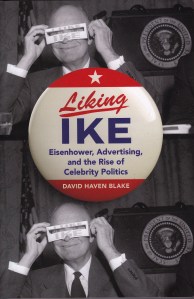
“Television today plays too great a part in our national life for us to allow it to fall into misuse by unprincipled hucksters. We must demonstrate at the polls tomorrow that we will not be treated like suckers at a nation-wide Republican carnival.” The words aren’t mine. Nor are they of this decade. Orson Welles (not the actual source) was reputedly speaking for Adlai Stevenson in the 1956 campaign against Dwight D. Eisenhower. There is a larger context, of course. That context, with a changed cast of characters, reaches right up to this minute and is explored in David Haven Blake’s Liking Ike: Eisenhower, Advertising, and the Rise of Celebrity Politics. In the 1950s Eisenhower disliked and distrusted television as a serious political tool. As Blake traces the story, however, his televised likability led to key components in the elections of John F. Kennedy and the once Democratic Ronald Reagan. Americans, swept off their feet by media advertising, ceased to elect the better candidate, starting over half a century ago.

Don’t get me wrong—Blake is no conspiracy theorist. His book was published before the otherwise inexplicable election of Donald Trump. It is a disturbing thesis to contemplate. The progression is impossible to miss. Eisenhower permitted Madison Avenue ad men to commodify him, reluctantly. John F. Kennedy embraced the media. He was, however, a career politician. Richard M. Nixon tried to play the game, and did so sufficiently to win. Meanwhile, Ronald Reagan, a Democrat inebriated by the money and power of big business, was a B-movie actor cum politician. He won elections like any high school popularity contest. The course was laid. Elections would be won or lost on superficial appeal. No longer would education, intelligence, and the good of the nation be primary in the minds of the electorate. We would vote the way the media decided we would vote.

Blake’s book, as stated, was written before Trump. Many noted last year, although the media was against him, it handed him the election. Front and center in headline after headline, in retrospect how could the election have gone otherwise? His narrow victory (and downright landslide loss in the popular vote) required every bit of energy on the side of reason to combat. Reason, however, is hardly a worthy opponent to media. We want an entertainer, not a leader. After all, that’s what television’s for. Even now the Tweeting’s on the wall. We mainline our news and wonder why things are the way they are.


Wonders and Signs

Raised by a woman who would be perhaps classified as a “single mother” these days—she was technically married except for a very brief time just before my step-father came along—I have always had great appreciation for the power of women. She didn’t have super-powers, but she raised three young boys largely single-handedly without the help a young woman has a right to expect. Wonder Woman, when I saw her on television, struck me as a very different kind of female. Strong, yes, but clearly there for men to look at. But then again, I didn’t have the benefit of Patty Jenkins’ Wonder Woman. I left the theater speechless. Apart from a few sniffles my wife didn’t have much to say until about an hour later. It’s that kind of movie.

I’ve seen many superhero movies. In fact, heroes are almost custom-made for the big screen. Comic books are basically storyboards already, and the colors and action are the very definition of spectacle. Wonder Woman, however, complicates the tale of the hero fighting for justice and truth. She fights instead for peace and love. Never supposing she’s anything but capable of defeating the evils of war, she doesn’t take orders from men. She actually shames an elderly, heavyset general for not being on the field of battle where, he acknowledges, others will die for the cause of the armistice. It’s a world inverted. Yes, the men are drawn to Diana, and can’t help but be awed by her. They don’t control her, however. She’s the first out of the trenches and she requires no man’s help when combatting the enemy.

Perhaps the most striking thing about the movie is the respect it to shows to women. Only one nude body appears in the film, and it’s male. I suspect I wasn’t the only man present made uncomfortable by the curious female gaze and the assessing questions of the goddess. Women are made to sit through countless movies as the subject of the male gaze. The embarrassment here is a reminder that making women sexual objects is the normal expectation. What if the roles were reversed? When Wonder Woman fights she is largely defensive. Men want to destroy her. She responds by declaring love will overcome war and owning her role as the “God-killer.” This is a movie with substantial subtext. It challenges the paradigm of men’s rule as wise and beneficial. A god may have to die, but the world is a better place for it. We could use some inversion about now.


Scaping By

Failure is a part of life. We don’t like stories about failure, however, unless the protagonist goes out with a memorable bang. So it is that when we fail we start looking for a scapegoat. Now it’s a little too early to tell if Ken Ham’s Ark Encounter can be considered a failure. According to a story on Friendly Atheist, “Ken Ham is Now Blaming Atheists for the Economic Failures of Ark Encounter,” the ark may be loaded with dinosaurs, but not money. People need their myths, yes, but myths that take themselves too seriously often fail to convince. Atheists, even the friendly variety, have always been convenient scapegoats. I wonder how many scapegoat species are in the Ark Encounter.

I don’t know about you, but I’m curious about the Ark Encounter. I don’t want to go because I don’t want them to have any of my money. As I’ve told academic friends who visit—I just can’t see contributing to their cause. Although the Right seems to implode when it reaches power (there are far too many selfish people in the Party, and selfishness leads to easy splintering) one thing that it has is money. Think about it, the extremely wealthy are on their side. If I was given a free pass I might find it worth my while to wend my way back down to Kentucky. Who doesn’t like a spectacle? And I would like to see how they represent scapegoats in their dioramas. Besides, with sea levels rising from “fictional” global warming it might not be a bad idea to get a few tips on how to build an ark, no matter what you believe.

You only fail when you fail to try. That was a phrase a friend used to repeat to me before disappearing from my life. A friend from college once told me that I had to stop admitting my failures if I wanted to move ahead in life. There is a danger in easy appearances of success, however. Failure can be a very noble teacher. There are mornings when I’m walking across Manhattan, passing the homeless in their blankets on the street, and I realize that I would not be where I am were it not for failures. I could hide them, but if I haven’t learned from them they’ll only burst out of the closet again when it gets too full. Is Ken Ham’s Ark Encounter a failure? It’s far too early to tell. One thing we know for sure, however, is that scapegoats will never be an endangered species even if there’s a world-wide flood.

James Tissot,Agnus-Dei: The Scapegoat (Brooklyn Museum via Wikimedia Commons)


Ammonia Avenue

It’s 7:00 p.m. I’m still sitting on a bus, in unmoving traffic a mere three miles from home. I stepped out of my front door over 13 hours ago and I have only another hour before retiring to start it all over again tomorrow. My phone’s down to a charge level that the effort of getting a non-wifi connection will only drain it completely. I have no idea why I’m being rerouted. Later I’ll learn that we’ve been instructed to shelter in place because of a N-Aminoethylpiperazine spill. Better living through chemicals. I’m sheltering in place, all right. This bus is my ark.

There’s much about this complex world that I don’t understand. I readily admit that I don’t know much. One thing I do know is that I live my life trying not to impact others negatively. I’m reminded of this every time someone blows a cloud of smoke into my path, plays their music so loud that even they can’t really hear it, or spills Aminoethylpiperazine all over the place. I don’t haul corrosive chemicals (beyond what may be trapped in my gray matter) through anybody’s hometown. I think of that scene from Close Encounters of the Third Kind—a dangerous chemical spill. Evacuate Devil’s Tower. There’s nothing to see here, folks. It strikes me that this is a larger ethical issue. The right to use, and potentially destroy, somebody else’s space. If you inhale Aminoethylpiperazine fumes, it can be fatal. It may take longer, but the same is true of second-hand smoke. The things that go beyond our own personal self-abuse into the realm of harming others. Somebody call an ethicist!

Commuting isn’t really a lifestyle choice. There may be a few stalwarts on this bus that really enjoy it, but from hearing the weary conversation of the regulars somehow I doubt it. We’ve been rerouted to New York City for our jobs. Our free time is consigned to an aluminum lozenge on wheels. Sometimes it actually moves. Have you ever tried to read a book when the head of the snoring guy next to you keeps falling into your lap? I think about those animals on the ark. Life is more than eating and breathing. You’ve got to have some space to move about. Even when I wake up I’m not in the same position as when I went to sleep. Of course, ethics demands I look at it from the other’s point of view. Someone needed a truckload of Aminoethylpiperazine, and they’re disappointed that it never arrived. Just don’t breathe too deeply. This flood can’t last forever.


Making Prophets

I first read 1984 around its eponymous date. The context is informative. I was a student at Grove City College, a conservative, Reagan-esque school of strong free-market inclinations. Being a first-generation college student I knew nothing of choosing a school, and since my upbringing was Fundamentalist, and since Grove City was a place I’d been many times, it seemed the natural choice. As my four years there wore one, my conservatism became effaced before what should be the effect of higher education. I was reading and learning new things—ideas that in the pre-internet days were simply inaccessible to someone from a small town which had no library, no bookstore, and, to be honest, no charm. How was someone supposed to learn in those circumstances? Largely it came down to high school (for those who finished) in a nearby town, and television. George Orwell saw the potential of the latter far too clearly.

It was in this great conservative bastion that I read 1984—I don’t even remember what course it was for. I do remember vividly the discussion of the Appendix on Newspeak—that it was a danger, a very real danger, to engineer language to prevent free thought. That was conservatism in the literal era of 1984. When that year passed we breathed a collective sigh of relief that Orwell’s prophecy hadn’t happened. Maybe Orwell wasn’t a prophet after all. The thing about prophecy, however, is that it unfolds slowly. Trump may have caught the world by surprise, but the evidence is there that the Orwellian groundwork was being consciously laid from the time of the Clinton Administration onward. Those who seemed to think Ingsoc was onto something good began working in local politics—the level of school boards and state elections, to build a strong conservative bloc. How many states have Republican governors? Go ahead and look it up, I’ll wait.

Progressives blithely moved ahead, making real ethical strides. One problem that they’ve always had, however, is believing that Evil is real. It’s an outmoded idea, fit for Medievalist thinking only. There are, however, very real racial supremacists out there. And avowed, unrepentant sexists. They feel that the great white way has been slighted and they are itching for revenge. Don’t believe me? Turn on the news. This is not your father’s Republican Party. In 1984 the Republicans were warning us about 1984. By the next decade they were actively emulating it. Orwell died paranoid and the world was relieved as his prophecy was harmlessly classified as fiction.


Remember Ronnie?

Listening to Comrade Trump, I wonder what it is the GOP really wants. My doublethink may be fuddled a bit, but I’m old enough to remember a guy called Ronald Reagan—champion and darling of the Republicans, some of whom say he was the greatest president ever—who stood firmly against Russia and its designs on this country. Now there is clear evidence that, no matter what the Comrade-in-Chief personally did, his inner circle has been dancing with Putin and they’re more than just a little tipsy. And the GOP stands up and cheers. I don’t know about you, but those who voted for Trump have to be wondering where they laid their Russian dictionaries about now. The Red Scare has come to town and Ronnie’s rolling in his presidential tomb.

The utter stupidity of not seeing when you’re being played astounds me. Look, I’m not the most worldly guy—I taught Bible for goodness sake!—but even I can see when a senator’s smirk says “sucker!” Where were the Trump supporters in the 1980s when we were against everything the Russians were doing, and that’s when they had Gorbachov leading them out of communism? It’s enough to make an old believer in common sense like yours truly crawl into a bottle of vodka and never come back out. Of course, in my days at Nashotah House some in the Episcopal Church were having their own fling with Russian Orthodoxy. Even to the point that the refectory was ordered to serve borscht. I personally didn’t see the charm in it.

I’m not the greatest nationalist alive. Borders, which are artificial, cause far more problems than they solve. You might call me a communist, since that’s in vogue these days. Nevertheless, if we wanted another country to decide our fate for us, I wouldn’t have chosen Russia. My personal choice? Vatican. As the smallest nation in the world they seem to have the best leader on offer. Pope Francis at least has a serious concern for the poor and needy at heart. There are those, after all, who argue that JFK, our only Catholic president, was even better than Reagan, as hard to believe as that might be. There seemed to be a little kerfuffle about missiles in Cuba, I seem to recall, but let’s let bygones be bygones. We live in a world of Newspeak and tweets. And if I didn’t know better, I’d say this borscht tastes a bit off to me.


Analyze This

Reading other people’s scripture is a privilege. Although somewhere in my long study of the history of religion I must have read excerpts of The Analects, I have not concentrated on reading them through before. Reading other people’s scripture is like being invited into their houses. You can learn a great deal in a little time, but that doesn’t make you an expert. Confucianism is about the same age as classical Judaism. The foci of the belief systems are clearly culturally bound, and those of us raised in cultures heavily influenced by Judaism and Christianity find scriptures like The Analects somewhat bewildering. For those raised in Confucian cultures, the Bible must also be like coming into an unfamiliar country. That’s the way scriptures are, and it doesn’t mean that any are more or less valid than others. That’s often difficult to accept.

I don’t know much about Confucianism, but it is clear that The Analects are intended as a guide particularly for those who seek public office. In Confucian thought, unlike that of the current United States, only the brightest are believed to be worthy of high office. Indeed, it is impossible to read The Analects at this time in history and not see that Trump is so wrong in multiple languages. Master Kong’s description of “the small man,” the petty sort who has no business governing, is the job description of the GOP right now. Is it possible that one political party has ruined two religions? Probably far more.

Learning—even in small increments—of the religions of others takes away the need to feel superior. In fact there are many commonalities between religions, particularly on the ethical front. Reading other people’s scriptures isn’t easy. There’s so much that’s foreign in them. But like the fact that foreign trade brings desirable things from abroad for us, so should be the study of other religions. There is much of value here. I don’t read Chinese. I’ve never been to China. Reading The Analects, however, demonstrates that the noble minds of different cultures have much to learn from one another. No scripture is perfect. All are necessary. It’s only when one faith decides that it alone is true that religious strife begins to replace religious respect. I’m not about to become a Confucianist, but I do have a a slightly better sense of what it might mean to be one. And small steps can lead to impressive places for those willing to learn.


Bull

Bulls have long been symbols. If I write “that’s bull” your mind will likely fill in the missing implied word. In ancient times the king of the gods, El, was known as “bull El”—probably for a very different reason than the veiled scatological reference above. Bulls were powerful and, to those in settled, agrarian societies, necessary for life. Of course, they can turn on you and kill you with little thought. Even in our high-tech, urbanite world, we keep our bulls at hand. “Charging Bull,” a golden calf if there ever was one, is a famous Wall Street statue erected to the glory of mammon and greed. On May 7, to celebrate International Women’s Day, a statue called “Fearless Girl” was placed in front of “Charging Bull.” Our symbols require some reevaluation. In a kind of Trump-up, another artist placed a statue of a dog lifting its leg on the girl, according to the Washington Post.

We creative types can be sensitive about our work. Apart from writing I’ve dabbled in drawing, painting, and sculpting, although few have seen the results. I know that the space around an artwork is part of the art. I’ve posted before about Grounds for Sculpture, one of my favorite places in New Jersey. The idea of a sculpture park is that the context of the image is important. Statues show up fairly frequently in New York City. The ever-changing art along the pedestrianized part of Broadway in Midtown keeps the walk to work interesting. Interacting with art is performance. At the same time, the respectful viewer knows, artists are making a statement. Placing a girl before a charging bull says so very much.

“Fearless Girl,” unlike the great lummox she faces, is temporary. Nevertheless, the statement she makes is loud and clear. Wall Street might more aptly be named Ball Street for the amount of testosterone that surges through the place. Men erected a system to keep women out of positions of power. And even when a small symbol of female resistance is placed, some man has to have a pug pee on her. I wonder what our society’s become. We’re hardly agrarian any more, yet we still feel “bullish” about things. When’s the last time anyone used “girlish” as a compliment in a business context? “Fearless Girl” will be allowed to stand until February. The pug is temporarily gone, but will be back. When the girl goes the pug will follow. All that will be left in Bowling Green Park will be bull.


Girls to Men

Seminary in the 1980s was a time of endless debate. Some of my classmates at Boston University School of Theology thought me too conservative—I’d made progress from my Fundamentalist days, but these things wear off slowly. Part of the issue, however, was that I look at things in terms of history. (That’s how I ended up teaching Hebrew Bible although my work is generally history of religions.) I remember an argument over changing a text from reading “man” to “human.” The latter, of course, still has the offensive root, but language is only so flexible. My thought at the time (which has changed since then) was that English “man” derives from German “Man.” In German the noun is masculine since all nouns have gender, but it can refer to either a female or a male. “Man,” in origin, is gender-neutral on the human side of the equation. Mark Twain once famously wrote an essay on the barbarities of the German language where he highlights this.

I’d studied German seriously in high school. After four years of the language I felt that I could understand it in a way that comes when you begin the think of certain expressions and wonder how you say that in English. I had come from strongly Teutonic stock on my mother’s side, and German felt quite natural to me. Of course, in college I had little opportunity to use it. Even less so at seminary, so the details had begun to slip considerably. If “Man” could mean “woman” what was the problem, I wondered. Then I started to think of it from a woman’s perspective. As English speakers, “man” is an exclusive term. It refers to males. Over time it has come to refer to males only. Retaining it in hymns or Bible translations makes them exclusive. We need language to meet new ways of thinking.

The other day I was consulting an Oxford dictionary for something. My eye fell on the word “girl.” To my surprise, I read that “girl” originally referred to a small child of either gender in its germanic roots. This is an archaic usage to be sure, but it helped to explain old photographs where toddler boys were dressed as girls and had long, flowing hair. The young were girls, the adults were men. Gender, I have come to see over the years, is a concept that doesn’t conform to simple binaries. Intersex individuals don’t fit into the either/or paradigm. Language struggles to keep up with reality. Traditionally we all started out as girls and ended up as men. And those would be fighting words these days, whether in seminary or out.


Hex Marks the Spot

Public versus private has been on my mind quite a bit lately. Partially it’s because I’ve been reading about magical beliefs and their persistence. It always amazes me how publicly we declare ourselves rational and uninfluenced by the supernatural. Once we get behind the closed doors of our domiciles, however, a transformation takes place. Our insecurities and uncertainties surface. Given the right circumstances we might even confess that we believe in magic. I know I’m generalizing here, but private space does allow for private thoughts and getting out with others can bring a much-needed relief. I was reading about Hex Hollow in an article a friend sent me from Roadtrippers. Hex Hollow is a small town in my native Pennsylvania where a murder took place over witchcraft. I won’t go into the details here—the Roadtripper story is quite brief and tells the tale—but it turns out a man was killed for being a witch. His murderer was also a witch who’d been sent to him by yet a third witch. The crime took place in 1928.

Think about the timeframe for a second. It was between the World Wars. Technology was fairly advanced. Witch trials had ended centuries ago. Still, some people believed enough in witches to kill for their conviction. Historians of religion have pointed out that Americans have never really outgrown the belief in magic that we deny so assiduously. I’m not trying to single out one nation here—there is widespread evidence that magical thinking is endemic to the human thought process. We aren’t so quick to let something go that, according to reason, has served us well. Had magical thinking been purely detrimental it should’ve died out long ago. We need our magic.

As yesterday, so today.

I’m not suggesting witchcraft is real. At the same time I know that it’s natural enough for thoughts to move into familiar terrain when stressed out. In Hex Hollow the man who did the murdering was convinced he’d been hexed by his victim. Perhaps he’d climbed the ladder of inference (what we tend to call confirmation bias) to a rung where the only way down was a criminal act of desperation. That’s no excuse to kill someone, of course, but it fits with what we know of an all-too-human form of stress relief. Nor is it rustic rubes to blame. Psychics in New York City are abundant and even US presidents have been known to consult the stars a time or two. Of course, once I step outside that door I’ll say it’s all nonsense.


How to Type a Stereo

In the early days of publishing, type was set by hand. Individual letters, inserted backward onto plates, were used for printing the positive of a page. Printers could make as many pages as desired, but once the letters were released, it was time-consuming and costly to arrange them all again. If a book (principally) was expected to sell well enough for reprints, a plaster or papier-mâché mold was made of the page. This could be used to cast a solid metal plate of the pages to store for future print runs. This solid plate was known as a stereotype. Every copy from the plate would be exactly the same. When the plate was no longer needed it could be melted down and recast. The origin of stereotyping is a useful reminder of what happens when we preconceive a notion. For example, if I write “computer programmer” there is probably an image that comes to mind. No matter how many stereotypes confirm that mental picture, it isn’t true to the original.

Photo credit: Roger and Renate Rössing, Deutsche Fotothek, via Wikimedia Commons.

A piece by Josh O’Connor on Timeline, “Women pioneered computer programming. Then men took their industry over,” tells the story. Back in the early days of computing, when programming was seen as the menial labor of swapping out cables and plugs, it was “women’s work.” When it became clear how complex this was, and how many men didn’t understand it, the job was upgraded to “men’s work” and women in the industry were replaced. Stereotyping wasn’t just for boilerplate any more. The unequal assumptions here have led to a situation where computer engineering jobs still overwhelmingly go to men while women take on more “gender appropriate” employment. Any task that requires mental calculus benefits from input from both genders. One’s reproductive equipment is hardly a measure of what a mind is capable of doing.

Stereotyping is so easy that only with effort can we force ourselves to stop and reevaluate. The computer industry is only one among many that has been remade in the image of man. Our archaic view of the world in which everything is cast metal should be softening with the warming of intellectual fires. A large part of the electorate in our technically advanced nation admitted it just wasn’t ready for a woman in the role Trump is daily cocking up. It will take more hard lessons, perhaps, before even men can be made to admit that women can do it just as well, if not better. Stereotypes, after all, are eventually melted down to make way for new words. This may be one case where literalism might be a reliable guide.


Light and Dark

Prophets, mothers, messiahs. A new religion for a new world. While these may not be main themes of Robert Repino’s new novel D’Arc, they’re clearly there in the background offering verisimilitude to a world turned upside down. Continuing the diegesis created in his previous two novels Mort(e) and Culdesac, Repino again shows an uncommon awareness that when survival becomes difficult people (and animals) turn to religion. Many fiction writers create worlds under stress and pretend that characters simply forget the religious option. That may be realistic on an individual level, but as history shows, not on a societal one. People—and mutated animals—are meaning-seeking beings. D’Arc doesn’t shy away from this fact. In a wildly integrated world of different species coping with consciousness and opposable thumbs in various ways, religion naturally arises.

If you haven’t been initiated into Repino’s universe, it begins with a virus and/or a plot—themselves religious—which allow animals to become bipedal and to grow human hands. They can talk and reason and they show us a true reflection of who we are. D’Arc, the female companion of Mort(e), finds her way in a world under threat. Planning to speed up global warming in a dramatic way, the aquatic antagonists conspire to melt the ice caps to flood the entire world. Repino knows the value of the flood story and uses it to full advantage. Along the way we meet beavers who’ve developed a religion that functions between water and dry land. Indeed, as a species their religion defines them as much as their engineering skills. This is a world that’s just been through war and instead of reconciling all species, there remain those (most notably humans) who can only live with their own superiority. This is a complex universe.

The hero of this tale, D’Arc, is sympathetic to the religious sensibilities that have sprung up around her. She herself is a character prophesied in this world where Mort(e) is messianic. There’s a scripture in the background somewhere and theirs is a world without embarrassment about it. There’s also plenty of action and adventure—the war with no name is really not over—but there’s a subtlety to the narrative as well. When things go awry many people do assume they’re alone in the universe and try to find their own way. It’s equally true that many look for meaning in a structured form of belief where all of this has been foretold. Such worlds, to me, seem to be more honest to the human condition, even when the characters are cast as talking animals.


Ellis Island

A few years back we made a trip to Ellis Island. This is a common field trip here in New Jersey, although none of my immediate family passed through this portal. The most recent immigrants in my own heritage seem to have arrived by the early 1800s. In any case, Ellis Island is an impressive location. Now a museum, you can wander through the rooms and get an idea of what newcomers faced after a long and trying ocean voyage. What struck me the most was that large numbers of people were turned away for mental problems. I suspect mental illness of one sort or another is unnervingly common among human beings, and our current frenetic pace of life probably only exacerbates the situation. Still, I wonder if we really have a clear grasp on what is “normal.”

As humans become more adept at understanding their own brains, a need for more precise definitions asserts itself. A friend recently sent me an article suggesting “Neurologists Have Identified Brain Lesions That Could Be Linked to Religious Fundamentalism” on Science Alert. The article my Mike McRae ultimately doesn’t suggest that brain damage is the answer to Fundamentalism, but the story reminded me of an unscientific observation by one of my seminary professors decades ago. Harrell Beck once said something along the lines of Fundamentalism isn’t a theological position, it’s a psychological problem. Indeed, those who fall into the literalist camp have a preternatural urge to see things in black and white. Rules that can’t be violated, even if it means your deity’s an angry old God. With literally Hell to pay if you’re wrong, the right course of action is strikingly clear. Only life’s seldom so simple.

We study our brains but we don’t have a baseline for normal. I can’t believe that waking before dawn to catch a bus to work a job that pays less than a successful high school degree in other states is a good bet by anybody’s standard measure of normalcy. Those who read probing biographies find that even our brightest and best have quirks they didn’t wear in public. Surely the physicians on Ellis Island had some guidelines in mind when they were turning away those who didn’t measure up to the standard of what an ideal American mentality should be. Although Ellis Island shut its doors over half a century ago, it’s clear that even if we kept some unstable candidates out, we’ve done a stellar job of growing our own. And that can be taken as truth by faith alone.