Steel Pennies

409px-CasablancaPoster-Gold

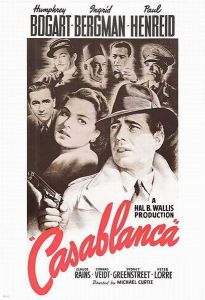
I remember seeing my first steel penny. At first I didn’t think it was real. Like many poor kids, I was a collector. I collected anything cheap: cancelled stamps, bottle tops from glass pop bottles, fossils, just to name a few free trinkets. And I’d started coin collecting, with pennies. I’d noticed the difference between wheat backs and Lincoln Memorial pennies, and I knew that the former might be worth something some day. There was a hobby store in town and by thumbing through the collectors’ books, before being shooed out, I’d learned that keeping an eye out for wheaties was a kind of investment. Just hold onto it long enough, and it’ll grow in value. I never saw a 1943 penny, though, until a fellow collector traded me one. During the war, he explained, copper was too valuable to use for pennies. Wartime, it turns out, changes lots of things. About the same time as these steel pennies were being minted, Casablanca was still showing in theaters.

As I sat down to watch Casablanca again last night, some new thoughts occurred to me. A wary eye can spot the cost-cutting measures of a wartime movie. Somethings never change. Nazis were bad guys, obviously, but we still didn’t know who’d win the war by then. And refugees flooded to Casablanca to try to escape Europe for America. The movie makes quite a lot of this endless waiting. It’s hot in the desert. People are waiting to go somewhere better. And there are elements of torture there as corrupt officials cooperate with Nazis, even though this is Free France. It occurred to me that this is an allegory of Purgatory. I’m pretty sure it’s not intentional, but here are lost souls waiting for deliverance. The plane to Lisbon is the soul’s escape to Heaven. Meanwhile the relentless waiting.

For a movie approaching 75 years old, Casablanca holds up remarkably well. The extras on our DVD tell us the plane in the final scenes is a cheap cutout just a few feet away on a sound stage. The mechanics attending it are little people to bring it into perspective. Tucked away in some box somewhere I’ve got a few steel pennies. These days coins change so frequently that I wonder just how stable this world really is. While the “Middle East” still has us as worried as ever, our money is, for all practical purposes, only virtual. Paychecks are mere electrons and I’m just a temporary repository between my employer and those who claim increasingly more of my pretend money. We seem to be caught between two worlds. In one nothing is really real at all. Rick’s Café Americain feels somehow very familiar, as we spend our time waiting for passage on a plane to Lisbon.
Gallows Hill

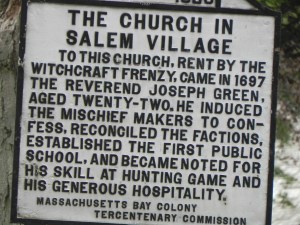
Over the past couple of weeks it has been in the news that the site of the “witch” hangings in Salem, Massachusetts has been identified. The actual site had long been suspected, and it was only recently confirmed by a group of historians using the empirical evidence available to historians. Although my interest in the Salem trials pre-dated my wife, nothing brings you so close to history as being a part of it. Descended from the brother of three of the women accused of being witches at Salem, my wife brings a sense of reality to the tragic accusations of three centuries ago. Although toyed about in the media (an episode of Sleepy Hollow, “Spellcaster,” in season two, featured an actual Salem witch) the fact is that nineteen innocent people were executed for a fanciful belief that the Devil was roaming about New England, and when you can’t catch the Devil, you have to use a scapegoat.

DSCN0518

One of those investigating the location of Gallows Hill was Benjamin Ray of the University of Virginia. I’m sure Professor Ray wouldn’t remember me, but one day as I was doing a campus visit for Routledge, I had taken AmTrak to Charlottesville to visit the religion department. Many of the faculty declined to see me, and as I sat on a bench in the hall (one of my academic dates had stood me up), Dr. Ray walked up to me and asked me if he could help. I explained who I was and he invited me to his office where we talked about Salem. I told him was wife was related to Rebecca Nurse, Mary Eastey and Sarah Cloyce, the two former, as he knew, executed for an imaginary crime, and the third accused. A strange quiet settled over the office. He told me his interest began because he too had descended from a Salem family. His ancestor, however, had been an accuser rather than a victim. It was a strange rapprochement. Opposite sides brought together in scholarship.

What truly frightens me about Salem is that we have not outgrown it. Presidential hopefuls spew the same fear and hatred toward Muslims, the hispanic immigrants who make our economy possible, and women (this should sound familiar) trying to “take the place of” men. And the crowds cheer, as crowds will do. Even though Donald Trump cussed twice in his Liberty University speech (an infraction for which a student would have to pay), President Jerry Falwell, Jr. (typing that makes me shudder) shrugged it off saying that we’re all sinners. Some sinners, however, carry a wicked, knotted rope with them while other sinners try to eke out a living in a nation where some can get rich by owning casinos while others frantically spend their inadequate cash hoping to win Powerball. We now know where innocent people accused of witchcraft died, but have we learned anything from it over these past three centuries?


Not Your Father’s Demon

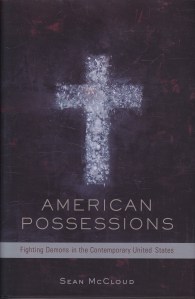
AmericanPossRegan MacNeil is a name that can still send shudders up and down stout spines. Despite advances in CGI and special effects, The Exorcist is consistently rated among the scariest movies of all time. Demon possession, clearly, is a very troubling thing. American Possessions, by Sean McCloud, is not a place to go to find Catholic priests expelling the forces of darkness. Subtitled Fighting Demons in the Contemporary United States, the book, one might suspect, is saying more than it seems to be letting on. This is a book about Third Wave evangelicalism and its demon-fighting manuals. Although the term “Third Wave” may be unfamiliar, the next time you go to a Tea Party you’ll know you’re among them. These born again uber-capitalists believe in a literal demonic world. In fact, demons are so common that Jesus would’ve had a hard time keeping up with their exponential economic growth. These demons are more frightening than those that possessed Regan. The are more akin to a different Reagan.

Especially popular among Pentecostals (the fastest growing form of Christianity) this modern day belief in demons sees them in places Jesus didn’t think to look. Family curses (at places ruled out in the Bible, but still, apparently, possible), addiction, depression, sexual urges—these are all demonic. And once these modern demons are cast out, unlike that of Regan, they can come back. And if they don’t possess you they will oppress you. And they can live in your material goods, your house, and even the land it is built upon. They are everywhere, and they have to be fought against constantly. They also, apparently, vote Republican.

This view of the world, strange as it is to many people with a basic education in science, motivates a large sector of the United States population. Expelling these demons requires a specific view of Christianity—a view that absolutely excludes Catholics. And it is a view that promotes free market economics, blaming the victims of poverty for allowing themselves to be oppressed by demons. Many aspects to this belief system will strike the reader as completely unbelievable, all the more for being so seriously believed. At the same time, we are told, we should pay no attention to religion, at least as educated people. The problem with this is that these true believers vote. And the kingdom they would have come on earth is, in a way they would certainly deny, possessed.


Yopp

My fellow academics, lend me your ear. Two or three friends have sent me articles this past week, featuring academics speaking out against the businessification of academia. I’ve been railing about this for years, and I am encouraged by my fellow academics who are looking up from their research long enough to realize they live in a crumbling, if ivory, tower. Too long and too often academics have taken the road of least resistance. Jobs may be rare, but hey, I’ve got one, so who’s to complain? It is tres chic not to believe in anything these days, but I am now, and have always been, a believer in education. And education is not something that can be bought or sold. Higher education is not a business, and if society insists on replacing university presidents with CEOs, then it is time for those of us who believe in education to unite and form our own forums to educate. It won’t pay as well. You might have to skip an academic conference or two, but if we really believe, we can make a difference.

I’m not finger-pointing here. I know that when I had an academic post, such as it was, I wasn’t particularly motivated to suggest that a new model was needed. But now that adjuncts and those of us who are underemployed Ph.D.s outnumber our tenured brethren and sistren, it is time for us to begin talking about alternatives. Once a university becomes a money-making machine there’s no turning back. Too many people love money too much for there to be enough integrity for a president to say, “No, I don’t need a raise. Hire more faculty instead.” Those academics who believe it will happen need to get out more. Although the most educated people in a given society, academics can also be among its most naive. If you can’t join them, beat them. (Metaphorically, of course.)

My education, in many ways, began with Dr. Seuss. We couldn’t afford the books, growing up, but we had television—especially the poor have television. I remember watching, anxious with encouragement, as JoJo sets aside his yo-yo to lend his voice to a cause. His lone “Yopp” saves an entire world. My fellow academics, those with ears like Horton are rare. His species of elephant (let those with ears to hear, hear) may be extinct. I am suggesting right here, right now, that we get together and start working on a solution. This is my Yopp. I shall not, however, be surprised if my inbox fails to light up. The temperature, I know, is already rising. And Whoville, as always, will make itself available for purchase to the highest bidder. I believe it can be different.

IMG_2582


Long Revision

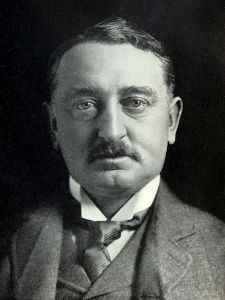
Cecil_Rhodes_wwThose of us who write know all about revising. You go back to a piece you wrote, maybe even just days ago, and you see all the things you want to change. Corrections, improvements, deletions, retractions. Histories are particularly prone to being viewed in new ways with the passing of time. I once thought histories were factually true, but in this postmodern age we’ve learned that while histories contain some facts, they are largely interpretations of those facts. Even the Gospels are interpretations. Recently I’ve been reading about student movements wanting to efface some facts of history because they make current-day people feel bad. A piece in The Guardian, for example, explains how some students want to remove the statue of Cecil Rhodes from Oriel College, Oxford, because Rhodes was an imperialist and a racist. A similar movement is afoot at Princeton University to give Woodrow Wilson the old Akhenaton treatment for similar reasons. Student interest groups, as The Guardian points out, don’t want to be reminded of their once marginal status. Removing Rhodes (or Wilson) from his pedestal, however, won’t change history.

I wonder if those in these special interest groups have enough experience to realize the implications of their complaints. What if, for the sake of argument, one of these student leaders became a national leader? What if her (or his) nation became oppressive during her or his lifetime but s/he didn’t see it because it was the operating milieu of the age? And what if their nation later repented and brought those from their former oppressed colonies to their homeland and those who came turned against that past leader? The point of this scenario is to suggest that none of us—or at least very few of us—have the ability to think beyond our age. Can we be blamed for being children of our time? Will removing our mementos change the facts of history that will have transpired? Will it make us feel better to bury the truth of what happened?

What's behind that self-satisfied smile, Akhenaten?

What’s behind that self-satisfied smile, Akhenaten?

An issue that often weighs upon my mind when I hear of these groups of the marginalized is that there is a very large, and very diverse marginalized class that has no voice, even today. The poor. Sure, some of us raised in poverty can claw our way to a descent living, but succeeding in a world where you need connections and favors owed and special knowledge of how a system works will be forever beyond our grasp. I knew a refugee, once upon a time, who was a student of mine. He used to complain to me of the costs of having his shirts sent out to be laundered. His clothes were tailor made. He refused to use a washing machine. He was also quick to point out that I was the oppressive race. This he did without a nanogram of irony. Cecil Rhodes may have been as evil as some say he was. His money, however, made it possible for some of the heirs to his oppression to study in his shadow. And I write that with a heavy dose of irony. Do they not realize that Akhenaton is now considered by many to be the most interesting Pharaoh of them all because he was erased from history?


Monstrous Intentions

Atlas Obscura is one of those websites where you could spend all day and feel like you’ve just traveled the world. Featuring less know locations, and strange spots that you might like to visit, sometimes it also has stories about monsters. Well, at least one story about monsters. A friend of mine recently shared Cara Giaimo’s story about thirteen lesser-known monsters from history. While none of these are likely to keep you up at night, they do demonstrate the endless imagination people devote to the unknown. Monsters, like religion, defy easy categorization. Is something that’s “too big” or “too small” for its type a monster? Is it a monster if it is a mix of things that don’t normally come together? Or is it merely a matter of baleful intention? What doth a monster make?

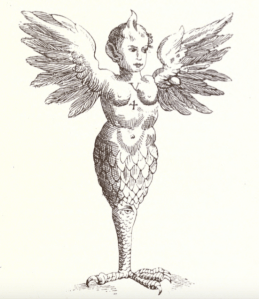
Taking a page (almost literally) from John Ashton’s Curious Creatures in Zoology, the Atlas Obscura page runs down some monsters once believed to have existed. Some of them, despite our flattened world seen only through the eyes of rationality, were actually reported to have existed. The “monster” of Ravenna, for example, was apparently a sad case of a medieval/early modern birth defect that, in the popular imagination took on monstrosity. We now know that birth defects may contain throwbacks to earlier stages of evolution, or that genetic coding may contain mutations. None of this suggests any evil intention on the part of anybody. Accidents of nature may be the saddest kind of monster of all.

Screen Shot 2016-01-27 at 5.42.32 AM

A surprising number of the monsters from Ashton’s sampler here are mixes between human and animal. Indeed, that mix is still a potent force, theologically. One of the loudest voices speaking out against evolution is the one that says people are “not animals.” Having grown up with that belief, it took a couple years of college to convince me that we fit into the greater biological scheme of things. We fear that which resembles us, but is not quite us. Perhaps part of the mystique is that we haven’t quite yet learned to be humane to one another. Being a monster may just have more to do with what one does with prejudices than it does with physical features of their bodies.


When Gospels Mattered

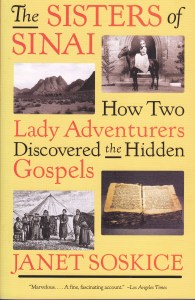
SoskiceOnce I met with a group of writers and intellectuals in the Pacific northwest to discuss ancient—indeed, dead—languages and their cultures. I’d never before been accorded “rock star” status for what, for me, seemed a natural progression. I had spent my youth learning archaic languages and reading documents that few people had heard about and even fewer cared about. It was a delight, therefore, to read Janet Soskice’s The Sisters of Sinai: How Two Lady Adventurers Discovered the Hidden Gospels. I have to admit having never knowingly heard of Agnes and Margaret Smith, also known as Mrs. Agnes Lewis and Mrs. Margaret Gibson, nineteenth-century Scottish twins who chose to use their inheritance in finding, reading, and preserving ancient documents. To appreciate the importance of this avocation, as Soskice points out, in 1881 when a new translation of the Gospels went on sale based on recent manuscript finds, Oxford University Press sold a million copies on the first day of sale and carts carrying the Bibles caused traffic jams in London. Today a doctorate in those ancient languages and five bucks might get you a cup of coffee.

What makes this story so intriguing, admittedly, is that here were two women in a men’s world, accomplishing great scholarship when the University of Cambridge refused to grant women degrees. (The twin sisters lived in Cambridge.) It is with some sense of familiarity that I read how, after discovering and photographing the Syriac palimpsest which turned out to be perhaps the earliest complete copy of the Gospels known at the time, the sisters could not even get Cambridge professors to look at their photographs. Professors, as we all know, are too busy to bother with amateurs like the rest of us. As soon as one of the more promising Cambridge scholars almost accidentally viewed one of the pictures, the men stepped in eagerly claiming the discovery for themselves. The manuscript was in Saint Catherine’s Convent in the Sinai peninsula, a journey not easy to make, even today. Agnes had discovered the palimpsest there on a journey to discover ancient manuscripts. But she was a woman in a man’s Cambridge.

We can congratulate ourselves on many things in academia today. In many fields a woman stands a better chance than a man in landing a teaching job. But we still have far to go. Salaries for women continue to lag behind those of men for doing the same work in general. Healthcare issues that effect primarily women are decided on by legislatures that consist mostly of men. In many parts of the world, women are, by default, treated as the property of men. Two Scottish sisters managed to help upset the world, in their quiet way, at the turn of the twentieth century. They did it by acts of scholarship. Genteel, proper, and very Presbyterian. If only we could say that in the century since then we had reached equality, we might have done something of which we could truly be proud.


The Great Slumbering

Even in days of secular education—I am a product of public education throughout my childhood—Jonathan Edwards is a name that still retains recognition among many Americans. Perhaps best remembered for his sermon, “Sinners in the Hands of an Angry God,” Edwards thrived at a time when being a clergyman was a recognized path to success in this world as well as the next. Not that all ministers became famous, of course, but those with the inclination had access to books and time to study. They could write books and influence public policy. Indeed, Edwards was part of the “Great Awakening” that spread throughout the young United States, before its independence. George Whitefield had brought a showman’s sensibility to preaching, and people gathered to listen to roving reverends who brought their wisdom to new locations. In fact, revivals continue to this day—I had attended a few as a child—and they are largely responsible for the denominational map of American Protestantism even today. The “Second Great Awakening” brought Methodists and Baptists into the mainstream to stay.

The first major revivals, however, were fueled by a Calvinistic intensity. Having spent many of my educational years in schools established or supported by Presbyterians, I know their theology well. Judgment is important in the Reformed tradition. Indeed, without the element of threat, the heat is stolen from much of revivalism. Edwards’ sermon encapsulates so well the vital element of a theology that preached total depravity, unconditional election, limited atonement, irresistible grace, and perseverance of the saints. In other words, unless God has already selected you, you’re out of options. As Presbyterian teachers were eager to state, you should still try to live as if you were saved (“elect”), even if you were going to Hell because of, well, you know, an angry God. Campus rules at Grove City embodied that ethic in a real-time way.

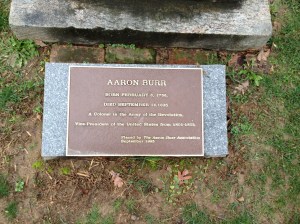
Jonathan Edwards went on to become president of Princeton University (the College of New Jersey, at that time). He died at about my age, having been inoculated for small pox—he was a believer in science—to demonstrate the value of the practice to students. He contracted the disease and died merely weeks later. Ironically, Edwards felt he was past his prime and had to be persuaded to take an academic job—somewhat of an extreme rarity today—and largely because his son-in-law, Aaron Burr, Sr., had recently died as the incumbent. Today, starting on the path to ministry is often a fast-track to job insecurity, popular derision, and poor earnings. For all that, it is difficult to be accepted in the ordination track without jumping through many hoops. So Jonathan Edwards came to rest in Princeton, New Jersey, as a famous, published, and highly respected man. A more different world then his in such a short time in the same location, is hard to imagine.

DSCN6140


Hamilton

Religion and politics. It’s difficult to get over the wisdom instilled in your earliest years, and I was one of those who learned that religion and politics always cause potential friction in polite conversation. They are both, however, very important to people and knowing how to communicate about them irenically is a sign of maturity. While I can’t afford Broadway shows, I have read reports about the brilliance of a couple shows that feature—what else?—religion and politics. “Book of Mormon” has continued to be a success in the theater district, and, starting this summer, “Hamilton” joined the ranks of most popular Broadway shows. A hip-hop-inspired version of the story of Alexander Hamilton, the show offers history to audiences traditionally just out for a good time. I haven’t seen the show, but on a recent long car ride, I listened to the soundtrack and I have to admit that I haven’t stopped thinking about it since. Part of the reason is the sadness of the story—the dual between Aaron Burr and Alexander Hamilton ended up with one of the “forgotten founding fathers” dead, and another cast forever as a criminal.

IMG_2652

Although my interest in history has defined my career (such as it is), I don’t pretend to know much about the revolutionary period. One of the reasons is that I’m more than a bit ashamed by the treatment of American Indians by the colonials. It is hard to celebrate when you feel like a criminal yourself. Another reason has been that ancient history has always captivated me, and events two-to-two-and-a-half centuries ago feel too recent. Nevertheless, I find myself in New Jersey where much of the Revolution played out: Washington crossing the Delaware, the Battle of Princeton, the Battle of Monmouth, and many other famous episodes. The British of that time enjoyed the power of empire—keeping others down so that the privileged might see themselves entitled. In the musical, King George has a role, in my mind, similar to Pontus Pilate in Jesus Christ Superstar.

I can’t help but think that what Lin-Manuel Miranda has offered in “Hamilton” is an extended kind of parable. The show is noted for its multi-ethnic cast in a story that was almost entirely, historically speaking, one of white privilege. Who can hear the songs swirling around the shooting of Hamilton and not think of the equally insane shooting of young African Americans who, like Hamilton, have no intention of causing harm? There are writers and poets and lovers who still try to find their place in a country that bathes the uber-rich with adoration and tax breaks and far too much power. “Hamilton” may, if people actually pay attention, turn out to be revolutionary. Politics and religion share that feature in common.


Storm Watch

Nothing encourages sleeping in like a blizzard. Although it’s a talent I’ve largely lost over the years, hearing the bellows of the wind and seeing the white reflecting through the blinds, and being a Saturday morning form the perfect recipe for letting my brain relax enough to fall back asleep after I’ve awoken. It’s a guilty pleasure that I had, quite honestly, nearly forgotten. Unlike several winter storms predicted last year, this one has actually come to pass. Prediction of the future may be one of those “God-of-the-gap” things, but meteorologists are modern-day prophets. In a society driven by work uniformity, days off are unwelcome, so a weekend blizzard might just seem to come from God. The highly anticipated list of school closings simply doesn’t apply. Many businesses still recognize the sanctity of the weekend, and we can just roll over and go back to sleep.

In ancient times the weather was anything but natural. The sky—so large and so far away—was purely the realm of the divine. The only way to impact it from down here was to pray and sacrifice and hope that it would behave. Getting back to that view of the world is nearly impossible here in the twenty-first century. We are so accustomed to natural causation that it is just one of those “butterfly effect” things. In truth, though, we know that human activity also has to share some blame with the butterfly.

Winter storms in January are not uncommon in the northern hemisphere, of course. January hurricanes, however, are. And as political rhetoric heats up and we once again ponder what it would be like to have another clown in the White House, global warming is dismissed as just another bad joke. As a nation we’ve been enamored of those who can provide the most entertaining gaffs and still claim they know enough to lead the nation. I have a hard time believing those who voted for Reagan had any success at separating fiction from fact. I still can’t convince myself that W was legitimately elected. The second term of both of these actors freezes me as much as the chill draft making its way through my apartment. The meteorologists nailed this one with their predictions. I’ll stay inside and huddle under my blankets until the all clear. And that may not be until well after November.

DSCN6166


Quaker Way

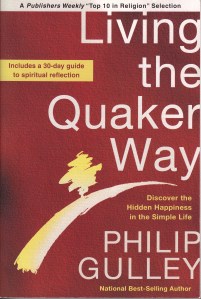
QuakerWayDoctrine can be an immense stumbling block. As a person who’s been involved with many churches in my life, the virtue of virtues often seems to be sacrificed on the altar of doctrine. If you don’t believe X, you’re not one of us. It was a great delight, therefore, to read Philip Gulley’s Living the Quaker Way. Having grown up in Pennsylvania, you might think I’d know a great deal about Quakers. I never met any, however, when I lived in the state. And I really didn’t know much about their beliefs. I knew they called themselves Friends, and I knew “Quaker” was originally a derogatory title, like “Methodist,” “Jesuit,” or the near homonym, “Shaker,” later reappropriated as a name for the group. I also knew that numerically they were on the smaller end of the religious demographic. Reading Gulley’s insightful little book was an epiphany.

I learned of Calvinism at a Presbyterian College. There I was taught TULIP: Total depravity, Unconditional election, Limited atonement, Irresistible grace, and Perseverance of the saints, the first three of which struck me as dangerous and unholy. What a beaming of light to read instead of SPICE: Simplicity, Peace, Integrity, Community, and Equality. This acronym is Gulley’s shorthand for what defines the Religious Society of Friends. Doctrine is nowhere on the list. A deity who creates people just to throw them into Hell is also missing. As is Transubstantiation. And religious violence in the name of spiritual purity. There is an awful lot to be learned from the simple message of people who understand that they are people and every other person is too. Gulley is not naive; he knows Quakers aren’t perfect. What he does show, however, is that those who are willing to relinquish self-assured self-righteousness make far better neighbors who resemble what Jesus taught than do many who would rather destroy the livelihoods of those with whom they disagree.

The beauty of what this book describes is that one need not be a Quaker to live this way. Not being doctrinal, a Quaker wouldn’t insist on that and still be true to the ideals of the Friends. If we could learn to want less, to get along with those with whom we disagree, be honest, welcome others, and treat all people as if they had a bit of God inside them the world would be a better place. There can be no doubt about that. One might say, “that’s just common sense.” I would guess that most Quakers would agree. Religion, freed from platitudes, could be a viable and valuable way of being in the world.


What You Pay For

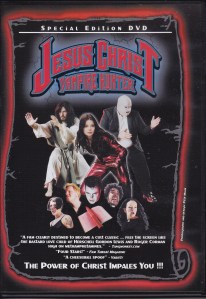
VampireHunterWhen a friend pointed out the easily missed 2001 film, Jesus Christ Vampire Hunter, (well before Seth Grahame-Smith came up with the same role for Abraham Lincoln) I knew I was duty-bound to see it. As regular readers know, although I’m not a fan of gore or violence, I have a soft spot for vampire movies. Vampires, although often evil, are frequently presented as conflicted characters. As former humans they have some level of sympathy for their victims, while at the same time, all people are objectified for the vampire. We are food. This low-budget, independent film didn’t promise to deliver on many levels, but as the end credits show, they did shoot enough film to be able to cut out a few bloopers. The story, in as far as there is one, has Jesus fighting lesbian vampires in modern-day Ottawa (where the film was shot).

Not that the film was serious enough to invite critical dialogue, I did wonder what Jesus had to do with the whole thing apart from the shock value. There were a few cute moments, as when the “atheists” pile, clown-like, out of a car for an extended fight scene, but the lead could have been any character apart from one scene where a miracle does occur. Jesus fights with his fists, not with supernatural power. Tossing in Mary Magnum and “professional wrestler” El Santo, the movie came close to the screwball level of Attack of the Killer Tomatoes. It’s difficult to critique a film where logic isn’t held accountable for the plot—the only thing to keep the film going is the action of a particular scene. And that, as I’ve intimated, can’t be counted on.

Interestingly enough, Jesus is treated throughout the film in a positive way. Although he doesn’t use supernatural powers, he is the “good guy” and is even tolerant of alternative lifestyles as long as love is the basis of relationships. The movie is biblically literate, using the Good Samaritan in a scene that underscores the accepting nature of the new millennium Jesus. The vampires don’t add much to the lore of the monster. They can be out in daylight because it is cheaper to shoot film that way, but the plot does come up with an explanation for it. Vampirism, at the end, can be healed by prayer, and when Mary Magnum, El Santo, and Jesus go their separate ways at the end, we are left wondering what all the fuss was about.


Free Words

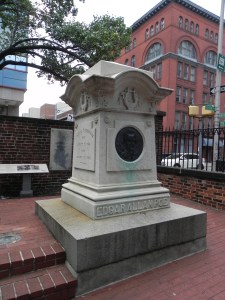
Just over a couple of centuries ago on this date, Edgar Allan Poe was born. That auspicious moment is an inspiration for those of us who write, and not just those of us who like scary stories. Poe was one of the first Americans to try to support himself by his writing—an occupation that has remained difficult to replicate and attain, even centuries later. There had, of course, been earlier writers. Mostly they wrote as an avocation to their jobs or they had family wealth, but Poe knew his own talents well enough to believe that writing was his occupation. He still stands out as an icon to those who are hopefully of making some kind of mark in the literary world. The surface is, however, much harder than we anticipate. It is like diamond, which may be marked only by another diamond. It is worth stopping to think of literature today.

DSCN2335

Over the long weekend, celebrating the human spirit in the person of Martin Luther King, Jr., I decided to read William Shakespeare’s King Lear. Probably not the source of as many famous quotes as some of the Bard’s other plays, it was nevertheless fitting as a tribute to writing. King Lear is sometimes cast as Shakespeare’s most thoroughly tragic works. The mood of misfortune hangs over the entire play. And although Lear is likely a fiction from the mind of Geoffrey of Monmouth or his sources, his name recounts the Celtic god of the sea, Llyr. Historians and grammarians tell us that Lear is not directly derived from the god’s name, nevertheless, there is a divine madness about the drama that unfolds as love and power vie for control in ages long past. In the present day the tragedy is that love seems no longer to be part of the equation and raw power is left to mark those who would be kings.

IMG_0969

The holiday weekend afforded the opportunity to visit a local bookstore and to ask the owners what to read. It would give Poe, I’m sure, some hope to know that despite the difficulties there are those who still strive to live by their words. Indeed, it is difficult to conceive of a better way of celebrating freedom than to indulge oneself with the written word. Words lead to liberty. Although Poe’s life was short, and often tragic, Martin Luther King, Jr. lived to about the same age, and through his often tragic life, changed the world with his words. In this day of money hunger and electronic stimulation, it is good to set aside some time to reflect on the words that have made us who we are. Words are our ultimate freedom.


Head of STEAM

The market producing doctorates in the humanities is showing no signs of slowing down. The fact is we’re all human, and many of us aren’t very technically inclined, unless we have to be. There are fewer and fewer jobs for these bright students who graduate with doctorates in the humanities, but the plight of the “privileged” is no concern to wider society. Let the eggheads figure it out. At the same time, wisdom in the job market is that careers in Science, Technology, Engineering, and Math (STEM subjects) are growing and showing the most promise for future careers. The pace of technological change is so rapid that yes, obsolescence for new devices is six months or less. My iPhone 4 is a dinosaur, although when I first held it some three years ago it was so advanced that I was afraid of it. A moment’s reflection will reveal that the most advanced technology is already in use in the military since staying ahead of the enemy is always the bottom line.

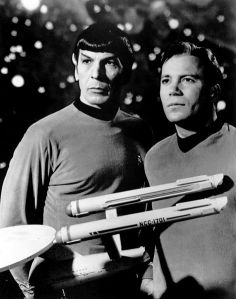
This situation has led to some concern, and not just among those of us in the humanities. Some in the world of STEM are saying that quality of life suffers. To indulge a stereotype, try to imagine geeks without Star Trek. We know that Star Trek was as much fantasy as science fiction. My iPhone makes a communicator look just plain silly. Star Trek is, however, creative indulgence. While many would hesitate to raise it to the status of “art” it is part of the Arts: fine arts, literature, film, music, and some television. The stories it tells are the stories of human beings (and one alien) struggling against often more advanced civilizations. In the end, humanity always wins. If we exit the stereotype, scientists are often musicians and writers as well. Some become novelists or consultants on box-office busters. We are more than meat machines.

Recently voices have been heard suggesting that STEM should be STEAM. The Arts have an integral role to play in the scientific and technological fields. Even some numbers are imaginary. The basis for developing imagination is the Arts. Although we could have made it to this point in our development without Star Trek, the fact is that many of us growing up with it, as well as the more silly, but also influential Lost in Space, and what we now know is a most assured cash cow, Star Wars, know that these shows helped shaped the present we inhabit. Arts give us visions. There continue to be those who castigate the Arts as “soft” and “weak” and tangential to the cold hard facts. But they are wrong. Humans can’t survive without a source of warmth and energy. And the first great engines of advancing civilization still have much to teach us, for those engines ran on steam.


Episcopal Pity

Call me naive. Really, I won’t mind. I’ll readily admit that I was raised in a conservative household that held a fundamentalist view of Christianity. But even though I grew and matured and eventually joined the Episcopal Church, I have always held consistency as one of the basic building blocks of any religious outlook. What’s fair for you ought to be fair for me. When I read that the Episcopal Church has been suspended, like the bad boy of the Anglican Communion, my mind went back to the consistency issue. The Anglican Communion, like many Christian bodies, is marked by strong membership from “conservative” constituencies. This was clearly felt while I was on the faculty of Nashotah House. As a conservative institution, we received many visits from diocesan leaders from more “traditional” cultures. They always expressed concern with America’s sinful, “liberal” culture. We should be more biblical, they opined. They didn’t, however, mind us paying the bill.

Book_of_Common_Prayer_1760

The Episcopal Church is being kept after school because of its approval of homosexual marriage. This is a social justice issue that has the backing of many major Christian denominations. Cultures in the developing world, however, see it as sinful and claim marriage is one man, one woman. Well, most of the time. I’m no anthropologist, but I do pay attention to what people say. While at Nashotah House we had a student from Kenya. He was already a priest, but he was there to get some basic training. Naturally enough, his biblical understanding was quite literal. Once I asked him about his life back home. He had a wife, it turns out, and kids. They couldn’t be with him in Wisconsin, so I asked how they lived when he wasn’t there to support them. He told me his brother took her as wife while he was away. His brother was already married, but in his culture it was traditionally for brothers to act as husbands in the absence of the latter. He gave me to believe that “husband” was used in every conceivable sense of the word. He was, of course, against same-sex marriage.

Levirate marriage (a brother “taking over” a wife) is arguably biblical. The problem is that the Bible states the first brother must be dead for levirate marriage to take effect. My point is not to condemn the “traditional” marriage arrangements of the visiting priest’s culture, but to try to get some consistency here. There are a wide variety of “marriage” practices recognized in traditional cultures. They have two things in common: women are subservient to men and their needs, and males mate with females. Beyond that, variety, as the traditional saying goes, is the spice of life. There used to be another traditional saying about the inappropriateness of peering into other people’s bedrooms. So the naughty Episcopal Church has been sent to a corner with a dunce mitre on its head. Meanwhile the other boys, typical of those in middle school, sit around and talk about the girls they’d like to have. It’s tradition we uphold, after all.