Wars and Holy Wars

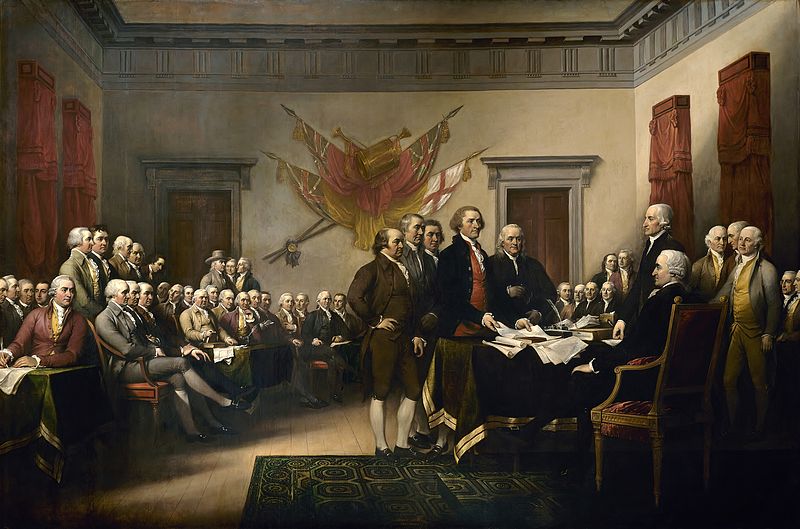
An article by James P. Byrd, promoting his new book Sacred Scripture, Sacred War: The Bible and the American Revolution recently appeared in the Washington Post. Byrd asks a very relevant question in our era: “Was the American Revolution actually a holy war?” He suggests that perhaps it should be interpreted so. The reason is straightforward enough—our nation, our culture in the United States, is so deeply steeped in scripture that even our Deist founders knew their Bibles better than many preachers today do. Byrd suggests, in his article, that people who believed in the separation of church and state could still have a deep sense of divine mission, and a belief that their war for freedom was a divine cause. Early state leaders were not anti-religious, nor über-religious. It is a balance that we would benefit from regaining.
Declaration_independence

I guess I’ve seen enough political shenanigans to realize that such posturing as the Tea Party and the Religious Right or Moral Majority present are deeply cynical. The use religion as a platform to achieve political ends while conveniently slashing and burning huge swaths of biblical reasoning leaves many questions in its wake. Were such motives sincere, I would expect a lot more turning of the other cheek, and walking the second mile uncoerced. I suspect there would be fewer hungry people and even fewer living in positions of extreme wealth and power. In short, without the agenda of political religion, I suspect we would be a more Christian nation.

War is difficult to justify from a strong ethical stance, as most ethicists know. Our founders decided to go to war against what they believed was unfair oppression by a more powerful nation. This takes on the cast of a holy war because people were being oppressed. The pre-emptive strikes were throwing crates of tea into Boston Harbor, and yet the more advanced nation refused to lessen the pressure. In the Bible, Pharaoh declared the Israelites should make bricks without straw, and we all know where that got him. Or we would know, were we as literate as our forebears were. Freedom was considered a sacred trust. We live in a time when trust is at a premium. You can’t fly or surf the internet without being watched in intimate detail. There is no talk of holy wars, it seems, since the sacred has no place in a society that does not promote the concept of liberty with all the risks and benefits it entails.

Hidden Messages

Symbolic gestures are among the simple pleasures of life. Unobserved, and certainly unappreciated, they comfort only those who perform them most of the time. Nevertheless, sometimes I just can’t help myself. Upon being summarily released after long-term employment at a certain institution of higher education, the day I left campus for the last time, I left a note with a Shakespeare quote tacked to my office door before literally brushing the dust from my feet as I drove through the gates never to return. The quote was from Julius Caesar, a play to which my niece had taken me that summer for a Shakespeare in the Park performance:

Let me have men about me that are fat
Sleek-headed men, such as sleep a-nights.
Yond Cassius has a lean and hungry look;
He thinks too much: such men are dangerous.

I have no doubts that my symbolic gesture was overlooked and the chit summarily discarded as the detritus of a warped (i.e., liberal) mind. The act, however, had been done.

Due to a booking accident, I once found myself flying first class. Those who know me will understand just how vexing this was for me. I fly quite a bit for work, and I am a populist through and through. Airlines set apart special bits of feet-darkened carpet for premium-class passengers to tread upon. They cordon off a special “lane” for the pampered class that is a nothing more than a matter of a jump to the left and a step to the right away from where those of us who wear last year’s (or decade’s) clothes board the same vehicle headed for the same destination and to which we’ll all arrive at the same time. I don’t disparage those who like receiving drinks while on the tarmac and hot towels to freshen up, and actual food on real plates while those of us before the curtain insist that there is no wizard hiding up there after all. I’m just not one of them.

IMG_0899

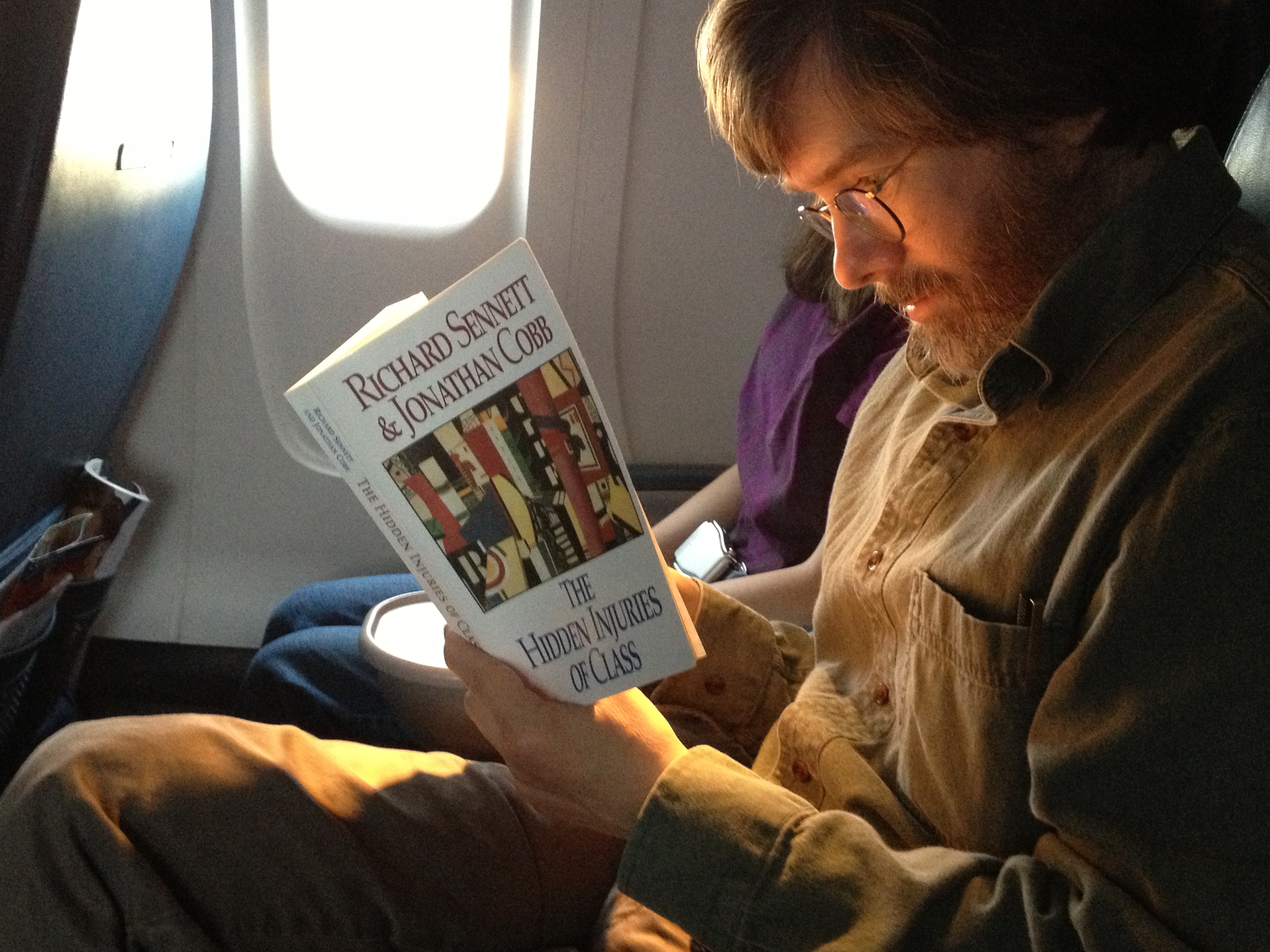
So I found myself in a leather seat with an entire cow’s worth of skin to myself. I had never been so kindly treated on a plane, with perhaps the exception of flying economy on Virgin Atlantic. I knew from the in-flight magazine that those behind me received only little pretzels and overpriced snack boxes while I was offered warm food and champagne. I pulled out my reading for the flight, The Hidden Injuries of Class by Jonathan Cobb and Richard Sennett. I’m sure nobody else noticed. But wasn’t that precisely the point?


Fly Like an Eagle

Hummingbirds, according to my bird book, have hearts that beat 1260 times a minute. That translates, if my math is to be trusted, to 21 beats per second. As the only birds capable of flying backwards, their aerial acrobatics are fascinating to watch as they hover, accelerate, and change directions like a biological UFO. During the summer they guzzle the empty calories of sugar-water that we leave for them in our feeders, so that we can lure them close enough to observe (that is, after all, how humans interact with their environment). The other day I watched a snapshot of developmental behavior. This July has been a good one for hummingbirds, with several a day visiting the local watering hole. I sometimes wonder about the flowers that are overburdened with nectar as these tiny birds hover by their communal font. At first it seemed that only one bird frequented the feeder. Then two came along, and although four feeding spouts were available, one would always chase the other away in a dogfight worthy of Baron von Richthofen. A third showed up, and when the first was busy chasing the second away, would fly over to the feeder to attempt a nip. Then a fourth. Eventually a fifth. And although there are four evenly spaced openings, only one took a drink at a time.

DSCN4076

“Bird brain” is a speciesist insult. Many birds are very intelligent and the comparison with human behavior is often apt. Protecting one’s private stash that is more than adequate for the community is worthy of comparison. Not to complicate speciesisms, but when a person prevents another from enjoying what one cannot, we call it being a dog in a manger (dogs, of course, do not eat the provender of the barnyard herbivores). A bird flying so fast that it’s a blur chases another away and cannot enjoy the high-calorie, human intoxicant we offer so that we can appreciate its incredible display. If we could fly like that, would we be so short-sighted?

God-like, we attempt to make nature in our own image. And mix metaphors like a professional editor. Not far from the shelter of the human breadline we offer, hover the larger, predatory birds. Those who fly fastest, super-charged with sugar and spite, stand a better chance of surviving. And when a luxury liner encounters an iceberg in the frigid north Atlantic, those who’ve lingered longer at the feeder are better equipped to gain quick access to the lifeboats that are sorely inadequate for the overbooked cruise. And if I were on board, would I not be like a hummingbird in the manger? My heart beats 21 times a second just to think about it.


Human, All Too

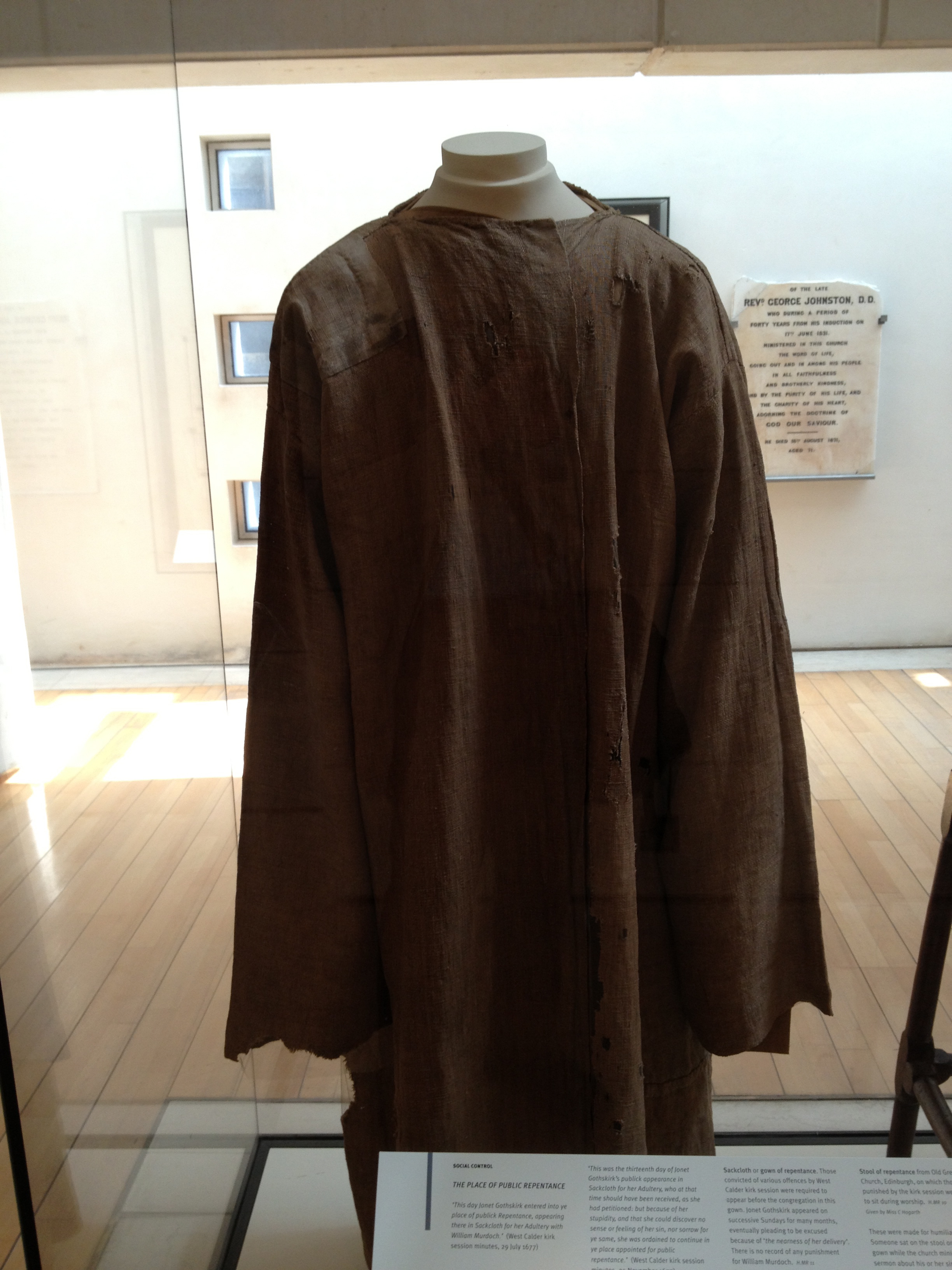
Back in the days of The Scarlet Letter, and before, an even more egregious double standard afflicted the sexual practices of women and men. Our primate nature promotes two conflicting principles: disgust at cheating and the desire to get away with what we can. Unfortunately, biology has often showcased female infidelity with the “illegitimate” child, and religions have stood in line to condemn the behavior that led to such circumstances. I was reminded of this while looking at a “gown of repentance” at the National Museum of Scotland. The Scottish Reformation led to an unusually severe kind of Schadenfreude when it came to pointing out the faults of others. Janet Gothskirk, spiritual kin to Hester Prynne, was convicted of adultery and had to wear a “gown of repentance,” literal sackcloth, to humiliate herpublicly. Her partner in crime, William Murdoch, is not recorded as having received any punishment for the affair, according to the placard.

IMG_0845

Thus it has always been: boys will be boys, but girls will be good. And when it comes time to dole out the blame, well, boys sometimes just can’t help themselves. This double standard is still in widespread practice throughout the religious world today. It shares roots with the same thinking that leads to many major religions denying sacerdotal leadership to women, and to the unfair punishment doled upon women in cultures where their behavior “dishonors” that of the men-folk. And we have all seen where male leadership has steered this ship.

What struck me hardest, staring at the dirty, ratty garment of shame, was that forgiveness seems so far removed from the religion of the Reformation. Christianity has always claimed a basis in the concepts of love and forgiveness, but when it comes to the very real circumstances of human failings, the animal tendency to attack the weak is often the driving force. We deflect because deep down we know that we all have failings. Clergy and braggarts may sometimes claim otherwise, but we share this very common liability of humanness. We should try to help each other through it. We should remember the golden rule. We should remember that sackcloth was meant to be self-inflicted and that the role of the church was to absolve the guilt, not to showcase it. Janet Gothskirk is forgotten to history, save for the garment she once wore to display her weakness for all to see.


Free Freedom

A weary-looking TSA official asked me why I opted out of the full-body scanner at the airport recently. As always, I responded that it is against my religion. The haunting lyrics from a Larry Norman song waft through my head; “I was born and raised an orphan, in a land that once was free…” It used to be, when I was little, that you were innocent until proven guilty. As I stand in line at the airport, next to an eerily humming x-ray machine that is examining all my secrets, learning what I’m reading without ever having to read my blog, I watch fellow citizens step inside a sci-fi-inspired glass chamber while being bombarded with God-knows-what so that any unnatural contusions might be spotted and analyzed. They raise their hands above their heads like outlaws in the old west. We are all guilty now, until proven innocent. If you are Trayvon Martin, you pay for the assumption of guilt with your life. Don’t worry, Mr. Zimmerman, you’ll be acquitted.

IMG_0622

In my darker moments, I wonder who benefits from a government that keeps increasing amounts of data on its citizens while cutting programs to ensure their comfort and health. We have elected a police force, not officials of the people, by the people, for the people. Vigilantes can literally get away with murder, as long as the skin-tone algorithm is correct, but if you’re perverted enough to want to fly, you have nothing about which your government is not interested. Who is being protected here? Who is being kept safe? A stranger has his gloved hands on my crotch. I’m feeling a little more than vulnerable.

Protest is a sign of love in this troubled world. If I step inside that glass chamber and raise my arms, I am declaring that I am guilty. Let me prove my innocence to you. Technology has made our private lives so easy to scrutinize. I used to think the future envisioned by Jacques Ellul was just a touch paranoid. I’m now beginning to think he didn’t go far enough. This computer on my lap can be like a TSA official in my own home. My website visits may be traced and analyzed, and my self-publish words misconstrued. And if I go to the store at night, a stranger can follow and shoot me with the blessings of our legal system. Of what are we so afraid? Is it time to stand our ground yet?


Monument to Madness

Reflections on the implications of my recent trip to the United Kingdom will likely continue to filter into conscious expression over the next few days. Jet lag will inevitably fade, and some concepts will shake down and settle into place as the reality known as work once again demands its pound of flesh per day. One of the realities that struck me during my time in St Andrews was how violent the Reformation was when it came to Scotland. Truth holds the world hostage, since everyone wants to believe they own it. And it’s my word against yours unless one of us can pull in a larger authority—and who is larger than God? There was a lot of credibility riding on the Reformers’ certitudes. And resistance was strong. Fatal even.

Reform is nearly never gentle, especially religious reform. After the Society of Biblical Literature’s meeting disbanded last week, I wandered around the old, medieval section of St Andrews, trying to get a sense of what such conviction must have been. One of the participants narrated to me more of the stories of those who’d died in the course of conversion. Patrick Hamilton, it turns out, may have been the first victim of the Reformation, but he was not the last. Walking along on a sunny afternoon in a country where several religions consciously coexist (I was, as an American, surprised to see so many large mosques in the UK), it seemed difficult to believe that humane individuals would torture someone to a horrendous death by burning just because of religious differences. The killing times seemed so long ago. Or perhaps our killing has just become more subtle.

IMG_0814

Following the directions I’d been given, I came upon the Monument to the Martyrs. Not wishing to belittle the atrocity of undeserved deaths, I could not help thinking of the pillar as a Monument to Madness. Is the need to feel right so great that others must be made to die for it? After all, among those generally considered to be sane, we all believe that we are right. Who consciously accepts untruth as reality? In such circumstances the best, the only reasonable response is to agree to disagree. I can let you accept your truth, if you’ll let me accept mine. And perhaps such tolerance would serve our planet well. Even the number of trees spared had autos-da-fé been forbidden provides a silence to the wisdom of allowing difference to thrive.


Hansel and Regretel

HanselGretelHansel and Gretel: Witch Hunters was on offer on the trans-Atlantic flight. Since I missed it in theaters, I decided to watch it on my mini-screen inches from my face. Witches, among the classical monsters, have a strange longevity into the world of science—like van Helsing (of movie fame) the protagonists have steam-punkish gadgets to destroy the naturally invincible foes. What’s not to like? I could not help but be disturbed, however, at what seemed to be the inherent misogyny of the film. Perhaps it was the lighting on the plane, but I saw only one male witch among the monstrous hordes of females who were battered, shot, and burned with apparent sangfroid. Women were guilty, it seemed, until proven innocent. And Mina, the white witch, again underscores that women who are “clean” are still potential witches underneath. Naturally, she dies before it’s over, but in a noble way.

The witches in the movie are strangely removed from a traditional, satanic context. They derive their power, like modern wiccans, from nature and strange mixes. The source of their magic is never explored very deeply, but when they catch trespassers in their forest, their queen states that even God himself fears to go there. Bewitching bravado, to be sure, but where does this image of God originate? A god afraid of the very nature that (in a film such as this, certainly) “he” created? The sacrifice of children is a good biblical trope, but seems to do little more here than to build the tension.

Monster movies, I realize, are “guy flicks.” Something about all that testosterone seems to be energized by images of ordinary people fighting monsters, against incredible odds. The monsters here, however, are barely distinguishable from regular women. Folklore has a deep well of traditions about witches from which the savvy might draw to write an intelligent, entertaining tale of witch-hunters. After all, the real antagonist, traditionally, is the male devil. He is, in medieval tradition, the source of witching magic. By removing Satan from the picture, we are left with strong women who must be repressed, and the world is really no safer when Hansel and Gretel are done. In fact, the end of the movie implies that they will never be finished. An opportunity for a subtle shift of paradigm was missed in this film, and, as usual, it is women who end up paying the price.


Burning Faith

1528. February 29. St Andrews, Scotland. 24 year old Patrick Hamilton was burned to death for espousing the teachings of Martin Luther. St Andrews University is the oldest of Scotland’s four ancient centers of higher education. Heterodox religious teaching was considered a very dangerous thing in those days, especially in the halls of academe. Once infected with Lutheranism, like a zombie, you had to be burned so that the rest of the world could be safe, the virus contained. Only the problem in this case was an all too human one—difference of opinion regarding religion. The Thundering Scot, John Knox, would’ve been all of about 14 at the time, and reformation for the Catholic Scotland was still years in the future. Now, one of the largest European cathedrals, in St Andrews, lies in ruins because of that very reformation.

Religious bickering has a tendency to move beyond the ridiculous to the insane. Burning young men, after decades of burning hundreds of young and old women alike throughout Europe, was one of the most heinous symptoms of a horrid madness that had grown from religious fervor and fear. Religion itself is not to blame as much as the human tendency to use it as a weapon against those who are perceived as different. Some five centuries later and the physical stakes are gone but the fervor and fear are as strong as ever. As we hear politicians and televangelists lash out against those of whom God disapproves, the smoke still rises from the spot where Patrick Hamilton, late of the University of St Andrews, was sacrificed for his faith.

IMG_0729

Ironically, as I sat on the quiet morning train from Edinburgh to Leuchars, from the headphones on the young man behind me wafted AC/DC’s “Highway to Hell.” Was Patrick Hamilton aware that he was on a literal highway to hell as he returned home to Scotland? Did he have an inkling that his own people would torture him to death because he taught such dangerous ideas as salvation by faith alone and Scripture as the instruction for that salvation? Could anyone have guessed that the then teenaged John Knox would introduce what was to become an even less forgiving form of Christianity to Scotland by the time young Hamilton should’ve reached his dotage? Religion is funny that way. Even those who give their all to defend it easily become its victims. And a few yards down the road the Society of Biblical Literature meets in a university building dedicated to the sciences. History’s ironies never end.


The Importance of Being Honest

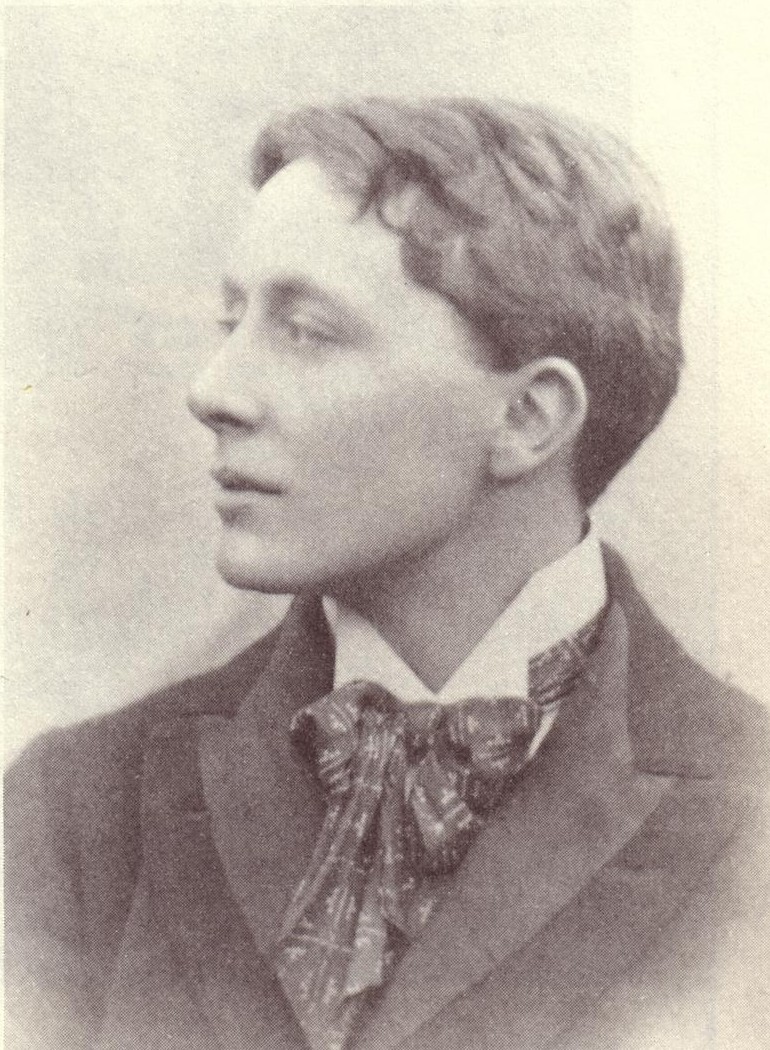
JohnGrayContinuing our quest to be a family out of sync with the modern world, we used part of our free day in Edinburgh to take the Book Lover’s Tour. Edinburgh has a long literary history that includes such writers as Sir Walter Scott, Robert Louis Stevenson, J. M. Barrie, and Sir Arthur Conan Doyle. A more recent star in that constellation is J. K. Rowling. The tour we took was led by the redoubtable Allan Foster, a geology student turned literary psychopomp. Although not associated personally with Edinburgh, Oscar Wilde had an unusual connection that made for an interesting tale. One of his male lovers, John Gray (a model for the eponymous Dorian) eventually became a Catholic priest, and lover of a wealthy Russian poet, Marc-André Raffalovich. When the Gray was assigned to St. Patrick’s in Edinburgh, Raffalovich was appalled at the state of the building and offered to finance a new church with the provision that his friend be appointed priest in charge. Thus the new building came to be and still stands on Cowgate.

Of course, nowhere is the priest or his lover, benefactor of the parish, mentioned in the church literature. Morality often parades as self-righteousness. Secret lives are not restricted to the clergy, of course. The fact is that people everywhere are human, and people are complex. So complex that we will sometimes carry on a charade to ensure religious respectability, to the point of having political candidates endorsed by clergy for issues that run counter to the very sources of their funding. Righteousness can be very costly, but self-righteousness comes cheap. Religious systems that demand standards that they can’t uphold either collapse or excel in duplicity.

When the tour was over, we walked by St. Patrick’s church. I wondered how many of the patrons knew the history of the lovely building they use for worship. Should they take a literary tour and learn the background of the church, would it make any difference? Ethics can be a matter of convenience, particularly when it is a matter of sexual propriety. Somebody else’s sexual propriety, that is. The real business of religion should be helping to improve authentic lives. Today it has often become the business of supporting the political system that bankrolls the special interests nearest to one’s heart. And reading, especially of unapproved materials, only gets in the way.


Unspoken Reality

In that impressive cultural marvel known as Facebook, a few gems amid the overburden occasionally appear. The post of a friend brought to my awareness a site known as everyday feminism, where, last year a post about religious privilege appeared. The brief piece entitled “30+ Examples of Christian Privilege” highlights one of the persistently overlooked aspects of religious liberty. No matter how much the founders of the United States valued freedom of religion, the colonials were, at least on the part of the non-slave side of the equation, Christians. Whether Jamestown, Plymouth Rock, or Guanahani, those Europeans who first set foot ashore did so under the banner of one variety of Christianity or another. (Such a case might be made for Vineland as well.) Religious liberty meant fleeing the oppressive practice of state religion—always Christianity—that kept shifting according to the whims of frequently unstable monarchs. For all its wide variety, Christianity is cut from a bolt of the same cloth. At least in the lining.

The Christian Privilege cited on everyday feminism is the most insipid kind brushed with the widest strokes. Still, it does reveal just how thoroughly Christian even the secular can be. Christianity, as I often told my students, pervades our culture. We live it, breathe it, ingest it. Often subconsciously. America was and wasn’t founded as a Christian nation. Intentionally, according to the wishes of the founders, no. Unintentionally, according to the dictates of privileged classes, yes. The problem here is not Christianity—it is privilege. Depending on whence you read the words of Jesus, his message seems to have been one of a general equality, or at least fairness. Those same words, however, can be distorted to support the monolith of the privileges granted those who follow the “one true faith.” The privilege to own slaves, for example. Or to oppress others born into less fortunate circumstances.

Ironically, among academics, I’m told, there is a push to hire those who are authentically unprivileged. Although I must, by my accidental Caucasianness, maleness, and inherited Christianity, be classified as privileged oppressor, I did grow up in economic privation. So much so that my wife feared to take our infant daughter to the unsafe house in which I was reared (which was, fortunately, condemned and demolished before that became an issue). It still shows in my natural, placating obsequiousness to supervisors and bosses—I was raised knowing my place. Yes, sir. As a first generation college student, I still find myself confused by why I was rejected by a higher education into which I poured all my youthful energy. Yes, in such circumstances, it is difficult at times to see the privileges. They are there, however, as anyone willing to walk across town with their eyes open may see.

IMG_0714


Seems Reasonable

Florida is a state of contrasts. A news story from the Associated Press highlights that divergence. On the lawn of the Bradford County courthouse is a monument to the Ten Commandments that American Atheists sued, unsuccessfully, to have removed. In response to their legal defeat, they have placed their own monument to atheism alongside it. Well, what’ fair’s fair. Local reaction, according to the story, has been anything but positive. Nevertheless, I wonder what a monument to atheism must look like. The partial photographs reveal the atomic symbol-based American Atheists logo on top, and words on the sides. The monument, the story indicates, bears quotes from Thomas Jefferson, Benjamin Franklin, John Adams, and Madalyn Murray O’Hair, the last of whom was gruesomely murdered as an early martyr to the atheist cause. There are those who suggest that the atomism of Democritus in the fifth century BCE already tolled the death knell of the gods. Deities and very small particles, however, have continued to get along for the past 2500 years.

Ephesians_2,12_-_Greek_atheos

David Silverman, the current president of American Atheists, is quoted as saying the monument is an attack on Christian privilege, not Christianity. This may seem a fine point, but it is valid. Most reasonable atheists have no difficulty granting freedom of religious belief to anyone (only the more radical members of the atheist camp suggest religion ought to be stamped out). Does that mean governments should not display monuments to Moses’s magnum opus but not to, say, that of Lao Tzu? Or, perhaps in this instance, Lucretius? It might appear to be over-protesting, but what would a Hindu’s thoughts be, should s/he be ushered past the statutes of a foreign god on the way to court?

One of the most difficult things for a person to do is envision their normal as another person’s weird. Religions that seem perfectly logical to those raised within them have a way of seeming unbelievable to those who encounter them as a part of an exotic culture. To me it is difficult to suppose anyone would see American culture as “exotic.” I mean, we’re talking Wal-Mart and MacDonald’s here. It seems pretty ordinary to me. When I take a mental step back a little further, however, I begin to see a nation of widely varying traditions. Little pockets of true culture punch through the plastic here and there, and the light that shines through can be brilliant at times. And if you happen to run afoul of the law while visiting, you might end up in a courthouse that not only advertises the Ten Commandments, but also has a monument to humanistic spirit as well.


Dirty Laundry

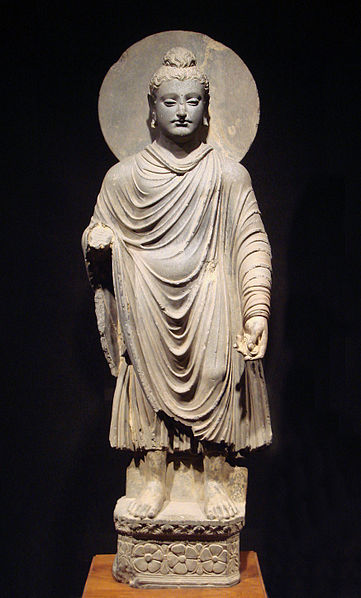
Wirathu may not be a household name, although Time magazine devoted an article to his teachings last week. The media has become fascinated with religiously motivated violence of late, although such violence is nothing new. Capitalizing on the fact that many of us in the western hemisphere see Buddhism as a religion of peace, Hannah Beech’s article, “The Face of Buddhist Terror,” reveals the growing conflict between some Buddhists and Muslims in Myanmar. The article took me back to my seminary days where, in a class in systematic theology, our professor was extolling the virtues of Buddhism as a religion of peace as opposed to Christianity with its history of warfare. Not denying that history, I raised my hand and asked how Christians then had come to know Jesus as the Prince of Peace. And Muslims, as any student of religion learns, also value peace. The ideals of most religions promote peace. The problem is that the practitioners of religions are humans.

Gandhara_Buddha_(tnm)

Like our chimpanzee cousins, we humans distrust those of other tribes. In one of the more disturbing aspects of chimpanzee research, encounters between especially a male isolated from his troop and another family group often end badly. Biology has programmed us to keep valued resources for ourselves. It’s as if nature knows there are limits to her bounty, and in order to survive and thrive, some will need to starve. Or be killed. Critics of religion—and there are many who are quite vocal—often overlook the aspect of religions that call for the reversal of our natural tendencies. Yes, I’m selfish. As a biological creature, I’m concerned that I get enough to eat, and have sufficient space. I want to stockpile money so that I may retire (unlikely to happen in reality), and spend my final years in peace and relative comfort. Yet, my religious upbringing has left the door open for others. What about those with even less than me? My empathy reaches out for them. Don’t they deserve what I deserve?

The problem is always at the friction point where belief systems rub passed each other like immense tectonic plates. The Buddhists of Myanmar say they just want to be left alone. The Muslims of Myanmar say they just want to survive. Their religions are pressure points building along fault lines. Still, I suspect that there are other sources of tension and violence in Myanmar, besides religion. I know there are in American society. In fact, most everyday violence, I suspect, has nothing to do with religion. Violence is part of human nature. Religion, at its best, urges us to fight this compelling biological message of self-preservation at any cost. Religious violence is a very real cause for concern, but to get to the root of the problem we must look past religion to biology. And sometimes—just sometimes—religion turns off the flame beneath the simmering pot.


Liberty and Justice for

Looks like America will be divorcing the self-proclaimed “Defense” of Marriage Act. It’s a small step, but a small step in the right direction. Religious dogma has too long held sway over politics in this land of religious freedom. It must seem astonishing to rational people the world over how a country founded for the very purposes of religious liberty has homed in on a very narrow sect of one religious tradition and used that as the basis for discriminatory laws. After all, even the Bible says very little about marriage—something about taking your main squeeze into the tent with you and voila, you’re married. The Bible never asks what they’re doing in the privacy of their own tabernacle. Now we have a political system that legislates what can legitimately turn you on. Finally we see some light beginning to dawn in the judiciary system.

I don’t take marriage lightly; those of us who are married seldom do. I also don’t take my status as being the only possible way of finding love in a world that sorely needs more of it. Every day I witness acts of uncaring and sometimes outright cruelty, often in the name of the progress of business. And until yesterday I had to live with the knowledge that it was perfectly legal to discriminate against committed couples just because their gender’s don’t fit a preconceived mold. The land of the free? Maybe, just a little bit yes, now.

Our legal system, which pours out its love on corporate culture, protecting business owners more readily than employees, shielding the wealthy whose lifestyles are beyond scrutiny, ends up telling citizens whom they may love and whom they may not. And we complain against countries with arranged marriages. Freedom for some is not freedom for all. Until we as a nation recommit ourselves to life, liberty, and the pursuit of happiness, we’ll have to take the small steps towards freedom when they come. Yesterday, for at least a little while, I was glad to see that the system can work for the good of all, when it puts its mind to it. America, you can be proud. Say it loud!

800px-Joseph_Anton_Koch_006


Just Plain Bible

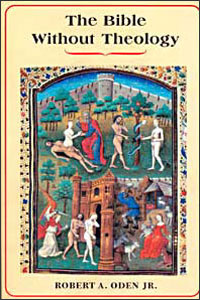
BibleWithoutTheologyBack when I was teaching Hebrew Bible in a seminary for a living, I purchased a book entitled The Bible Without Theology by Robert A. Oden Jr. I had intended to read it as a sanity break from the over-compensatory theological glosses that even the slightest reading of the Bible had in that setting. As the years passed and the book remained unread, I came to think of it as a systematic deconstructing of theological readings of the Bible, which it is not. Instead, Oden has gathered in this useful little book several essays centered on the topic of how the theological reading of the Bible has all but drowned out any other interpretations and has secured the privileged position of the Bible not only in society, but also in academia. Naturally, many people see such privilege as a witness of undisputed truth, even though how that truth is interpreted remains an open question.

Scholars, however, have the obligation not to favor their worldview over the evidence. Oden begins by discussing how history itself is perceived differently among those of various mindsets. History is an important part of the Bible’s theological reading since many Judeo-Christian interpretations revolve around a sense of historical veracity. After illustrating how history and mythology both lay claim to the text, Oden points out that even obviously mythological episodes have been blockaded by a theological reading of the scriptures. With examples from socio-anthropological studies, he demonstrates that parts of Genesis are best understood by investigating how kinship structures work, as well as how clothing serves as a status marker rather than a hidden justification for sacrifice, or chilly nights outside Eden.

Although The Bible Without Theology wasn’t exactly what I’d come to suppose it was, it remains a proper prologue to the issue. When Oden’s book appeared in the 1980s, the Religious Right was just finding its feet, fueled by a hyper-theological reading of the Bible. Since that time, the Bible has been used as theological justification to repress everyone from women to those biologically inclined toward their own gender. Bible scholars have, in general, known this is wrong. However, theologically inclined institutions won’t pay instructors for honestly engaging the text. Bible scholars are expected to throw their expertise behind the theological outlook of their institution in a way that Oden rightly points out, no other academic discipline would accept. In reaction to the biblical abuses of the Neo-Con crowd, many Americans are wondering why this one holy book is so privileged. While it may not have all the answers, Oden’s riposte will help to explain why the Bible deserves better.


Guiding Girls

Girl Guides are the British equivalent to the Girl Scouts. I first learned about them during the three years that I lived in the UK, although, as far as I know, they don’t sell cookies. An article in the Huffington Post last week announced that the Girl Guides have decided to drop God from their pledge, as a move toward inclusiveness. I’ve often pondered the place god holds in various social societies. At my daughter’s Girl Scout bridging ceremony a couple weeks back, I noticed God in the pledge. In New Jersey, where diversity is synonymous with breathing, I wondered how this antiquated oath felt to those who maybe grew up without the concept. Stretching my mind back a few years, when my daughter was in Middle School, she was awarded a good student prize by the Elks. As I sat in the tastefully decorated meeting room, with only a very faint tinge of beer in the air, I wondered if I might ever join a fraternal order. One of the officers stood to welcome us, inviting applications for membership. Democratically, she was a woman in a “fraternal” organization. She reeled off the requirements. As an afterthought she said, “and you have to believe in god.”

How does one measure belief in divinity? It has been my experience that many beliefs fluctuate with time. I can decide to believe, but in many ways, belief decides me. As a mantra to modern society, on the old X-Files series Fox Mulder’s famous poster read, “I Want to Believe.” To join the Girl Scouts, the Boy Scouts, or the Elks, you have to say you believe. Nobody’s going to hook you up to a polygraph machine, but you need to make your public declaration. At least in the last case, beer come later.

Religious diversity is a reality of our lives. From the invention of the steam engine, it became inevitable. Our world was going to grow smaller as we met people who had previously been isolated from us by distance. In 1893 the World Columbian Exposition was held in Chicago. As part of it, the Parliament of the World’s Religions introduced many Americans to the religions of the world for the first time. Hinduism, once an exotic strain quaintly captured in the archaic spelling “Hindoo,” became a sudden fascination. Buddhism was a curiosity. How had it been that the United States seemed only to know about Christianity, Judaism, and Islam (in that order) when other belief systems existed? How could we have missed them? More importantly, what were we going to do now that we knew about them? We couldn’t unknow them, like you can unfriend someone on Facebook. We were going to have to learn to live together. After all, we all have just one planet to share. Social organizations are great places for introducing tolerance. You can be moral without being Judeo-Christian. And if our social organizations want to promote equality of membership, maybe the Girl Guides are truly living up to their name.

1918_girl_guides