Dominus Flevit

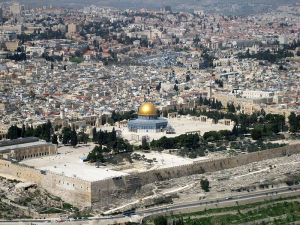
I couldn’t believe I was actually there. Ever since I was a child I’d read about this place. The city conquered by David and visited by Jesus. The city around which most of the Bible rotated. Jerusalem the golden. One of the perks of working on an archaeological dig was the opportunity for weekend travel, and here I was, amid camels and cars and churches and synagogues and mosques, in Jerusalem. No amount of reading prepares you for such an experience. Suffused with the rich mythologies of three major religions, this city is like a dream. So much had happened here. The church I was attending at the time was only the latest in a long succession that informed me that God himself had actually been killed here and had risen again. The ultimate game-changer. The once in forever event of all time had taken place right here.

Gnu Jerusalem from WikiCommons

But this was not a city at peace, despite its name. There was a bombing the first weekend I was there. Young men and women in military garb carried scary looking weapons openly in public. Even civilian bus drivers wore pistols. Jerusalem had a long history of violence, but that didn’t justify it. If God had really been here—in either Jewish, Christian, or Muslim contexts didn’t matter—how could this city be so prone to terror? In the old city old men sat around hookahs, placidly smoking. Tourists, many bearing crosses, thronged. Jerusalem, however, was also a very political place. The fragile, Christmas bulb-thin peace of the region involved the city being divided up and not being claimed by Israel alone. Even that man driving his goats through these ancient streets knew that.

Trump, to the cheers of evangelicals who want nothing so fervently as the end of the world, has said he’ll recognize Jerusalem as the capital of Israel. This political move of weaponized ignorance will almost certainly lead to war in the Middle East. Another war. An illegitimate presidency leaving a frothing sea of corpses in its wake. Negotiating in this part of the world is like haggling with that street vendor for a pair of sandals. You go back and forth on the price. You act insulted and walk away. You come back and haggle some more. It’s a delicate dance. This is no place for egomaniacs who can’t understand such subtleties. Just ask the last Caligula who wanted his statue set up as a god in this city. Jerusalem is home to too many jealous gods, and those who are self-appointed divinities will only leave the city, the world, in tears.


Home of Cthulhu

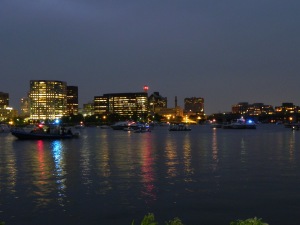
Travel by train seems to be so much more civilized than flying. You don’t need to arrive at the airport two hours in advance for the privilege of standing in long lines to be practically strip-searched. You just hop on the train and find a seat. The wifi is free and you don’t have to set your phone on “train mode.” Amtrak isn’t perfect, of course, but it’s not bad. When I’m flying I often wonder where I am. I guess at each large town we fly over, although some natural features can’t be mistaken from the air. The Great Lakes, Grand Canyon, and even Niagara Falls are all pretty obvious. The names of many towns, however, remains unknown from above. On the way from New York City to Boston, each stop is announced, small towns and large. I noted that one of the later latter was Providence.

Providence is, of course, many things to many people. To me it will always be the home of Cthulhu. Yes, I know that Brown University and Providence College are both located there, but higher education doesn’t seem to have a room for me, so I revel in the imagined monsters of H. P. Lovecraft. You can’t help but experience a bit of Lovecraft’s New England on the train. Skirting not far inland, the tracks take you through swampy lowlands with grand houses and dilapidated hovels overlooking them. Miskatonic University, as is widely known, is based on Brown, which Lovecraft never attended. He was a writer keenly aware of place. These tracks take me through the world of his murky water gods on the way to Boston.

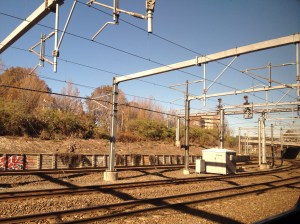
The train station in Providence turns out to be subterranean. Well, not really, but it is under the street level with no noticeable distinguishing features. Lots and lots of graffiti cover every concrete surface along the tracks coming into the city. It’s hard to tell from the train, but none seem to make reference to Cthulhu. I thought of Lovecraft’s gravestone with it’s famous epitaph, “I am Providence.” Idling in the shadowy station, unable to see anything of the enjoyable town I recall from my few visits here, it’s easy to suppose that this might be Cthulhu’s home after all. Caught somewhere between civilization and the sea, in the half-light of a late autumn day, buried under what we think is somehow progress, I think perhaps Lovecraft was right. Cthulhu may be dead, but he is dreaming still.


Holiday Season

It was just after dark and the red and blue lights were shredding the night in Wallkill, New York. We’d driven past this mall just over an hour ago to take our daughter home after a too brief Thanksgiving break. Now there were police cars lined up along the length of the Orange Country Galleria Mall, and my wife said, “I hope it’s not a shooting.” Life in America’s that way. About two hours later we were home and yes, it had been a shooting incident. For reasons nobody knows, a man discharged a handgun into the floor at the crowded shopping center, injuring two. Police had not located the shooter, and no motive was known. The mall was evacuated and holiday shoppers feared for their lives.

Just a few months ago I was in Penn Station, New York when a similar panic ensued. Rail police had used a taser gun on a passenger who’d gotten out of hand. As we were entering the station to catch our train, scores of people were running out in a panic. It had sounded like a gunshot. Clothes and personal effects littered the floor of the station once we got inside. This is the world in which we live. A world enamored of weapons. A world where we hate and distrust the stranger. A world where our government receives support from gun lobbies and refuses to put controls on the sale and ownership of firearms. A world where a peaceful Sunday night on the busiest shopping weekend of the year ends in panic and tears.

Wallkill, New York, is not exactly a metropolitan area. Upstate, as we’ve been learning for the last several years, is pretty big. Small population centers dot an impressive landscape of Catskills, Finger Lakes, and beautifully wooded hills. The people are generally friendly, less brusk than they tend to be in New York City. It seems that where two or three are gathered together there’s a handgun in their midst, however. Trusting ourselves to be good people, we want to arm ourselves to shoot the “bad guy.” Meanwhile Congress still tries to pass legislation to reduce health care since, I guess, too many people are getting shot. It can be a real drain on the economy if the wealthy have to chip in. It’s upstate New York. We have about two hours to go before we can rest at home. Galleria Mall is in lockdown. The rest of the nation is too.


Spinning Wheels

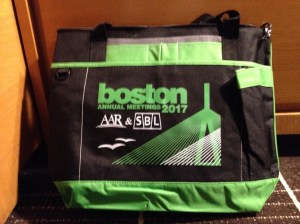
That warm, secure feeling of being home for the holidays never goes away. Admittedly Thanksgiving takes on a different cast for those of us who are vegetarians becoming vegan, but it’s not about the food, really. It’s never been only just about the food. Thankfulness as a way of life seems to hard to obtain when your own government has turned against all the principles that once made America a wonderful nation in which to have been born, but it doesn’t mean you can’t be grateful. As a commuter, I’m especially thankful for time. Each day’s normally spent riding a bus, working, and riding again. Over the past several days I took a train to Boston for the AAR/SBL annual meeting, and then a long train ride back. Followed by a single-day drive to Ithaca and back. I’m thankful for a little time not to be on the move.

Among the many memories for which I’m grateful is a mountain road that divides Glen Kinglas and Glen Croe in Scotland. Known for its splendid view, it’s one of many places that I have had the privilege of visiting. Although sitting still, here in my chair, I recall yet another busy day of driving with friends. Poor graduate students all, we nevertheless knew the value of good company and taking little for granted. As someone who grew up poor, I had managed to move to Boston, travel to Israel and work on a dig, and now I was living in Edinburgh, working toward a doctorate in one of the world’s great universities. That afternoon, however, I was out viewing what the wider world had to offer. The name of the viewpoint on the A83—from which that world all seemed visible—was “Rest and Be Thankful.”

The name speaks volumes. New Jersey certainly isn’t Scotland. My job is not that for which I trained. I continue to live as if I were a graduate student while friends have purchased houses and furnished them nicely. Today none of that matters. I’m not on a bus, train, or plane. I’m not glued to my seat in an automobile. I’m thankful to have some time to sit and reflect. Catch up, perchance, on a little bit of sleep. Unstructured time is perhaps the rarest commodity in a capitalistic society. Today I have it in relative abundance. No turkeys have lost their lives on my account and I’m able to rest and be thankful. There’s still a long way to go, but for today I’ll enjoy family and stillness. And I am thankful.


Ordinary Sacraments

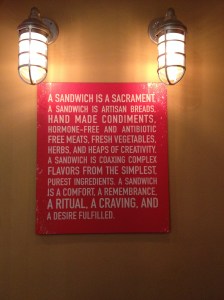
It’s like they knew we were coming. The towns that host AAR/SBL must remember the event after we leave. We make quite an impact around the convention center, and since everyone wears their name tags in public, it’s pretty clear that we’re all related. So when I stepped down into a local sandwich stop on Newbury Street, I saw a sign that could’ve been commissioned just for us. “A sandwich is a sacrament” it began. Going on to list the wholesome ingredients, the sign concluded “A ritual, a craving, a desire fulfilled.” I’d been taught that a sacrament was an “outward and visible sign of an inward and spiritual grace.” Of course, it could be more carnal than that. I’m not a priest, after all.

Food is indeed intimate. With packed restaurants full of religion scholars hungry for more than just sustenance for the mind, the city makes way for what may be a secular sacrament. Those who cook for a living do so in exchange for lucre. Everyone has to contribute something, and while we’re burning our calories debating fine points of theology, or in lexicographal deliberation, someone’s stoking the fires for the lunchtime rush. We hand over our credit cards and don’t stop to think about what we’ve just experienced. We’ve been given the means to convert matter to energy, an energy we’ll expend in purely cerebral consultation. The meeting of the minds. After the outward and visible sign of a sandwich becomes in inward and digested energy. And so the cycle spins on and on.

Large conferences like this bring the blessings of cash flow to local economies. Even in the poorest of times eating out’s a necessity. We’re not, after all, close to home. Time is at a premium with papers peppering each hour of three-and-a-half days, lined up like items on a menu. We select and choose, keeping to our intellectual diets. Or not. It takes plenty of energy to think so much. Some sit in the restaurants and return thanks. Others pay their respects in less visible ways, for this is the world of sacraments. Not ordinary time. What goes into a person, a sage once said, does not defile. Rather, what comes out does. We sit in respectful silence and listen to what emerges from our fellow conventioneers. It’s like being in church, almost. And we all know, deep down, when the talking’s done it’ll be time to eat.


The Pace of Progress

Scientists tell us the earth is slowing down. It’s only by a fraction of a fraction of a second, but like a top set spinning these endless revolutions can’t go on forever. Although the evidence all points in this direction, it feels like it’s speeding up. How else can I account for the apparent loss of time I’ve been sensing? Let me contextualize that. I’ve been attending the Society of Biblical Literature and American Academy of Religion annual meeting since 1991. That first meeting in Kansas City’s acid-etched in my friable consciousness with the long hours waiting for interviews that never came and no mentors to show me what to do. Those three-and-a-half days stretched on into an endless Tom Sawyer summer. I was anxious to get back to my wife in Edinburgh to and finish my dissertation. Fast forward a quarter of a century.

My days are now filled with back-to-back meetings. Normally by now I’d have had a leisurely perambulation among the bookstalls (where I spend all day) taking in the volumes the competitors publish, noting what I need to read. Instead, the time has been shortened. I have to keep a constant watch on my watch for the next appointment. Hearing about new books being born rather than tending the infants that surround me. We are a thriving population of readers here. Although it looks like a large crowd, I know that in reality we don’t make much of a dent. Boston’s big enough to absorb us and all our feverish ideas. When wakefulness arrives at my usual New York commuting time, even the nights seem to be shorter. Where has the time gone?

Most of those I meet have no idea I write books of my own. It was a process started long before the conferral of a diploma from a university far away. The earth is spinning in that direction, I’m told, so I should be in the tailwind of Edinburgh all the time. I’ve grown old with some of these colleagues. Those I’ve known since I was a young man, thinking he knew something about life, learning how little he really knew in this very city. I’m pretty sure I know even less now. The world, for example, seems to be speeding up to me. In fact I know it’s slowing down. Days are growing longer, but there is ever more yet to do. And all I want to accomplish right now is to walk around a bit and browse the books that others have written. I’m absolutely sure the earth is indeed speeding up.


Sacred Sartorialism

Proselytizing comes in many forms. It can be what you say to people, or how you treat them. It can even come down to what you wear. Every year I’m struck at the AAR/SBL annual meeting some attendees wear religious garb. I’m not criticizing it, please understand, simply observing. This is an academic gathering. Participants represent many different religions, and few, I suspect, are here to outright convert others. Seeing clerical collars and Buddhist robes, however, it becomes clear that what we wear says quite a bit about what we believe. Most attend this gathering vested in mufti. Should anyone in the tweed industry be reading this, I would humbly suggest not having a booth here is a missed opportunity. You are what you eat. You are also what you wear.

I was thinking just the other day how people used to be recognized by their clothes. In the days before consumerism, it wasn’t unusual for people to have just one or two sets of clothes. You knew who was coming, it seems from reading these older accounts, by recognizing the clothes before the face. Religious vestments are a signaling device somewhat akin to animal breeding displays, I suspect. The priest dresses differently to let you know that this person can be approached for true spiritual advice and consolation. Did your paper not receive the accolades you expected? Is there a clergy-person in the house? For sure there is. You’re never far from a practitioner here. As one of those who is unaffiliated, perhaps I’m just jealous.

What do my togs say about me? I tend to wear the same old clothes here year after year. Tucked somewhere in the furthest reaches of my closet are those duds not touched since last year. Publishing, for those who only see it in movies, is a very casual business. We don’t dress up, and I have to stop a moment before the mirror to remember how a half-Windsor goes. I’m guilty of donning aforementioned tweed from my teaching days. Students used to say I dressed like it was the 1970s. I didn’t have the heart to tell them that the clothes were often of precisely that vintage. Long after I’m gone, and AAR/SBL carries on without me, I wonder who might bear the uniform of this peculiar office I occupy? Not priest. Not professor. Not mere participant either. The name tag may say “Exhibitor” and that’s only part of the story, but it’s the pectoral cross I wear.


Sacred Places

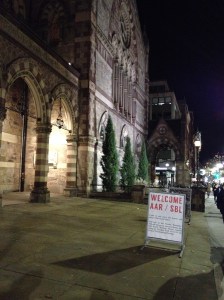
Boston Brahmins, lock up your doctrines—AAR/SBL’s come to town. Boston always has special associations for me. My first home away from home. Where I met my wife. Where I learned what you can only learn at seminary. Coming back is like coming home. Of course, I’m here to work. As I was getting ready for this trip I recalled that the conference met in Boston when I was studying for my Master’s degree at Boston University. Unlike many graduate schools these days, no overtures were made for students to attend. In fact, I didn’t know what all the in-joking among the faculty was all about. I relearned the existence of the conference as a grad student in Edinburgh a few years later. Few traveled across the Atlantic for it, at that point. In fact, none of the Edinburgh faculty who’d eventually become regulars had ever considered going. My first meeting was in Kansas City.

The meeting has grown since those days. Now regularly expecting about 10,000 scholars (can one help but think of 10,000 maniacs?) a year, the venues are limited. Atlanta, Boston, San Antonio, San Diego. Chicago and Denver once in a while. Personally, I’m glad it’s close enough for a train ride. New York City and Boston, two peas in a pod. My only regret is that I won’t be able to get out to my old stomping grounds. Some colleagues (few read this blog) contact me at the last minute asking if we can get together. My schedule’s booked from breakfast through supper each day. Those who attend as participant-observers have no idea. These are the longest working days of my entire year. Still, they’re in Boston.

I often muse about place on this blog. We’re attached to the place where we’re born—it’s our personal sacred space. In life we grow attached to other places, whether we can settle there permanently or not. I wanted to live in Boston. I did so for a year after attending seminary here, making a living doing this and that. Having a master’s degree in religion doesn’t get you far in life. In those heady days of sleeping on the floor and finding out what life was really like for the unconnected, I learned an awful lot. And when the woman I wanted to marry came back for a visit, I proposed. I’ve only ever visited Boston since. But whenever I manage to do so, even if it’s just for work, it’s like coming home.


Some Bible Lovers

I’m on a train heading to Boston. If you notice a dearth of religion scholars in your neighborhood this weekend, it’s because it’s time for the American Academy of Religion and Society of Biblical Literature annual meeting. If a religious emergency comes up, take two of your favorite scripture and call the office next week. Viewed from the outside, this must be one of the stranger scholarly gatherings. A few thousand people get together in posh hotels and convention centers to exchange ideas about which the larger world cares very little. Ironically, the vast majority of people in the world are religious, but as a society if we know enough about the Bible to get us through the most recent indiscretion, so we’re good. Let the scholars have their fun.

This year there’ll be a session on monsters and monster theory that I helped to organize. That doesn’t mean I’ll get to attend it—the conference is a very different beast for those on the exhibit hall floor—but I’ll have the satisfaction of knowing that it’s happening. Years ago I discovered that many of my colleagues who are teaching shared an interest in monsters. Many of us weren’t aware of the others because this isn’t the kind of thing you talk about in polite company. One thing an editor may be is a vector. We hear what widely separated people are working on. Every great once in a while we’re able to put the pieces together. So it was with monsters. There seemed to be a critical mass, and two or three colleagues took the idea and ran with it. Or ran from it, whichever you do with monsters.

For me Boston will be a series of meetings that will blend into one another until I’ll have to consult my notes to remember anything at all. If I could feel this wanted outside the conference I’d never have to dream of being a rock star. You see, editors are the gatekeepers of academic publication. For those lucky enough to have teaching jobs, it’s publish or perish, so the editor is a vital link. The rest of the year we fall into the background. Emails go ignored. Reminders are forgotten. Requests unanswered. But here, out on that carpeted concrete, we’re the ones they’ve come to see. What we do in the conference matters very little to the world at large. But we do it anyway. We gather together just before Thanksgiving, thankful to be reminded that there are others like us.


Keystones

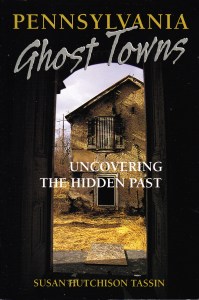
It was one of the very few parties to which I’d been invited in Edinburgh. “When a Scotsman asks you where you’re from,” one of the guests said to me, “he means where you were born.” Although we have no control or say over where we come into the world, we do feel that the place has a claim on us. Combined with my undying interest in local history, that means I like to read books about my native Pennsylvania. I was a first generation Pennsylvanian, to be sure, but to keep a nearly forgotten Scotsman happy, that’s where I’m from. Sarah Hutchison Tassin’s Pennsylvania Ghost Towns: Uncovering the Hidden Past is that familiar kind of book considered light reading, geared largely to the tourist and nostalgic past visitor or homebody crowd. Still, these kinds of quick studies often inspire the imagination. Lots of people lived here before you did.

A couple of factors stood out to me about Pennsylvania’s elder communities. One obvious feature is that a number of them began as intentional religious communities. Often breakaway sects from some major denomination, they established settlements to pursue spirituality in their own way, generally with strict rules, such as celibacy, that would spell their ultimate demise. Pennsylvania is well known for its separatist Anabaptist sects—Amish, Mennonites, and others who’ve been around for centuries and have integrated into the cultural mix of the state. I had no idea that a few ghost towns remain where some less successful spiritual seekers had broken ground. The second feature that stood out is how many communities were intentionally founded for commercial purposes. Often these were mining or lumber-processing towns. Some wealthy individual would buy a natural resource, build houses and a communal store, and permit workers to purchase goods only there. This meant individuals could never save money and never really afford to leave the mine or mill.

These are two very different conceptions of what it means to live in community. One is overly idealistic the other overly exploitative. At one end, the basic necessities of life—food, shelter, clothing—were kept from those who found themselves, like most of us, in need of a job. Or, at the other extreme, being held back from eternal life by failure to keep to the rules of a newly revealed religion. I never really thought of towns intentionally founded in these ways before. My naive view was more eclectic. But then, what do I know? I was born in a small Pennsylvania town and never thought to question why it was there. Where are you from? It’s a matter of perspective.


Digging Even Deeper

What does it mean to exist for someone else? Isn’t this the very definition of slavery? Yes, we may voluntarily give ourselves to someone for the sake of love, but woe to the person who thinks he owns his spouse. Human beings may be an acquisitive lot, but that doesn’t excuse it. To be civilized, after all, means to be more advanced than we are by nature. These thoughts follow on hearing one of my colleagues interviewed on Game Plan on Bloomberg. In the light of the Harvey Weinstein scandal, Francesca Levy and Rebecca Greenfield are interviewing people in different professions to see what inappropriate treatment women receive at the behest of men. Their job is, unfortunately, not one where it’s difficult to find examples. In this particular case, they interview Beth Alpert Nakhai of the University of Arizona. Dr. Nakhai is an archaeologist and she describes the perils faced by women in the field.

In 1987 I volunteered on the dig at Tel Dor in Israel. I had just graduated from seminary, didn’t have a job, and was pretty sure I’d be going on to graduate school. Tel Dor, like many digs, had different loci excavated by different university teams. I was on the Boston University area, B1, next to the section being worked by one of the universities in California. At one point one of the seasoned men—I can’t remember who—remarked to me that digs in Israel were great because of the three A’s: “alcohol, adultery, and archaeology; in that order.” It was intended as a joke, but it had that time-worn feel of a sentiment that’s been around for a while. At the time I thought little of it. I was there only for the last A, and, had circumstances been different, I might’ve made that my career choice.

Listening to Beth’s interview, however, showed me the darker side of careless remarks like this. Archaeologists often work in remote locations where local laws treat women differently than men. University professors have great power over graduate students and are able to make or break careers. Often married men leave their families in safe locations while they spend their summers directing teams that include female students and other volunteers. I’d never thought of the experience from that angle before. As a man I didn’t have to worry about anyone coercing me into an unwanted physical relationship far from prying eyes or legal systems which, at least in theory, protect women. The truly sad thing about all this is that forces are, especially now, at work to make women victims again even in this country. The point of archaeology is to try to understand civilization writ large. And yet, civilization in the advanced world is now moving backward. How long before we too are buried under a pile of shiftless dust waiting to be discovered by some future excavators whom we can only hope are more advanced than we are?


Which Window?

October slipped in this year, and now I find myself unexpectedly in the season of ghosts, monsters, and witches. Given the number of posts on this blog about horror movies, it stands to reason that these are a few of my favorite things. The nights are longer now and since I work in a cubicle all year round, I miss the daylight from 8 to 4 on most days. Judging by the billboards along highway 22, others have noticed that Halloween’s approaching as well. One of the odd things about being on the internet myself is that I don’t spend much time web browsing. Who has time? But when a friend sent me a story on witch windows, I had to take a look.

I’ve only been to Vermont twice. Of all the New England states, it, along with Rhode Island, are kind of out of the way for the areas I tend to visit. I’ve enjoyed my time in Vermont (and Rhode Island), but there just hasn’t been much of it. The article “Witch Windows Are Still A Thing And Here’s Why They Actually Exist” by R. J. Wilson points out an architectural feature I didn’t notice during my brief Vermont visits. Confined to the Green Mountain State, for the most part, are slanted windows in line with the slope of the roof. When I saw the photos in the article my first thought was that they were for admitting more light. Vermont is a northern state and already in September days are getting a little lean on light. These windows, however, are commonly called “witch windows.” Nobody really knows why they’re called that. As the Urbo article points out, nobody really believed that witches couldn’t enter through crooked windows.

People are quick to posit supernatural explanations for mundane things. It’s one of the more charming things about the witching season. We need not believe the explanations for them to convey some kind of meaning. Ghosts, monsters, and witches survive because they provide such meaning for us. They symbolize the things against which we have to struggle. Looking for light as the nights lengthen is a very human thing to do. We often house our monsters in the dark. There is utility in taking them out in the daytime to give them a closer look. Now that October’s here, of course, there’s less daylight in which we might easily see. If I were in Vermont I think I’d want a witch window too.


Not Devil’s Tower

The Sourlands, apart from being the setting of Joyce Carol Oates stories, are one of New Jersey’s characteristic features. Although the Garden State brings visions of heavy industrialization to many imaginations, there are also lots of outdoor options for getting back to nature. One is the Sourland Mountain Preserve. No one’s sure of the origin of the name—was it named after a person, or was the land poor for farming? Could it have come from another language? No matter what the source might be, these areas are today criss-crossed with hiking trails—some of them quite rugged. On a sunny September weekend my wife and I decided to take a walk. The sunshine and cool temperatures made the opportunity beguiling. Although it’s not far from where we live, we’d never been there before. Time to look at a map.

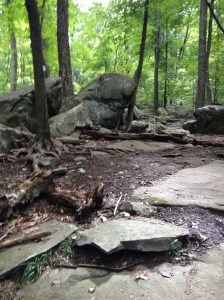
The most distinctive point listed was the Devil’s Half-Acre Boulders. Geonyms, or place names, can be quite evocative. New Jersey and Pennsylvania along the Delaware both lay claim to some impressive boulder fields. The Devil’s Half-Acre was clearly a place for rock climbing, as chalk dust on the trail indicated. It’s not territory that you can get through quickly. But why devilish? Across the Delaware may lie the origins of the name. Near another boulder field, Ringing Rocks, is the site of a tavern along the Pennsylvania Canal. Said to have been the locale of lawlessness, haunted by the ghosts of dead canal workers, the location earned the same diabolical sobriquet in the early nineteenth century. What we found on the Jersey side, however, was an impressive jumble of massive stone and a rather popular hiking path.

“The map is not the territory” Alfred Korzybski once famously wrote. His expression was borrowed and adapted by religionist Jonathan Z. Smith in a book that’s still required reading for those starting out in the field. The point of the saying is that a map is an abstraction. The experience down here on the ground is very different from that projected from a bird’s eye-view. We can easily adjust to the concept however, using maps to tell us what lies ahead. The difficult work of digging a canal, or the unyielding nature of boulders, may symbolically point to the devil. At several points on the trail we had to pull out our map to make sure of our bearings. Trails are hard to follow over rocks. There was no literal devil there, but territory might just help to explain the name on a map.


Ned Ludd and Company

I’m sure you’ve seen them too. Maybe in the movies, or on a newsreel, or maybe on a filmstrip in school. I’m referring to those scenes, usually in some foreign location, where bicycles, ox-carts, cars, buses, and pedestrians all crowd the same streets in a holy confusion of conflicting human intentions. Some can afford no transportation at all beyond their own feet. Others can own, and use, automobiles. On a scale like this I’d put myself around either the bicycle or ox-cart-driver level. I’m referring to technology, of course, and not actual transportation. At a recent family discussion I was left completely in the dust and exhaust fumes of new technology, trying hard to comprehend the words that other family members were speaking so fluently. Software names, devices that do things I can’t divine, and what is a dongle anyway? I’ve fallen behind not only on my movies and books, but on technology as well.

Tech develops quickly despite how slowly the rest of the world moves. Some members of my family don’t have computers or use the internet. Others have devices so advanced that they might’ve been salvaged from Roswell, and I wonder how all this happened when I thought I was paying attention. I’m a late joiner when it comes to tech. Although I’d been warned, I made it through my Master’s degree having barely touched a computer. When I took a decidedly low-tech job teaching at a medievalizing seminary, we couldn’t afford television service and we haven’t really watched TV since. Now I hear that you don’t need to pay for the privilege. If you have the time, black boxes, sticks, and even software downloadable on your phone can be your television. I look at our flatscreen at home and wonder where the on/off switch might be. How have I fallen so far behind the times?

The real problem, from the view on my bicycle seat, is that in order to maintain some level of expertise in my field of study, I have to dedicate quite a bit of time to it. While others tickle their devices on the bus, I’m reading my books made of genuine paper. I’m thinking such activities will make me better informed. Most of these books address the past. If I want to upgrade from to an ox-cart, however, I have to learn a whole new language and the nouns that accompany pieces of hardware that look an awful lot alike to these antique eyes. Perhaps we have become cyborgs after all, and I just missed the introductory session. I wouldn’t know; I’m too busy trying to keep this bicycle out of the path of that speeding lorry.


Oil Heritage

I love optical illusions. Apart from the sheer fun of ambiguity, such illusions are really all about perspective. Shifting perspective can be one of the most powerful ways of changing a person’s life. One of my more stalwart perspectives is that those who originate something deserve recognition. If that something is important, they may even deserve acclaim. And sometimes that thing may turn bad, in which case the discoverer may end up being notorious. Originality, the subject of bestsellers and media gurus, is sometimes the result of thinking differently than other people do. It can be cultivated and grown. Sometimes it’s simply fortuitous.

Every time I visit my own place of origins in western Pennsylvania, I think of the oil industry. It’s pretty hard not to around here. “Pumping jacks” still operate in some back yards, and petroleum tanks suddenly appear along beautiful rustic roads. The presence of fossil fuels isn’t as evident as it was when I was a child, for all the big refineries have closed down. Many of them have been dismantled. Still, I can’t drive by the site where a refinery fire glowed beyond the next hill from my childhood home and not wonder about it. Seeing those huge oil tanks melted and crumpled as if they’d been made of wax is an image that doesn’t get easily erased. Today, that’s all gone. Still, the oil industry itself was originally from this region. The auto industry—although increasingly electric—would’ve never started without the obvious boost that petroleum production gave transportation.

In the light, or perhaps dark, of Hurricane Harvey we’re set to see increasing gas prices. They will impact the economy in other ways, and energy giants will continue to degrade the environment in the quest for cheap and abundant crude. I’m not sure if that makes the discovery of oil in this region worthy of acclaim or notoriety. It does seem, from my perspective, that since big oil is so lucrative, a lifeline ought to exist for the struggling communities in my childhood home. Empty storefronts were rare here in my youth. Now they are almost as common as shops that remain open. I know; if people can’t move on, then maybe there’s a reason the economy is sagging. There are ghost towns in this area, and there may be more in the future. I just wonder how all this will looks from another perspective. Will it all be an illusion once electricity makes the past superfluous?