Holding Still

For some people today is the start of the “holiday season.”  Thanksgiving begins what often becomes a rush up until Christmas.  Moods tend to be more festive, if not carefree.  As for me, I always save up vacation days so that I can make my own mini “semester break” late in December.  From the onset of the holiday season I can see far enough to be able to make it through the rest of the year.  For me the season seems to begin at Halloween.  It’s not a federal holiday and I don’t know anyone who gets Halloween off of work, but I take holidays seriously, and Halloween, Thanksgiving, and Christmas are all anticipated days.  And in the spirit of the day, I’m thinking of the many things for which I’m thankful.

Family, friends, and health go without saying.  I really don’t need a holiday to remind me to be grateful for these things.  This year I’m thankful to have made it back from Denver unscathed.  Since it was over twelve hours of travel (less than three of those hours spent in flight) to get home, it was a long, weary, mask-wearing day of travel.  Denver Airport is nearly an hour from downtown.  The American Airlines agent was able to get me an earlier flight to Chicago.  My reading was disrupted by sleepiness and the fact that the woman next to me was watching Jordan Peele’s Nope on her laptop.  I’ve been meaning to watch it again, so I hope I wasn’t obvious when I didn’t strictly observe the custody of my eyes.  The most grueling part, however, was the four-hour layover in Chicago’s O’Hare.  

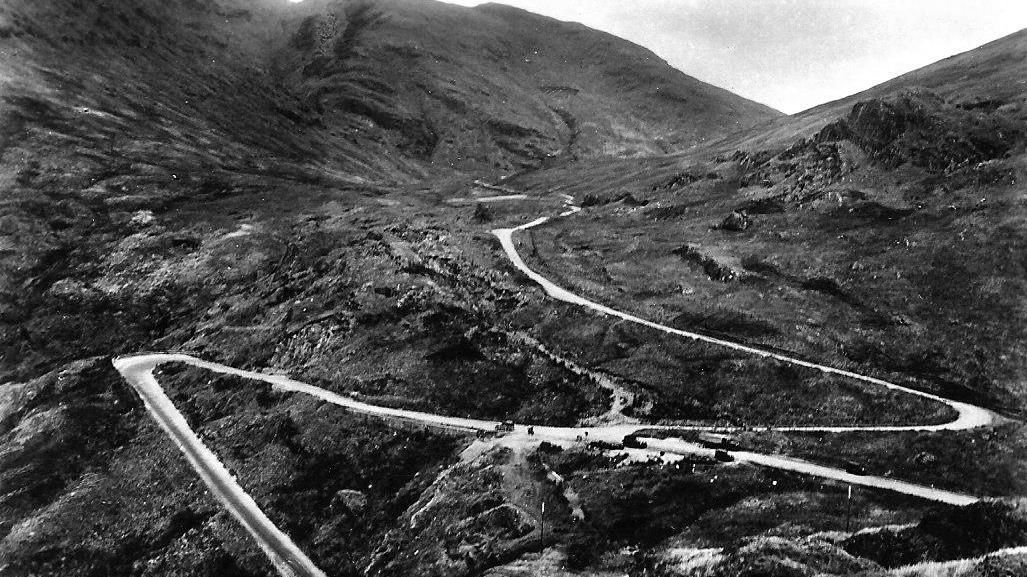
No matter what the owners do, there’s a limit to how comfortable airport waiting can be.  You have to keep a constant eye on your bags.  Very, very few people are wearing masks.  And two days before Thanksgiving is a busy travel day with people trying to avoid the busiest travel day of the year (yesterday).  I’m thankful to have gotten home and not to have been too much the worse for the wear.  And I’m thankful to spend a day not having to wear a mask.  It’s funny how having to wear one for five straight days all day long can become a point of dread.  I like being able to take a drink of water without having to pull down a mask.  Returning to life as usual will take some adjustment—it always does.  So much travel after spending years not doing it is a bit of a shock to the system.  I’m reminded of one of the most colourful place names we encountered in the highlands of Scotland, and it is my theme this Thanksgiving: Rest and Be Thankful.

Rest and Be Thankful, unknown photographer

Religion in the Air

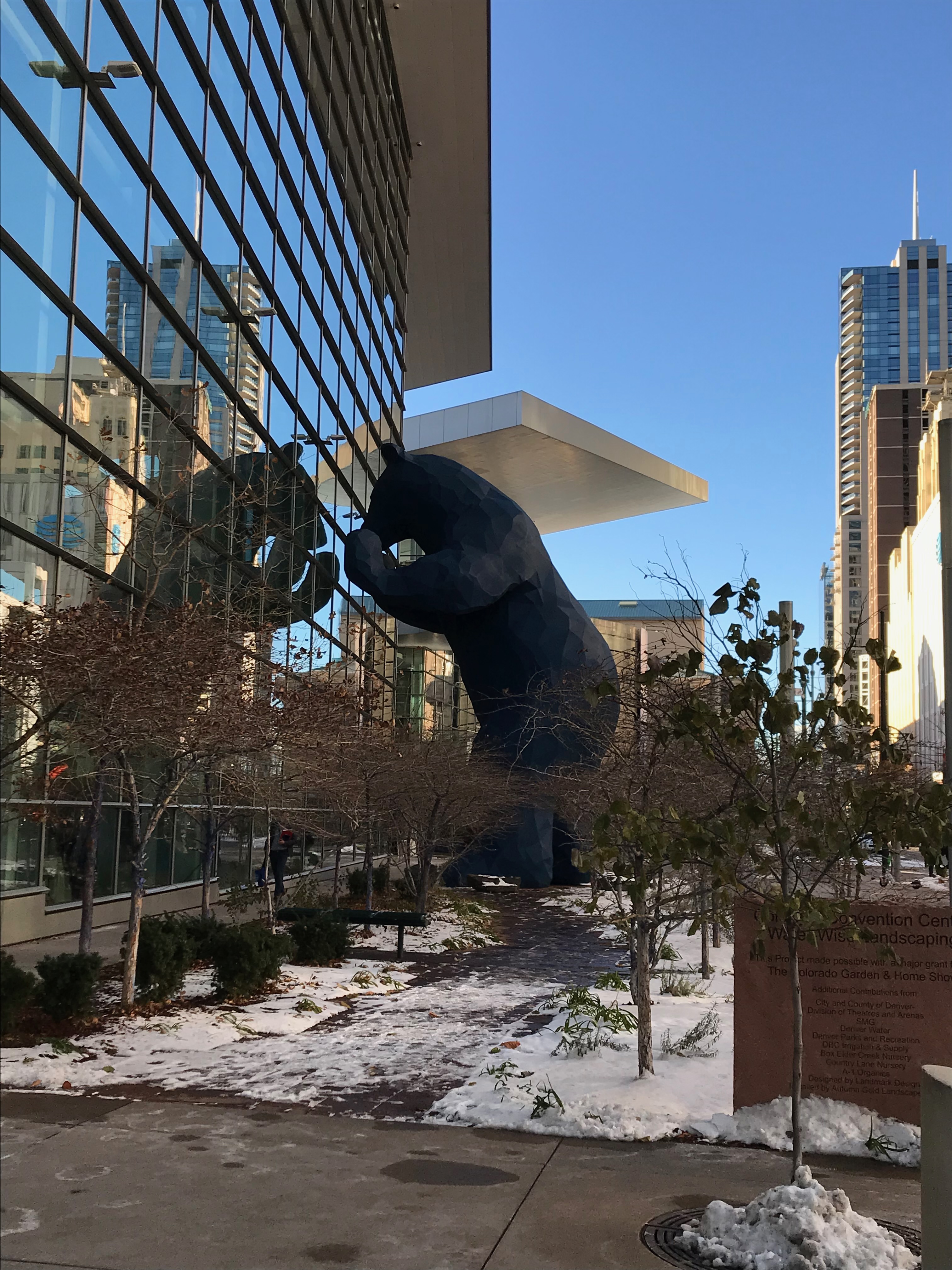
There’s a physicality to it.  Being in Denver, I mean.  My hotel was a mere four blocks from the convention center and the short walk inevitably found me huffing and puffing.  My first night there it had me wondering if something was wrong—should I call a doctor?  I jog on a regular basis and try to stay healthy and so I’m not used to being winded by an inconsequential walk.  My second scheduled meeting saw me with a seasoned scholar.  He pointed out as we slowly made our way to the seating area that the altitude was probably to blame.  The mile-high city does lack the oxygen more abundant down where we lowlanders dwell.  I often wonder if my first trip here was beset by altitude sickness.  I met a colleague at the conference, on his first trip here, who had the same non-Covid symptoms I had all those years ago.

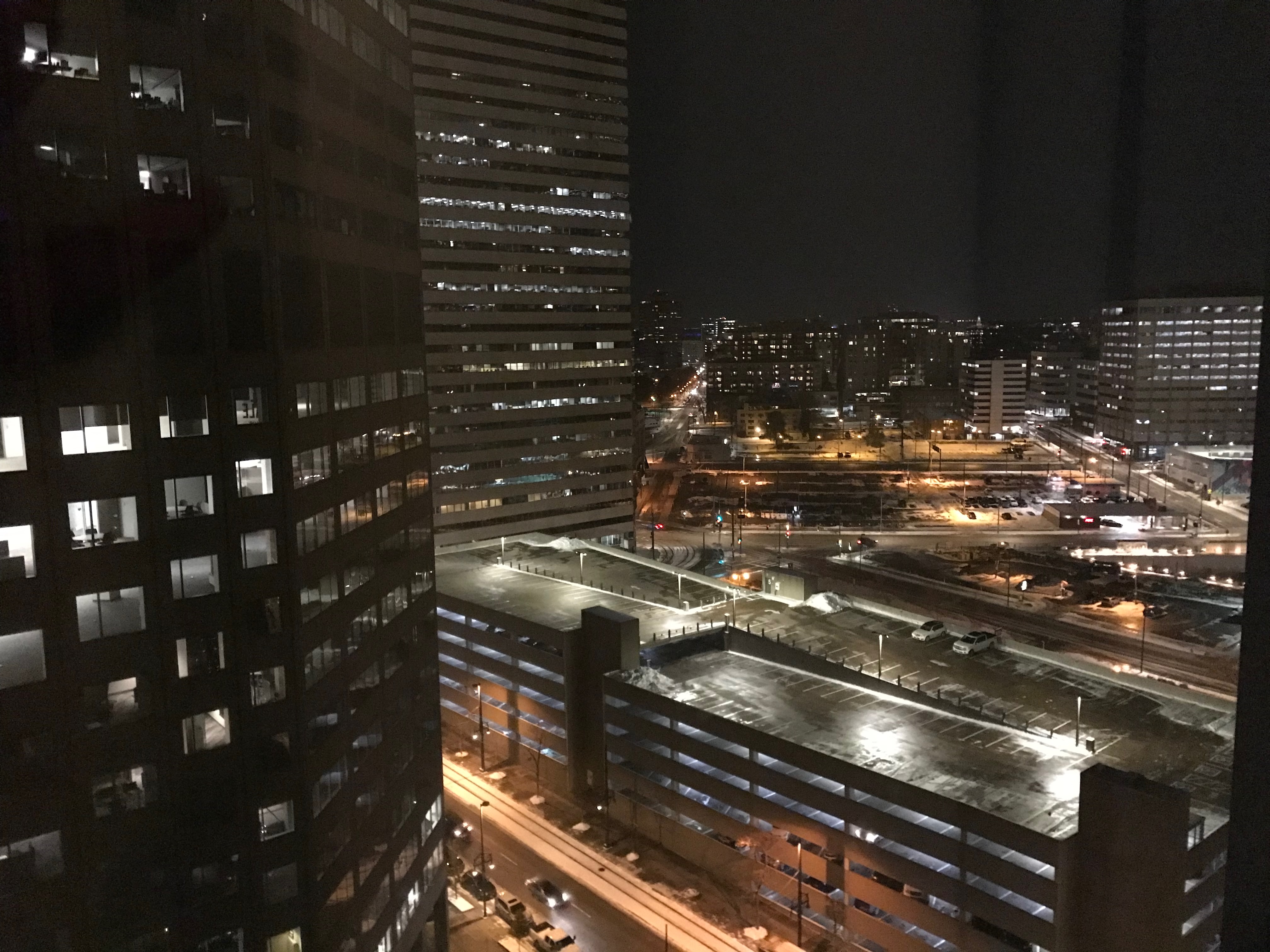
We’re used to our own air.  The familiar atmosphere we breathe each day.  Taken out of that context we’re not exactly fish out of water, but we’re not exactly not either.  The combination of back-to-back meetings, the effort it takes to walk around city center, and the constant chill in the air during my time there dissuaded me from exploring.  Or even finding places to eat.  I started to worry that they’d recognize me at the Chipotle where I ordered carryout the first three nights in the city.  I know there must be other places to get some good, vegan options, but it was always dark by the time I was done with work and I was still waking up on Eastern Time.  On the positive side, I didn’t get sick this time.  And I would really like to explore the place further.

Many years ago, on a family driving trip from Wisconsin to Idaho, we drove through Colorado on the way home.  High above Denver, in the Rockies—driving through Rocky Mountain National Park—I told my wife I felt strangely elated.  “It’s like a religious experience,” I said.  Perhaps it was the physicality of that altitude, mountains spread out before us, that led to that brief moment of rapture.  It’s so closely related to that acrophobia that whispers the warning not to fall off the edge of this globe when you’re so high in the air.  Even now as I’m heading home from Denver when I’ll be even higher in the sky for a few hours, I reflect on what it means to be a physical being enveloped by the air.  And I’ll appreciate with wonder the planet of mountains, endless plains, and eroding hills on which I live, and I’ll be thankful for every breath.


Reflections of a Hermit

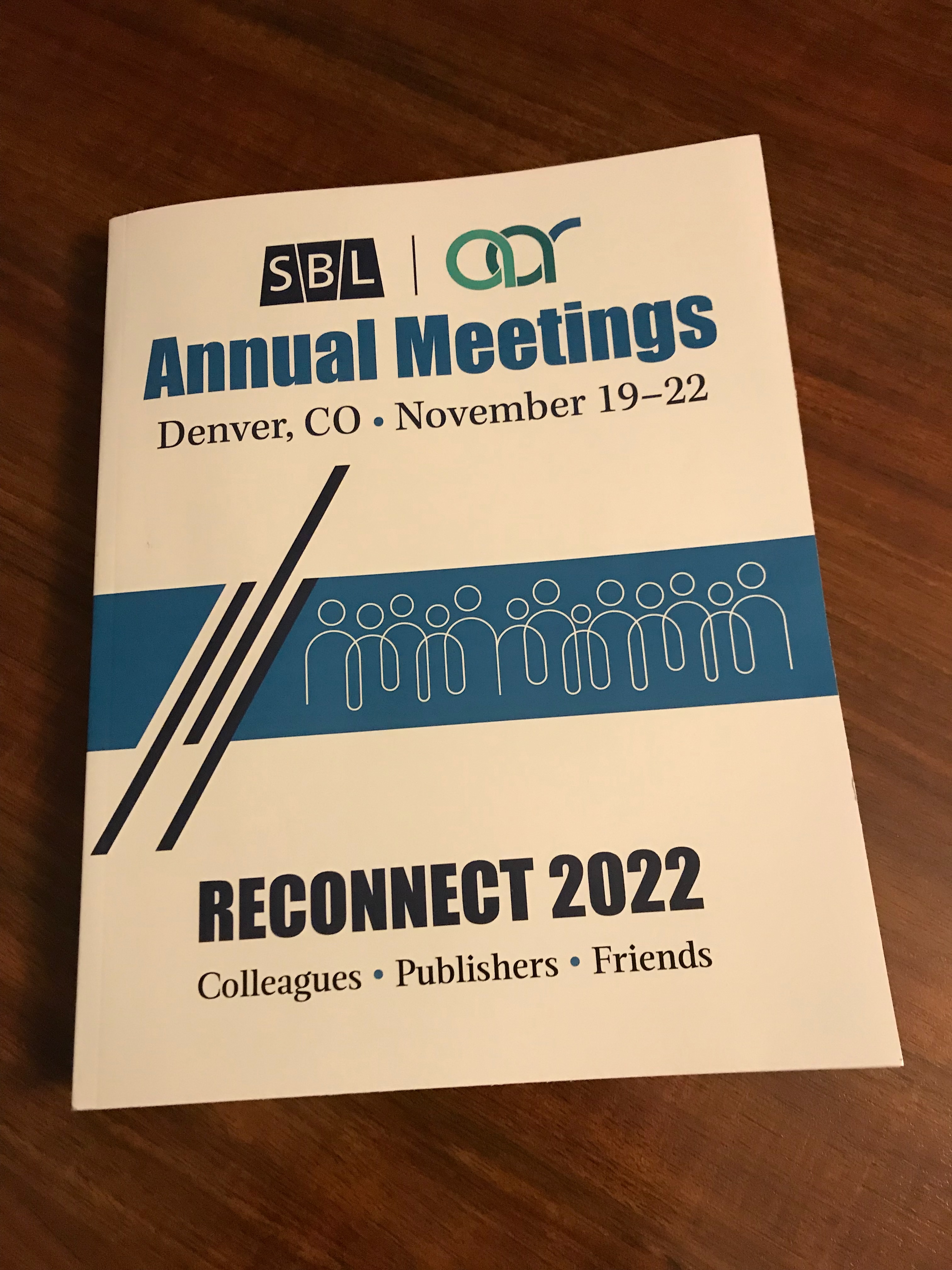
Although I acknowledge that Covid has made even more a hermit of me—I won’t deny it—and I often complain when I have to travel for work, I generally end up glad that I have.  (As long as I avoid Covid.)  Being at the AAR/SBL annual meeting is like being in a living library.  You meet and talk with so many smart, smart people and their ideas and yours begin to blend in an amazing kind of way.  I suspect that it shows that my books have been written by a guy in isolation.  That is, they could be improved by other eyes on them.  That’s what peer review is about, of course, but there’s something exciting about talking to my monster friends and engaging them about their ideas.  Frequently they will ask about mine.  I’ve even had colleagues mention that they’ve read some of my work.

The only real problem with how this unfolds is that I have so many meetings in a day that I sometimes lose track of the many ideas that crowd into my head.  Hastily-scrawled memos in my notebook—I’m too busy paying attention—mean that only fragments remain the next morning.  Each of them a gem.  (Fitting for Denver.)  When conversation comes around to what I’ve been working on, no matter how obscure it is, my monster friends know the root story and even have ideas that help shape my work.  No one scholar can read everything, and those of us who tend towards being hermits have the limited sources of one human imagination.  When imaginations get together, however, these ideas blossom.  I learn so much from these brief days that I think I might’ve been dangerous if I’d remained in the academy.  The man with an exploding head.

I sincerely hope that I give as well as receive at these meetings.  It’s really unfortunate that we don’t support humanities scholars in this nation.  These are some of the bright stars in our national constellation, yet they struggle with underfunding, and pressures such as “metrics,” as if you can quantify the influence on young brains and the potential future of our collective imaginative life.  Although I grouse, as is perhaps to be expected of an aging hermit, I can’t help but be enriched by the fertile minds I encounter, even if behind a Covid mask.  I’m never quite sure how to thank all these idea-conjurers properly.  I wouldn’t have met most of them had my career not taken the strange turns it has.  Now I realize that even hermits may have many friends.


Day Two

You have your suspicions when you first spot them, but you have to wait to confirm it.  You’re flying in mid-to-late November and they’re concentrated around one particular destination.  They won’t be the only ones going there, of course—families with kids, late vacationers, others traveling for business—but they will be among them and you can learn to spot them.  The attendees of the American Academy of Religion and Society of Biblical Literature annual meeting.  Pre-pandemic there were reliably about 10,000—a biblical myriad—of them.  We’ll have to wait to get the figures on them this time around.  In any case, I make a game of spotting them at the airport.  Well, if you’ve got a connecting flight you need to wait until the final leg.  It’s possible some got on with me in Allentown, but I didn’t spot any likely candidates.

The male of the species is easier to identify at a glance.  Bearded, serious demeanor, slightly out of touch when it comes to fashion.  Incongruously sometimes they’re wearing jeans but you know that’s just their traveling raiment;  once they arrive and get tweeded up they’ll be easier to place.  Otherwise you can identify them on the path by their talk.  If they enter into discussion with a seat mate or someone walking to the baggage claim or getting onto the public transit, or even in restaurants, they will speak of strange things.  Their language will grow technical and their frowns will be discerning.  They are assessing, you know, assessing the ideas that don’t fit with their personal theories about samsara, or Origen, or Jeremiah.  And they don’t mind saying so, right out in public.

As important as I know religion to be, and as much as I know that to understand it deeply you must spend years and decades studying it, I sometimes wonder just how others must view us.  I still dress like them, although I travel in my tweed because it makes my suit-bag too bulky to pack it.  On the plane I read an actual book (likely about religion, but that’s not a guarantee), and once in a while someone who hasn’t realized that the conference is over will want to talk business in the airport while waiting for a flight when all I want to do is pull out a novel and try to get the shop talk out of my head for a little while.  This is the unusual experience of attending AAR/SBL.  I’m sure there’s enough material here for a sociological study, but I think the sociologists have conferences of their own to attend.


Remember November

I didn’t get his name.  I could have, because he was wearing a name tag.  I was too busy thinking, “that won’t be me.”  I ended up being wrong about that point.  He was sitting in that depressing place at the AAR/SBL meeting in Kansas City.  That room for those waiting to see if they’d scored any interviews.  “I’ve got publications,” he told me, “I’ve got years of teaching experience, but no interviews.”  Our capacity to fool ourselves should not be underestimated.  I was just sure that once I was in that place—publications, teaching experience—I would be able to find a professorship.  I did find one that lasted about fourteen years, but after that, my nameless friend, I have to say “you were right.”

I can’t help but think of that when I attend this conference.  It’s a place of lost dreams for me.  I can see my books on display here.  I can see literally hundreds of people that I know.  I’ve gone from a vocation to a job, and there’s no going back.  Sometimes I wonder if adjacent careers are a good idea or not.  I’ve put some books under contract from new Ph.D.s who eventually decide to disappear.  Not to be found anywhere in academia, their books left unpublished.  Perhaps they met my mysterious prophet.  Maybe they came to realize that working in a job right next door to where they want to be will only ever remind them of loss and regret.  We continue to the glamour of a conference that reminds many of what they never found.  El Dorado.

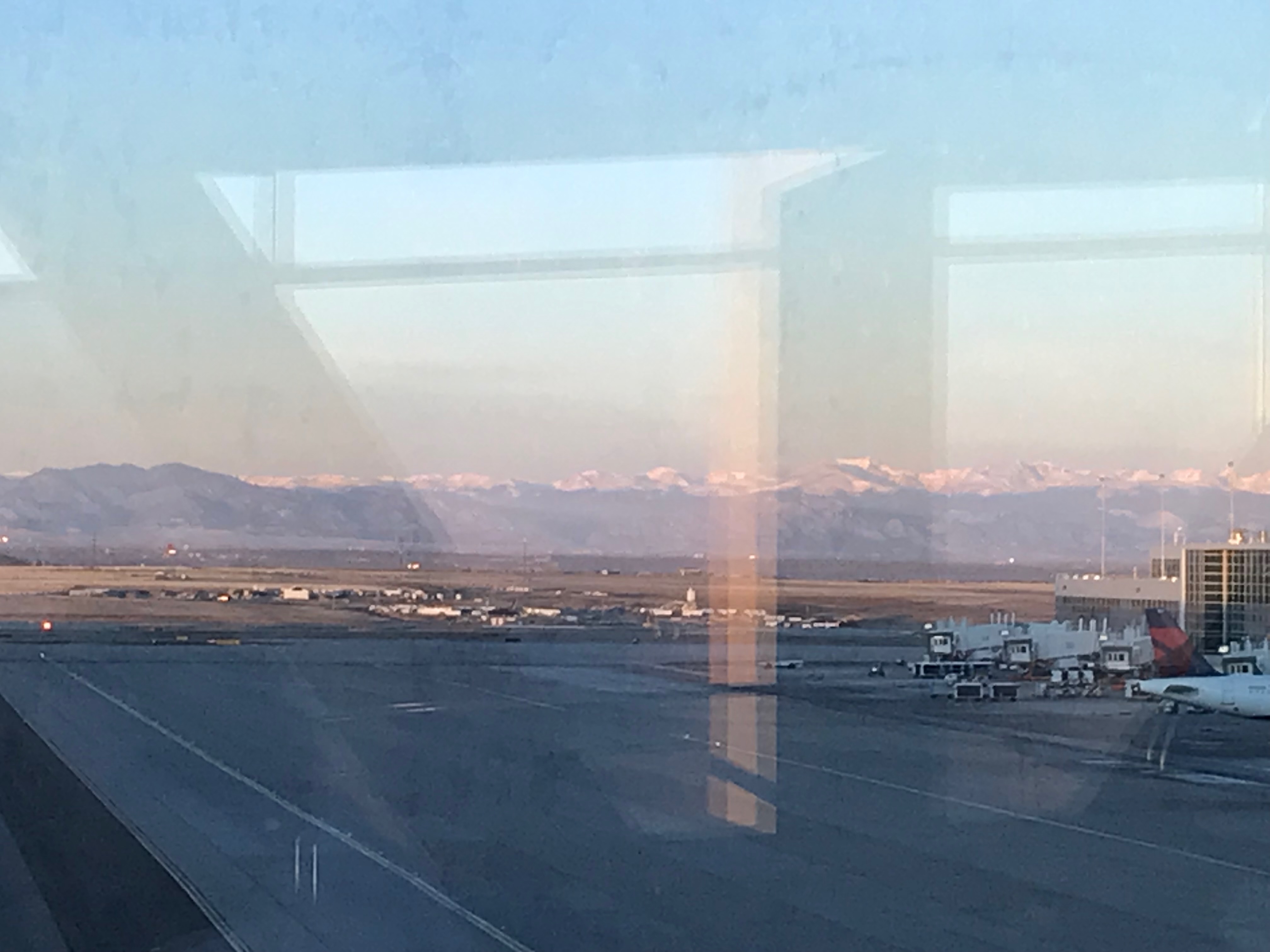
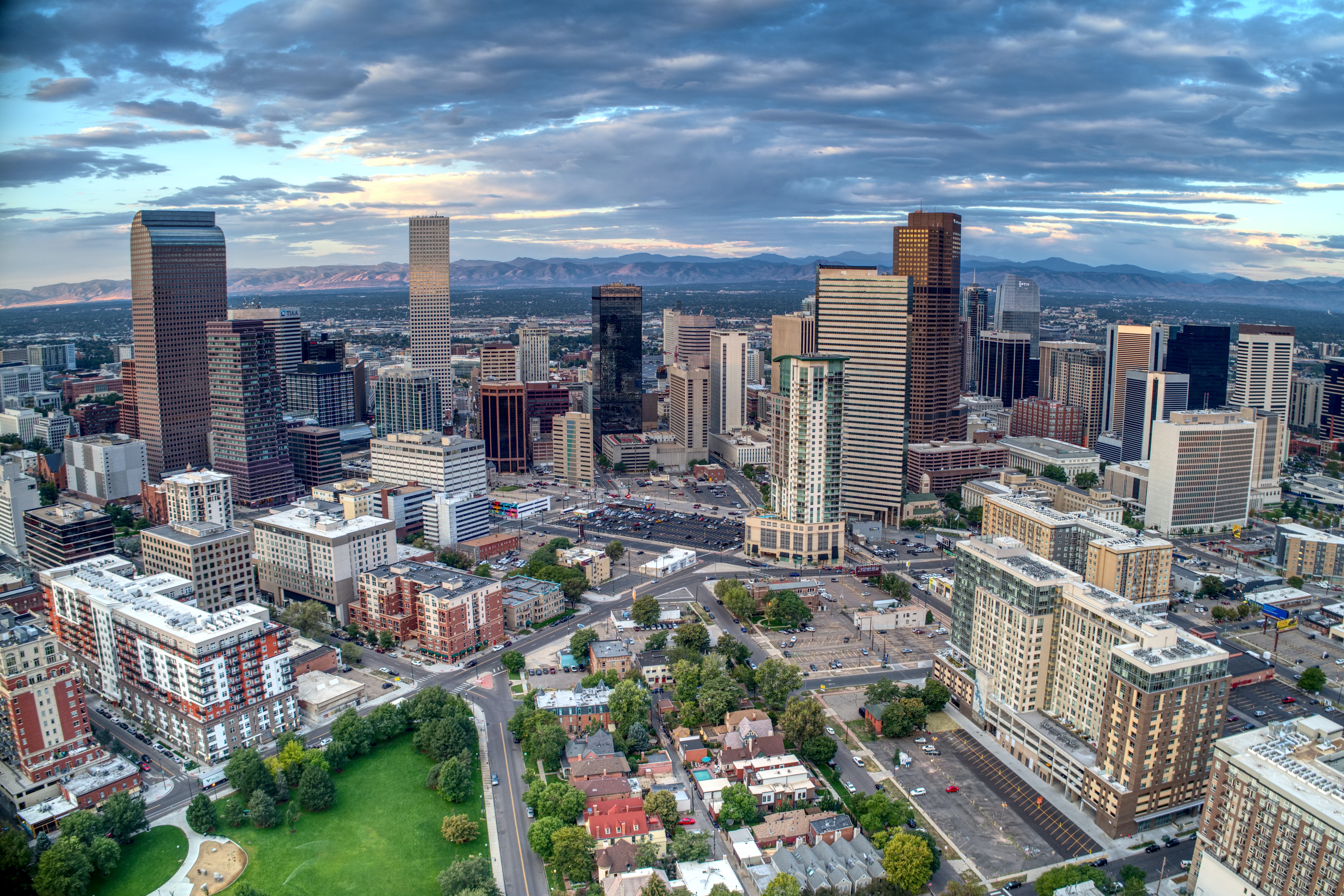
So as I sit here in Denver with my past.  I actually made it to Denver, which is, I suppose an improvement over last time.  There was snow, in Denver, but the locals seem to be fine with it.  Not many people are wearing masks these days, I’ve noticed.  There were a few stalwarts on the plane(s) and a few here at the conference who did.  The pandemic doesn’t bend to the will of people, not even religion scholars.  Viewing Denver from the airport (it’s a considerable way out), it looks so small and insignificant backed by the front range of the Rockies.  Maybe that’s what all of this is about: significance.  My association with this conference spans 31 years.  Perhaps there’s a bit of weariness here too.  The pandemic may never really end, not in any meaningful way.  I do wonder if my nameless friend ever found a job and if he still attends.  If he does I wonder what he would say about all of this.


The Denver Curse

I’m posting this early today because I’m flying to Denver for the American Academy of Religion and Society of Biblical Literature (AAR/SBL) annual meeting.  At least that’s the plan.  I don’t have a good track record with Denver and this conference.  I’d been attending AAR/SBL since 1991.  I can’t recall what year it was when I first attended in Denver.  I was still a professor then and had a paper to read.  I also had free time (something editors don’t have at conferences).  I decided to view the world-famous mineral and dinosaur exhibits at the Museum of Natural History the morning of my paper day.  While at the museum something very embarrassing happened—I got sick in public.  It was scene-from-a-cheap-movie bad.  Literally sprinting to a public waste can to throw up in front of strangers.  I’d never been sick at AAR/SBL before, despite the November timing.  When I went to read my paper that afternoon, the motion of my eyes made me sick again and I had to sit with my head between my knees while a bunch of biblical scholars looked on with what passes for concern in academic circles.

The second, and last, time I was flying to Denver  for the conference there was a small snowstorm.  I was flying out of Newark on an evening flight.  Because of the snow (which ended up being about two inches) my flight kept getting delayed and delayed.  They made the decision to cancel the flight after 11 p.m. by which time all local hotels were full from the earlier cancelled flights.  To make matters worse, there was no way out of the airport.  All public transit shut down.  Even if I could’ve caught a taxi where was I to go?  I live in Pennsylvania.  With no other choice, I slept on the floor of Newark’s Liberty International Airport.  I awoke early, having used my briefcase as a pillow (a step up from a stone, I expect) and found my way to Somerville, where we used to live.  My wife picked me up at the train station there and drove me home.  I missed the conference, needless to say.

And so you see that I’m a bit dubious about trying this again.  I have nothing against Denver.  Before getting sick I was enjoying my time there.  So, if things go according to plan, I’ll be on a plane headed that direction by the time I usually post my daily thoughts on this blog.  Will the Denver curse be broken?  Only the next few days will tell. Watch this space.

Photo by Acton Crawford on Unsplash

Ode to Auld Reekie

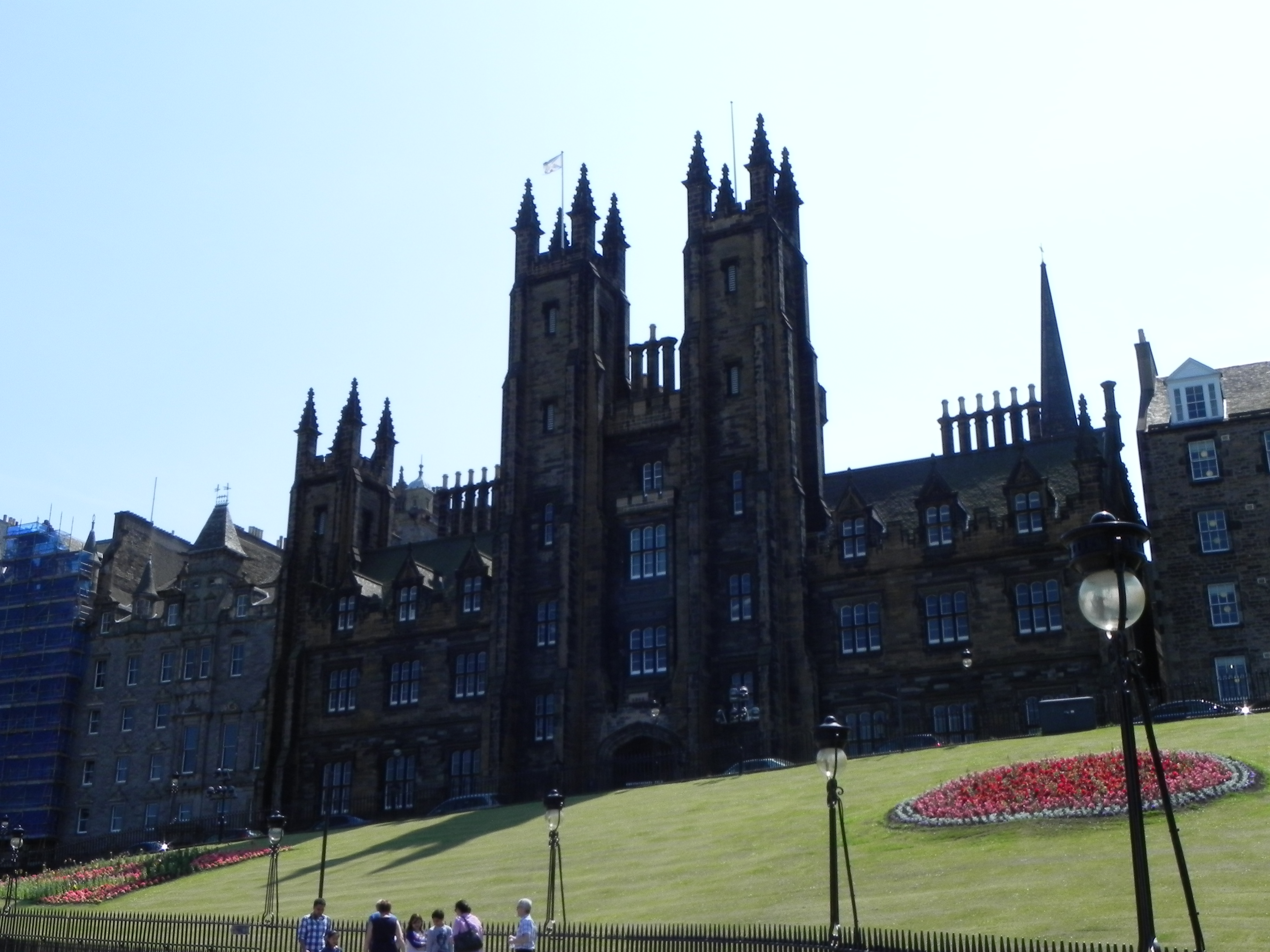
Edinburgh is a sizable city, although not large like New York, more like Boston, but smaller.  Like Boston, it has had an outsized influence globally, even apart from its world-class research university.  I think of the creatives that are from, or spent considerable time there (J. K. Rowling, take a bow) and the many great thinkers who’ve called it home.  Our three years there went by too quickly, but money being what it was (and is) and laws dictating how long we could linger, we had to leave it in 1992.  If you’d have asked us when we were there we’d have told you we’d’ve stay if we could’ve.  We had no money, no car, no television, but we had Edinburgh.  Somehow that seemed to be enough.

Places have great significance to people, but it’s not reciprocal.  I occasionally find out a famous person was from Edinburgh and say “I didn’t know that.”  Having spent three years and the cost of a doctorate there, I was a mere drop in the Firth of Forth.  I’m frequently in contact with faculty members at the Divinity School for work.  None know that I studied there—I suspect most university folk don’t sit around talking about long-ago post-grads.  Indeed, there may be no faculty left from the time I was there.  New names, new faces, new research agendas appear.  Indeed, you wouldn’t choose Edinburgh as a place to study Ugaritic now, even though there was once an “Edinburgh school” of thought in the discipline (and I can footnote that).

Still, when I hear “Edinburgh” my ears prick up like those of a dog who’s been called.  It is a part of me.  I’ve only been able to return once since our original stint there.  It was a strange sort of homecoming.  Familiar and foreign all at the same time.  Some shops were right where we’d left them, others now merely ghosts in our memories.  Fortunately Edinburgh hasn’t had the building mania that often causes old cities to try to reinvent themselves.  It was already great to begin with.  More and more I hear about the Edinburgh Festival, and the Fringe.  People are starting to notice this jewel in the crown of the United Kingdom.  On a molecular level there may still be a little bit of me there.  We’re constantly shedding, I suppose.  And someday perhaps we’ll be able to return.  It may not remember me, but I can’t forget her.


Flower Power

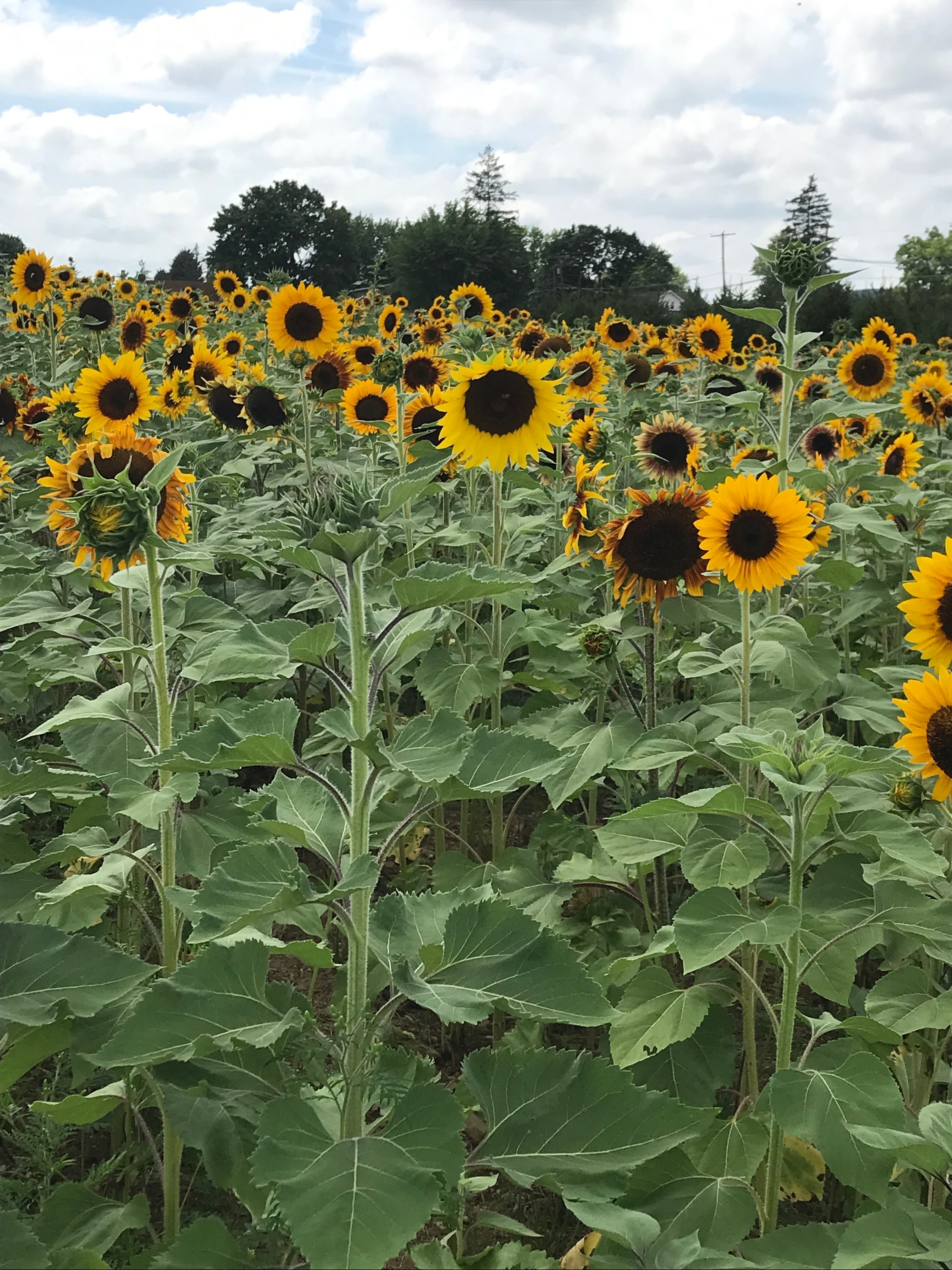
Why do we find flowers so attractive?  Often what separates weeds from desired plants are the flowers.  (Not always, though, as the much maligned dandelion can attest.)  The bright colors clearly help.  Intended to entice pollinators, flowers offer many natural attractants—nectar, intricate patterns, stunning colors—that draw both insects and humans to them.  Summer is the time for weekend festivals, and thus we found ourselves at Yenser’s Tree Farm for their Sunflower Festival.  Located near Lehighton, it’s in some pretty territory.  At this time of year it’s dedicated to sunflowers.  Perhaps all the more poignant this particular year, given that the sunflower in a national symbol of Ukraine, lots of people were there a warm Saturday afternoon.

The Helianthus genus is actually part of the daisy family.  What we call the “flower” is what botanists call a “false flower” because the head of a sunflower consists of many tiny flowers surrounded by a fringe that has petals like other flowers.  In other words, a sunflower is a cooperative venture.  The name “sunflower” either derives from the disc head looking like the sun, or by their trait of heliotropism.  The buds, before blooming, track the sun across the sky.  Most remarkably, at night, typically between three and six a.m., they turn back east anticipating the sunrise.  This speaks of an intelligence in nature.  There is a scientific explanation, of course, having to do with changing growth rates in the stems that allow a kind of swiveling effect.  To me it seems to indicate plants are smarter than we give them credit for being.  Not having a brain doesn’t mean you can’t be amazing.

The tiny flowers in the head are arranged in a spiral that follows a Fibonacci sequence.  I can’t even follow a Fibonacci sequence, so I’m glad to cede intelligence to our plant friends.  How can they anticipate where the sun will rise?  It’s the anticipation that’s heavy with significance.  Sure, using the word “anticipate” is to ignore the garden sprinkler analogy of snapping back once you’ve reached the end of your trajectory, but even so, when a seed bursts from its pod it has to figure out which way is up.  Plants move, to give themselves the advantage of sunshine.  We plant flowers because we want to be near them, admire them.  Plants provide food and oxygen, and we offer nutrients, at least in theory, when we decompose.  We’re all part of an intricate system, and we benefit when we turn to face the sun.


Twisted in Knots

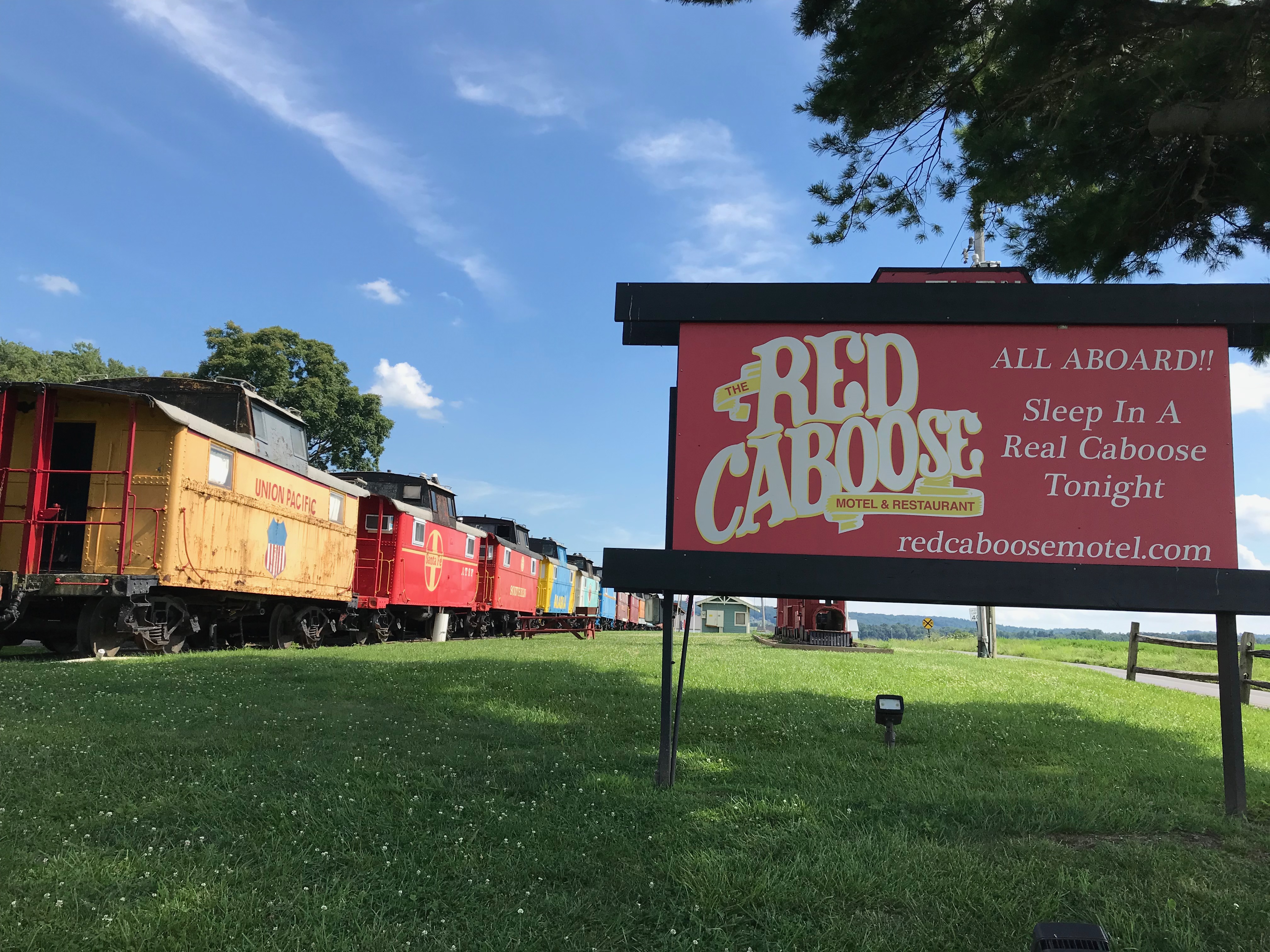
Our staycation at the Red Caboose in Ronks brought to mind the Weird Al Yankovic parody of “Amish Paradise.”  Bored-looking tourists in Lancaster County can’t find anything to do.  While it may be true that many big city entertainments are lacking, we had no trouble filling up a day.  We discovered the little town of Lititz.  Just north of the city of Lancaster, it retains several buildings from the eighteenth century along its main street, and the same quaint, boutique feel of Lancaster itself continues.  I have to admire the creativity of shop owners who have to appeal to the varied tastes of the tourist crowd.  Of course there was a bookstore—there are several in this area—and we long ago discovered the dual value of books as souvenirs.

The reason we were in Lititz, however, was the pretzels.  The Julius Sturgis Pretzel House makes the claim of being the oldest commercial pretzel bakery in North America.  Built in 1784, this is one of the early buildings still standing, and they offer brief tours where you’re taught to roll  and knot a pretzel.  Pretzels are, of course, a European invention.  Since they were an avocation of monks, their shapes became imbued with religious symbolism.  The initial U shape was, like a gothic spire, intended to point thoughts upward, toward God.  As I learned, the twist (which was an indication of a handmade pretzel) was symbolic of marriage and “tying the knot.”  This leaves a fish-like shape, and the Icthys moniker for Jesus would’ve been known to monks.  The folding the knot onto the outer loop symbolizes the arms across the chest used in Catholic prayer as a way of embracing the cross.  The resulting twisted breadstick has three holes for the Trinity.

The real innovation in Lititz, however, was the hard pretzel.  If I heard correctly, Julius Sturgis was working at a pretzel bakery in town where he had the duty of cleaning out the ovens.  The hard bits could be used for animal food, but they gave Sturgis the idea of intentionally baking hard pretzels.  This is the most common commercial form sold today, but southeastern Pennsylvania, which produces eighty percent of the pretzels sold in the United States, is still a soft pretzel paradise.  Radiating out from Philadelphia to locations like Lancaster, Reading, and Allentown, pretzels are eaten more frequently in Pennsylvania than elsewhere.  The religious aspect of pilgrimage still exists for those who venture to Lititz to find the birthplace of the hard pretzel, and the opportunity to stick your fingers in the dough.


The Magic of Cairns

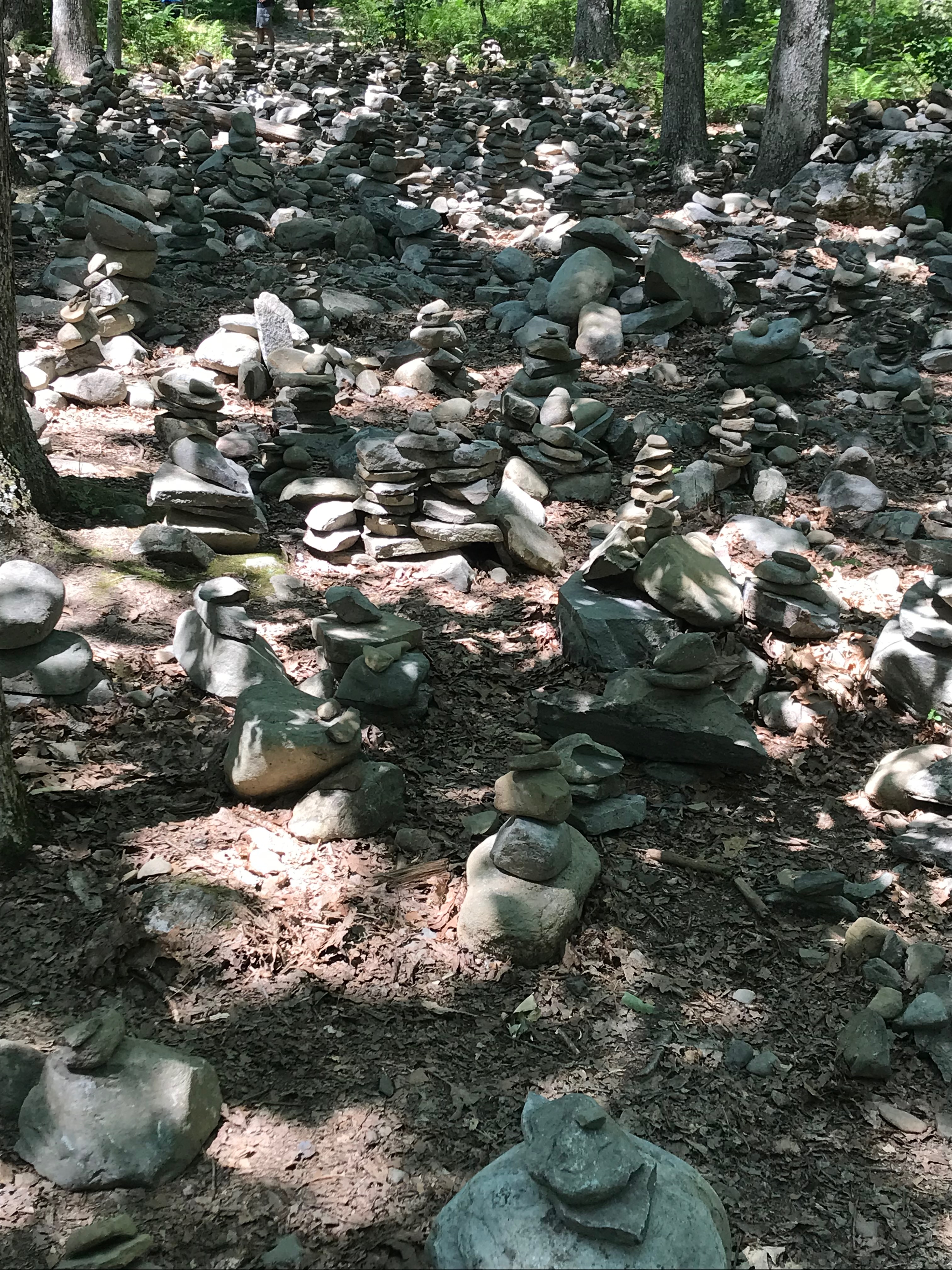
They’re one of those things, my daughter explained, that people do that make them so likable.  She was talking about building cairns.  Cairns are piles of stones, but not exactly the kind a farmer might make at the edge of a rocky field.  Cairns are intentionally built.  And they have been for millennia.  The thing is, while people could choose to knock them over, instead most people add to them.  When we’re out hiking we add rocks to cairns, and we’ve started our own from time to time.  I first became conscious of them in Scotland.  While out with some friends we spied a carefully stacked pile of rocks—I think it was at some remote location on the northern Scottish coast—and they told of of the tradition of adding to them.

While recounting this, I also recall seeing a pile of rocks—it wasn’t called a cairn at the time—at Walden Pond.  Some friends from seminary and I went to visit Thoreau’s famous site and although his cabin hadn’t survived, other pilgrims had started a rock pile.  It was, if I correctly recall, conical because the stones weren’t flat.  Most cairns involve the flat kinds of rocks that break off of bedding planes.  They are fairly easily stackable and they quite often tumble due to the forces of nature.  I recall building or adding to cairns in Ithaca, near Ithaca Falls.  Such cairns would be fortunate to survive the harsh winter and torrents of the spring thaw.  And yet still we build them.

While on the red trail at Bushkill Falls, where picking and taking items is forbidden, we found cairns.  There were isolated stacks along the river, dotted here and there.  Then, at about the halfway point we came across a field of cairns.  Alongside the trail, cairn builders had obviously seen the beauty of repeated patterns.  Other hikers were snapping pictures there as well.  It was clear that this was a joint venture that had spanned years of cooperating with strangers.  Nobody asks your race or gender or orientation when you add to a cairn.  In fact, those who start them are unknown and leave them for other strangers to carry on the work.  This is frequently the case with human ventures, but when they involve money we become very specific about who might be considered a proper owner.  Stones are common, and although useful are generally not valuable.  Make them into a stack and they become a symbol.  And that symbol can be a guidepost for future travelers, left in the spirit of cooperation of those we don’t know.


Ephrata Cloister

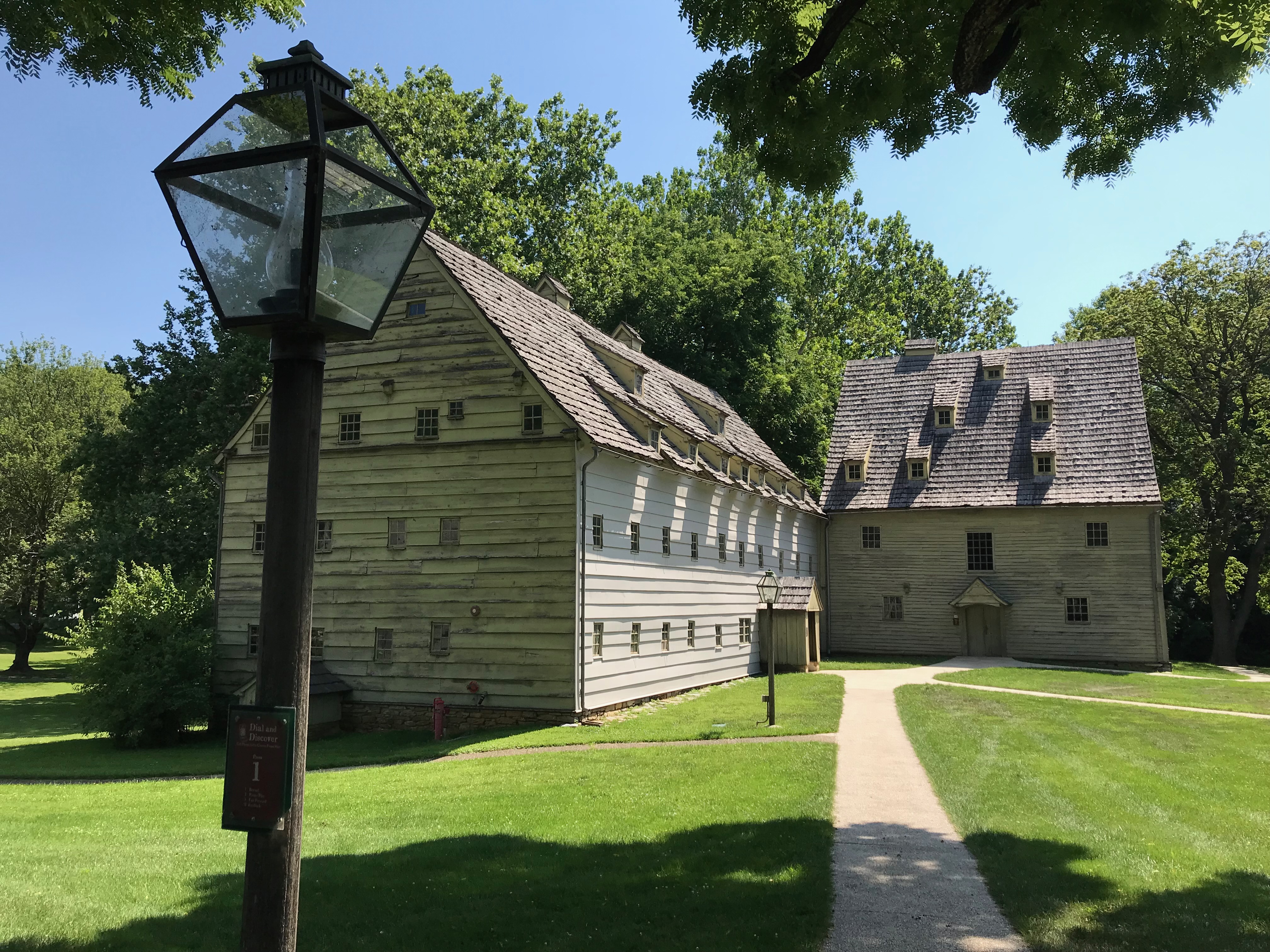
Conrad Beissel isn’t exactly a household name.  I never heard of him until a visit to Ephrata Cloister during a Lancaster staycation.  My wife knew about the Ephrata Cloister due to a music course she took at the University of Michigan; he was influential in developing a distinctive musical style.  Since we were in the area we stopped in for the tour.  Beissel was banished from what would become Germany in the early eighteenth century.  He made his way to America where he established a kind of monastery in south central Pennsylvania in the early 1700s.  Not Catholic, he was inspired by German Pietists, the Anabaptists, and Christian Mysticism.  Not ordained, he established what became a Seventh-Day Baptist association because whenever he tried to settle as a hermit others came to him.

Celibacy has always been a hard sell for religions.  Once his Camp for the Solitary was established, it grew to about 300 members, with only some 80 celibates, or solitaries.  This 80 was half men and half women.  They built around 40 buildings in what was then the frontier and they couldn’t have survived without the 120 or so married people who joined the church but continued to live at home with their families.  Like many separatist groups, the Seventh-Day Baptists were expecting Jesus’ return at any day and lived their lives accordingly.  Not strict about others joining him in this, Beissel was an early vegetarian, eventually becoming primarily a vegan (although that name wouldn’t develop for a couple centuries).  They had midnight worship services since they believed Jesus would return in the middle of the night.  They were, with the supportive families, self-sufficient.  The group established a printing press, and at one time it was possibly the largest printing operation in the colonies.

After Beissel died, the community continued.  They realized that, like all celibate communities, it would be difficult to survive and the celibacy rule was dropped.  The last celibate member died in 1813.  The community by then had taken on the form of an independent church and it survived until the 1930s.  The remaining land—some of it had been sold off over the years as the community shrank—was bought in the early forties to be preserved by the state.  Theirs was never a very large group, but it was significant enough that their memory was felt to be important enough to preserve.  Beissel wasn’t alone in establishing such sects here in Pennsylvania.  The tradition is, interestingly, part of the American heritage and demonstrates how the religious, ordained or not, live in their own worlds.


Odd Getaway

It’s small.  Almost cramped, you might say.  But then again, a Pennsylvania Railroad caboose wasn’t really designed to be a two-bedroom apartment with en suite bath.  Why the Gideon Bible was laid open to Ezra 2.62–4.19 I couldn’t fathom.  I suppose the story begins in Wisconsin, and ends up with me deep in Trump territory for an overnight getaway.  Let’s start at the Badger State.  I’ve always been a sucker for the unusual.  In that regard, I suppose getting a job at Nashotah House was inevitable.  When I spied Weird Wisconsin in Books & Company in Oconomowoc, it became an obvious birthday ask.  When we moved to New Jersey I learned that Weird NJ was a magazine as well as a book, and I bought, and read, every issue.  I also bought both volumes of the book and those of nearby New York and Pennsylvania.  It was in the latter that I first read about it.

The Red Caboose Motel began as a kind of a lark in the late sixties.  A Lancaster county man bought a bunch of cabooses at an auction and then had to figure out what to do with these tons of steel.  He settled on refurbishing them as individual hotel rooms.  I read about them in Weird Pennsylvania and hoped that someday I might stay in one.  My family, feeling restless after more than two years of pandemic isolation, wanted a short staycation.  Hotels involve corridors and breakfast rooms, often tiny, and too many Americans just won’t get vaccinated.  This seemed an ideal opportunity to spend a night in a discrete, self-contained caboose.  And, I admit, to tick something off my bucket list.

Driving behind Amish buggies to get there after a hot day on the streets of Lancaster—a surprisingly busy and loud city—the Red Caboose felt like a good getaway.  Given the number of cars parked outside cabooses, we weren’t the only ones with this idea.  Lancaster is more than just Witness territory.  Known for its boutique shops and pretzels, as well as its thriving Central Market, it’s a busy place in July.  Bumper stickers and loud, aggressively roaring pickup trucks indicate that outside the city the Trump myth reigns supreme.  In town we visited two independent bookstores, one of them quite large.  With at least seven to choose from, Lancaster feels like a readerly place.  Indeed, I could, had I the money and time, envision renting a caboose for a month or two to do nothing but write.  Why they wanted me to read about rebuilding the Jerusalem temple I just don’t know.  I’ll chalk it up to being weird in Pennsylvania.


Stay Safe

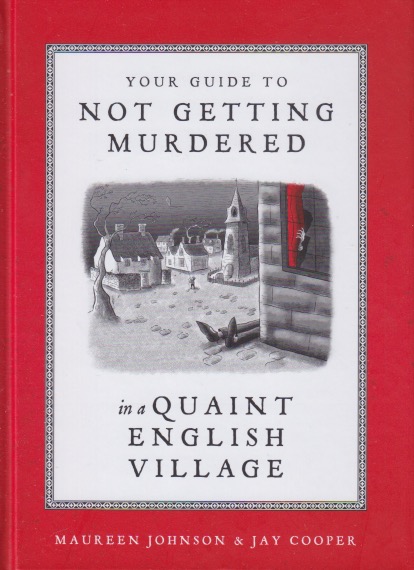
I’m not an impulse buyer.  Having grown up poor, I tend to walk into stores with a list firmly in hand and I don’t deviate from it.  Advertising has virtually no impact.  I don’t pay attention to ads unless they’re for things I know I need, and even then I shut them out most of the time.  I do let my guard down in independent bookstores, however.  So it was that I found in Aaron’s Books in Lititz, Your Guide To Not Getting Murdered in a Quaint English Village.  It was totally an impulse buy, easily read in a sunny afternoon in a caboose motel.  Or a rainy afternoon in an English manor house.  Maureen Johnson and Jay Cooper have produced a wonderfully witty illustrated guide here.  It helps to have lived in the United Kingdom for a few years.

Shelved face out in the thriller section, it’s a great opportunity for murder-mystery, gothic literature, horror movie fan types to laugh at themselves.  Some parts are snort out loud funny.  Okay, so I was on staycation and being a bit free with cash for a change, but I’m sure I will keep this one near my desk and turn back to it from time to time.  Maureen Johnson is known for her young adult novels and Jay Cooper is a children’s book illustrator.  Their talents, however, work together incredibly well for this slightly naughty guilty pleasure read.  The Wicker Man even gets a nod or two.  Something that those who disdain horror don’t often realize is that it quite frequently has its own sense of humor.  It’s an intelligent genre that doesn’t take itself too seriously.  At times it does, of course, but those of us who are fans can tell fantasy from real life.  Maybe.

Independent bookstores are starting to make a comeback.  A significant part of our population isn’t on board with retailers trying to convert everyday life to the metaverse.  We want to hear our music with the occasional pop and microphone hiss.  We want to drive our own cars.  We want to browse in actual bookstores.  Given my buying record online, I have to laugh every time I look at the recommendations.  The electronic world brain doesn’t know me very well at all.  It assumes it knows why I bought that ladder or that round blank four-inch stamped electrical cover.  Some of us play in nontraditional ways with such things.  And we get ideas from wandering into independent bookstores.  As long as they’re not in quaint English villages.


Time Well Spent

If you want a bookstore mostly to yourself, go on a fine, sunny summer weekend.  There will always be those with reading on their minds, of course, but since we’re still dealing with a pandemic, going when it’s quiet feels right.  Having to drop someone off for an event in rural New Jersey, I found myself with a couple of hours and the prospect of sitting in a hot car and trying to read or to find another way to use time productively.  It was a fine, sunny summer weekend day.  I realized the event wasn’t far from Frenchtown.  Now, I’d been through Frenchtown several times, often with my wife on her way to a weekend stint at work.  I’d noticed Frenchtown Bookshop, but since we were always on our way somewhere, we could never stop.

Public parking in Frenchtown is difficult on a fine, sunny summer weekend.  There is a bike and hike trail that passes near the Delaware there, and there’s also the river itself.  Kayaking and rafting on the border between New Jersey and Pennsylvania are popular pastimes.  The mercury was creeping up to 90, so people were out, either sweating on the trail or cooling their heels in the water.  Both public lots in town were full, as was all the on street parking I could find.  A bank tow-away lot—the bank was closed—seemed like the only option.  Independent bookstores are national treasures.  I always carry a list with me since it’s too easy to lose my head when surrounded by print.  If my specialized tastes aren’t represented, I can always find something.

Books are one of the great achievements of humankind.  Although circumstances may have prevented many women from making careers in writing early on—Enheduanna proved even among the Sumerians that women had wisdom to convey.  Once novels came to be written, the form was well populated with female sages.  Reading and writing were kept from slaves for fear of what might happen could they see what the knowledge of humanity really said.  The internet has, of course, become the great democratizer of writing, but has made it more difficult to get a publisher’s attention.  Apart from all that, books laid out on a table, or stacked neatly on shelves, are one of the simple, usually inexpensive, joys of life.  For about the price of a movie you can stretch that entertainment dollar out over several days.  Even when they’re fine, sunny summer weekend days.


Bushkill

Waterfalls are fairly plentiful in this part of the country.  Although they’re not the Rockies, the Appalachians are mountains, and mountains lead to waterfalls.  Niagara is an outlier, of course, where one great lake drains into another.  In the area around Ithaca and Watkins Glen, in New York, there are great falls where the water, through the eons, has eroded the softer rock to flow down to sea level.  While most of the waterfalls in Ithaca are free, you have to pay to get into Watkins Glen.  The waterfalls cascade down into Pennsylvania as well, where the geology is similar, where the bedding planes of ancient seas left layer after layer of rock washed away by yet more water millions of years later.

Bushkill Falls, like Watkins Glen, is privately owned.  Deep in the Poconos, it offers a shaded walk around what has been called “the Niagara of Pennsylvania.”  When we went, it had been mostly a dry summer.  Still, there’s a draw to all that water.  Like Watkins Glen, there are stairways to ease the access among tourists; there are those who might be inclined to sue should they lose their footing.  There were lots of others there the day we went.  Many speaking languages other than English, deep in Trumpian, xenophobic territory.  In nature we’re all just human.  Water washes and water erodes.  Water smooths out rough edges.  There are many parables in water.  It makes life as we know it possible.  It flows to the lowest point, creating incredible beauty as it tumbles over many different types of rock that make up the crust of the earth.  There’s a wisdom in water.

The red trail, around the outline of the several waterfalls, has 1276 steps to descend and climb.  Going down the stairs at the start of your journey assures that you will need to climb at the end.  The air is full of negative ions around breaking water.  Positive feelings are created.  Perhaps people should live near waterfalls.  It’s difficult to imagine hatred thriving in such a place.  I recall a family walk, back in some troubled times, when my older brother led us all to a waterfall hidden deep in the western Pennsylvania woods.  The tension and strife melted away.  We probably all knew that it wouldn’t last, but at the time the present was all that mattered.  Water is so basic, but so unbelievably wise.  Paying attention to such things is worth the price of admission.