Everything but a Name

As we once again near the Ugaritic session of Ancient Near Eastern religions, I ponder the strange wonder that the city has all but completely escaped modern notice. As far as ancient city-states go, Ugarit had it all: drama, sex, violence, everything but a memorable name. Many ancient sites capture the imagination by their names alone: Nag Hammadi sounds exotic, the Dead Sea Scrolls bespeak a hidden mystery. Even Nineveh and Mari suggest hidden riches, but Ugarit? How short-sighted our ancient founders of civilization could be!

To begin with, nobody knows how to pronounce a word that begins with “u.” Vowels are notoriously amorphous, but never more so than when initiating a word. Is it “Yu-” or “Oo-”? The name then launches into the morass of uncertain syllabification. We moderns like to stress the first syllable of a word. Ancient Semitic language speakers tended to throw the emphasis back a syllable or two. How to say “Ugarit” with emphasis on the last syllable without sounding utterly pretentious and affected? Many of my colleagues pronounce the word with an emphasis on the penultimate syllable, “Harvard style.” To me this smacks of a pointy-nosed fish.

In a society that prefers the quick and superficial, stopping to think about pronunciation before barreling ahead into the substance of the matter is a decided detriment. If that ancient society provided us with our earliest complete alphabet and the nearest analog to stories from the Bible, well, it would gain some notoriety if it had a recognizable name. The Israelites forever changed the world that followed their appearance in the Levant. They borrowed concepts, characters, and ideas from their neighbors. Their associates to the north, gone by the time the first Israelite appeared, had chosen a forgettable name and have quietly fallen by the wayside until somebody unafraid of initial “u”s might come along and resurrect them.

Artificial Ugarit

Yesterday a friend pointed me to an article in the MIT News entitled “Computer automatically deciphers ancient language.” The language in question is Ugaritic. The article, by Larry Hardesty, narrates how three computer scientists have developed a program that may potentially decipher as yet non-readable languages. Ugaritic was chosen as a test-case because it has already been decoded and since it meets the specific criteria needed for the program to work. Results from the program could be measured against the standard translations already produced by specialists. Perhaps Ugarit will have another day in the sun.

The larger issue, of course, is technology and its role in understanding the human endeavor. Written texts are an extension of the human mind and those of us who practice it copiously know that the written piece is a piece of the author. Ancient texts may not suffer the same burden of individuality – some undoubtedly were rote pieces set to clay only after a lengthy oral life – nevertheless they participate in the constant paronomasia that is the human psyche. We invent the myths that Ilimilku and his colleagues inscribed so carefully over three millennia ago. Computers may indeed aid us in unlocking their often obtuse forms of expression, but how close will they put us to laughing at Ilimilku’s jokes or wondering deeply at his profundities?

Having been involved in a research project involving computerization and the Ugaritic texts (I was an editor in the now defunct Ugaritic Tablets Digital Edition) I am very aware of the benefits that technology brings to the table. As a sometime writer, I am also aware of the ironies involved. Our ancient predecessors, humans like ourselves, wrote texts that they considered worthy of preservation. Their civilization collapsed. Their language died. We rediscovered it and eagerly wanted to know what they had to say. We, however, have lost the ability to understand. Computers have taken on a dominant role in disseminating the written word. They daily participate in the human experience. Perhaps some day it will be AI that is scrutinizing our whimsical words and trying to decipher what in the world we meant. When they succeed they will find we are not that far from where Ilimilku began.


On the Origins of Goddesses

In what is fast approaching two decades ago, I was facing the prospect of meeting a thesis approval committee at the University of Edinburgh without a solid proposal. I’d meant to focus on Dagon, but the committee felt there was too little information on that deity to fill the requirements for a doctorate. I’d long been fascinated by the role of goddesses in ancient religion and their rather sudden disappearance – more properly sublimation – in what was becoming a male-controlled official religion. (Private religion could have been quite different, as it still is, from official theologies.) It was then that my attention was drawn to the, at that time, relatively understudied Asherah. Apart from having avoided excessive attention, Asherah was also the chief goddess of Ugarit, and possibly other cities.

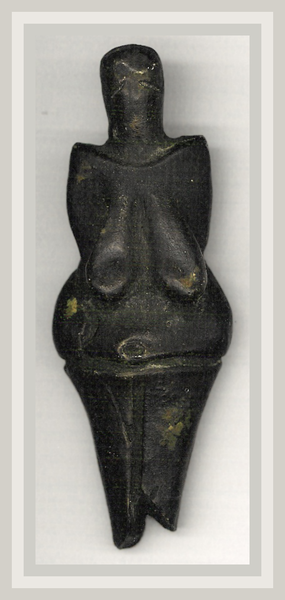
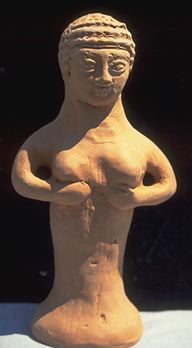
Turning the hands even further back, into prehistory, we find that goddesses seem to have been a natural part of human psyches of antiquity. Few things are as fundamental to human experience as the complementarity of the sexes; why would there be gods without goddesses, and vice versa? Prehistory is excessively difficult to read, existing as it does without written records to interpret artifacts. The discovery of Paleolithic female figurines, however, would seem to suggest that the female divine was a powerful force. The “Venuses” of Willendorf, Hohle Fels, Dolni Vestonice, Tan-Tan, Brassempouy, Galgenberg, Lespugue, Laussel and others demonstrate the acknowledgement of feminine mystery, if not divinity. With the advent of monotheism, one sex would have to accept subordinate status. A sexless divinity is simply too difficult to imagine.

Western religions thus began their descent into the omnipotent masculine. Even the Classical Greeks with their gender-mixed pantheon had to acknowledge the superiority of Zeus. In a monotheistic world, worship of the female divinity became heterodox, heresy, and “pagan.” There it has stayed for millennia, only to reappear in the cults of Mary and other chaste saintesses, clearly beneath the authority of Him. The origins of goddesses? They have been with us from the beginning. The real mystery is not where they came from, but whither have they gone.

Wiki-commons' Venus of Dolni Vestonice


And With Perfect Teeth

This week drug stores across the country will begin offering a testing product that will help assess genetic predispositions to various diseases and weaknesses. Potential parents might learn what debilitating illnesses could plague their children. Who wouldn’t want to eliminate needless suffering and create a world involving less pain and wasting away? Who wouldn’t want to know in advance? Ethicists are up in arms for such knowledge is surely a dangerous thing, just like an overcrowded lifeboat.

Ancient peoples had their own way of dealing with such dilemmas – blame the gods. Disease was not the result of genetic predisposition or even microbes. Illness, plague, pestilence and degeneration were the punishing weapons in the arsenal of ill-tempered deities who didn’t really understand what it was to be mortal. In Ugarit the archer-god Resheph was the divinity who brought pestilence. Shooting from afar with his fiery arrows he could topple cities and nations. Yet few prayers to him are recorded. Better to appeal to a higher power, an outranking deity who might overturn random suffering.

With the loss of many gods comes the loss of the right of appeal. Should the one God be the one who sends disease, to whom can prayers be offered? For many prayers to Jesus or even to Mary are made to circumvent the sad lot poured out upon a destitute humanity by an implacable father. People now recognize genetics and microbes, but still talk to the spirit world about woes and fears. Starting on Friday, however, there will be a product locally available that might provide relief in advance. Who’s willing to take on the gods and give Pathway Genomics a try?


We Still Need Asherah

A very prominent documentary-making company contacted me today. It is in the research stage of planning a documentary on Asherah. I am overwhelmed that I have been asked for advice and that the old girl has finally received some public interest. Scholars are generally accustomed to spinning in smaller and smaller circles of specialization that have little draw for the wider public. Having said that, Asherah is, my own interests aside, a most fascinating deity.

One of the greatest obstacles to modern readers on ancient religion is the fact that gods don’t neatly fit into predetermined categories. We like to think of deities as the “god/goddess of –” where the blank is filled by some natural phenomenon. This is a fallacy that I once whimsically coined the “divine genitival construct.” It is easy to think of Baal as the god of rain, but he is so much more than that! I tell my students that they must think of deities as “persons” first; they are fictional characters, and like good fictional characters they have many aspects to their personalities. They are complex, multilayered, and often conflicted. This is especially the case with Asherah. She is a goddess who represents the royal female. Kind of hard to picture. Not queenship, but the power behind the throne. She is more familiar in the form of Hera in Greek mythology – the primary spouse who tries to keep a philandering husband in line. She is, however, a powerful goddess. She is mother of the gods, the character without whom no other lesser deities would exist. By extension, she is the producer of the gods who make our world possible.

Publications continue to emerge claiming all manner of hypostases for Asherah, many of which are unfounded. I believe it is because we all need the sacred mother, the female authority figure. Our society, still hopelessly patriarchal, yearns for the goddess who understands. Unfortunately, that is not this historical Asherah, it is the Asherah of the modern imagination. If she helps to assuage some of life’s inequities, however, even a mythical Asherah may still serve a valuable function today.

Not Asherah, unless you need her to be


Patriarchal Goddesses

My fascination with goddesses began when I decided to research Asherah. Having grown up in a monotheistic milieu, goddesses were strangely, but not surprisingly, irrelevant. I had, of course, read about them in mythology classes, but they seemed less defined than the gods who had strong, striking characteristics. Now that I’m revisiting many classical goddesses in the course of preparing my class on Mythology, I’m discovering a renewed appreciation for the feminine divine and its contribution to the ancient world.

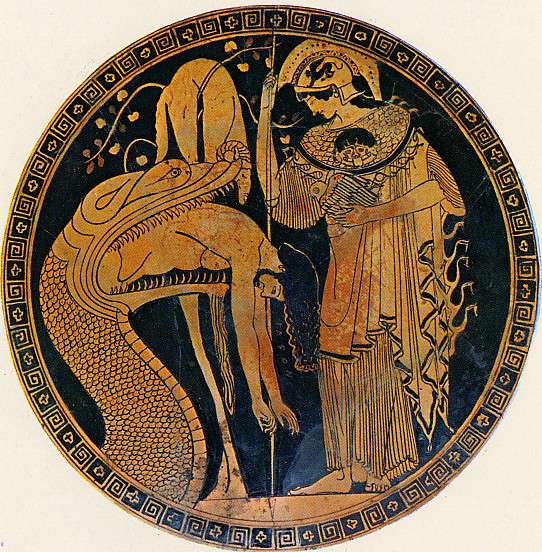
Athena saves a hero

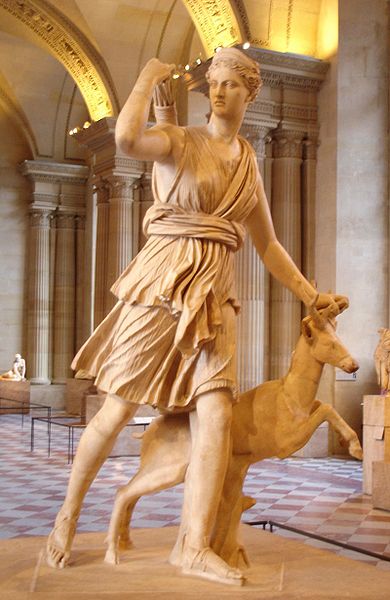
Athena and Artemis have been on my mind for the past several weeks. Among the Olympian deities they are among the strongest female figures (Aphrodite, of course, provides her own feminine form of power, and Hera, although mighty, remains largely in the background). Perhaps what creates such a striking form for Athena and Artemis is that they blend the traditional masculine and feminine roles in a way that the ancient Greeks were prescient to devise – they both possess weaponry and strength that frequently brings mortal men to their demise. They don’t wile with “feminine charms” like Aphrodite; instead they meet men on their own tuft – hunting and warfare, bravery and muscle. They are virgins, not needing male approval. Together they form the basis of many ancient aspects of divine nobility.

Artemis and her man-dog

Today, however, when we think of Olympians Zeus and Poseidon come to mind almost immediately as the two major figures. No one disputes the unstoppable power of Zeus’ thunderbolt or Poseidon’s earthquake. The goddesses, however, display their power on the human level. They may set the fortunes of armies going to war or individuals out for personal glory or fame. They touch the characters on a more human level. They also have their counterparts, unfortunately often eclipsed, in the world of the ancient Near East. Astarte is still poorly understood, and Anat, although more fully fleshed out at Ugarit, largely remains an enigma. The importance of Athena and Artemis thus stands out in sharper relief for having survived the overly acquisitive masculine ego to remind people everywhere that goddesses also will have their due. Given enough time, perhaps even the gods will understand.


Hadad in Copenhagen

Let us talk plainly about the weather. Global warming is a reality, and yet the issue is clouded by religious conservatism. To be precise, it is difficult to determine whether it is really greed or the religious right that stands so firmly behind free-market capitalism that is driving this chariot of the sun. The strange and unholy alliance between religious and political conservatism, however, has become a force daily striving against reality and its proponents want to be on the top of the pile when the whole thing collapses.

I can not speak to the political end of this continuum; I am not a political scientist or economist. As a “religionist,” however, I recognize a deeply disturbing trend that I have followed since my youth. Fundamentalists have consistently taught their young that the “Second Coming” is only minutes, possibly seconds, away. Undaunted by the two-millennium delay in wish-fulfillment, they suppose the words supposedly uttered by Jesus indicate a kind of divine “I’ll be right back” just before pushing off from the Mount of Olives. The signs of the times given in the Bible describe the then current condition, yet modern-day Fundamentalists wish to force the almighty hand, call the bluff of the Texas Hold-‘em expert above. If the general in the sky said wars would come, well, we’ll make wars. If the only way to get his attention is by destroying the planet around us, so be it. Deny global warming for the sake of the religious right, since their world is about to end.

Baal in Copenhagen?

The rest of us might want to stick around for a while. Ancient meteorologists believed that particular gods controlled the weather. At Ugarit Baal, or Hadad, took responsibility for drought and plenty. If there was a problem, they knew just to whom to offer a sacrifice. In our monotheistic western world, we’ve pared the gods down to a single man. Not everyone agrees on his mood or character, but some are convinced that he has his bead trained right on this planet and they want to help from here below. Others believe — o the heresy! — that natural processes control the weather and that we can do something to make our situation better. We might be in a better place if those who believe the gods control the weather were relegated to theology classes rather than political offices.


The Call of Balu

After writing a post on Natib Qadish, a modern revival of Canaanite religion in the United States, I received some comments from Lilinah of Qadash Kinahnu, another modern Canaanite religion revival. These movements are a fascinating development in an overly technological era — both movements have online resources that include serious scholarly treatment of ancient religions of the Levant. Both appear to be sincere attempts to get in touch with what modern religions seem to have lost. Both have heard the call of Balu.

In a society where universities seldom offer programs to study the Ancient Near East, people are starved to know about it. I realize that the field of study will never bring in the money that the sciences or finance do, but obviously there is something deeply satisfying about it. And students are hungry for it. Not only appreciated by those who start revivals of ancient religions, many of those who read more recent popular treatments are intrigued. Neil Gaiman’s American Gods was a New York Times bestseller. Although much belatedly, H. P. Lovecraft’s Cthulhu Mythos has become a paradigm for many undergraduates I’ve met. I was reminded of this as I watched Stuart Gordon’s 2001 movie entitled Dagon. A relentlessly tense and macabre film, the Lovecraftian base assures a constant draw for those who hear the call of the ancient deities.

We love technology. I’m posting this entry on an internet where ideas are simply electrons forced into recognizable patterns. We can’t imagine what life was like before being able to communicate with people just about anywhere in the world instantaneously, and where we can live our entire lives without ever actually touching physical money. Over all the noise of technological progress, however, can be heard the distinct call of Balu — a call to a simpler era, pre-Christian, pre-Judaism, pre-Iron Age. It was an era when human destiny fell into the hands of ancient gods.


Yarihk Finally Gets a Drink

594px-Full_Moon_Luc_Viatour

Gnu moon

Yarihk once again makes the news as NASA announced yesterday that they have discovered a substantial amount of water on the moon. I’m still reeling as if I’d joined Yarikh at the Marzeah. Although the local paper only deemed it page 2-worthy, this is a paradigm-shifting discovery! The arid, airless, lifeless, dead rock daily racing around our world has suddenly blossomed with new potential. Water on the moon? It seems as unlikely as satisfactory jobs for all graduate students.

Students are generally surprised to learn that in the Ancient Near East the moon was often considered superior to the sun. Given our knowledge of astronomy and physics it is difficult to look behind the curtain to see that it is not self-evident that the moon reflects sunshine without the subsequent development of a scientific outlook. For ancients the moon provided the gentler light that illuminated night — when you really need some light anyway — and was responsible for generating dew, a necessary source of water in regions where summer rains are unheard of. The benevolent moon waxes and wanes, forming a perfect circle and, by degrees, the crescent shape of the horns of divinity, and finally disappearing completely to start the cycle all over.

At Ugarit Yarikh is a thirsty character in text 114. He marries a foxy Hurrian goddess in the myth of Nikkal, a princess much above his station, then he easily fades into the background from the dearth of textual sources. Some have suggested a lunar connection for El as well, the very head of the gods. If El was lunar, perhaps Yahweh also drove the moon. Whoever is in charge, however, thought to pack water for the journey and as we further explore our nearest astronomical companion we will discover that Yarikh is just as interesting as the denizens of Ugarit had suggested.


Neo-Canaanites

The world of religious studies is full of surprises. Since people are forever seeking new forms of fulfillment, the endless variety of religions itself comes as no surprise, but the results of religious experimentation sometimes lead into uncharted waters. One of my students at Rutgers recently pointed me to a new religion called Natib Qadish, “the sacred path” in potentially vocalized Ugaritic. (Ugaritic, like most ancient Semitic languages, was written without vowels. Some modern scholars, basing their reconstructions on likely vocalizations known from other Semitic tongues, have tried to give voice to this dead language.) I have no idea how large a following this religion has, but it does maintain a substantial website explaining its core beliefs — the modern worship of the Ugaritic/Canaanite gods.

Unsatisfied with the tradition monotheism that eventually drowned out polytheistic voices in western religions, followers of these reconstructed religions are looking back to something more ancient, more primal, and perhaps, more human. What strikes me as odd concerning all of this is that religions such as Natib Qadish are based on extremely fragmentary understandings of ancient religions. We have perhaps a 101-level understanding of Ugaritic religion; some parts are very well attested, but there are huge lacunae that confuse the overall aspect. As I tell my students, ancient religion was based less on belief than it was on practice. Belief-centered religion is a relative newcomer on the historic scene. Ancients inherited their “religions” without question, based on where they were born. Tess Dawson, the founder of Natib Qadish, writes: “I have yet to find any word that means ‘religion’ in any of the ancient texts.” I would argue that it is because the concept of religion itself is a modern one.

Humans seem to have believed in gods from very early times. If gods are there, they must be placated. This is not religion; it is commonsense. Not to placate gods is to invite disaster. In Ugarit these gods included Hadad (Baal), El, Asherah, and Anat, among a host of others. These were the gods people “discovered” as they tried to fumble their way through a difficult existence. And gods like to eat meat, they learned. Sacrifice was born. What is a feast without ceremony? Ritual must emerge. I know this is overly simplistic, but belief doesn’t really enter into this scenario until late in the game. Heterodox belief was normative until Christianity assigned eternal consequences to correct belief, and now we are free to believe whatever we will.

As far as I can tell, Natib Qadish does not actually involve animal sacrifice to the gods (although it is based in Chicago, long known for its slaughterhouses). Like many modern Christians, the followers of this religion wish to reach back to a more pure form of ancient belief. It is an exercise in futility, however, in many respects. The framework has changed beyond recognition and we have no way of knowing what any ancient god would require of us in an internet age.

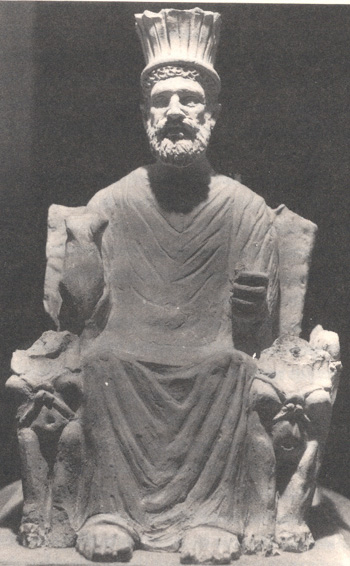
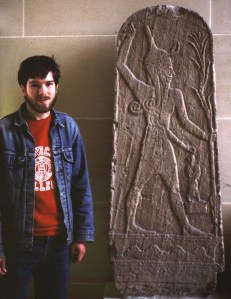
SAWHadad

A young Dr. Wiggins meets Hadad in Paris


God’s Wife

Podcast 13 follows up on the previous two posts concerning Asherah. Here a little more background is provided on the discussion/debate concerning the goddess. I trace the origins of Asherah, best attested at Ugarit, and explain why this should be our primary source of information about the character of the goddess. I consider the 40 biblical passages briefly before moving on to the Mesopotamian, Hittite, and Epigraphic South Arabian material. Clearly the most important evidence for the debate on whether Yahweh was wed or not is the set of inscriptions from Kuntillet Ajrud and Khirbet el-Qom. I examine these bits of evidence as well, explaining why I doubt that they intend to portray a divine couple. The podcasts closes with what I believe to be the way forward — a clear understanding of Asherah based on Ugarit and read without a scholarly agenda (yes, they do exist!).


Here Comes the Bride – Maybe

Kuntillet

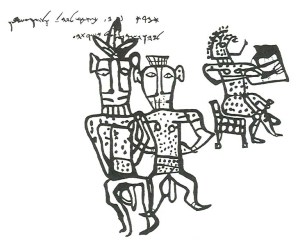
This is one of my favorite doodles from the ancient world. Its rich ambiguity lends to its appeal — some see it as salacious, while others see it as sacred. For those of you unfamiliar with the graphic details of the Asherah debate, this image is an ancient graffito from a desert way-station called Kuntillet Ajrud, a one-period site from the eighth century BCE. Like any number of other ancient drawings, this one would have probably remained in the obscure curios-portfolio of ancient scholars if it hadn’t overlapped an inscription that mentions “Yahweh of Samaria and his asherah.” Discovered in 1975–1976, this inscription, along with a couple others, revolutionized many scholarly assessments of ancient Israel’s religion. Yahweh had a soft side after all, a wife no less, the old god!

I’ve taken some flak in my circumscribed academic career for suggesting that this inscription, and a perhaps somewhat similar one from Khirbet el-Qom, are ambiguous. Sure, I’d like to see Yahweh happily married as much as the next guy, but is that what is going on here? Yahweh and Asherah, sittin’ in a tree? My doubts don’t stem from a squeamish conservatism (come on!) but from a concern of over-interpreting ambiguous evidence. Asherah, as a goddess, was rediscovered with the excavation of Ugarit. Forgotten by time with only cryptic references in the Hebrew Bible to some kind of cultic item called an “asherah,” scholars were excited to learn that she had a body and a personality. Many aspects of that personality fit, circumstantially, with a lovely pairing with Yahweh; wherever Asherah appears she is the consort of the high god, she is royal, matronly, and never showy.

The image above, however, has nothing to do with the inscription it overlaps. The two larger figures in the foreground are clearly Bes, the minor Egyptian protective deity. The characteristics are so clichéd that only the will to see Yahweh and Asherah arm-in-arm suggests anything different. Scholars like a happy ending just as much as anybody else, but I am obligated to state that, taken objectively, Asherah simply isn’t in the picture here.


Banned Bible?

Florian b.'s 2005 image

Florian b.'s 2005 image

It’s Banned Book Week again. Each year the American Library Association promotes free thought by raising awareness of books that have been, or currently are, banned. Having just exited ABE books’ Weird Book Room (among the currently featured: Paint it Black: A Guide to Gothic Homemaking, The Bible Cure for Irritable Bowel Syndrome, and Is Your Dog Gay?), it is easy to see how the morally squeamish might wish that some books had never been written, but being a firm believer in personal expression, I give them a rousing cheer. Odd ideas are also among the Lego blocks that build our world.

I also ponder the texts with which I have spent so much time, and wonder what the ancient censors would have done with the great classics of antiquity. History’s first great novel, the Epic of Gilgamesh, would certainly have been on their crushed clay list. On only the second tablet we read, “Enkidu sits before the harlot. The two of them make love together… For six days and seven nights Enkidu came forth, mating with the lass. Then the harlot opened her mouth, saying to Enkidu: ‘As I look at thee, Enkidu, thou are become like a god” (Speiser’s rather tame translation). A sex scene with the first woman Enkidu ever met? We can’t have our kids reading that! Where do you put the V-chip in this tablet?

Perhaps the people of ancient Ugarit would have fared better? Their epic tale, the story of the trials and ultimate triumph of Baal, includes his unfortunate defeat at the hands of death. Baal is ordered to the underworld. “Mighty Baal obeyed. He loved a heifer in the pasture, a cow in the steppes of death’s shores, seventy-seven times he laid with her, she let him mount eighty-eight times.” Whoops! Hope the kids weren’t reading that. Surely this is some kind of sacred marriage ritual with Anat and not a cow? Good thing we never figured out where KTU 1.10 fits into the cycle! There’s another one for the rock crusher.

It’s a good thing the Egyptians were more civilized. Their culture would never allow for such liberal, naughty writing, would it? Well, maybe if we ignore the Memphite Theology. Not for the shy, here we are told how Ptah brought the Ennead into being using just his fingers.

I started reading the Bible as a child. To my surprise, it would not have gotten away with a G rating either. It seems to me that books deal with the greatest complexities human beings face. Sacred books as well as secular delve into the darker grottoes of the mind, and here the Bible is clearly among them. If we had systematically destroyed all written work that had offended others throughout history, we wouldn’t even have the Good Book left to argue about.


Here Comes the Sun, and Is She Ever Hot!

As I enjoy my Kellogg’s Raisin Bran at breakfast, a benevolent sun smiles down on me from the box. I know from social conditioning as a child (courtesy of television), that the smiling solar disc converted the healthful grapes into equally healthful raisins so that I could grow up to be big and strong. While there is no doubt some truth to this solar myth, it does demonstrate how pervasive solar personification is.

A persistent myth to minds conditioned by trinitarian concepts of early Christianity is that the ancients recognized three major goddesses. Although their names are distinct in the original languages, in English three of them begin with A and form a delightful Trinitiess: Asherah, Anat, and Astarte. So this feminine triune godhead is considered to represent the female power triangle of the ancient Ugaritic world. (Ugaritic, I know, is a far too limited term for what was a widespread idea. On the other hand, “Aramean” and “Canaanite” are inherently problematic!) It has been my contention for years that this construct is A) modern, and B) false.

Throughout the ancient world the sun was considered a major deity. And although deities frequently overlapped in their spheres of interest, the principle Ugaritic deity in charge of the sun is Shapash. (With apologies to Nicolas Wyatt, I simply can not find Asherah in her.) In the surviving Ugaritic mythology, which we know for sure is only a portion of a larger corpus, Shapash appears frequently to enlighten both gods and humans. She guides the dead to their repose in the underworld and provides them with some kind of light while the world sleeps unknowingly above. She even seems to have the ability to cure snake bites. Now in the heat of summer, there is no question of Shapash’s ability to turn our grapes into raisins. She even kept many indoors in India last week as the longest solar eclipse of the 21st century crossed that country (chalk one up for Yarikh). Let’s give the sun her due!


Yes, Mammon

In the continuing coverage of the most recent New Jersey scandal the Star-Ledger, on Monday’s front page, posted a picture of San Giacomo Apostolo in Hoboken. San Giacomo is traditionally the brother of the equally mythical St. Ann. The statue, which stands outdoors in a public street, has monetary donations tacked to it. The image flashed me back to my Nashotah House days when students became visibly excited nearing the date for the procession of Our Lady of Walsingham at the proto-shrine in Fond du Lac, Wisconsin. Seminarians would beg for an opportunity to hoist the holy statue, or at least be a lowly acolyte. (These were grown men, mind you — many of them seeking the priesthood as a second career.) I never attended Walsingham, but it was my understanding that pilgrims and penitents at the festival also adorned their lady with money in hopes of some gift of grace. I grew up in a blue-collar household where paying ladies for favors was itself considered a sin.

Looks like Our Lady has put on some weight

Looks like Our Lady has put on some weight

While on a recent trip home, I saw a church for sale. As I started to break out my checkbook, I recalled how closely money and religion are tied together. The more I pondered this, the clearer their ancient, entangled roots became. The religiously observant bringing gifts to the temples of their gods was a standard act of piety and civic duty in the ancient world. Temples were expensive and the staff could only be supported by continuous donations. In the Ugaritic tale of Kirta, our protagonist seeks a son and makes a vow to Lady Asherah that if he successfully procures a wife he will make a statue of her in silver and gold. The favors of gods may be purchased. Today credit cards are accepted, but we are still caught in the web of those who claim God has asked them for your money.

For sale, God not included

For sale, God not included

When I was a teenager a friend invited me to attend a public presentation by some visiting Rev. Harrington, a popular evangelist. Several times during his high-energy sermon he sent the collection baskets around. The first time it was for your standard church offering. The second time was for any change you had in your pockets. The third time was for a special blessing. For those who had checkbooks ready, a thousand-dollar donation would get your name on a personalized plaque in his private jet. Years later I saw Harrington on television during an interview on his private estate. He puttered around it in a customized golf cart with wheels designed not to scuff up the gold-plated bricks that constituted the drive before his opulent mansion. “If we’re going to walk on streets of gold in heaven, I want to get used to it here,” he casually explained.

So, as an (unofficial) agent of Asherah, if you are seeking to make a divine investment, get out your checkbooks and I’ll tell you where to send the donations (checks made to “cash” please!).