Hadad in Copenhagen

Let us talk plainly about the weather. Global warming is a reality, and yet the issue is clouded by religious conservatism. To be precise, it is difficult to determine whether it is really greed or the religious right that stands so firmly behind free-market capitalism that is driving this chariot of the sun. The strange and unholy alliance between religious and political conservatism, however, has become a force daily striving against reality and its proponents want to be on the top of the pile when the whole thing collapses.

I can not speak to the political end of this continuum; I am not a political scientist or economist. As a “religionist,” however, I recognize a deeply disturbing trend that I have followed since my youth. Fundamentalists have consistently taught their young that the “Second Coming” is only minutes, possibly seconds, away. Undaunted by the two-millennium delay in wish-fulfillment, they suppose the words supposedly uttered by Jesus indicate a kind of divine “I’ll be right back” just before pushing off from the Mount of Olives. The signs of the times given in the Bible describe the then current condition, yet modern-day Fundamentalists wish to force the almighty hand, call the bluff of the Texas Hold-‘em expert above. If the general in the sky said wars would come, well, we’ll make wars. If the only way to get his attention is by destroying the planet around us, so be it. Deny global warming for the sake of the religious right, since their world is about to end.

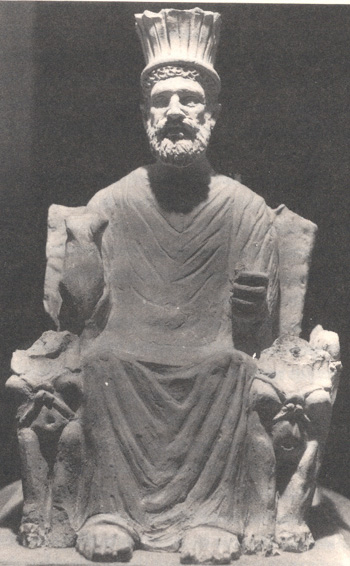
Baal in Copenhagen?

The rest of us might want to stick around for a while. Ancient meteorologists believed that particular gods controlled the weather. At Ugarit Baal, or Hadad, took responsibility for drought and plenty. If there was a problem, they knew just to whom to offer a sacrifice. In our monotheistic western world, we’ve pared the gods down to a single man. Not everyone agrees on his mood or character, but some are convinced that he has his bead trained right on this planet and they want to help from here below. Others believe — o the heresy! — that natural processes control the weather and that we can do something to make our situation better. We might be in a better place if those who believe the gods control the weather were relegated to theology classes rather than political offices.


Sky God Redux

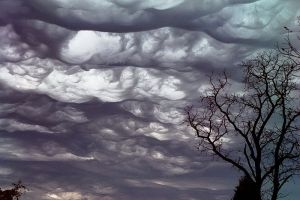
This week’s Time magazine includes the periodic feature of the 50 best inventions of the year. Flipping through the pages looking at techno-gadgets that leave me vacantly spinning in my office chair, I was surprised to see that invention number 49 is the work of our hypothetical sky gods. The undulates asperatus cloud has been receiving high profile attention of late, and now it is seeded on Time’s greatest inventions list! When I last posted on undulates asperatus, it had been written up in Wired. Prior to that I had seen a feature on the cloud in the New Jersey Star-Ledger some months back. Having written a(n unpublished) book on weather terminology in the Bible, I have had my head in the clouds for several years now. To find the humble collections of condensed humidity making the news is a strange but welcome validation of my work.

Undulatus_asperatus

Undulatus asperatus from Wikipedia, by Agathaman

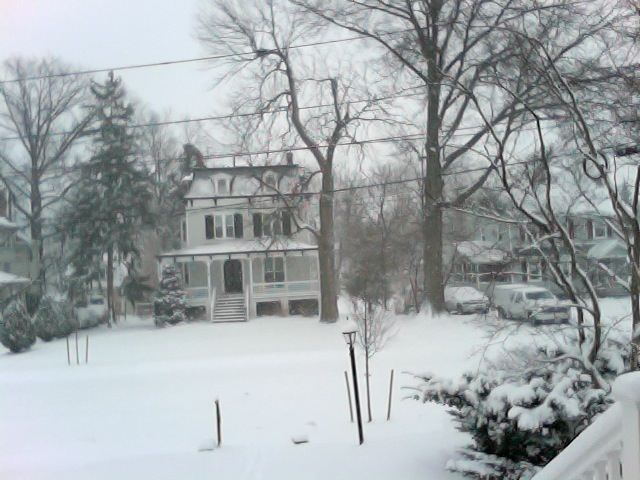
Time resists bringing the divine into the description of the cloud, preferring the more neutral term “ominous” to describe undulates asperatus. After having spent several days under the blanket of a nor’easter here in New Jersey with its impenetrable gray clouds, I can appreciate how ominous thick clouds can be. The more I study ancient religions the more I am convinced that major gods primarily reflect the content of the sky. After all, gods were seldom seen in the fields and cities of antiquity, but the sky holds endless possibilities.

Perhaps some editor somewhere will stumble across my conviction that weather matters in the biblical world and will want to take a look at my book. If not, no worries. I’ll just be looking at the sky.


Sky God

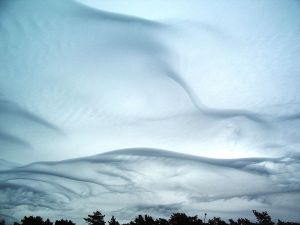
The latest issue of Wired arrived in my mailbox yesterday. Generally the people who write for the magazine frighten me — they are so smart and hip and ahead of the curve, something that a scholar of very ancient stuff hardly even aspires to. When I can understand what they are writing about, however, I am often fascinated. A story that caught my attention is entitled “Sky Wave” by Mike Olson. Around the world people have been noticing a new type of cloud that is being called undulatus asperatus. undulatus1 Here is a Gnu-license photo of one of these clouds; there are more dramatic images, but they are mostly covered by copyright. What immediately caught my attention in the Wired article was the subtitle: “Weather Geeks Are Championing a New Armageddon-Worthy Cloud.” The Bible appears in the sky yet again.
Back when I was doing the research on my (still unpublished) book on weather terminology in the Bible, one of the pitches I used to potential publishers was the upward inclination of religion. Ask any kindergarten-dropout where God is and the fingers inevitably reach skyward. From earliest times people have associated the divine with the sky. Among the Sumerians, keepers of the earliest recorded religion, the deity An, the sky-master, was the most ancient of deities. While the origins of religion will forever remain obscure, it is certain that they have a celestial component.

I have to confess to being in love with the sky. If I didn’t have to earn a living I would spend hours each day staring upward. It is the repository of endless potential and ineffable beauty. Clear skies remind me that no matter how far we might go upward, there will always be more of it ahead of us. Cloudy days provide a palette and a canvas for the imagination. Even the brilliant writers at Wired can be forgiven for a foray into the mythology of the sky. Its power over us is as endless as its very expanse.


Praying for Rain

Stomping the mud of another county fair off my shoes and doing yet another load of laundry with enough dirt on it to begin my own excavation, I ponder the weather. Although we are daily reminded that we have no effective control of the weather, one of the most common prayers I hear uttered is for “good weather.” I could have done with a little less rain and a bit of broken sunshine with a temperature of 78 and humidity of 20 percent, but I didn’t bother to ask for it. Once at Nashotah House we the faculty (and the student body) were asked to pray for good weather for an outdoor liturgy. I was both bemused and alarmed that a high-ranking priest made that request of us in all seriousness. Perhaps the biggest problem is that, as much as we like to deny it, we are like other creatures considering our immediate environments. We lack the big picture.

Our neglected atmosphere is the key to life on Earth. So immense that it coats our entire planet with the gases we all need to breathe, as well as some gases that have little apparent function in our particular setting, it is a simple matter to take our atmosphere for granted. And yet the weather affects every aspect of our lives. When we ask the Weatherman for an adjustment in our region, we are requesting a graduate-level course of calculations in fluid dynamics to be undertaken just so we can get the right mix of weather conditions for our picnic or day at the beach. Hackneyed to the point of caricature is the rain dance — that ritual that is expected to end a drought.

In the twenty-first century, people who rely on science to keep them safe from severe weather by predicting hurricanes and tornadoes with accuracy still pray for the weather they want in their little corner of the globe. If watching Jurassic Park taught me anything, it was that a butterfly flapping its wings in China might cause rain in New York. Chaos theory has demonstrated the intricate connections between all components of a complex system. The atmosphere is one of the most complex systems on earth (well, around the earth, actually). Rev. Chuck’s church picnic weather is integrally tied up with typhoons that may be drowning thousands of people in low-lying coastal regions of Asia. And yet we just can’t resist asking for the weather to tip in our favor. In the Bible it worked for Elijah, so why shouldn’t it still work for us?


The Divine Finger

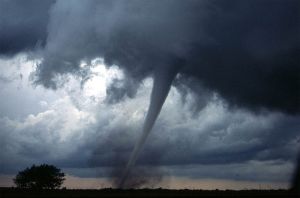
As the thunderstorms break out overhead yet once again, I am naturally reminded of tornadoes. I grew up in a part of the country relatively free from natural disasters. In my little corner of western Pennsylvania we felt secure from the earthquakes, volcanoes, wildfires, mudslides, and hurricanes that seemed to plague other parts of the continent. Then one night a tornado came. I happened to be a few hundred miles from home working a summer job when the cheery newscaster announced that a tornado had swept through my hometown during the severe thunderstorms we’d had the night before. I had always believed our unrelenting hills made us somewhat resistant to the tornadoes that plagued our next-door neighbor Ohio. It was probably then that my fascination with severe weather, especially the tornado, began.

Pulling the divine plug?

Pulling the divine plug?

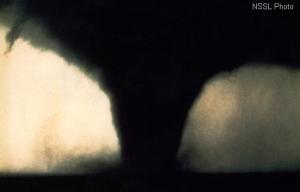
One of the reasons for the entirely understandable fear accompanying tornadoes is that they have all the hallmarks of an ideal divine weapon. In an article soon coming out in Maarav, I argue that an obscure Hebrew word should probably be associated with whirlwinds rather than tumbleweeds. Although violent tornadoes are rare in Israel, the story of Elijah seems to imply that a weighty prophet may be hefted skyward by a whirlwind, and that sounds tornadic to me! There are passages where whirling winds are referenced as harbingers of divine wrath, an association that clings to tornadoes even today. I ended up writing an entire book on weather terminology in the Bible that had been fueled on by this ambiguous fascination. Publishers, it seems, alas, do not share my enthusiasm for the topic.

Classic F-5

Classic F-5

The popular media, however, shows a glimmer of understanding. The second half of the 1990s (when I finished my draft of my book/doorstop) was a bonanza of American storm fascination; Sebastian Junger’s The Perfect Storm (1997) was shortly followed by Erik Larson’s Isaac’s Storm (1999) and both tailed the much-touted movie Twister (1996). Being somewhat of a connoisseur of tornadoes, I was disappointed by Twister, but one scene remained scoured into my memory. A layman asks one of our overly-folksy, lovable storm-chasers what an F-5 tornado (the F-, or Fujita-scale is the measure of a tornado’s intensity based on the level of damage it leaves behind — 5 is the highest number on the scale) would be like. One of our jocular heroes becomes suddenly serious and replies, “The finger of God!” Despite the cornball, this is an accurate explanation of the awe that surrounds a storm as random as a tornado. Adjacent houses can suffer entirely different fates in a tornado, or, in a poignant story I’ve never forgotten, a Wisconsin tornado killed one of a set of young twins in the same house during the storm. Finger of God, indeed. If Moses had lived in Iowa I’m sure he would have made liberal use of the tornado for precisely that image.