Bugging Out

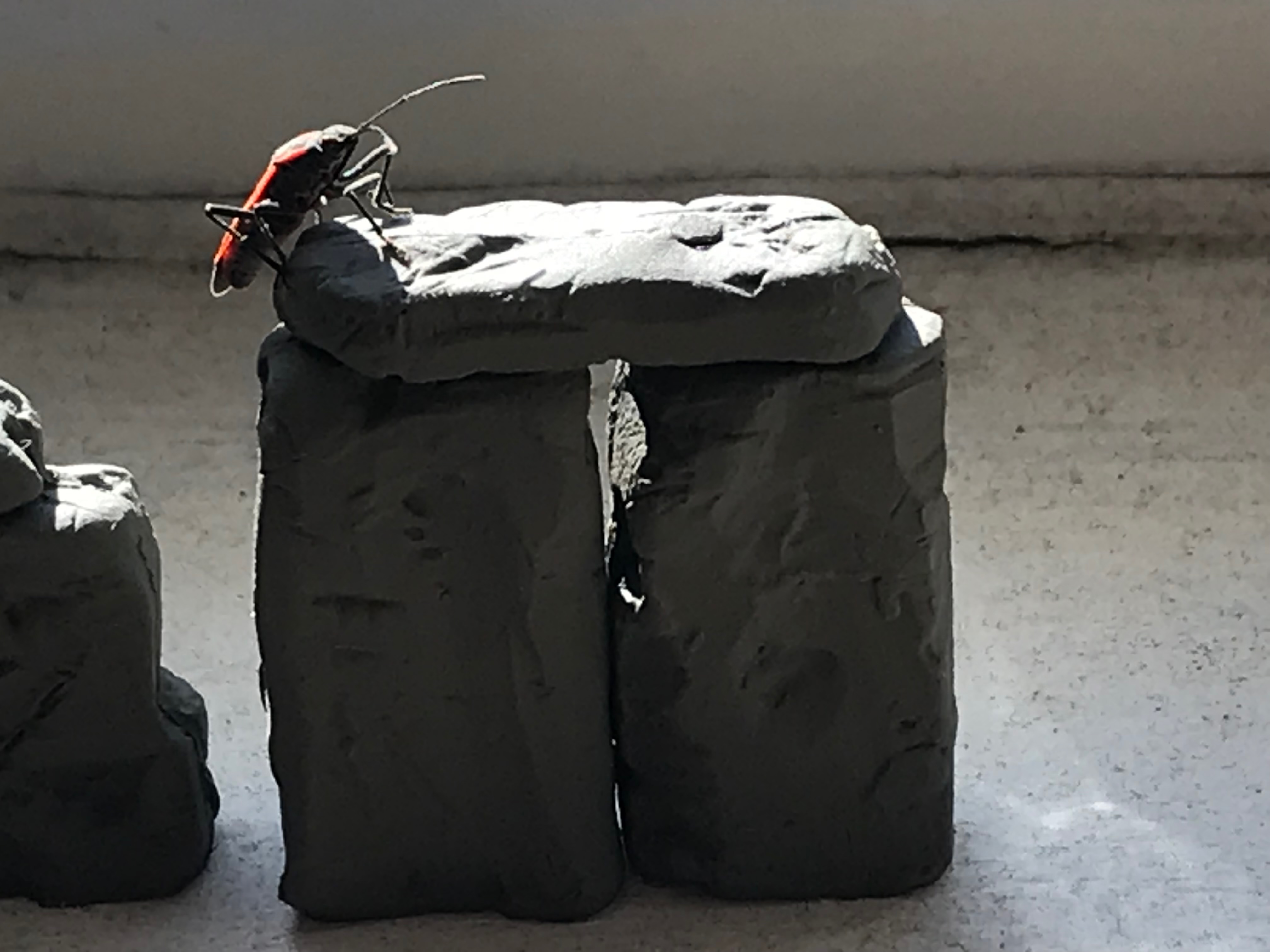
There’s a scene in Disney’s Hercules where Thebes has just been through a bunch of unnatural disasters sent by Hades to lure Hercules into the open.  The people, visibly shaken by the tragedies are talking about their need for a hero.  Then a locust hops in.  An old man says that does it, he’s moving to another city.  So with yesterday’s super soaker around here—we’ve had our roof completely replaced—water was still getting in.  I’m no expert, but it looks like it was condensation rather than roof leaks proper.  The air was saturated and cold, while inside it was at least a few degrees warmer.  I got up to find buckets scattered around that my wife had set up after I’d fallen asleep.  Then a boxelder bug appeared on the curtain in my study.  The insect on top of other misfortune.  It’s classic.

That’s because insects swarm.  We live in an older house (the only kind designed with space that can be used for books).  It doesn’t have wooden siding, but boxelder bugs like to overwinter in the walls.  I really can’t figure out why because in nature they winter in, well, boxelder trees.  Or a maple.  There are no boxelder or maple trees near our house, but they seem to like it nevertheless.  The problem is they get inside, in numbers.  We try to run a catch and release business.  It seems decidedly unfair to kill a harmless bug for doing what human-altered climate tells it to do.  When the heating kicks on, their insectoid brains tell them it’s spring and they crawl out looking for food.  Well, we don’t have any trees they like growing inside, so they wander about aimlessly.  I catch them and take them outside, figuring maybe they can find, I don’t know, a tree?

Usually when winter’s serious chill sets in, they go dormant.  This year we’ve been hovering between freezing and not, and when the sun comes out—which it sometimes does—they awaken.  They must be confused.  Somehow they don’t realize that the world has changed around them.  Going about their daily bug business (nothing seems to eat them—apparently they taste bad) the climate has broken their hibernation into segments of a few days at a time.  Perhaps they’re cranky when they crawl up the curtains, or across my desk (they pretty much stay in my study).  At least they don’t sting.  They’re not bad enough to make us leave Thebes, but it would be wonderful if they’d wise up to global warming, and maybe plan in advance.  Or maybe they’re waiting for a hero.


Waiting for the Sun

Waiting.  It’s difficult in the best of circumstances.  It’s even harder when dealing with multiple sources of delay.  For example: it has been unseasonably cool around here for a few months.  Looking at the US weather maps, it looks like we’ve got just about the coolest temperatures in the lower 48.  September is usually reliably a month where you don’t need the furnace in these here parts, but that’s not the case now.  A slowly moving weather system has blocked the sun for days and our poor old house just can’t warm up.  I feel like Noah waiting for some sign of hope.  The weather apps all say, “oh, two or three more days…”  Endurance, I remind myself.  Stoicism.  Still, we need some sun about now.  But that’s not all.

In addition to wearing three heavy layers and my fingerless gloves (in September—and this will last until May!), I’m also doing my prep for a colonoscopy.  In case it’s been a while—that means a liquid diet for a day.  I need to wait until this time tomorrow to have anything to eat and my teeth are on edge because the allowable fluids tend to be sweet and I really need something salty with a bit of crunch about now.  I see I’m allowed ice pops.  But did I mention that it’s cold in here?  If it were a normal year at least one of these two things wouldn’t been an issue at this point in time.  Nobody that I know of looks forward to a colonoscopy.  I know I’ll barely sleep tonight and the whole situation ends up looking downright Dickensian.  Chilly, hungry, persistent rain.  All I really need at a time like this is just some indication that the following days might improve.  Don’t look to the Weather Channel for support.  No, rely on your Stoicism.  Endure.

The trick I usually use on myself is to dangle a small carrot—lunch will be in just three hours!—to get through a long, chilly day.  (You’ll be able to eat something hot…)  I suppose giving up caffeinated beverages a few years back (when the last colonoscopy was well forgotten), might’ve been a poor decision.  I sure could use a Thermos of coffee right about now.  And one of those solar headbands that tricks you into believing you’re getting some sun.  Hey, September’s my second favorite month, after October, so shouldn’t waiting be just a smidge easier?  I’ve been waiting for September since last November.  And still I wait.  Such is the human lot in life.  Endurance is important, I know.  But a peek of sunshine (haven’t seen anything like it for three days) in September—is that too much to ask?  Or at least a hot meal.  What would Zeno do?  (Of course, he did live in sunny Greece…)


Self-Correcting

A comment by a friend regarding Wikipedia recently got me thinking about self-correcting systems.  When I was teaching, I didn’t eschew Wikipedia like many of my colleagues did.  In case you’ve been living in a cave the last two decades, Wikipedia can be edited by anyone.  When I had more time than I do now, I used to correct errors I found there.  The thing is Wikipedia shouldn’t be used as the final word.  It’s a good place to start and, if you’re concerned about the truth, you’ll follow up by checking footnotes and looking up the references.  (Standard operating procedure for academics.)  Readers always need to keep in mind that what they’re reading may have been manipulated and distorted, which is why you want to check with established sources—some of us still prefer print, which isn’t so easily altered.  Still, Wikipedia is self-correcting and it works fairly well.

This got me to thinking about other self-correcting systems.  Those who know me know that I take criticism pretty hard.  That’s because I was raised with a crippling fear of Hell that let me to self-correct whenever I discovered an error.  And to scan my thoughts and motivations constantly for mistakes.  Sensitive bosses know that I only need to learn about an error I made, even obliquely, and that I don’t need to be told to fix it.  Of course I don’t!  Hell awaits those who let mistakes fester.  I’m not sure this is a good kind of self-correcting system, but it keeps me on my toes, and at times, even on my toenails.

The human body is often a self-correcting system.  We need the help of physicians when disease or injury occurs, but healing is part of a self-righting system.  (I’m indebted to an episode of Northern Exposure for reminding me of this recently.)  On an even larger scale, life on earth is self-correcting.  We humans have done more than our fair share of damage, and the self-correction (e.g., extreme weather because of global warming) may not be to our liking, but it is a system doing what it does best—righting the ship.  This kind of self-correction is inspiring and inspirational although we often take it for granted.  If healing didn’t occur none of us would be here to notice just how remarkable it is.  I don’t dismiss Wikipedia just because we can’t be sure everything’s written by experts.  Self-correcting systems are often the way of the world.


What Kind of Night?

“It was a dark and stormy night.”  If you’re like me, this evokes images of Snoopy sitting atop his doghouse, clacking away at his typewriter, trying to write the great American novel.  Many of us have tried a hand at that.  And as a writer, finding that allusive incipit, or opening line, is a major preoccupation.  For many years I believed the sentence “It was a dark and stormy night” originated with Edward Bulwer-Lytton since his 1830 novel Paul Clifford begins with this sentence.  Now considered melodramatic prose of the purplest kind, it may have been serious back then.  1830 was early in the days of novel writing.  Then I found the phrase from an even earlier work, Washington Irving’s A History of New York, from 1809.  Had Bulwer-Lytton read it?  Irving was quite popular in the pre-Dickens days.

This raises a question encapsulated in the other old phrase, “You can lead a horse to water but you can’t make it drink.”  Unless someone tells us explicitly that they read something—journals and footnotes often convey this information—it’s difficult to know.  There’s a whole genre of history books these days that examine the libraries of deceased historical individuals to determine what they read.  I suppose in the days before mass book sales there was a better chance that owning a book meant you’d read it, but not necessarily.  In college I worked as the secretary for the chaplain, Bruce Thielemann.  When he read a book he wrote a category of note in the margin and paid a secretary to go through and write the citation under a heading in a set of looseleaf binders he kept, with several pages dedicated to each category.  For sermon preparation he’d look up his theme and immediately see what he’d read.  I knew he’d read those books.

So, was Washington Irving the origin of the phrase, “It was a dark and stormy night”?  Many websites, many of them authoritatively, insist that the credit goes to Bulwer-Lytton.  I located an edition of A History of New York that replicates, word for word, the 1809 edition.  You see, Irving, like many writers, revised after publication and not all (or even most) modern editions tell you which version they use.  Irving indeed used the phrase in 1809, I confirmed.  The internet is wrongly giving credit to Edward Bulwer-Lytton for a phrase first printed by Washington Irving.  The two were contemporaries and ironically, Wikipedia points out that Irving first used “almighty dollar,” another phrased credited to Bulwer-Lytton.  It doesn’t however, point out that “it was a dark and stormy night” also belongs to Irving.  Something to ponder on a dark and stormy night.


Balance

Psych!  Yesterday was actually the vernal equinox.  And speaking of psychs, it was about the coldest morning jog I’ve had all winter.  (The equinox itself didn’t occur until 5:24 p.m., which is way it was the 20th instead of the 21st.  And I honestly can’t understand how that works since don’t you need 24 hours for night and day to be equal?  There’s a reason I went into the humanities.)  Interestingly, in the pagan Wheel of the Year, it was Ostara.  And the similarity of that title to Easter isn’t really coincidence.  (By the by, I discuss this to some extent in The Wicker Man, due out in September.)  Easter is, in essence, a spring holiday.  Ēostre, a germanic goddess of spring, seems to have been its namesake. 

First light comes suddenly, for those awake early enough to see it.  I keep a close eye on the diminishing darkness so that I can get out and jog in the twilight.  It will be too dusky to see and then suddenly it’s not.  Sunrise is like an epiphany each day.  From now on light will increase both morning and evening until the summer solstice, or Midsummer.  Between Ostara and Midsummer lies May Day, or, as it was also known, Beltane.  Beltane is the fuel behind The Wicker Man, or so I argue in my book.  Holidays are important.  More of them should be recognized.  If the pandemic taught us anything it’s that most of us probably work too hard.  At any rate, spring is now here.

The mornings are still below freezing, at least around here.  The winter never got very cold and we had very little snow.  Some would argue that it was more like an extended, chilly spring.  The light, however, was missing.  I spend a lot of time awake in the predawn hours.  There’s a stillness to that time that’s a daily gift.  Yesterday was a brief moment of balance.  Soon it will be time to start mowing the lawn and to do the endless weeding of summer.  Those will last until long after the other equinox, awaiting in September.  Climate change has assured us that the weather will be erratic, but the waxing and waning of the light is as old as the spinning of this weary planet.  We’ve entered the light half of the year.  Equinoxes remind us that balance is rare and should be appreciated when it arrives.  It’s worth making into a holiday once more.


Weathering the Winter

Although it’s been cold out, in many ways this feels like the year without a winter.  Around here we’ve had no real measurable snowfall and temperatures have generally hovered around 40 F, mostly cloudy.  I get cold easily, however, so I need to know how to dress for jogging.  During a warm spell I looked at WeatherBug.  It’s my go-to app for such things.  It told me the current temperature was 49.  Since it’d been in the sixties the day before, that was believable.  Then I glanced at our outdoor thermometer.  It read 39.  A ten-degree difference is significant for jogging, so I called in a third party.  Weather.com said it was 40, much closer to my actual feeling of things—it was chilly inside that morning.  WeatherBug also said it was cloudy, but Weather.com disagreed.  A glance outside showed thin, hazy cloud cover.

Now, I know apps can’t cater to individual needs, but it does seem that WeatherBug was using projections rather than real-time information.  Either that, or somebody was standing too close to the thermometer at the local reporting station, and perhaps breathing on it.  I’m not one of those people who rely on my phone for everything.  I do use it for navigation and snapping quick pictures, but until today I also used it for checking the weather.  I’ve been surprised how often WeatherBug tells me it’s sunny out when I can see nothing but clouds.  Sometimes looking out the window is the best way to learn what your individual weather is like.  Weather is terribly local.

The capriciousness of weather is one of the main factors that led me to write Weathering the Psalms.  Another, of course, was the hope that an academic post might actually consider a guy like me.  The weather has always been a source of personal fascination.  The threat of severe weather, particularly in the Midwest, was a source of naked awe.  I remember standing outside in Illinois with the wide, expansive horizon all around, and staring straight up to a brewing storm cloud thousands of feet overhead.  I didn’t need an app to tell me to take shelter.  Or that time in Wisconsin when a weather system led to repeated, identical cycles of storms that lasted days, leading to localized flooding with rain following a clockwork regularity.  Even then I was a jogger, and for a jogger knowing the weather in advance is important.  These days all that majestic sky drama comes via a device that fits inside my pocket.  It seems we’ve lost something, even though we’re safer this way.  At least within ten degrees.


Ideal Christmas

This blog is even open on Christmas.  I’m enough of a pragmatist to realize that few read it today, but even Carl Sagan knew that launching the Pioneer plaques into the void was the smallest spark of hope.  A quark in a universe so vast that we suppose it infinite.  And even so, it makes room for us.  So, if nobody reads this on Christmas I’ll certainly understand.  If you do, and if you celebrate Christmas, a merry one to you.  Thanks for stopping by.  For some folks, I know, Christmas is a time for gathering together.  A British colleague recently remarked to me, “But Thanksgiving is the big American holiday.”  I think he meant both for family gathering and for time off work—it’s the only regular four-day weekend capitalism deigns to give to those who live between the anvil and hammer of nine and five.  But today’s Christmas, we don’t have to think about that.

For me the ideal Christmas is one hunkered down with my family and when we don’t ever have to get out of our pajamas.  A bohemian holiday when you don’t have to go outside to check the mail.  As cold as it is this year, that’s really a relief.  And it’s also a time for stories.  Most of the Christmas gifts I give require explanation.  Even if they don’t, I like to tell stories about them.  That’s the way writers roll, even us obscure ones.  Holidays are based on stories and are made up of stories.  Those we tell only to our families are the most intimate kind.  You see, the brain doesn’t stop working just because it’s a holiday.  So all the books bear witness.

Although it’s too early to tell (the sun isn’t up yet), we might just eke out a white Christmas around here.  In eastern Pennsylvania we managed to avoid the worst of the massive storm that ruined holiday plans for many.  At the tail end of the rain, and at the knife’s edge of the frigid air, come a dusting of snow.  The temperatures have kept low, so if the sun hasn’t managed to warm the still green grass enough, we may see some white today.  It seems we have Bing Crosby to blame for this particular dream.  Christmas isn’t predictably white around here, and global warming only makes it less so.  But this is a holiday, and we don’t need to think about that.  I know not many will read this post, but if you are one of the few, and if this day is special to you, celebrate it for all it’s worth.


Blooming in December

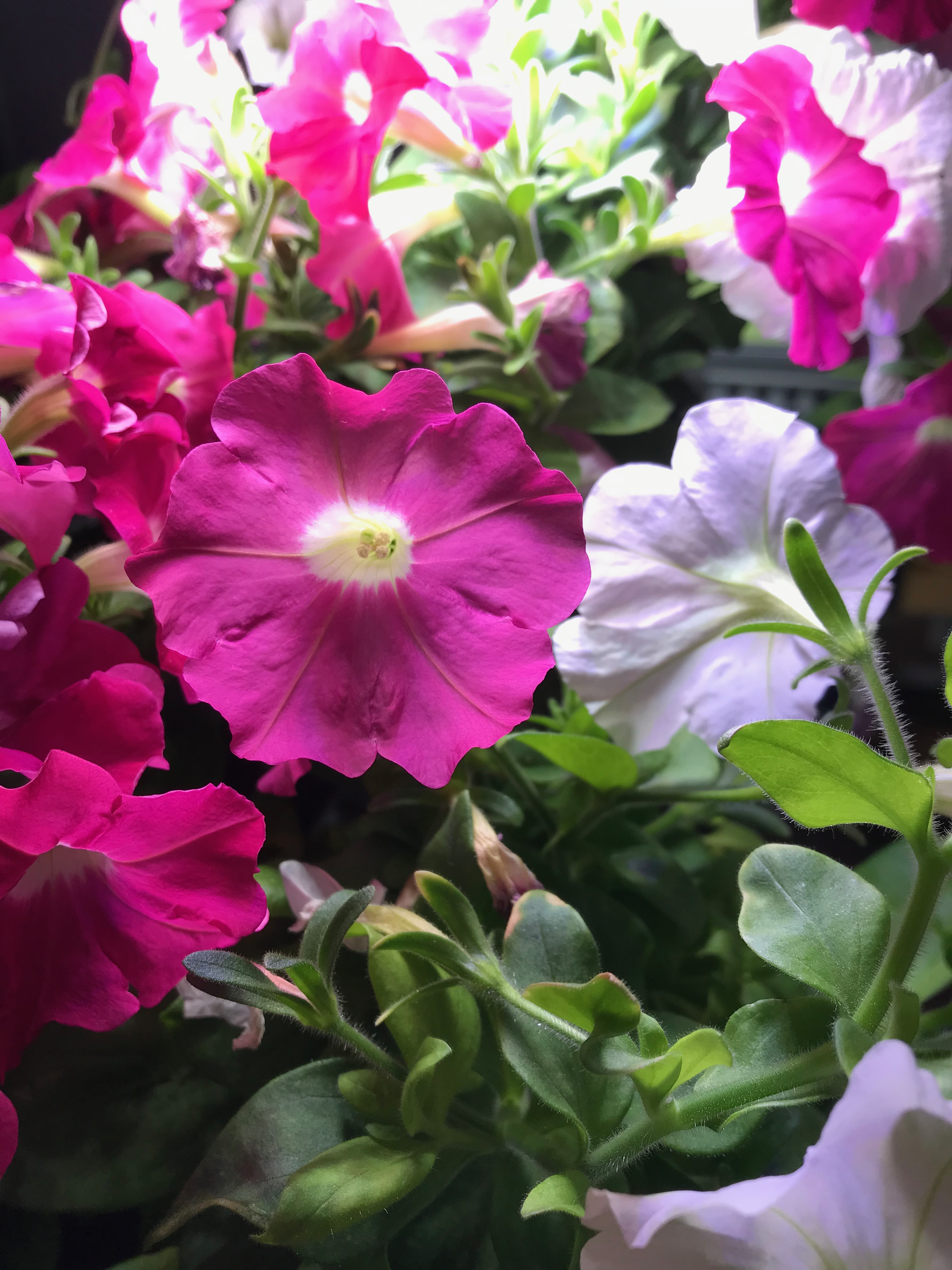
The cascading petunias are doing fine.  It’s a little odd to see them in December, given that petunias are annuals, not perennials.  (The terminology has always been confusing to me—annual could mean, as it does, that they only grow one year.  Exegeted differently, however, annual could mean that they come back yearly, but it doesn’t and they don’t.)  The Aerogarden (not a sponsor) system provides plants with a perfect mixture of light, water, and nutrition.  The only thing missing is the soil.  Hydroponic, the unit gives plants the ability to prolong their blooming life preternaturally long.  These particular petunias have been blossoming since January and they’re showing no signs of slowing down.  This is kind of what science is able to do for people too—keeping us going, even as nature is indicating, well, it’s December.

I often wonder what the flowers think about it.  We keep our house pretty cool in winter.  Partly it’s an expense thing and partly it’s an environment thing.  In the UK they talked of “overheated American houses”—how many times I Zoom with people even further north and see them wearing short sleeves indoors in December!—and we went about three years without using the heat in our Edinburgh flat.  You see those movies where Europeans are wearing vest and suit coat over their shirts (and presumably undershirt) at home?  It occurs to me that it was likely because they kept their houses fairly cold.  In any case, I suppose the low sixties aren’t too bad for plants, but they certainly aren’t summer temperatures.  Still, what must they think?

Set on a counter where the summer sun came in, at first they gravitated toward the window during May and June.  Even with their scientifically designed grow light, they knew the sun although they’d never even sprouted outdoors.  That’s the thing with science.  I’m grateful for it, don’t get me wrong, but it can’t fool plants.  We can’t replicate sunshine, although we can try to make something similar.  (Fusion’s a bit expensive to generate in one’s home.)   So it is with all our efforts to create “artificial intelligence.”  We don’t even know what natural intelligence is—it’s not all logic and rules.  We know through our senses and emotions too.  And those are, in some measure, chemical and environmental.  It’s amazing to awake every morning and find blooming petunias offering their sunny faces to the world.  As they’re approaching their first birthday I wonder about what they think about all of this.  What must it be like to be blooming in December?


Birthing Stars

Fusion.  The recent breakthrough with fusion announced so close to Christmas hardly seems a coincidence to me.  I have to admit to having been interested in fusion since high school.  One of my school term papers was on what was then called a “magnetic bottle”—a theoretical device capable of containing a fusion reaction.  The hydrogen bomb, of course, had already demonstrated that fusion was possible.  Controlling it was, at the time, the difficulty.  Now, I’m no scientist.  I’ve read quite a bit of lay science over the years and even worked on a project about the relationship of science to religion.  Still, you can’t follow everything.  I’d lost contact with fusion until the announcement this week that scientists have finally demonstrated that it’s possible to get more energy out of a controlled fusion reaction than it takes to get the reaction started.

In case you know even less about science than I do, fusion is what powers stars.  Unlike fission, it’s a “clean” nuclear reaction and one, as far as we can tell, that has made life possible on this planet.  Star power.  We’ve known for many decades that this could be the solution to humanity’s energy needs.  Of course, big petroleum has tried to slow such research down—there are personal fortunes to be lost and what is life without a fortune?  Now, with technology far beyond my comprehension, a fusion reaction was born that showed promise that we’re on the right track.

Photo credit: NASA, via Wikimedia Commons

Since it’s been rather gloomy around here this December, the thought of more sunshine cheers me.  Living in the Lehigh Valley, of course, my thoughts turn toward the Bethlehem star.  It’s such a crucial element to the Christmas story that we’d hardly know what to do without it.  Stars are our guides through the dark.  Winter nights are often clear and are opportunities to see the nighttime stars, even as we light up our artificial ones here below.  Light encourages light.  In a laboratory somewhere scientists are busy making stars.  I have to believe it’s satisfying work.  Perhaps the kind of job you’re eager to get back to the day after Christmas.  Although fusion would be used for power in general, one of the functions would surely be the giving of light.  As we move toward next week’s solstice and light our Yule logs, encouraging light to return, women and men in white smocks are designing and using complex equipment to help it on its way.


Natural Wonder

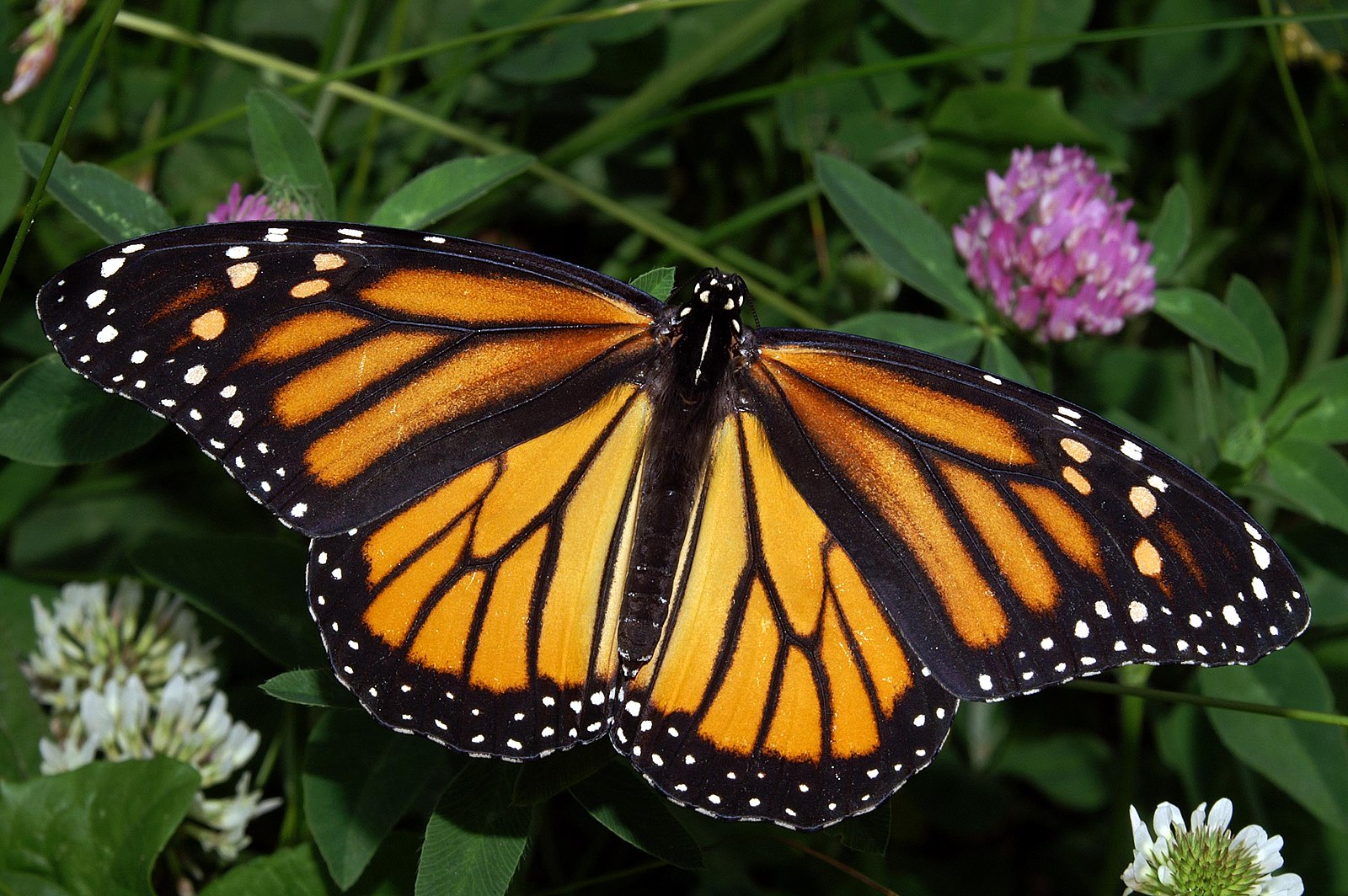
I recently heard a talk about monarch butterflies that left me in awe, once again, of nature.  These remarkable insects have been in the news because of declining numbers—largely because of global warming, it seems.  We’ve only begun, however, to learn how remarkable they are, even with the head-of-a-pin-sized brains.  You might wonder why I’m discussing butterflies in November, but it’s not the first time I’ve done that.  Besides, global warming has made it relevant.  So what about monarchs?  Perhaps the most remarkable thing is that they migrate.  And to do so it takes about four generations.  This deeply embedded behavior shows an intelligence in nature that we’re reluctant to grant.  Still it’s clearly there.  I live in Pennsylvania and we have monarchs around here and they can be found as far north as southern Canada.

Photo credit: Kenneth Dwain Harrelson, via Wikimedia Commons, GNU Free Documentation License

These monarchs around here aren’t the ones who left their overwintering spot in Mexico.  The earliest ones we see up here may have flown in from the Carolinas or the Midwest, where they may’ve been born.  As adults they feed on flower nectar, but to be born they require milkweed plants.  Monarchs only lay their eggs on this one plant family.  The milkweed contains a toxin that they’ve evolved to eat and that toxin gives them a really bad flavor.  That’s why birds tend not to eat monarchs.  So they reproduce in northern locations until environmental cues change the late season eggs.  These late season generation produces the butterflies that will migrate.  Instead of hanging around sipping nectar, they find south (they can tell time and they only fly on days with a south wind) and make their way to one specific area in Mexico to overwinter.  They don’t eat at that stage.

In the spring, hungry, they following blooming desert flowers north.  They follow the food supply, birthing new generations to carry on, until they reach the latitude they prefer.  So some stay around here, eating and reproducing until the cycle begins again in the autumn.  It might seem like a lot of extra work (consider what we do in the office all day and try to criticize) yet it demonstrates the remarkable intelligence of nature.  That migrating generation has to know to fly south and they have to be able to find direction.  Once there, and ready to return, their offspring’s offspring will (we suspect because of other species) know where their great-great-grandparents lived and they head there over three generations.  All of this is being endangered by global warming, however. Because one species thinks of itself alone as remarkable.


After It’s News

We live our lives by the news cycle.  It tells us what to think about and worry about, often beyond our local, daily concerns.  And sometimes we forget about yesterday’s headliners.  If you’re curious about whatever became of actual Hurricane Ian, I can tell you.  He’s been hanging around here.  Oh, he’s a mere shadow of his former self, becoming just a low-pressure system sitting off the Atlantic coast between New York and Philadelphia.  And spinning, and spinning, and spinning.  Around here we haven’t seen the sun since last Thursday.  The rain has been intermittent, but yesterday it was pretty much all day and he’s set to continue dominating the skies here at least through today.  Your typical hurricane, if there is such a thing, just keeps moving until it reaches unpopulated areas and nobody cares any more.  This one has been a long-term guest.

With the first few days of lassitudinous rain we had maybe an inch.  Rainfall spat and sputtered and sprinkled.  Yesterday it began to really come down and as I write this it’s too dark to tell but I can hear it splashing on my windows.  The toadstools popping up in the yard are impressive.  As has been the wind and below average temperatures.  I’m wearing my winter-level protection and dodging raindrops on my morning jogs.  Some days I’ve had to delay them for the water.  Not too many other people are out taking their exercise, I notice.  The Weather Channel’s taken to calling it just a low-pressure system, but we’re on a first-name basis now.  Ian is still very much a thing.  At the end of “daylight” yesterday the rain gauge read about three inches.

The thing about these “unusual” storms is they’re becoming the norm.  Global warming has been affecting us for years now, even as we deny it exists.  Our summer around here was very hot and very dry.  The dry was okay by me, but the heat prevented any outdoor work or play for a good deal of the time.  Days when you’d stay inside and try your hardest not to move.  We had maybe one or two days of transitional weather then boom, straight to November.  The leaves around here are still mostly green although they’ve been starting to change more readily now that October’s arrived with December in it’s train.  Forecasters tell us, like Annie says, the sun will come out tomorrow.  Around here we sure hope that’s right.  I wonder what else is happening hidden behind the news?

Not Ian, but you get the picture

Lost Day

There’s a continuity of life and we’re used to it with only small, regular interruptions, such as a night’s sleep.  Each day builds on the previous one with plans being fulfilled, projects attempted, and yes, work.  Then something happens to disrupt that and it’s like starting over again.  I imagine (and feel for), for instance, those who’ve lost everything to Hurricane Ian are going through it.  They are reassessing and rebuilding, even as around here we’re beginning to get some of its rain.  A break in continuity may be smaller, however, and on an individual scale.  I had, for example, my first Shingrix vaccine in January.  Never having reacted to any vaccine before I was completely caught off guard when the next day I couldn’t get out of bed.  But more than that, I knew this was a two-part vaccine, and I was going to face this again.

I kept putting it off.  I needed to have a day when continuity could be broken so that I could recover.  That’s always tricky because I’m busy all the time.  I’ve got a book manuscript under a December deadline and I have to work every weekday.  Yesterday I took a personal day and had Shingrix 2 after work on Thursday.  Yesterday was a lost day.  Although I knew this was an important vaccine, like the various Covid vaccines I’ve had, I wasn’t ready for the consequences.  With short periods of wakefulness, I slept until 1:30 in the afternoon, unable to do anything.  Feverish, I couldn’t read without falling back asleep.  Working on my book was out of the question.  Meanwhile, emails kept coming in, asking for this or that.

The lost day takes some time for recovery.  It’s not nearly so bad as those who’ve lost their homes and communities because of this massive storm that’s tapping its outer fringes on my windows right now.  Still, I have to try to remember where I left off.  Amazingly, after sleeping for some seventeen hours, I was nevertheless ready for bed at the usual time last night.  The nurse who gave me the vaccine assured me that it was better than having the actual disease.  I don’t doubt that.  Those I know who’ve had shingles warn that it’s nothing to mess with.  Still, I sit here slightly stunned this early Saturday morning, wondering where I left off before all of this began.  The continuity has been temporarily broken, and I lost a day in there.  I’d forgotten what it’s like to sit in a chilly room before sunrise with a tabula rasa before me.  But I do recall that I have a final manuscript due in a couple months.

Photo by Estée Janssens on Unsplash

Tuning Up

Climate change is marked by its erratic behavior.  I can relate.  Nevertheless, one of my favorite things in the whole wide world is the slow transition of summer to winter.  Autumn includes that honeymoon time between air conditioning and furnace when you have perhaps a month of reasonable utility bills.  After that hot summer we had around here, this weekend showed why we call it “fall.”  I awoke yesterday morning only to feel the indoor temperature slipping into winter range.  (Seriously.  The furnace isn’t on yet.)  It was 41 degrees outside, a full five degrees lower than projected.  There’s a subtle insidiousness to morning chills.  I tend to wake around three or four, but that’s not the coldest part of the night.  No, that comes just before sunrise.  Morning connoisseurs know that.  It’s always coldest before the dawn.

Weather forecasting is a dicey business, not for the faint of heart.  When it’s getting uncomfortably chilly, a degree or two can make a difference.  You see, I get out of bed, throw on some lounging clothes, and go into another room where I won’t disturb anybody.  That means if I underestimate how cold the house will be, I’ll spend some time shivering until those who awake on normal schedules get up.  That, or I have to wear a jacket indoors.  I’m not above that, of course, but it’s only September.  Honeymoon time.  Global warming doesn’t mean it’s going to be hot all the time.  So all of this has me thinking about winter already.  It’s only September and I’m already wearing fingerless gloves.

I’m extremely sensitive to cold.  I attribute it to a case of mild frostbite I had as a teen.  The cold didn’t bother me so much before then.  My brother and I, dutifully awaiting the school bus, stood for the required half hour or so at the bus stop.  It was bitterly cold and there was no bus shelter.  When we were finally allowed to head home the pain was incredible.  My extremities are still chilled at the slightest suggestion.  On all but the hottest days my feet can count on being cold.  The  morning skies were a beautiful blue yesterday, suggesting that the predicted cloudiness of the previous night had not performed, allowing full radiational cooling.  Yes, global warming is real and all of us alive today will be dealing with it for the remainder of our time here on earth.  That doesn’t mean it’ll always be hot outside.  It does mean the honeymoon may be over. 


Is It That Time Already?

Maybe it’s just me, but August seems to be the new October.  If any of you are experiencing the heat wave that’s (oddly enough) like global warming, my apologies.  Around here—and local is what we all are—nights are cool enough to require blankets after our very hot July.  In fact, I need long sleeves and long pants in the mornings, it’s so chilly.  By mid-afternoon I’m starting to roast, but the grass is brown and that October feeling is in the air.  Or maybe it’s just that I’m awake at odd hours and the perspective from this time of day is somehow prescient.  Who knows?  As I try to sneak a jog in before work I see the walnuts have already gone yellow.  And I wonder.

We idealize the weather of our youth.  That sense of oughtness sets in early.  This is the way the weather should go.  We’ve been pouring greenhouse gasses into the atmosphere, however, for all of my life and before.  The warning signs have been around for decades but somehow liars with false hair convince us that any progress ought to be reversed.  I wonder if he’s been outside lately.  The planet is constantly changing based on the larger picture.  It has been doing this for eons, well before our species evolved.  Thinking it was created for us distorts our thinking.  The real question is whether we’ll be able to adapt.  I can’t say the prognosis is rosy, given how we’re constantly trying to kill those who live just across that mountain range, or that wide river.  We can’t seem to coexist.

I like October.  Still, I can’t help but think of all the things we didn’t get done this summer because it was too hot to be working outside.  Or we couldn’t get contractors to return our calls.  Seasons change as the atmosphere tries to adjust to all the chemicals we cough out.  October and its monsters seem to arrive earlier each year.  I’ve been feeling it for weeks already.  Seasons are really negotiations.  Around here, in this temperate zone, we spend most of the year with the furnace on, taking the edge off cold mornings and trying to keep this drafty house habitable for about six months of the year.  Everything’s constantly in flux and we simply try to adjust.  Not even the sun will last forever.  But for now I see the signs of harvest season beginning, and I feel the change in the air.  And I can sense October just around the corner. So goes August.


Dark v Light

The summer solstice was days away and the earliest sunrise had already passed.  The earliest sunrise and the latest sunset are not on the same day.  To those of us who rise before the sun, it does make a difference.  I’m a morning jogger (when my back allows it).  I prefer to go out before work because otherwise you have to interrupt your day to put on your scuzzies and then come back all sweaty, hoping you didn’t forget about a meeting just after.  The thing is, I start work early and my preferred jogging time is around 5 a.m.  Back in May it’s easy to believe that this timetable is workable.  Then in August, almost like it’s pinned to the first of the month, you realize that it will be much closer to six than five before it’s light enough to see.  So the seasons go.

Even in the midst of a heat wave, you can smell autumn coming.  Yes, I know there will be hot days and uncomfortable nights yet.  But just as surely as Back to School merchandise begins to appear in July (school had been out maybe two weeks by then), fall inexorably follows summer.  Around here it’s been drier than normal.  Stressed trees began shedding leaves in July as if to say, “Alright, we’ll give this a try again next year.”  They are much more obvious about seasonal changes than the rest of us, but we’re all impacted by the always shifting patterns of light and warming, or cooling, mercury.  Seasons remind us of what it means to be mortal beings.  Melancholy isn’t always a bad thing.

Being a morning person, at least in my case, means spending quite a bit of my creative time in the dark.  In fact, back in June it’s like it gets light too soon for me to go jogging right away—I still have things to do first.  I also know it will still be some time before it’s dark when I go to bed.  I have no trouble sleeping in the light.  Our schedules are part of our perceptions of time and light.  We all agree, more of less, that from nine to five we’ll be at our desks, whiling away the most productive hours of sunlight.  I remember commuting to work in the dark only to commute home also in the dark.  Using that time for creativity is important, but so is trying to keep healthy.  Like the great dramatic acts of the solstices and equinoxes, it’s all a matter of balance.