Shifting Gears

The question’s very basic: do you pay with cash, or by watching commercials.  When it’s the same three commercials the whole way through—for products you’d never buy—just paying the cash may seem the better option.  But it’s too late for that.  It’s the Graveyard Shift.  There’s no doubt  that Stephen King is responsible for the ideas for more horror movies than probably any other single individual.  I’d read his story, “Graveyard Shift,” many years ago.  I was warned, though, that this was one of the least favorite of his adaptations, and that’s a pretty low bar.  Still, it was just a matter of sitting through the same commercials over and over.  And one of them was more entertaining than the movie.  Of course, I don’t really watch for entertainment.  This is a learning opportunity.
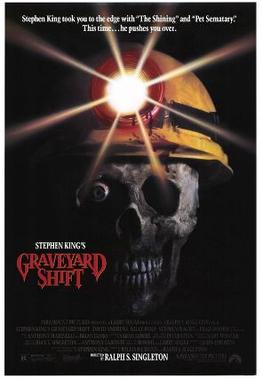
Let’s start with the basics: You need at least one sympathetic character.  Okay, you kinda like Jane, because she shows basic humanitarian traits.  And Carmichael.  Then you want a plot that makes some sense—what is Warwick’s motivation?  The writing is particularly bad.  If there’d been a bit more intentional camp, this might’ve made a reasonable horror comedy.  I mean, you’ve already got the empty aluminum cans being fired by slingshot.  As it is, it’s played straight with an evil foreman, rats everywhere, and a giant bat in the basement.  By the end you’re kind of rooting for the bat.  And whose idea was it to use voiceovers of the sub-par dialogue over the closing credits?  Is this so bad that it’s good?  I’m having trouble deciding.

Although set around the fourth of July I wouldn’t call this holiday horror.  Nevertheless, there are some moments of religious imagery that pop out.  The graveyard sinking in the river has a listing statue of Jesus near the start of the film.  And the exterminator—the only real camp in the flick—narrates how in Vietnam they pinned victims down, like Jesus, to feed them to the rats.  The final couple of minutes—well earned, I assure you—have Hall fighting the wicked foreman with the jawbone of an animal (one has to assume an ass), inexplicably among human bones (some still in their coffins).  And his slingshot ultimately killing the giant (bat).  The references are to Samson and David, respectively.  Perhaps this movie’s an indictment of capitalism, since the basement cleanup is on Independence Day.  Or maybe it’s just tired horror tropes on a break.  (Having one of the characters reading Ben in the diner was a nice touch.)  It may become a holiday tradition after all.


Storming Fourth

Our founders picked a day of uncertain weather to declare independence.  One gets the sense that people were more stoic about the weather in those days.  Of course, we’ve increased global warming and made things more extreme.  Nevertheless, I can remember very few fourths of July when the possibility of storms was zero.  The weather around here has been odd this year with a suddenly hot June, with a dry spell that killed quite a few plants, followed by a cool start to July and some very intense storms.  And now, on the fourth, the possibility of rain in the forecast.  The grass hadn’t been growing in the dry spell, but I’m hoping the rain will hold off today long enough for me to get that job done.  In fact, on this secular holiday I’d been hoping to get quite a few outdoors chores checked off the list.

When I was younger and fireworks were the main draw to the day, I noticed that just about every year rain fell, or threatened to, on July fourth.  I’m sure it’s not that way everywhere, but here in Pennsylvania, where the declaration was signed, it’s a reality of life.  Of course, the modern Independence Day celebrations evolved over time to include the cookout and fireworks—outdoor activities both.  For me, apart from the outdoor chores on a day off work, a movie seems like an indoor celebratory alternative.  Perhaps Return of the Living Dead, set on the fourth.  Or I Know What You Did Last Summer.  Or Graveyard Shift.  Maybe something else.

Watching the political theater unfold—and my, what a dramatic election year it’s been—perhaps a comedy horror is just about right for today.  This is going to take some thought.  Something to occupy my mind while doing those outdoor chores.  Of course, I’ve got a book to get submitted as well.  If the weeds can hold off for another day or two—is it wise to paint the porch when rain’s in the forecast?—maybe I can finish up Sleepy Hollow.  It’s a good American ghost story.  That might be appropriate as well.  You see, holidays are so rare that too many things crowd in on them.  They’re breaks from the constant earning of more money, which is the American way.  Of course, our founders were largely restless gentry.  For me a day off work is always a busy day.  Especially when the rains have returned and the grass has grown.  It must be the fourth of July.


Life After

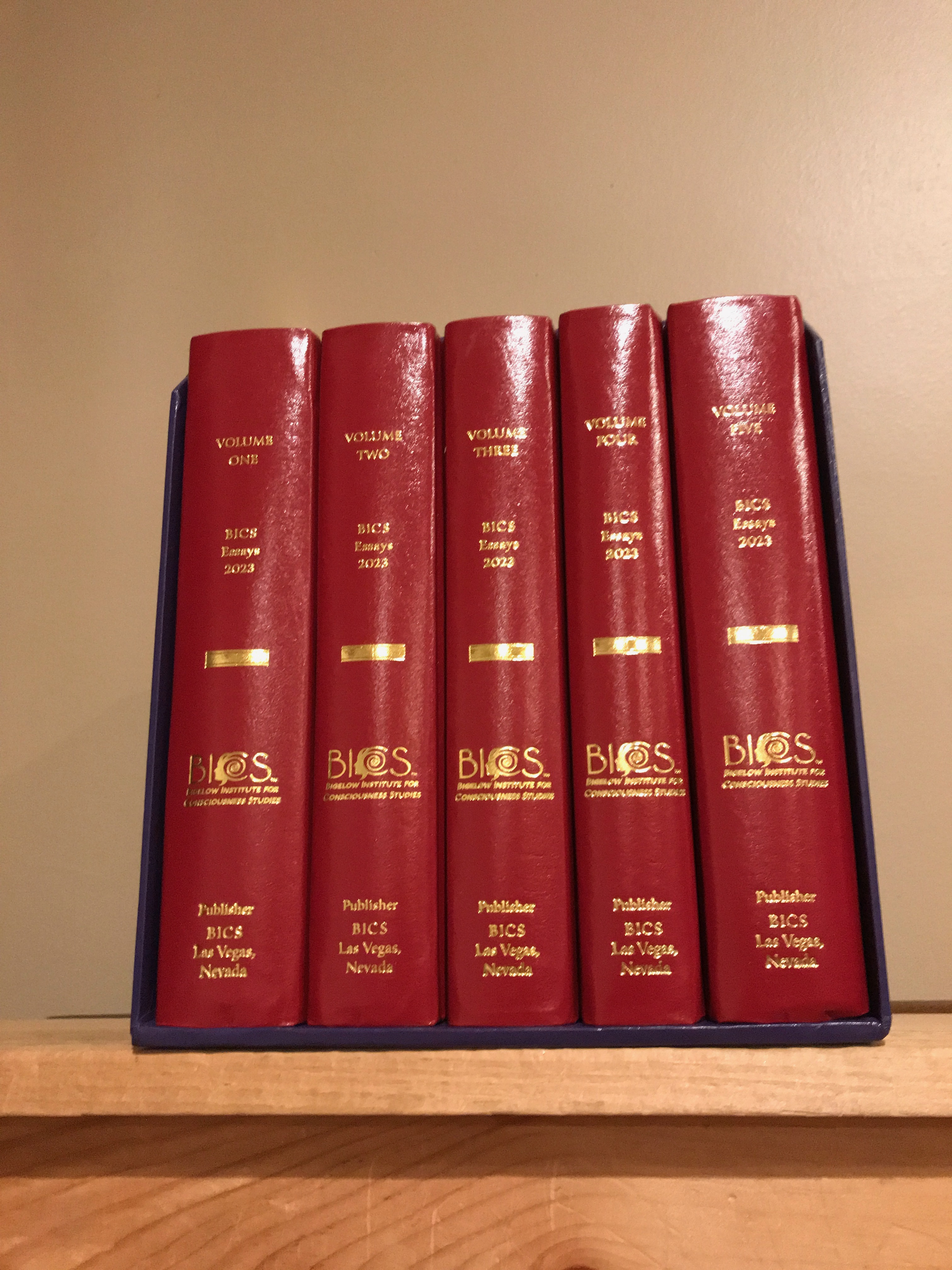
Robert T. Bigelow is wealthy enough to speak his mind.  A hotel and aerospace entrepreneur, Bigelow has made no bones about his belief that aliens are among us, for example.  After the death of his wife in 2020 he initiated a contest for essay writers to give their best proof that consciousness survives death.  The results took the form of a five-volume, twenty-eight essay collection that, according to those who’ve read all, is impressive.  Having spent my life studying religion, I can trace my motivation back to this basic concern.  As a child I was terrified of Hell—a fear that has never abandoned me—and consequently studied religion as a means of reassurance.  I’m not alone in this; the whole Methodist movement began because of John Wesley’s similar concern.  Most of us don’t have the money Bigelow has to attempt reassurance.

Having said that, some time ago, the Bigelow Institute for Consciousness Studies—the organization behind the essay contest—offered $500,000 for the first place essay.  The second received $300,000 and the third $150,000.  Those who were selected for publication received a copy of the five-volume set.  Then, the Institute made an announcement: while supplies lasted, anyone with a legitimate interest in the subject could write to them for a free copy.  I’m not of the intellectual caliber of these essayists, but I have studied religion my entire life.  And I am quite interested in what the BICS is calling “absolute proof of life after death.”  All it cost was an email.  They even paid for shipping.

The set arrived yesterday.  The postal worker at the door seemed apologetic (I had to sign for it), noting the package was heavy.  Now, this is going to take some time to get through.  The five volumes are handsomely produced.  The hardcovers are printed in full color (I know from work this is quite costly).  They have gilt edges and ribbon markers.  And a wealth of thought within.  I guess you’ll need to stay tuned here to find out, after I finally finish, if the results are assuring.  Glancing through the table of contents, and having looked over the judges of the contest, I’m optimistic.  Although Robert Bigelow stands at the opposite end of the political spectrum to me, we both understand that deep-seated human need to know physical death is not the end of who we are.  Even the famous skeptic Harry Houdini wanted the answer to this question as he debunked mediums in search of someone legitimate.  In any case, I’ve got years of interesting reading ahead of me.


A Land Forgotten

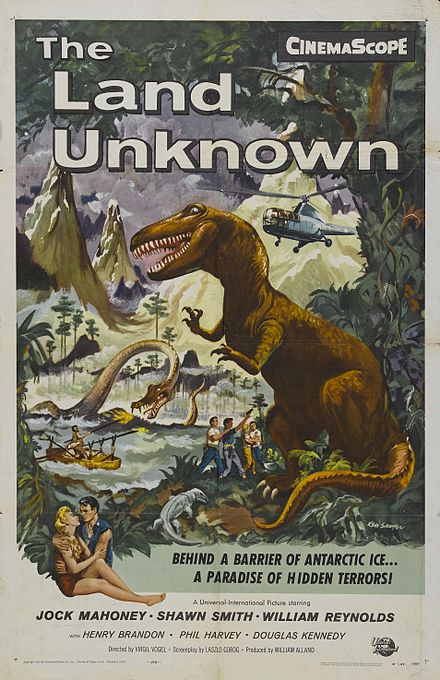
In case anyone’s noticed (which I doubt) that I’ve been discussing a spate of 1950s sci-fi/horror movies, I have a confession to make.  Several years ago I needed to see Tarantula.  (Anyone with similar headspace will know this need.)  The only place it was available at the time was in The Classic Sci-Fi Ultimate Collection.  Volumes 1 and 2 were sold together.  I did what I had to do.  Then I forgot I had the set before finishing volume 1.  Who knows what might’ve been going on in my life then?  Rediscovering it has been a budget-saving way to address my fix.  I had never heard of The Land Unknown before, and although it has one of the goofiest T-rexes ever, it is actually a good story.  Of course there are holes in the plot, but it is about the necessity of being humane, even when emotion dictates otherwise.

A helicopter crew on a South Pole expedition makes an emergency landing in a volcano that harbors prehistoric life in a hot spot in Antarctica.  The crew has a female reporter with them—these movies certainly have fifties attitudes about women!  Not having the parts to repair their copter, they try to survive among dinosaurs and an aggressive, giant monitor lizard.  There is another person there, the sole survivor of an earlier expedition, who’s become mostly feral.  The commander of the modern crew demands that they give him the dignity and fair treatment that all people deserve.  There’s a bit of drama around who will get the girl (again, the fifties), with the commander ultimately winning out.  How do our heroes escape this peril?  They’re able to repair the helicopter with parts from the earlier expedition’s crashed vehicle.

With its budget the special effects had to be cheap, but the story has redeeming value.  The message that we mustn’t let isolation drive us to bestiality is still as important as ever.  There are those who watch such movies solely to laugh at the special effects.  Hey, I laughed a bit too, but I’m only human!  There is, however, more to this movie than the dinosaurs, which drew audiences then just as the Jurassic Park franchisedoes now.  There’s even some serious talk about evolution, which was often present in these Universal creature features.  There are some slip-ups on the evolution part, but apparently the monitor lizards were meant to represent stegosauruses—did I mention the budget was tight?  I actually found the movie to be worth seeing for its intrinsic value.  Not bad for a forgotten set purchased mainly for one movie in a time unknown.


More Than Dark Shadows

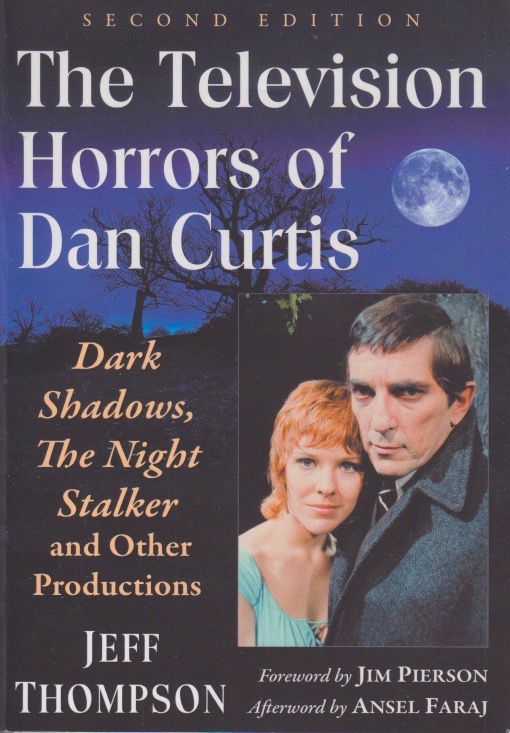
The Television Horrors of Dan Curtis is one of those books that makes me feel less alone.  Jeff Thompson is not only a true fan of Curtis’ voluminous quality output, but he knows more about Dark Shadows than might seem possible.  I knew I wanted to read this book as soon as I learned of it.  As I’ve confessed many times before, although Dark Shadows was formative for me, I’m a mere dabbler.  I saw a fair number of the original run on afterschool television, I read the novels, but I never dove in.  I was more of a wader.  Still, this book demonstrates that many people were influenced by Dark Shadows, some that you might not expect.  But the book is about Dan Curtis and his horror work (mostly).

Dan Curtis went on to a kind of fame for his war epics (considered “serious” work), The Winds of War and War and Remembrance.  Although he directed some theatrical movies (all of which I’ve seen), he mostly stuck to work in television.  One of the results of this is that he never attained the level of appreciation of a number of auteurs who focused on Hollywood.  And it’s also clear that Curtis was interested in more than just monsters.  I personally dislike gangster and war movies (although my great-uncle Melvin Purvis was one of his interests).  Curtis found them worth of his considerable talents.  As Thompson makes clear, however, even as his own death was approaching, Curtis knew that, like Washington Irving, his early work would be that for which he was remembered.  That’s because Dark Shadows went where nobody else dared to go, and it’s memorable even today.

I learned a lot from this book.  Enough to know that Curtis was an enigma.  He remains less recognized as a director and producer than many Hollywood personalities that are household names.  Still, if pressed, a number of people even today would recognize some of Curtis’ work, whether or not they associate it with him.  Dark Shadows went through a short television reboot, for instance, and a second reboot attempt before being made into a movie by Tim Burton.  This book, however, made me watch some movies I had only known vaguely before.  And it has inspired me to watch others as well.  Curtis was an incredibly hard worker, and a man with definite opinions.  It’s perhaps a bit surprising that he never really attained the kind of fame that other “content producers” did.  Even his Wikipedia article is brief.  This book helps uncover a large amount of information behind a person who influenced many people without the glamour associated with that level of impact.


Sweet Tooth

Often our luxuries come at someone else’s cost.  I personally don’t have much of a sweet tooth, but I do enjoy dark chocolate once in a while.  (Milk chocolate tends not to be vegan.)  My wife had discovered Moka Origins chocolate at a local health food store and then learned that their location is in the Poconos, just outside Honesdale.  We visited their facility, small but growing.  We learned how they’re committed to fair trade and sustainability.  And they’re gaining a reputation in a world where scale is everything and as scale increases quality declines.  We all know that to be true but we still support the big guys.  The visit to Moka Origins made me reflect, once again, how we prefer low quality and cheapness to something that’s really well made but costs more.  It’s one of the realities of our economic system.

There is a small but thriving vinyl market for sound recordings—the quality is better, and many are willing to work with the inconvenience of turntables and discs than simply streaming whatever.  I took a lesson from Moka.  The cofounder told us that large companies come into places like Africa paying low prices to buy in bulk.  They buy improperly fermented cacao beans in huge lots which probably includes some beans that aren’t even cacao.  Mixing these large lots with enough additives, they can get away with the chocolate taste most people have grown accustomed to having.  If, on the other hand, you scale down and pay attention to what you’re doing you can even tell the country of origin of chocolate by its taste.  Since Moka sells only single origin chocolate, we were given samples from three different African countries and they were obviously very different, even to someone without a sweet tooth.

Economic scale often drives quality down.  In a company where the owner comes in on a Saturday morning to personally lead a tour and where the chocolate bars they sell are literally wrapped by hand, you know you’re not in Hershey.  Or at Nestlé.  Or any other corporate candy giant.  These companies make astronomical profits.  The owners of Moka Origins spend time in Africa, developing fair trade farms to grow quality produce.  I also learned that cacao pods are technically fruits.  It’s a food.  We tend to overlook that in our quick snack culture.  This was a very educational half hour, even for someone not inclined to food tourism.  So, if you happen to be in northeast Pennsylvania on a Saturday morning, stop in to try chocolate that’s really a food.  Or you can order it online.  Just know that you’ll pay for fair pricing for those who are doing the work to raise and process cacao beans as they should be treated.  You can tell the difference fairness makes.

Oh, and I should mention they also do coffee…


Following Irving

I’m growing fond of staycations.  Maybe it’s because I’ve become such a creature of habit that major disruptions seem daunting, but I still like a change of scenery with my family.  We settled on the Poconos because of, well, a chocolate factory.  More on that anon.  In any case, said location was near Honesdale, Pennsylvania.  Before setting out we learned that Honesdale is one of those quaint downtowns that has made it an island of culture in a sea of red, if you get my drift.  While researching things to do we learned about Irving’s Cliff.  This is an overlook of the town from a bluff atop one of the many hills.  What really caught my attention is that the Irving was none other than Washington Irving, the author of “The Legend of Sleepy Hollow.”  This cliff was a view he enjoyed, so it was named after him.

The view from Irving’s Cliff

Honesdale is a small town.  Less than 5,000 people call it home.  Growing up in western Pennsylvania I heard about more affluent people going to “the Poconos” out east.  It was a “romantic” getaway for some lucky high schoolers while the rest of us had to use our imagination regarding what such a place might be like.  Of course, living just south of the Poconos now we’ve driven through them many times, but we never stopped to linger here.  As I tried to commune with the spirit of Irving on his cliff, it occurred to me that he had been a world traveler.  Nipping across the border from his native New York to Pennsylvania must’ve been no big deal.  Still, he wrote incessantly and the locals obviously appreciated that a famous writer had tarried in their town.  Standing here, I knew the view he took in was quite different.  The hills would’ve been here, but a much smaller town and, above all, no cars.

My forthcoming book on Sleepy Hollow will have a thing or two to say about Washington Irving, of course.  It’d be a fool’s errand to try to follow in his footsteps, just as it would be to try the same for his namesake George Washington.  Besides, I was born in a western Pennsylvania town visited by our first president.  Although we couldn’t afford accommodation in Honesdale itself (it is a quaint town), we checked into our hotel knowing that “Washington Irving slept here.”  And when you’ve spent a few years writing a book about a guy’s work, well, a staycation to a place where he had one is worthy of comment.


Praying for Mantis

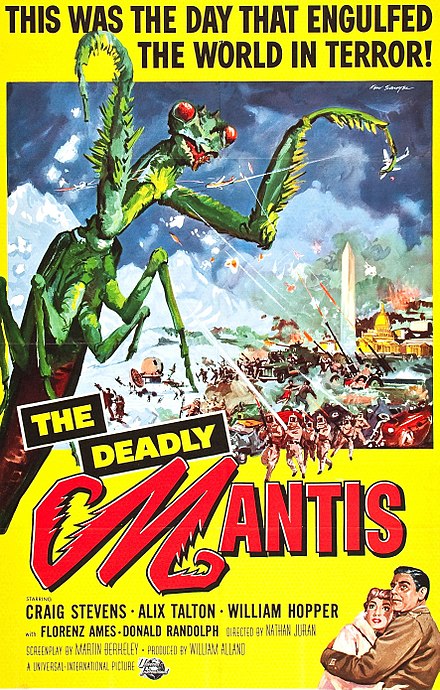
Now this is a Cold War movie.  And I mean “cold.”  The Deadly Mantis is one of those movies that hovers between “so bad it’s good” and just plain “so bad.”  I was kind of rooting for the mantis.  In any case, this was an ambitious movie for the time but it reflects the post-war paranoia in the United States.  It also makes very abundant use of stock footage, much of it military.  You almost expect a recruiting ad at the end.  (It does thank the Ground Observer Corps in the closing credits.)  Okay, so here’s the story.  A volcano in the south Atlantic causes the calving of an enormous Arctic iceberg near the North Pole.   That iceberg contains the frozen body of a 200-foot praying mantis from dinosaur times.  Even earlier.   Said frozen mantis, quite hungry after millions of years, begins attacking Arctic radar bases and flying south.  The Air Force calls in a paleontologist to help identify what they’re looking for.

The mantis is so big that it prefers people for food, although, one might note, a polar bear would’ve been easier prey.  In any case, given the technology limitations of the time, the military has trouble keeping track of the insect as it flies over the most populous part of the country.  They do get the cloudiness of the East Coast about right.  Eventually they shoot it down—actually a fighter jet crashing into it does the job—over Newark and the mortally wounded mantis crawls into the Lincoln Tunnel (called “The Manhattan Tunnel” in the film).  By this point the viewer is saying “just let the poor thing die in peace,” but they pump smoke into the tunnel, presumably to hide wires and other props, and commit a protracted insecticide.  

Now, I’m one of those people who hates to hurt any animal.  The death twitches of an insect are quite troubling, so I try to catch what I can indoors and release them.  I have trouble with the instructions to kill spotted lantern flies—it’s not their fault that they’re here.  The movie shows a bravado regarding the military and a machismo regarding the main female character that hearkens back to why it was so necessary to evolve out of the fifties.  Of course, we learned nothing from The Deadly Mantis and have catapulted back into a new Cold War and an even more robust military.  William Alland, the producer, had a real love of this genre of movie, and for that we have much to be grateful.  But even the big bug genre can produce a real groaner now and then.


Mustard Monster

Speaking of mustard seeds, as a child something troubled my literalist brain.  Mark 4.31, “It is like a grain of mustard seed, which, when it is sown in the earth, is less than all the seeds that be in the earth…” According to subsequent translations after the KJV “less than all” reads, “the smallest.”  Of course, in Elizabethan English that’s what “less than all” denotes.  Since these words came from Jesus, and since the Bible was factually true on every point, I wondered how this error had crept in.  The mustard seed, I knew as a child, wasn’t the smallest seed.  Not by a long shot.  I knew, for example, that poppy seeds were smaller.  Why had Jesus said the mustard seed was the smallest when it wasn’t?  I was too young for the casuistry called exegesis, so a small crisis of faith emerged.

Pardon the resolution: I don’t have a macro lens any more. Mustard (left) meets chia seed (right).

The mustard seed has other roles in the gospels as well.  I still frequently recite “If ye have faith as a grain of mustard seed, ye shall say unto this mountain, Remove hence to yonder place; and it shall remove; and nothing shall be impossible unto you” (Matthew 17.20).  All of this made me curious as to the history of mustard.  While in Wisconsin we used to visit the Mustard Museum in Mount Horeb.  It’s now the National Mustard Museum and is in Middleton.  It seems that mustard, in its familiar paste form, was developed in China centuries before Jesus.  And people had been using mustard seeds as a spice long before that.  Jesus, like earlier prophets, used nature to make a point.  The problem wasn’t Jesus, it was literalism.  

Jesus also said “For as Jonas was three days and three nights in the whale’s belly; so shall the Son of man be three days and three nights in the heart of the earth” (KJV) in Matthew 12.40.  Modern translations of “sea monster”—for the Hebrew says it was a fish—forced me to dust off my Greek New Testament.  So Jesus said “in the belly of Cetus.”  Cetus was mythical sea monster, not unlike the mythical Leviathan God describes in Job 40.  Good thing I couldn’t read Greek or Hebrew as a kid!  Well, it seems we’ve gone from mustard to monsters.  If you’re familiar with the history of this blog, that shouldn’t surprise you too much.  I wonder what literalists believe about the Loch Ness Monster?  But don’t get me started on that or we’ll be here all day.


Cryptid Caper

I don’t recall how it got on my fiction reading list—I probably saw it on Goodreads—but I picked it up because it was short.  And surprisingly, multiple copies were in Barnes and Noble.  Since James Daunt bought the chain out it has definitely improved.  In any case, Hunter Shea’s To the Devil, a Cryptid looked like it might be a fun romp, and if it turned out that I didn’t like it, well, it was short.  Ads in the back keyed me in that this was a part of a series of horror novels about cryptids.  Besides, I like to support publishers that aren’t part of the big five.  I’d just finished reading a five-hundred-pager, so something under two was very welcome.  The title seems to riff off the horror flick To the Devil a Daughter.  As much as I try to keep up on my cryptids, I was unfamiliar with the Goat Man.  And I did like it, by the way.

So, the real Goat Man is mostly associated with Maryland, but in Texas, where the novel is set, there is the Lake Worth Monster.  This seems a good fit for the cryptid part (whether intentional or not I don’t know).  A bunch of kids messing around with Satanism decide to sacrifice a goat in the woods where a Goat Man cryptid is said to live.  Something goes wrong and the goat fuses with a guy trying to break up the ceremony and mayhem ensues.  Lots of bodies torn apart in this version of the Lone Star State.  Still, the story is fun.  I’ve been writing cryptid fiction for years, and this may be a targeted demographic, but that doesn’t prevent this from being a good horror novel.  Particularly interesting is the resolution.  I’ll try not to give too many spoilers, but the next paragraph reveals something.

How do you stop a demonic, bulletproof Goat Man?  You call in a priest to do an exorcism.  The truly remarkable part of this is that the priest is treated sympathetically.  None of the characters are religious.  And of the two main young people who survive, you really don’t expect them to be found in church.  The story isn’t intended to be believable, of course.  The Goat Man is an urban legend.  Urban legends are often difficult to tease apart from actual cryptids sometimes.  Cryptids remind us that there’s still more to be discovered in the world.  And I may have just discovered a series of stories that work for a quick fix.


Not Poor

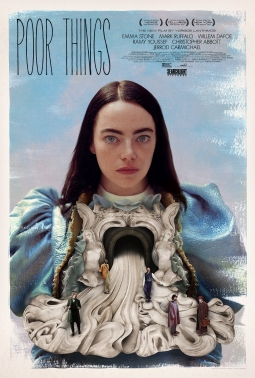
It’s an amazing era for cinema.  A number of genre-defying films have emerged and some of them are quite striking.  Some months ago I saw Everything Everywhere All at Once.  Some called it horror, but that label didn’t really stick.  It reminded me of Parasite, another movie difficult to classify.  Casting about for something we might both like, my wife and I settled on Poor Things, recommended to me by a fellow horror fan.  Other than being amazed by it, I have no idea how to classify it either.  Again, there are horror elements here but it’s certainly not a horror movie.  A comedy, yes, but a dark one.  It’s a movie that has a feminist message, but one that’s been disputed.    Perhaps a quasi-summary might help.

Bella Baxter is not what she seems.  Cared for by a Frankenstein-like doctor named Godwin, she literally has the brain of an infant in an adult body and is rapidly coming to know the world.  Rescuing her just after she died by suicide, Godwin transplanted her unborn baby’s brain into her revived body to see what would happen.  Himself experimented on mercilessly by his own father, Godwin is a rationalist, eschewing emotional entanglements.  He decides to marry Bella to one of his students but before that can happen an unscrupulous lawyer steals her away only to find he can’t control her.  After gaining experience of the world, and learning life lessons in a brothel, Bella returns home to marry her fiancé and be with Godwin as he dies.  Her cruel former husband reclaims her only to have Bella realize why she’d chosen suicide in the first place.  She returns to Godwin’s home and sets up life on her own terms.

A number of things stand out.  One is Bella’s innocence and utter lack of shame regarding her body.  Emma Stone’s acting here is incredible.  Another is the nods to steampunk sensibilities in a story set in Victorian times.  Perhaps the aspect that most caught my attention was Bella’s use of “God” as her name for Godwin, frequently calling him “my God.”  Her grammatical naivety leads to much of the comedy in the film, but this particular choice is freighted with interpretative possibilities.  Obviously, one’s parents are the models one incorporates into concepts of God.  That has been long recognized.  Another, however, is that Godwin did, in fact, create her to see what she would become.  As Godwin faces his own mortality, Bella notes “God is dying.”  What happens after this is that she becomes her own woman for the first time, not under the control of men.  I’m not sure how to classify Poor Things apart from a movie that may require another watching just to attempt a classification.


Passing Words

I’ve never counted, but it must be dozens.  Maybe a hundred.  And they have very high memory requirements.  Especially for a guy who can’t recall why he walked into a room half the time.  I’m talking passwords.  The commandments go like this:

You can’t use the same password for more than one system/platform/device/account

You can’t tell anyone your password (duh!)

You can’t write it down

You can’t send your password to someone electronically (duh!)

You must logoff your device when it’s unattended

You will be held responsible for anything done under your login

The word of the Lord.

Now, how much more ageist can you get?  I’ve never counted the number of passwords I’ve had to generate for work alone but I can’t remember much without writing things down.  Even the chores after work.  I hear that there are “keychains” you can get that remember your passwords for you.  I suspect you need a password to access your passwords.  Replicate the commandments above.

I know internet security is serious business.  My objection is that you’re not supposed to write any of this down.  I carry a notebook around with me (it has no passwords, so please don’t try to steal it) to keep track of everything from doctors’ orders to how to call the plumber if there’s a leak.  I can’t remember all that stuff.  Some of it is personal information, but with everything you’re expected to keep in memory these days—at the same time we’re unleashing AI on the world—is madness.

A friend pointed out that AI books are written without authors.  If I remember correctly, my response was “AI has great potential, but let’s leave the humanities to humans.”  I hope I’m remembering that correctly, because I thought it clever at the time. I wish I’d written it down.  Those who make the rules about passwords aren’t as close to their expiration date as I am.  My grandmother was born before heavier-than-air flight took place and died after we’d landed on the moon.  Guys my age regale their kids (and some, their grandkids) by telling them telephones used to be attached to walls and you could walk away from technology at will.  Now it follows you.  Listens to you even when you’re not talking to it—our car frequently interjects itself into our conversations.  At least she isn’t asking for a password while I’m driving.  I couldn’t write it down.  Our love affair with technology is also driving.  More often than we suppose.  It’s driving me too… driving me crazy.


Invisible Again

Sequels are a fact of life.  Movies, although some of us look to them for profundity, are made for selling.  (I guess my writing for so long with no profit from it has skewed my view a bit.)  Still, The Invisible Man Returns isn’t too bad.  In my mind, there were a set of six canonical Universal monster movies: Dracula, Frankenstein, The Mummy, The Invisible Man, The Wolf Man, and The Creature from the Black Lagoon.  In reality, each of these successful films was followed by a clutch of sequels, filling the thirties and forties—into the fifties—with monster movies.  I never really bothered with the sequels, but some of them are pretty good.  And I still haven’t seen the more recent Invisible Man, which I hear is quite good.

When I was a kid, Vincent Price represented horror like no other single person.  He had developed a persona that was lucrative and that influenced other monster boomers as well.  He was a relative unknown when he was hired for The Invisible Man Returns.  His face only appears in the last minute of the film and his voice had not yet settled into its characteristic menace tone that would make him a genre icon.  Still, the story has a typical plot for the period.  Sir Geoffrey Radcliffe is set to hang for killing his brother—they own a coal mine.  Dr. Frank Griffin, a friend of the family and brother of the original Invisible Man, believes him innocent and makes Radcliffe invisible so that he can escape the gallows.  As we all know, the problem with the invisibility drug—here duocaine rather than monocaine—is that it causes insanity.  Radcliffe discovers the real murderer before going insane, all the while being chased by police.

These “invisible” films demonstrated what special effects could become.  Shot in black-and-white, “black screen” technology was used to make Radcliffe appear headless and handless.  In fact, this movie received an Oscar nomination for the effects.  It’s not a scary film, but it’s a reasonably told story.  And the special effects really were cutting edge for 1940.  Probably somewhat scandalous for the time, Radcliffe has to undress in front of his fiancée at one point, leading the men who discovered her fainted to suppose that seeing a naked, if invisible, man could do it.  There is a subtle humor here.  Other films followed but they veered into the comedy realm.  Until the recent remake.  I guess I’ll need to add that one to my ever-growing list of must-see movies.


Discovering Ordinary

I wasn’t quite sure what sense of ordinariness to expect from Robert J. Wicks’ The Tao of Ordinariness.  I would say as a whole it is about becoming ordinary you.  I found the whole interesting, but it was chapter four that really caught my attention.  It’s here that Wicks starts to address those whose damaged childhoods have created a false (and frequently re-affirmed) sense of our ordinary selves.  I’ve always known I have issues—it’s pretty obvious that I’m not quite like other people I know.  I often lack confidence and, thanks to my career and publishing history, have had that sense pounded in even as an adult.  (Poundedness is not a protected category, however, and it won’t get you any special consideration.)  Up until that chapter I was thinking, “This is nice, but it just doesn’t match my experience of things.”  Then I learned why.

It is possible to change your outlook, of course.  It’s not an easy thing to do.  Our culture isn’t set up to allow for it, what with 9-2-5s and all that.  You see, my personality really fit the teaching mode and lifestyle.  I loved the work, although it was hard.  And I loved the fact that if you had free time during the day you could, if you needed to, run an errand or two.  I guess I’ve never been one to invest in that capitalistic idea that your employer is buying your time.  For some jobs, yes.  In fact, my first employment experiences were of that sort.  I started at nine, did physical work until five, with a lunch break in the middle.  Now work begins early and doesn’t really end.  Days off are few and they fly by quickly.  Changing your outlook requires time to think.  That, it seems, is what’s missing.  It makes it difficult to find out what my ordinary is.

Wicks’ book is a hopeful one.  His optimism comes through page after page.  He gives practical advice.  The subtitle reveals why the book is important: Humility and Simplicity in a Narcissistic Age.  (That last adjective is so common now that spell-check completes it automatically.)  Politicians have frequently been narcissists, but Trump has made it into a high art—care only for yourself and tell people the lies they want to hear.  You can see the calculating cynicism in every glance and gesture.  And yet, here we are.  Books like this are important.  We need to be told that there’s another way.  If only it were also possible to get your horse to drink.


Two-Eyed Cyclops

You can probably tell, if you read me regularly, that I’ve been going through an older movie kick.  A lot of these are easier to find for free on streaming services, so that’s been the path of least resistance.  So it was that I came to watch Doctor Cyclops.  I’d completely forgotten that I’d watched it about fourteen years ago.  In any case, a kind of precursor to The Incredible Shrinking Man, it’s the story of the deliberate shrinking of five people by a mad scientist with an endless supply of radium at hand.  The movie made a splash because of the use of Technicolor in a horror film (with no blood, however).  The story is a touch dull and the shrunken people (three scientists among them) spend most of their down time running around and saying very little.  They do face an alligator, which is kind of fun, and the big hand that holds the pompous Dr. Bulfinch is distinctly unnerving.  The movie received an Oscar nomination for visual effects.

There’s something distinctly enjoyable about these early sci-fi horror films that don’t explain much but nevertheless manage to employ some impressive cinematography.  The use of oversized props and forced perspective make much of this possible, perhaps making up for the simplicity of the tale.  Even by 1940 the “scientist goes mad and must be stopped” narrative was getting old.  The Second World War was underway but nuclear power wasn’t yet harnessed either for bombs or energy.  Interestingly, the source of the mad doctor’s radium is pitchblende, which one of the characters notes, is a source of uranium.  Of course, many movies were to follow where radiation mutated life forms in various ways, including shrinking them.

Coincidentally—it was a rainy Sunday afternoon—I watched the Twilight Zone episode “The Little People” later in the day.  Here was another story about the large oppressing the small.  This one, however, has a stranded astronaut who discovers the little people thinking that he is their god because he has the power to harm them.  The message here is much more profound, even if told with more brevity.  No clear motive is given for Dr. Cyclops’ work beyond his interest in pure science.  By the way, his real name isn’t “Cyclops.”  That refers to his being a giant with one eye—the latter because one of his glasses lenses gets broken.  Don’t worry, the shrunken people learn that the effect is temporary—their brush with radioactivity leaves no lasting harm.  There is, however, a decided danger to desiring to return to a “simpler time,” as Mr. Serling steps in to remind us.