Squeaky Clean?

A New York Times story, apart from the expected misunderstanding of actual Evangelicals, made me sad.  The article points out that, especially since 2016, “Evangelicals” have taken to soft-core porn, cussing, drinking, and premarital sex.  In other words, Trump has given them license to behave like secular folks while still claiming the name “Evangelical.”  Why should this make me sad?  I lament the loss of place for those who grew up, like me, striving for clean living.  It’s an image—a mirage—rather than a reality, of course.  But still, if conviction holds, you can get pretty close to the ideal.  That vision of life has been occluded by a guy who runs for President because he cares only for himself.  Jesus, on the other hand, was all about caring for others.  Going as far as, if the Gospels are to be believed, sacrificing his own life.

Like fiscal conservatives, such legitimate Evangelicals now have no public voice.  One of only two political parties has become identified with an individual rather than ideals—what used to be called a platform.  I have Republican friends.  I grew up identifying as a Republican.  I also grew up as an Evangelical.  I studiously avoided things like bad language, sex, tobacco, and alcohol.  Even at Evangelical Grove City College I was a bit of an outlier for how seriously I took all these things.  Of course, studying history can be dangerous, particularly for ideologues.  Still, “clean living” had its own virtues.  Those who continue to try to live that way are swimming into a rip tide, it seems.  For some Trump seems like the Second Coming, sans the white horse.  And this, above all, is sad.

There are those who claim, often loudly, that religion is bad.  I agree that when a religion tries to force others to obey its standards it can quickly become evil.  Still, the baby should be left behind when the bathwater’s discarded.  Religion has led to much good in the world.  Hospitals, charities, and yes, “clean living.”  These things, along with retirement homes and affordable apartments for low-earners in their autumn years, are necessary to pick up the slack that the government leaves.  It is cause for sadness that the clean living camp has succumbed to Trump-style hypocrisy.  Heck, religion gave us the word “hypocrisy.”  The standards of classical Evangelicalism are often impossibly high.  If we look at current Evangelical leaders we find many, many skeletons in a house with many closets.  And a wagging finger warning the young, “Do as I say, not as I do.”


They Come in Batches

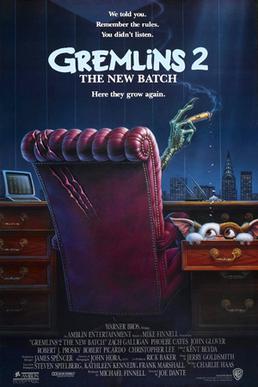
There’s horror and there’s comedy horror.  And then there’s just plain silly.  Gremlins 2: The New Batch falls into that last category but with the strange factor that it’s silly without being funny.  There are a few smirk moments, and sometimes the self-parody approaches clever, nevertheless it’s bad.  It’s a big budget bad movie.  The idea that the gremlins try to take over New York City is funny, at first, but other than Phoebe Cates and Christopher Lee, they don’t seem to know this is a satire of Gremlins.  I guess not knowing about the plot—I tend not to read reviews about movies before I see them—I was expecting something more like the first one, which I thought was pretty good.  The only reason I knew the movie existed at all was that the Blu-Ray version of Gremlins comes with The New Batch.  The late eighties and early nineties I was spending holed up in Edinburgh working on a Ph.D.  We didn’t have much money and didn’t see many movies.  We had no television (there is, or was, a television tax in the UK), so I never heard of the sequel.  

I presume we all know the three rules of mogwai, and needless to say, they immediately get broken.  The eponymous new batch takes over the Manhattan tower of Daniel Clamp.  His high-tech building needs no gremlins because the technology already doesn’t work well.  The high rise houses, among other things, a genetics lab where Christopher Lee camps it up, but which means the gremlins have access to formulas that allow them to grow wings, tolerate sunlight, and become spiders.  Sound silly?  You betcha.  One of the gremlins is even able to talk.  I watched with increasing stupefaction. 

Bad movies and cult followings are the peanut butter and jelly of cinematography.  Some bad movies never attain cultdom, but I can see why this one has.  The big budget ensured glitz and special effects.  Even the self-awareness to have Hulk Hogan being able to control the gremlins in the theater with a threat almost gives the movie an art film feel.  The horror, mostly based on the fact that there are monsters, is tightly constrained.  Although I felt increasingly like I was wasting my time as the movie went on, upon reflection I can see why some people have glommed onto it.  It may just have edged over into the so bad it’s good category.  I’ll need to think about it.  And avoid eating after midnight.


As We Know It

The end of the world, as we know it, is really more recent than we think.  Yes, Christians of a certain stripe have been looking for the second coming since the first leaving, but that detailed map of how we’re living in the end times, courtesy Hal Lindsey, is a new thing.  Here are the fast facts.

First and second centuries, Common Era: early Christians tended to think Jesus would “be right back.”  When that didn’t happen they began to look in the Bible for reasons why and started to develop theologies to cover the bases.

Late Antiquity to the Middle Ages: settled in for the long haul, theologians developed eschatology.  Although that sounds like a disease, it’s actually a system for thinking about how the end of the world will come down.  There were conflicting theories.  The two main flavors were premillennialism and amillennialism.

Early Modernism: Protestants came along and searched the Bible for minute clues to make into a system.  In response, postmillennialism became a thing.  Now there were three options.  Various phases were discussed: tribulation, resurrection of the dead, and the already-met millennium.

1820s: William Miller, a Baptist minister, began number-crunching and figured the end of the world would take place by 1843.  His followers, “the Millerites,” continued on after what was called “the Great Disappointment.” 

1830s: John Nelson Darby, a Plymouth Brethren leader, came up with Dispensationalism, a scheme that divides history into eras, or “dispensations.”  He thought we were living near the end of that scheme about 200 years ago.  The idea of “the rapture” was added to the other phases.

1917: Cyrus I. Scofield, published the Scofield Reference Bible.  A man with little formal education (and a “colorful” background), he applied Darby’s dispensations in his Bible, giving the United States a road map to the end times.

1970: Hal Lindsey, a seminary educated evangelical, published The Late, Great Planet Earth.  It became the best selling book (classified as nonfiction) for the entire decade.  New ideas, such as “the Rapture” and “the Antichrist” began to be read back into the Bible.  The book was made into a movie.

1976: David Seltzer, a Jewish screenwriter, penned The Omen.  The movie made use of Lindsey’s adaptation of Scofield’s adaptation of Darby’s ideas.  The wider public, seeing it on the big screen, believed it was about to happen.

2000: the world still didn’t end, either with a second coming or Y2K, as many predicted.  Round numbers will do that to people.  It didn’t stop predictions of the end of the world.

2012: the Mayan calendar gave out.  A movie was made.  People believed. Apocalypse averted.

2024: you fill in the blanks.

Image credit: Albrecht Dürer

Mirror Gothic

I have a soft spot for gothic novels.  I get the sense that Rebecca James set out to write the most gothic novel ever in The Woman in the Mirror.  Although the supernatural persists in the background throughout the novel, it’s mainly the reflection of two women who encounter the mysterious Winterbourne Hall, high on a cliff over the Atlantic in Cornwall.  Rachel Wright, in the present day, is a self-made woman.  Overcoming the life of being raised an orphan, she has opened a successful art gallery in New York City when she receives an unexpected letter informing her that she’s inherited an expansive property in England.  Not knowing who her parents were, this is a world-changing surprise, so she heads to Cornwall to find her past and to figure out what to do with her inherited property.

Her story is intertwined with that of Alice Miller.  An English woman from two generations past (I’ll come back to that), Miller grew up with a bully for a father and a desire to make it on her own.  She’s hampered, however, by a past secret.  She takes up employment as a governess at Winterbourne where a Rochesterian Jonathan de Grey is lord of the manor.  His two children, fraternal twins, require keeping and the last governess threw herself off the cliffs—you see what I mean by most gothic—so Miller takes the post.  The massive house, however, has a strange effect on her.  Not only on her, we learn, but on most of the women who live there.  The final housekeeper, however, does seem to be immune, perhaps because she’s older.

The story is slow paced, with a fair amount of romance thrown in.  Both Rachel and Alice have lost lovers and are coping with their pasts.  They never meet, of course, being from separate generations.  Perhaps this is just the perspective of an old geezer, but putting Alice Miller in, presumably, her twenties in 1947 doesn’t really seem long enough in the past for the story to unfold as it does.  I couldn’t help but think that this makes her about my mother’s age and I would have to admit that my own daughter is old enough to inherit an estate while having already become a successful artist in Manhattan.  The timing just seemed a little off to me.  The perfect gothic novel seems to require some Victorian aspects, in my opinion.  Nevertheless, this story becomes quite gripping toward the end.  If you want a modern-day gothic romance, you’ll likely enjoy The Woman in the Mirror.


Gather Round

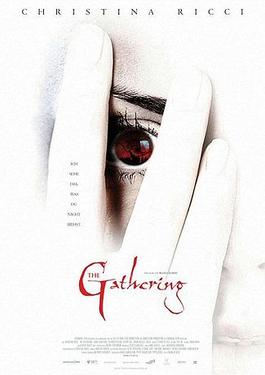
The church has been keeping secrets.  That’s the basic premise behind a fair raft of horror films.  Apart from giving those of us watching religion and horror quite a bit to talk about, it reinforces just how close the two are.  The Gathering is a film I missed when it came out, but one which has an interesting, if unlikely premise.  At times it reminded me of The Reaping, and at other times, the prequels to The Exorcist.  Cassie is a young American woman who loses her memory after being hit by a car near Glastonbury, England.  At about this time a deliberately buried church is being explored by an art history professor.  He asserts that it is the church Joseph of Arimathea built and represents, in its altarpiece, the earliest rendition of the crucifixion.  The clergy seem quite disturbed by this.

Meanwhile, Cassie recovers and is taken on as an au pair for the art historian and his wife (the one who hit her with the car).  The people of Ashby Wake stare at Cassie, as if they know her.  She has premonitions of several local people dying violent deaths.  The clergy learn that the altarpiece depicts those who came to watch Jesus’ crucifixion, not out of love or devotion, but simply for spectacle.  Since then they’ve been cursed and show up to watch various historic tragedies.  The clergy want the church, the earliest representation of the spectators, reburied.  The people of Ashby Wake include those of “the gathering,” indicating tragedy is about to unfold in that small town.  There is a twist ending I won’t reveal, but this is one of those horror films that rely on religion to make them work. 

Critics tend to dislike the film while viewers are divided on the question.  I actually enjoyed it, personally.  The concept of the watchers committed to bloodlust seemed different, particularly when put in the context of nascent Christianity.  It doesn’t handle religion as well as some horror does, but it’s a serious effort.  Why Joseph of Arimathea would want to have portrayed gawkers rather than those loyal to Jesus is one of the bigger questions left unanswered.  After the ending some of the unusual scenes earlier on make more sense.  But still no reason is given why an early church would have portrayed those not to be emulated.  As a horror film with no jump startles, but a slowly building dread, it fits the bill for some of us.  The “church keeping secrets” theme is one that should be explored further.


Showing Gratitude

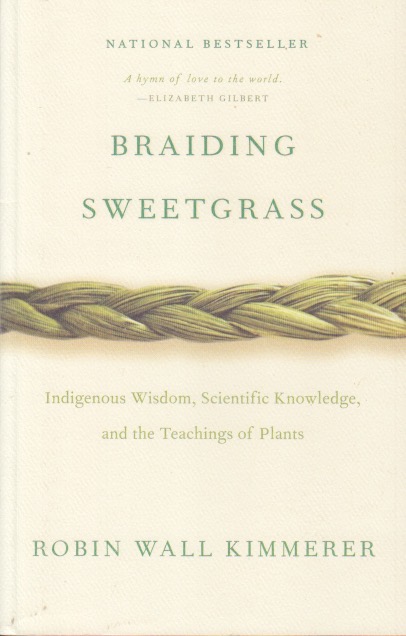
Stealing is something that we all, except some capitalists, know is wrong.  I think quite a lot about the land that was stolen to make America possible and I know that simply giving it back isn’t an option.  Nevertheless, I do believe that we should listen, and listen attentively to those who’ve been here longer than Europeans.  Robin Wall Kimmerer’s Braiding Sweetgrass is an important reflection of this dilemma.  Kimmerer is Potawatomi and she’s also a professor of Environmental Biology.  The book is a series of essays that focus mostly on plants and what we can learn from them.  It also brings in indigenous teaching, contrasting the outlook of gratitude against that of greed.  By turns sad, funny, and profound, Braiding Sweetgrass contains a message that is vital to counter climate change.  To correct our attitude before it’s too late.

There’s so much in this book that it’s difficult to know what to touch on in this brief notice.  Throughout, Kimmerer notes that the First Nations viewed life as a gift.  The earth is constantly giving and the native way was to be thankful and to accept the responsibility of being given a gift.  Seeing how the European attitude was “take until there’s no more to take,” she points out that taking what you need and leaving for others is a way out of our current dilemma.  She does this, most strikingly, by the story of the windigo.  The windigo has become popular among monster fans as a consuming beast, but Kimmerer shows how the story has a profound point.  If all you do is consume you become a monster.  You stop a windigo by showing gratitude.

Perhaps the most striking thing, to me, was how Kimmerer describes her own experience becoming a scientist.  How standard academics refused to believe they had anything to learn from Native American outlooks, especially when borne by a woman.  How she was told she couldn’t be a scientist, not with that outlook.  And how she learned the European way but didn’t give up her native understanding.  How she brings two worlds together and does so with a sense of urgency and hope.  Things have gone too far simply to turn back the calendar and say that our ancestors had it all wrong, but it’s not too late to learn from those who lived for millennia on this land and were untainted by ideas of private ownership.  Those who knew how to live sustainably with nature.  Those who knew, and still know, how to defeat monsters.


Hellish Fears

Aporripsophobia, the fear of rejection, and the fear of punishment (mastigophobia, or as I prefer, “spankophobia”) are closely related.  They define me.  Much of this comes from the fear of Hell, which I internalized early in life, along with the Calvinistic theology that backed it.  Some have thought that I’m “thin skinned” or afraid of criticism.  That’s not quite it.  I’m afraid of what criticism implies—I did something wrong and therefore may be punished for it.  What brings this on, all of a sudden?  Well, as I was getting ready to jog the other day a police car stopped in front of our house on a routine traffic violation.  My immediate thought was that I had done something wrong.  They were here for me, not the guy whose car they were attending.  Then this brought back that time in Boston.

I moved to Boston on my own, with all I had in a VW Beetle (old style).   I know now that the headache I had after that long drive was a migraine.  (I’ve had maybe a half-dozen in my lifetime, and they’re unmistakable.)  I parked the car, stumbled into my new apartment and went to bed.  The next morning I had a ticket for parking with the left tires to the curb (against the law in Boston).  I didn’t know it was illegal.  Even with a migraine I would’ve not parked that way had I known.  The receptionist at the police station actually said to me “Ignorance of the law is no excuse.”  That terrified me.  I thought it was only something Gilligan said.  If you don’t know all the laws how can you possibly avoid punishment?  And isn’t punishment rejection?

Some think I always have to be right.  They may not know the underlying cause—being wrong is to be subject to punishment.  And punishment leads to Hell.  When I was in Kindergarten the first time, I was held back partially because I was four but partially because I colored the triangle in the left corner purple instead of yellow, opposite to the verbal instructions.  It was because I don’t know my right from my left—I still don’t.  To me that first ever school correction was seared forever into my gray matter.  I’d done something wrong.  I was held back in school.  More likely than not, I was going to Hell.  I’ve known people to suggest, as does Richard Dawkins, that raising a child in a religion is child abuse.  I understand parents’ motivation, however.  You don’t want your child to go to Hell.  If they end up living in it all their lives I guess it’s a small price to pay.

Photo by Vadim Bogulov on Unsplash

Which Witch Where?

I like to think of myself as a kind critic.  I’ve been on the pointy end enough to know how it feels when those who don’t like my work are unkind.  I’ll try to find a nice way of saying Witches of Amityville, or Witches of Amityville Academy, must’ve been shot on a very modest budget.  It must’ve been written by someone who’s still working hard to master the craft.  And the actors are continuing to improve as the director gets better at that role.  Why did I watch it?  Amazon Prime gives it four stars.  The incongruity of Amityville and witches suggested it might be a bad movie, and in that regard it did not disappoint.  So what’s going on here?

There’s a witch academy in Amityville.  Although all the cars have steering wheels on the right, everyone speaks with American accents, apart from a couple of characters.  The interior shots, however, are also pretty British for the most part.  There does seem to be some awareness that Amityville is in the new world.  In any case, said academy is run by an evil coven that is seeking to release the demon Botis.  To do so they have to sacrifice college-age women (and no, it’s not that kind of movie).  One of their intended sacrifices escapes and is found by three white witch sisters who also live in Amityville.  They decide to train this young woman who, as it turns out, is a very powerful witch.  Problem is, the director of the academy can’t release the demon without sacrificing this particular victim.  So she kidnaps her back.  The three good witches burst on the scene, actually more like just walk on, and prevent the sacrifice.  The bad witch kills herself and releases the demon, but the young witch is so powerful that she destroys him.  In the end the witches must go to Salem.

What’s not to like?  Some of us, day by day, year by year, work to improve our writing skills.  We write stories that incorporate whatever ability we’ve managed to scrape together.  And we struggle to find publishers.  I like bad movies because they are a great place to find hope.  The world’s a big place.  Even the entertainment industry is large enough to absorb movies produced by Amazon, Hulu, and Netflix, among others, including the big studios.  They’ve got to be looking for content, right?  Those of us who channel our creativity towards writing, and who keep trying to get it published, have a chance, don’t we?  What’s the harm in believing in the power of magic?


Balance

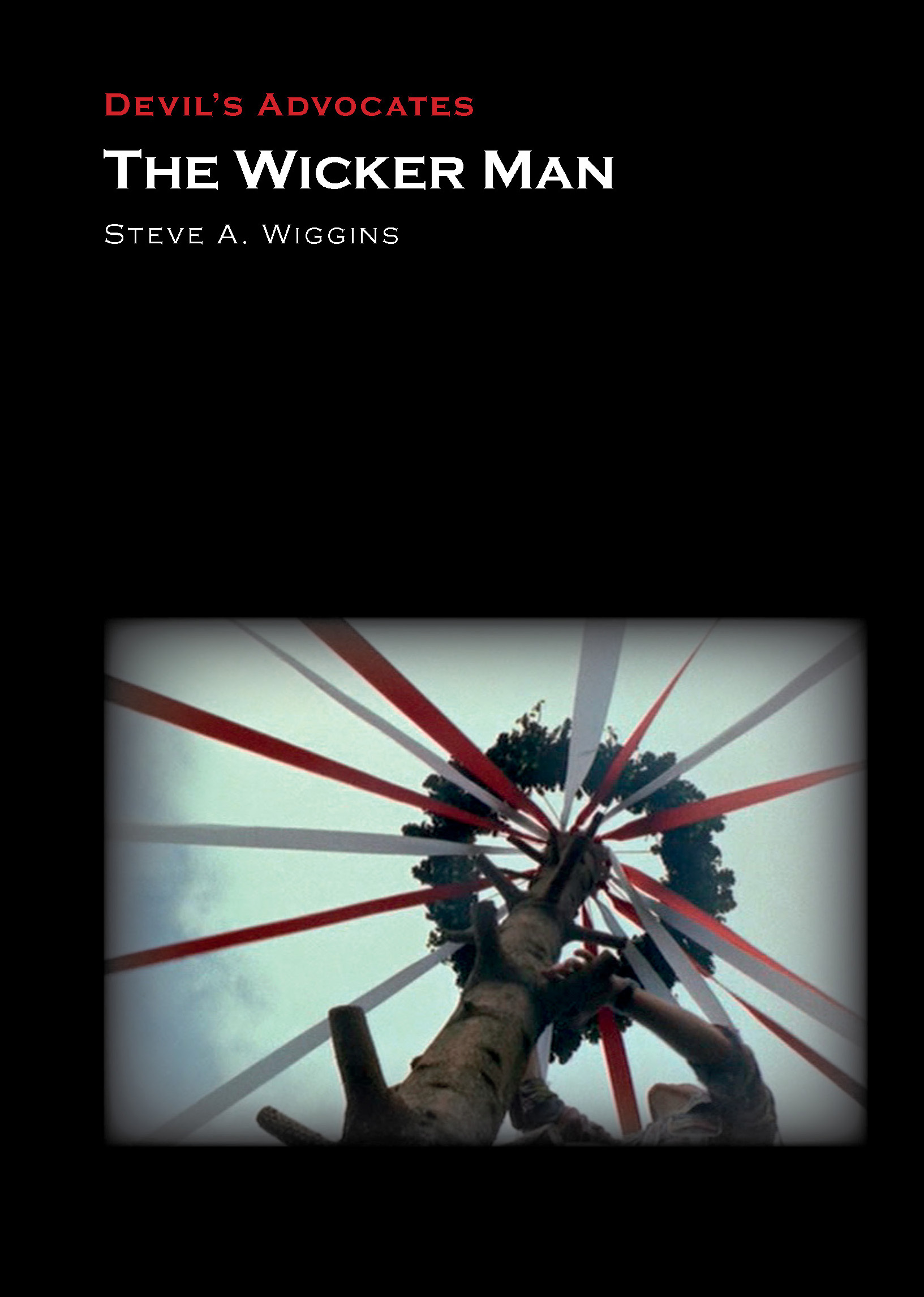
Spring came early this year.  I’m not talking about Punxsutawney Phil, but rather the fact that a leap year shifts the vernal equinox a day forward.  According to experts, spring begins today.  In The Wicker Man (it’s about oh so much more than the movie!) I discuss the seasonal holidays of the Celts.  The vernal equinox was surely known, but the beginning of spring was understood to be Imbolc, around February 2.  Since their summer began on May Day (thus the eponymous Wicker Man), the equinox was halfway through spring.  Modern paganism traces the equinox celebrations back to Ostara.  The day takes its name from the germanic goddess Ēostre, who also gave her name to Easter.  The holidays were intertwined, just as Christmas was entangled with Yule.

I find the equinoxes and solstices times for a spiritual pause.  Sure, there’s the simple astronomical fact of equality of light and dark, but there’s also something more.  Something that feels cosmic and that helps direct our destiny.  From now on there will be more light than dark.  But only for six months.  Even with Daylight Saving Time, our capture of light is of limited duration.  It makes sense to make use of the light while we have it.  Of course, those of us who rise early end up falling asleep before dark, but even so it’s starting to get lighter in the mornings again.  The equinox is a time for reflection.  And like most times for reflection, business doesn’t recognize it as a holiday.  Who ever heard of a holiday on a Tuesday?

The thing about spiritual messages is that they often come to you rather than the other way around.  At certain times, however, conditions are just right for something to break through.  It does require some listening, however.  So today, as nature holds everything in balance, try to take an unrushed moment to ponder.  For some of us it may come before the fury of work tears through our peaceful meditations, while for others it may come with the calm that five o’clock brings.  However we find it, this is a special time because this day is unusual.  It is a time of balance.  We all know how rare such things are in life in a topsy-turvy world.  The earliest flowers are already blooming around here, suggesting that as light increases so will hope greet us, if we watch for it.  The world is full of wonder, and an equinox is a time to look for it.


Bigger Picture

One of the quirks of my thought process is that I tend to look for the bigger picture.  I’ve always done this and I suspect it drives some people batty when they ask me a question and I begin to answer from what seems to be a tangent.  (I also think this is why I performed well in the classroom.)  So, when I saw the article by Eric Holloway on Mind Matters, titled “Why Is Theology the Most Important Empirical Science,” I had to take a look.  Mostly a series of bullet-points that point out some of the religiously-motivated ideas that led to scientific discoveries, the article is useful.  My penchant for the big picture goes a bit broader, however.  The entire worldview in which the scientific process was born, and thus its underlying presuppositions, are religious.  Science and religion are the dogs and cats of the thought world but I’ve seen dogs and cats live happily together.

Science has always been with us.  Early peoples weren’t benighted troglodytes.  They observed, hypothesized, drew conclusions.  Science as we understand it, however, began in the Middle Ages in Europe, drawing on observations from earlier thought in the Arab world.  The context in that Arab world was solidly Muslim.  The Middle Ages in Europe were solidly Christian.  None of this discounts the contributions of Jews to the whole, it’s merely an observation regarding the larger cultural outlook.  Many of the principles of science even today (for example, that people are categorically different from other animals) are based on those religious worldviews.  We seldom go back to question whether we might’ve gotten something fundamentally wrong.  Meanwhile, the dogs began to chase the cats.

College as a religion major involved a lot of discussions about basic presuppositions.  Then questioning them.  Not much of this went on in the classroom (Grove City was, and is, a conservative Christian school).  The wonderful thing about higher education is the bringing together of people with different outlooks.  It was those after-hours conversations that helped form my questing nature.  I’d already started asking bigger questions when I was a child, annoying my parents and, I suspect, sometimes vexing clergy.  A single human mind is too limited to grasp it all, but it seems to me to deny religion a place at the table is to leave out massive amounts of human experience.  Of course, economics, the dismal science, seems well on the way to eliminating the study of religion in higher education.  And we will have lost, if this happens, a large piece of the bigger picture.

Photo credit: NASA

Monster v. Alien

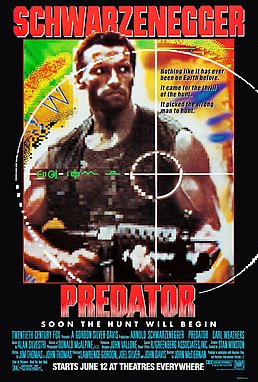
“Horror” is a faulty genre category.  Nobody quite knows where its boundaries lie.  Take Predator, for instance.  I recently watched it for the first time although I’d known about it since I was in seminary.  I am not a fan of tough-guy movies, so it took the fact that it’s sometimes coded as “horror” to get me to watch it.  Horror is often defined as a genre that has to have a monster.  Check.  We got your monster right over here.  The monster’s an alien but so is, well, Alien.  An action-adventure, sci-fish movie with a monster—is that horror?  I knew I had to see it for the sake of completion.  I’d heard of Predator vs. Alien (haven’t seen), and enough people comment on Predator that I was beginning to feel hopelessly outdated.  Or even more hopelessly outdated.

I presume the rest of the world saw it long ago, but I didn’t even know the plot.  A group of tough-guys are duped into a covert operation that allows for many explosions and bodies flying through the air.  Then they have to get out of the jungle alive because there’s an alien sportsman on the loose.  Apparently he likes earth for a good challenge since he won’t hunt somebody who’s unarmed.  He wipes out Arnold Schwarzenegger’s team—and to the film’s credit, the Black guys don’t die first.  There’s time for that, of course.  As they tromp through the jungle shirts come off because the guys are all ripped, of course.  One of the team, Billy, decides to fight without a gun so when it’s down to just Arnold and the alien the predator decides fisticuffs will settle this in a manly way.  When Schwarzenegger’s trap mortally wounds said predator, it sets off a bomb that allows for the biggest explosion of all.

So is this horror?  Hulu thinks so.  Schwarzenegger apparently thought it ended up as sci-fi horror—which is a thing.  It’s a thing because horror is a poor genre.  It’s ill-defined.  You kinda know when you’ve just seen a western or a romance.  But lots of horror films are disputed.  Critics repeatedly opine that The Shining isn’t horror.  Neither is The Exorcist.  Of course, both always wind up near the top of horror list movies.  Horror movies don’t win academy awards, as a rule.  Still, “horror” fans seek movies out that others classify as drama, or even action-adventure.  Horror is close kin with science fiction, another disputed genre.  The two are often quite distinct, however.  So, did I watch a horror movie this weekend?  I honestly can’t say.


Forewarning

The Devil’s Advocates series, as you learn from pitching and writing one, promotes alternative views on horror films.  Adrian Schober’s treatment of The Omen doesn’t disappoint.  Each time I read one of these little volumes I’m always amazed at how many ideas can be packed into such a small space.  Schober’s take on the film is that Damien’s role is left intentionally ambiguous.  There was disagreement between the screenwriter (David Seltzer) and the director (Richard Donner) on that point.  Donner wanted it to be left up to the audience whether Damien was the Antichrist or not.  Seltzer, not being a believer himself, wanted to be clear that the boy was evil.  As portrayed in the final film, however, Damien seems awfully vulnerable, in retrospect.  (I rewatched the movie before reading the book.)

I’ve seen The Omen a number of times.  It has never been my favorite movie and I actually read the book (a novelization) before I ever saw the film.  Having grown up as a fundamentalist, I believed that we were in the end times (which only really seemed likely starting in November 2016).  The movie had to wait until I was an adult (I read the novelization when the film first came out).  I can see the ambiguity now, having read this book.  There remain, however, some things difficult to explain about the presentation—how Fr. Brennan knows Katherine is pregnant and that Damien will be the cause of her miscarriage.  The extreme coincidence of both the priest and the boy having the same birthmark that looks like 666.  And that someone would go through the trouble of burying a jackal and Thorn’s actual son in an obscure Etruscan cemetery just in case the Ambassador ever got suspicious and wanted to check it out.  

Interestingly, different markets altered the ending, enhancing the ambiguity.  The final scene had originally been shot with three coffins rather than two, and that changes things, doesn’t it?  Movies are, of course, subject to interpretation.  Any form of media is.  The fact remains that many viewers flocked from theaters believing Damien was the Antichrist.  Schober’s book would give pause, however, about rushing to conclusions.  The idea for the movie was suggested initially by a marketer who was a true believer in premillennial dispensationalism (essentially the worldview of Keith Jennings in the movie), and some Catholic officials objected.  Different Christian sects have very different interpretations about the end of the world.  And this movie is subject to different interpretations.  This brief book might just change your mind.


Not a Peep

Time changes everything.  Peeping Tom, which has been on my list for some years, was castigated when it was released in 1960.  Now it’s considered a classic.  Indeed, it’s frequently discussed in books analyzing horror films, and it had a bit of influence on Alfred Hitchcock.  Films like this must be watched as period pieces, of course, but there’s so much psychology here to unpack that I wonder if it’s used in mental health courses.  Mark Lewis is a loner who inherited a spacious London house from his father.  He lets out the downstairs rooms but keeps to himself upstairs.  One of the reasons is that he realizes that he’s mentally unstable.  He’s a serial killer, in fact.  His young downstairs neighbor takes a shine to him and he reveals, via film, that his father tormented him as a child to film his fear reactions.

As an adult, Mark works in the film industry.  He also kills women while filming them to capture their fear reactions—taking his father’s work a step further.  Although shy, he is charming enough to others.  When he sees a fear reaction, however, he feels compelled to murder.  The neighbor downstairs doesn’t suspect him, but her ocularly challenged mother does.  Thinking back over it, many moments reminded me of a racier version of Hitch.  Racy because Mark picks up money on the side by taking boudoir photographs that the local news shop sells to certain customers.  This is a creepy film and perhaps the creepiest scene is where a local girl, well underage, comes into the news shop to buy a candy bar just after the owner sells an older man a pornography book.  We don’t like to admit that such things could happen.

There is so much going on in this movie that it’s clear, at least to me, why it has garnered such acclaim.  I spent the first twenty minutes or so wondering whether I should really be watching, but as I stayed with it I couldn’t look away (which is one of the very self-reflective issues that the film addresses).  The analyses I’ve read never really went into detail regarding the plot, so there were plenty of places where I wondered what would happen next.  The pacing is more in keeping with the turn of the sixties, but the mind work seems ahead of its time.  Some call it a precursor to slashers, but it doesn’t linger on the actual bloodshed (which is minimal, considering).  It does take its time to make you think while you watch.  And somehow it makes viewers complicit, it feels, with what they’ve seen.


Finding Books

This is a public service announcement to those who try to find books that aren’t issued by one of the big publishers.  I’m not shy about saying that my books all fall into that category.  One of the things I’ve noticed is that books feed out to different internet venues at an odd rate, before they’re published.  Some publishers use what they call New Book Announcements (NBAs) to get the metadata out to wholesalers, distributors, and other vendors.  Sometimes a book comes to public light in strange ways.  I’ve had my eye on a book that a friend pointed out.  I don’t know how they heard about it, but I went searching for it and found it on Barnes & Noble’s website, but not Amazon.  Well, that’s not quite true.  It is on Amazon, but not in North America.  Amazon China and Amazon Singapore have it, but you can’t find it here.  Yet.

I noticed a similar thing with The Wicker Man.  An anxious author, I kept searching for it online when I didn’t hear from the publisher.  It was first announced at German booksellers.  Eventually it got around to English-speaking sites, and eventually (it took a few months after publication), it became available in “all channels.”  Although, several websites still only list the hardback which retails for more than a dollar a page.  Now that’s inflation!  Even $40 for such a short paperback is a lot, but that’s why I’m looking for anything but an academic publisher for the next book.  But there’s a larger issue here.

Like old Joe, I sometimes can’t remember things.  I have an elaborate and Byzantine set of reminders that fit my neurological profile (mostly).  For books I want to remember to look up after they’re published (I can’t generally afford to buy them right away, so this takes advanced planning), I have an online list.  That online list is associated with a bookseller and I can’t easily add to my list until the book appears on said seller’s site.  I suppose I could write it down in my zibaldone, but will I recall that I wrote it there?  (Those little notebooks get filled up pretty quickly.)  It would just be easier if information on the internet could feed out instantaneously.  If, say, Amazon Singapore could let Amazon USA know that a book that is publishing in the United States can be listed—well, wouldn’t that make sense?  Systems are complicated.  So complex, in fact, that architects must be hired to keep them in order.  Or maybe books could be announced when they’re actually available? What? Lose the buzz?  In the meantime I’ll put a bookmark in this page and hope that I remember to look it up when the time comes.


Iron Age Angst

Browsing can lead to unexpected finds.  Such is the magic of bookstores.  Most of the books I read are recommended to me either through online sources or from people who have an inkling of my tastes.  Often such books are on the long side.  While I don’t object to really getting into a book, like most people I wonder where the time goes and a short read gives you a sense of accomplishment.  So it was that I was browsing a local bookstore for something brief.  I came across Ghost Wall by Sarah Moss.  The back cover bore no BISAC info telling the genre, but in this case the blurbs convinced me that I’d find this a rewarding read.  It’s not horror, but it has a sense of doom about it.  There may be some spoilers below but I won’t give away the ending.

Told from the point of view of Silvie, a teenage minor, it recounts a college anthropology experiment on the moors of northern England.  Silvie isn’t one of the students, but rather a high-school-aged daughter of a bus driver enamored of Iron Age Britain.  A professor has three students set to live part of the summer like Iron Agers, and Silvie’s father has brought her and her mother along to do “the women’s work.”  Yes, he’s a chauvinist and he has violent tendencies.  He clearly wishes he’d lived in “simpler” times.  I suspect what makes a novel like this work is that many of us know people like the father.  Hard, angry men.  As the story unfolds we witness his abuses and the clueless professor simply continues play-acting Iron Age.  Until they get the idea of sacrificing a victim like the bog people of northern Europe.

The style is spare, like Cormac McCarthy’s The Road.  As one of the blurbs says, there are echoes of Lord of the Flies as well.  What do groups of men get up to when unleashed from civilization?  It took me some time to figure out, since this is entirely first-person narrative, that there are only three students—one woman and two men.  With the chaperones it’s two men and a woman.  This uneven power structure raises its own questions.  Meanwhile Silvie is coming of age, beginning to realize her own sexual awakening.  Her best role model is the co-ed among the group since her working-class mother lives in fear of her husband.  The story is compelling and a bit scary.  It’s also a rewarding read that won’t take a month or more to finish.