Not Bram

I guess I wasn’t sure if Stoker was horror or not.  It’s similar to Hitchcock in many ways, and some suggest it’s a “thriller” rather than horror proper.  One of the refrains of this blog is that horror is a poor genre designation.  Too many other genres bleed into it and it grows into several others also.  Still, Stoker was conceived of as a horror movie and it fits that, generally.  The title made me think of Bram, the most famous bearer of that surname, at least in my mind.  I’m pretty sure that others had the same impression, since some websites take pains to mention that this is not a vampire story.  It’s not.  It is, however, a story about a psychopath or two.  But it generally gets compared to Shadow of a Doubt rather than Psycho.  I’ll spoil things below.
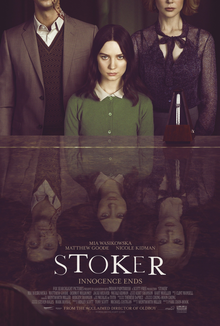
On India Stoker’s birthday, the family receives the news that her father has died.  She was very close to her father and distant from her mother. During his funeral she notices someone watching from afar.  It’s an uncle she didn’t know existed and who’s decided to live with them.  This uncle, we learn, was released from an asylum.  As a child he’d killed his younger brother.  After arriving at the Stoker mansion, people who recognize him disappear.  India was trained as a hunter by her father and senses something is wrong.  The uncle meanwhile seduces her mother so she doesn’t see his obvious faults.  (He’s a charming psychopath.)  He’s goal is to have his niece, India.

There’s a creepy atmosphere throughout, and it’s difficult to determine what India’s end game is.  She’s able to take care of herself, mostly.  She does rely on her uncle to save her, though.  India discovers that he’d been institutionalized at the fictitious Crawford Institute, interestingly in Crawford, Pennsylvania, not far from where I grew up.  Instead of accepting his plans for her, however, she charts her own violent course.  This is an odd film as far as determining character motivations go.  It’s not really clear what India or her mother really wants.  The uncle’s straightforward about it, but he’s a serial killer.  It’s difficult to know upon whom to cast your sympathies.  A movie about family dynamics as much as about horror (a character kills both his brothers, his aunt, and a housekeeper that he feels is in the way), it has no clear message.  And there are no vampires anywhere to be seen.


Drac Ops

Just don’t ask, okay?  Like most things in my life, I discovered Dr. McNinja way past when it was popular.  Who knows?  Maybe it’s still popular.  I’m not the best judge of that kind of thing.  I’ve read a few graphic novels in recent years, generally when someone lends them to me, or when a movie I like is based on them.  Now, the thing about Dr. McNinja is that it started out as a webcomic.  People younger and more with it than me have shown me other people younger and more with it than me making a good living web cartooning.  They don’t have 9-2-5s and they live, going by their videos, in nicer houses than I do.  So when someone suggested I look up Dr. McNinja I found an old-looking website saying it was no longer online.  The author had published it in book form.

Even though I work in publishing, I find it difficult to tell if a book is out of print.  We live in that strange purgatory where IP (intellectual property) can be kept on life support until copyright expires without ever really having to print more books when they run out of stock.  They’re never truly out of print.  I’m guessing that’s what happened when on Amazon you see that only used copies are available.  So which McNinja to select?  The one with a cover that riffs off Plan 9 from Outer Space, of course.  That movie keeps coming back into my life.  It’s one of Fox Mulder’s favorites on the X-Files.  In any case, I was hardly prepared for the amazingly creative imagination that Christopher Hastings has.  If you start with Operation Dracula! From Outer Space you’re entering the story in media res, as the academics say.

I confess to liking Teenage Mutant Ninja Turtles when it first came out.  These days the exoticism of eastern Asia is frowned upon by academics, but it’s still there in Christopher Nolan’s Batman Begins, so why not?  In case you’re wondering, there is a reason behind all this.  I can’t tell you at the moment, however.  I can say that if you’re looking for a wild, wild story with lots of unexpected twists and turns, Dr. McNinja will not fail to win approbation.  I’m dithering on whether to go back and start from the beginning—these print volumes are becoming collectors’ items, it seems.  And no matter how much fun it is, reading graphic novels always feels like cheating to me.


Using Brains

I’m old enough to know better.  Here’s a thought.  I recently saw a headline that suggested human brains filter out things like ESP because brains evolved to help us survive.  No matter what you believe about ESP, the idea got me to thinking.  We often act as if our brains are able to determine the Truth (that capital is intentional).  At the same time we don’t understand what consciousness is.  We know that other animals have brains and that the evolution of said organ is to help individuals survive to reproduce.  Some animal species end their existence at that point, but others linger on to wonder.  And I’m wondering if our brains are filters.  Stick with me here: we know that there are stimuli that we can’t perceive that other brains can.  For example, it seems that migrating birds can perceive magnetic fields.  Even if they can’t there are magnetic fields that we perceive only through their effects on objects.  Our brains have no direct access.

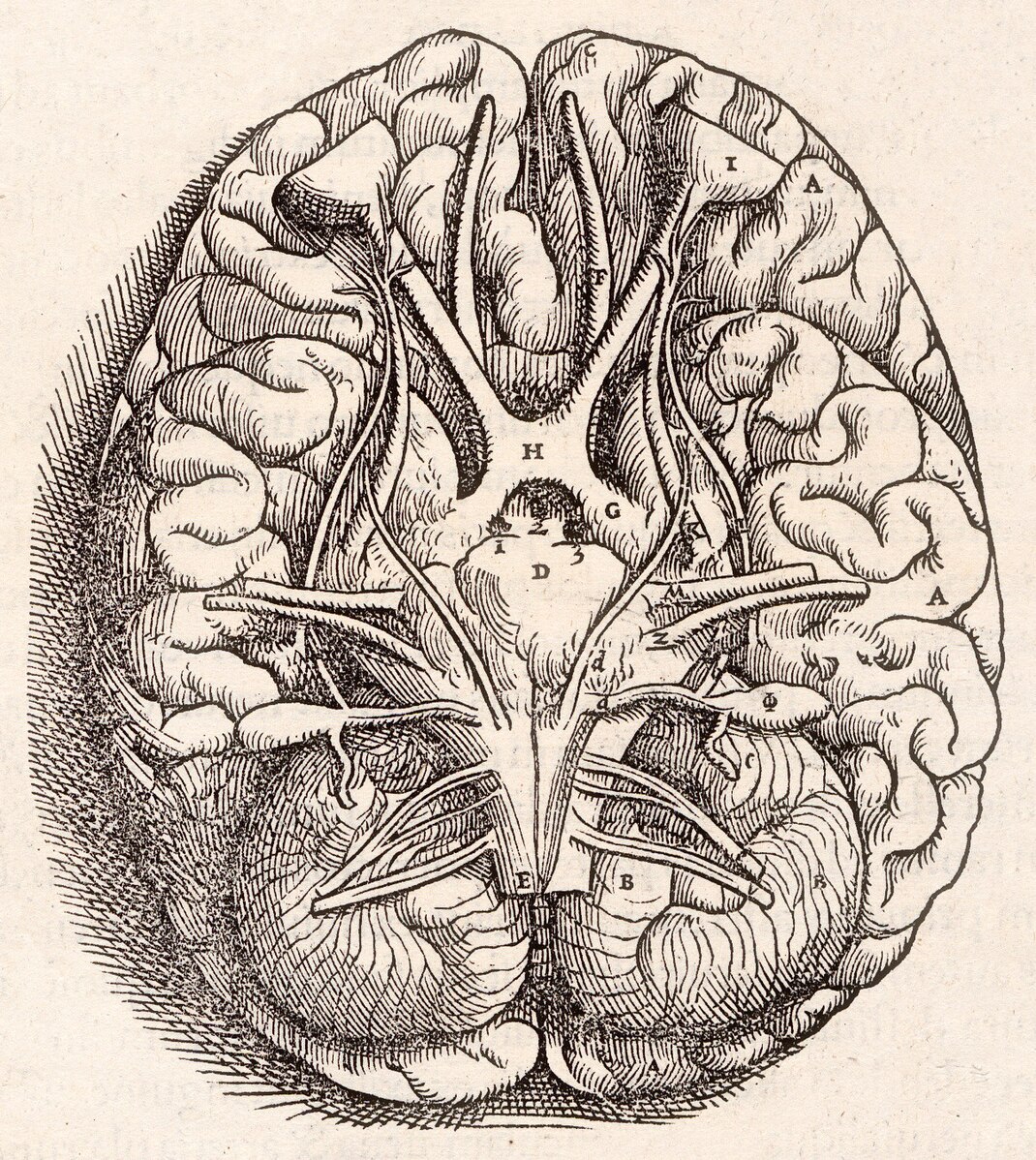
Image credit: Andreas Vesalius‘ Fabrica, showing the Base Of The Brain, by user Ancheta Wis

Here’s where it gets spooky.  If our brains filter out things that may hamper us in survival, what if they overzealously teach us not to perceive things that actually exist?  We’re somewhat limited by our “five” senses, no doubt.  We get along okay.  But what of those people who see things that others don’t?  We tend to medicate them or lock them away, but what if their brains have learned how to shut off part of the filter?  Having written a book about demons, naturally they come to mind as a test case.  Or, if you prefer, ghosts.  We tell our children these things aren’t real.  Trust the filter.  Get on with life in “the real world,” right, Cypher?

I didn’t have time to read the article, but I’d experienced a perspective shift.  If our brains are all about gathering information (and in part they clearly are), that’s one thing.  If they are actively filtering things out, well, that’s quite another.  We laud the imagination of children until they become “old enough to know better.”  Do we teach them to shut out what they can actually see, or sense, in order to accept the inevitable, material, adult world?  This idea has startling implications.  As we plunge ahead inventing AI to do our thinking for us, perhaps we’ve left something even more fundamental behind.  Have we lost interest in the Truth?  We may not be able to access it directly, but I wonder if we’re taught to give up without even trying.


Seeing in Darko

Having seen it I have to wonder why I waited so long.  Part of it was timing, of course.  I was still teaching at Nashotah House when Donnie Darko came out, and I didn’t watch as many movies then.  My loss of that job started me on my horror-watching spree, but Donnie Darko is more than horror.  In fact, it’s usually labeled a thriller instead.  Another reason I avoided it is, alas, the title.  It’s actually the name of the protagonist, and one of the other characters in the movie remarks that it sounds like a superhero name rather than a regular person.  What’s it about?  Well, that’s where it gets interesting.  Donnie has mental health issues, but those issues are tied in with time travel and philosophical discussions about the existence of God.  The high school Donnie attends, although not explicitly stated, seems to be Catholic but there aren’t priests and nuns about, and one of the teachers is seemingly evangelical.

Donnie has trouble distinguishing reality.  Instead of allowing the audience to get away with labeling him easily, the question of reality itself is left unanswered.  The movie is deep like Brazil or The Matrix, and is often considered one of the greatest independent films of all time.  It’s the story of Donnie’s October 1988.  He sleepwalks and sees a guy in a bunny costume who tells him the world will end in 28 days.  Of course he’s medicated and sent to see a psychologist, but what the guy in the bunny costume tells him ends up coming true.  The story is intricate and doesn’t bear a brief synopsis.  It is a movie that will make you think.  It’s become a cult film and I think I’ll be joining that crowd on this one.

Films that manage to put philosophical reflection in the spotlight are rare.  Even more uncommon are those that do so with high production values and convincing acting.  Movies that do this aren’t often cheerful—philosophers in general don’t tend to be a jovial lot (some are fun, of course, but they’re not the majority).  Thinking is serious work, even if those who do it aren’t really paid for their efforts.  Donnie Darko is a movie that will make you think.  Is it horror?  Some classify it so.  Others say sci-fi, but it didn’t really seem like that to me.  In fact, it’s very difficult to classify at all.  Many of the best movies are that way, in my experience.


One Another

Like much of the other information that I’ve managed to pick up in these six decades of wandering the planet, my knowledge of horror is self-taught.  In truth, I’m an eclectic reader—my various, periodic obsessions generally stem from books I’m writing.  For my unwinding time, however, horror stories seem to do the trick.  Nobody I know in person reads horror, so my recommendations are generally the results of other books I read.  That’s how I found Thomas Tryon’s The Other.  Although I’d only learned of it recently, it has been a classic in the field for many decades.  After having read it, I can see why.  And unlike many fiction works with an afterword, this edition has one worth reading.  Maybe you’re unfamiliar with the novel?  If so, in brief, it’s about twins.  It’s about twins.

Identical twins.  Holland and Niles Perry were born over the cusp of midnight, giving them different birthdays while still being the same age.  Unlike stereotypical identical twins, however, Holland is evil and Niles is good.  As the novel unfolds it contains some twists that, if like me you haven’t heard the story, really do work.  They live in a small town in Connecticut with their widowed mother, older sister and brother-in-law, maternal grandmother, and a couple of domestics.  An aunt and uncle, along with a cousin, settle in.  (It’s a large house.)  Family dynamics are strange and the locals grow increasingly impatient with Holland’s antics.  The Perry family is, however, long established and well respected.

Doesn’t sound very scary, does it?  That’s the genius of the work.  It’s a slow burn but when the fuse reaches the powder it leaves you trembling.  Nobody taught me how to find and read horror.  I’m still pretty much a novice and it seems that novels these days tend to have weight problems.  I was glad to find The Other wasn’t excessively long.  It shows that literary horror is possible as well.  Like Shirley Jackson, Tryon received acclaim for his work.  (And like Jackson, his novel doesn’t balloon out to over four hundred pages—something of a rarity these days.)  I guess I’m just a bit surprised it took so long for me to find out about this one.  I don’t want to give any spoilers because this is a beautifully constructed novel and knowing what happens might deter other readers.  I wouldn’t want to do such a disservice to a book I wish I’d known about when I was younger.


Strangers

Okay, so I like to think that I’m a reasonably intelligent person.  I can drive a car.  I’ve read over two thousand books.  I have been blogging for nearly a decade and a half.  Why can’t I figure out this password thing?  My brother has a blog on WordPress too.  His posts are quite different than mine, but I always like to read them since we think a lot alike.  Anyway, I wanted to leave a comment on a recent post he wrote.  You’d think that’d be easy since this blog is also hosted on WordPress.  (I’m the one who suggested WordPress to him.)  When I went to post the comment I received a dialogue box basically asking “and who might you be?”  When I gave my web credentials it wanted a password, but it wasn’t clear which password it wanted.

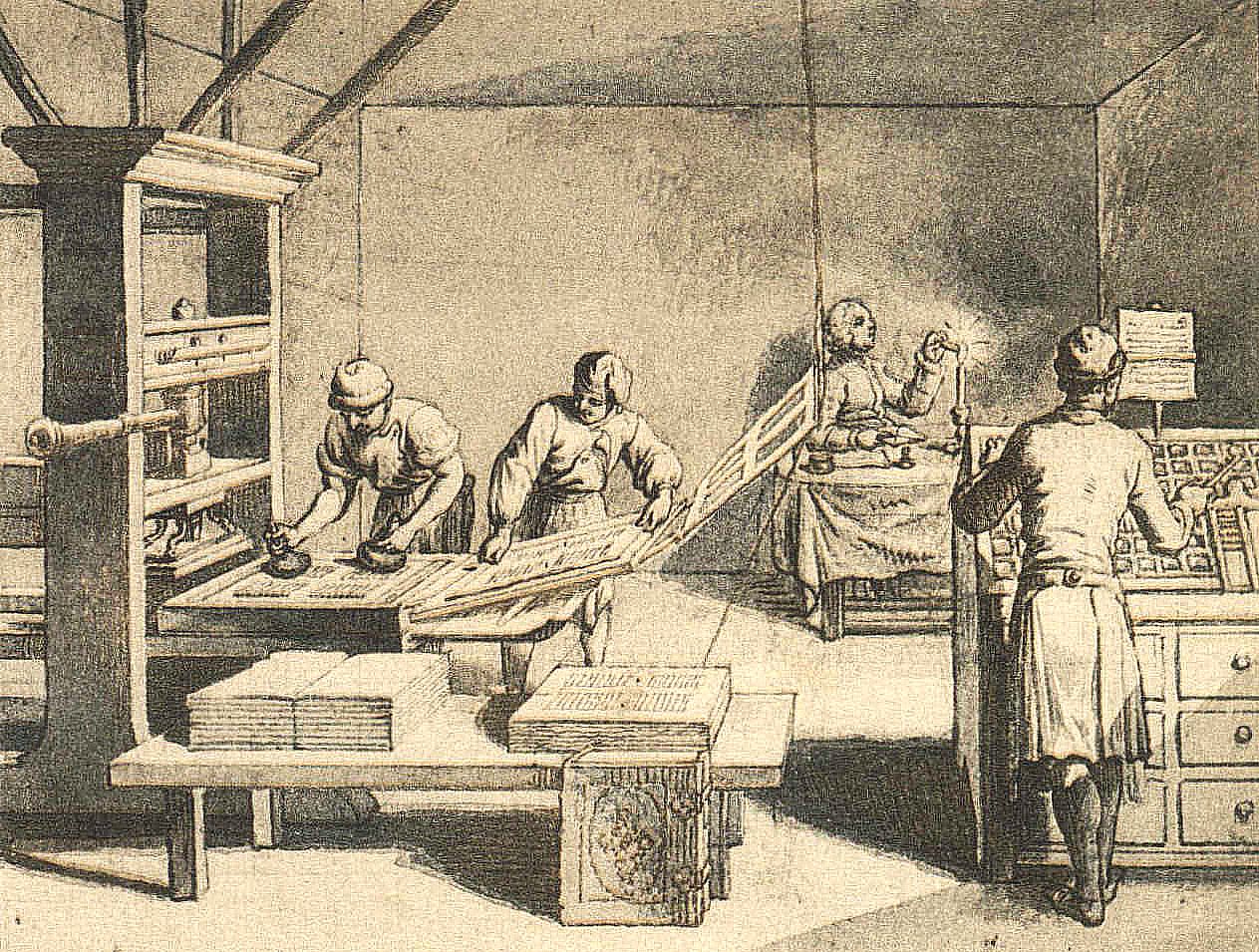
An actual word press; image credit: DANIEL CHODOWIECKI 62 bisher unveröffentlichte Handzeichnungen zu dem Elementarwerk von Johann Bernhard Basedow. Mit einem Vorworte von Max von Boehn. Voigtländer-Tetzner, Frankfurt am Main 1922, public domain via Wikimedia Commons

Like most human beings alive today I have more passwords than atoms in a typical tardigrade.  With a brain over sixty, trying to recollect them all in an instant, well, let’s just say that ain’t happenin’.  As I laboriously lumber through all relevant passwords (I’m pretty sure they don’t want all the unique ones I use at work, in addition to my private accounts), it rejects each and every one.  You see, WordPress is funny.  My own account, now 14 years old—maybe that’s the problem—those teenage years!—doesn’t recognize me at times.  Indeed, on my own blog (and I have a paying account) it sometimes blinks its virtual eyes and says, “and who might you be?”  I try not to take this personally.  I mean, we’ve only known each other for years.  And all I want to do is put a supportive comment on my brother’s blog—we share the same surname, and even the same web host.  What could be so difficult about that?

I’m pretty much logged into my WordPress account constantly.  I post every day.  There’s over 5,300 mini-essays of about 400 words.  That’s over 2 million words.  Is this relationship really so one-sided?  I’m trying hard not to let my aporripsophobia get the best of me here.  Just tell me which password you want!  And, if I can use it to log into my own WordPress account, why won’t it work for the WordPress accounts of family and friends when I want to make a comment?  We’ve been together for so long, do you really not know me any better than this?  Hey, I think I need a private moment with WordPress—you can check out my brother’s blog while you wait…


Mind Echoes

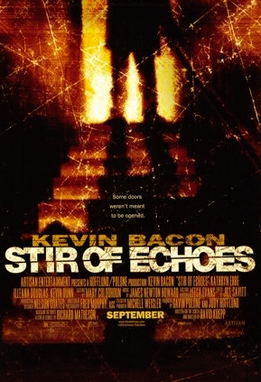
One of the things that must be frustrating about making movies is that so much competition exists.  Even when you hit on a great idea, such as using a Richard Matheson novel for a story basis, others might be producing something similar.  This isn’t unique to movies, of course.  Some of us have had the experience while writing books.  For those of us who watch movies online, rather than in theaters, the timing differential can still warp perspectives.  I’d not heard of Stir of Echoes until I stumbled onto a website that lists horror movies that have a little something extra.  While watching it I couldn’t help but think of The Sixth Sense, which I also saw at home, but quite a few years earlier than Stir of Echoes.  The acting in the latter is quite good.  The haunted kid pulls this off effectively.  And Kevin Bacon and Kathryn Erbe do a great job as parents (actor-wise).  Spoilers follow.

If you’ve intuited that the child sees dead people, you’re not far off.  It’s actually only one dead person and it’s not a Shyamalanian counsellor.  But the spooky part is his dad begins to see them too, after he’s been hypnotized by his sister-in-law, who’s an amateur.  At its heart the story follows the traditional trope of the undiscovered murder.  It does a good job of hiding the perpetrators until near the end.  The build-up is good also, with Bacon portraying Roy Neary-like obsession (interestingly, they’re in similar professions) quite well.  

The scary part, for me, was the sense that you’re not in control of your own mind.  There’s perhaps just a little too much possibility here.  We tend to think we own our minds, but what if they’re really just on loan?  I remember reading, as a high schooler, that religious people are difficult to hypnotize.  Hypnosis is still not well understood.  The larger fish in the pond is consciousness itself, which we really can’t even define.  We do know that memories are altered with time, and we can demonstrate this to ourselves by rewatching an old movie and seeing what we got wrong.  I suspect that’s why Stir of Echoes is so effective as a horror film—taking us into the realm of mind exposes us to so much that we really don’t understand.  And since ghosts seem to be pretty believable, well, the combination works.  Stir of Echoes is unsettling and a cut above much of what’s available for free streaming.  So if you’re in the mood for a ghost story, this might just fit the bill.


Not so E-Z

Paying for someone else’s mistake.  That’s what technocracy brings.  We’ve used E-Z Pass for years.  We first got initiated in Pennsylvania although we lived in New Jersey at the time.  In those days we were taking lots of trips from New Jersey to upstate New York, for which you generally have to drive through Pennsylvania.  Hey, we’re a tri-state area.  One of the ironies my wife and I noticed is that you have to pay tolls to get out of New Jersey, but not to get in.  That’s not a scientifically-verified fact, just a pedestrian (or vehicular) observation.  Since I’ve got more things on my mind than I know what to do with, we set the account to auto-replenish.  When funds get low, it automatically refills.  Nifty, huh?!

For some reason I can’t even remember the card on which this system was based had to be reissued.  Like most people I can’t remember all the auto-renews on any given card, so when I get a notice that there’s a problem, I update immediately.  So let it be with E-Z Pass.  See, there—wasn’t that easy?  But apparently not.  The day after I updated (and given that transactions are instantaneous these days, what, me worry?) we happened to drive to New Jersey.  My wife had four work-related trips to our neighboring state over the next two weeks.  Then the violations started arriving.  From New Jersey E-Z Pass.  I’d spoken with a rep from Pennsylvania E-Z Pass the day before and he assured me everything was set up correctly.  But New Jersey plays hardball.  They won’t even talk to you until you’ve received the violations by mail—weeks after the fact.

Any violation comes with a $30 surcharge.  I needed to speak to a person since NJ’s E-Z Pass menu doesn’t offer an option for “If our system has screwed up and your being charged for it, please press 666.”  The message immediately says there will be a forty-minute wait to speak with a representative (PA E-Z Pass picks up on the first ring, just sayin’).  Forty-minutes of muzak turned into an hour.  My phone died.  I recharged and tried again.  Another hour passed.  Finally I called at 8 a.m. the next morning—there’s still a forty-minute wait, but it’s only forty minutes.  I finally spoke with a truculent rep (if you’re already out of sorts by 8:40 a.m. perhaps it’s time to look for a different job) who told me I had to set up an account for NJ E-Z Pass—they don’t have truck with PA E-Z Pass—and check it seven-to-ten business days later to see if the charges had cleared.  E-Z Pass really isn’t that easy.  Keeping a pocket full of quarters might save you time in the long run.


Heavy Machinery

Funny how some things just stick in your mind.  And then come back at odd times.  Killdozer was a television movie from 1974.  I must’ve watched it pretty close to when it first aired.  Why it came back to me half a century later I just don’t know.  I haven’t been around any heavy earth-moving equipment lately, nor have inanimate objects been threatening me.  When I found it on a free (albeit with commercials, but hey, the original had commercials, so it’s a full circle kind of phenomenon) streaming service, I figured why not?  I was really expecting something cheesy, like I would’ve liked at eleven or so.  It wasn’t really that bad.  There’s actual characterization and the acting is believable.  Only the special effects of the meteorite and the blue glow were obviously low budget.  But you might not be familiar with the D9, so let’s go.

An uninhabited island off the coast of Africa.  Six guys on a construction job—building an airstrip for a petroleum company.  The supply ship’s a few days away and when the Caterpillar D9 hits the meteorite, it becomes a murderous machine, like Stephen King’s Christine.  You can outrun a bulldozer, for a while, anyway.  But if it never runs out of fuel, and you’re trapped on an island, your chances aren’t good.  They’re even worse if the thing is sentient and knows what you’re planning to do.  Six men were sent to the island, and only two make it back.  You get the picture.

As a child I had no idea who Theodore Sturgeon was.  When I saw that this was based on one of his stories, I had to ponder a bit.  Sturgeon wrote several of the original Star Trek series episodes.  His most famous stand-alone story seems to be Killdozer.  In fact, it’s become a cult classic.  I don’t have many friends, so I’m not always aware of what’s in during any given decade.  I think kids at school were talking about Killdozer, but nobody has really uttered that word in my hearing since Gerald Ford was president.  So if you don’t mind commercials, and you have a sleepy spare hour, some of us would be interested to hear what you think about this movie.  The sense of isolation and people being killed by something they construct to be basically indestructible struck me as a lesson worth pondering.  And I’ll continue to try avoiding heavy earth-moving equipment, just in case.


For the Music

Believe me, I’ve tried.  I took a year of piano lessons but just couldn’t get it.  I married a musician.  I tried to learn guitar.  (I would still play with it, but I broke a string last time I tried to tune it and who has time to get to a music store where it can be restrung?)  I can’t sing—I’ve never been trained and I just don’t seem to have the voice for it.  (In fact, since I no longer teach those close to me say I speak so softly that it’s a strain to hear me.)  But the fact is I love music.  That’s why I don’t listen to it as background.  If there’s music playing, that I like, I find it difficult to concentrate on anything else.  It goes directly to my brain, it seems.

My memory is such that if a piece of music is too familiar I sometimes just don’t want to hear it.  I’m also out of touch with contemporary music.  I have strong tastes, and not too much appeals to me.  When something does, it’s transcendent.  It’s like I’ve fused with the performers.  It’s mystical and amazing.  Growing up, we couldn’t afford much in the way of records.  (I’m sure I need not say anything about cassette or 8-track tapes.)  I listened to the radio with my brothers from time to time, and enjoyed what we heard.  I secretly enjoyed what I heard coming from my older brother’s room.  Left to my own devices, however, I tend to pick up a book and I can’t listen to music and read at the same time.  I know that this is my own neurological issue, but I’m letting you in because anything transcendent is worth sharing.  

Photo by Jefferson Santos on Unsplash

Although the quality isn’t as good, services such as Spotify and Amazon Music Unlimited have slowly introduced me to music of the nineties and later.  Why the nineties?  That’s when I began teaching and my spare time was spent researching (reading) and I had little time for other diversions.  You see, music may just be what it’s all about.  It’s being absorbed and enjoying every second of it.  Humans are visually oriented, but when we focus on sounds something happens to us.  I can be in a crowded store and stop dead right in the middle of the aisle if one of my special songs comes on in the background.  I have to stand and listen, shopping forgotten.  Transcendent moments are few.  If we were in transport all the time I fear it would become ordinary.  And such things are worth pondering on Groundhog Day.


Out There

While Amazon Prime includes a few A-list horror movies, those that it does I’ve already watched.  Since I can’t afford to pay for this habit, I watch what’s free.  That brought me to the horror comedy There’s Nothing out There.  Written and directed by a twenty-year-old guy, it’s kind of what you might expect.  Its main claim to fame, apart from being a low-budget monster flick, is that it anticipates Wes Craven’s classic Scream.   The latter is famous for being so self-aware.  One of the characters keeps telling the others what happens in horror films and, of course, those things happen.  Although There’s Nothing out There is silly, one of the characters does exactly that.  In the funniest moment in the movie he looks directly at the camera and says “It’s a distinct possibility” in response to one of the girls asking “So you’re saying we’re in a movie?”  Craven didn’t borrow that, but then, Scream is a landmark.

So what’s it about?  There are seven young people who head to a cabin in the woods.  Actually, it’s a regular house, and quite a nice one at that.  The three couples are there for sex but the single guy (Mike) is the horror expert and gets on everyone’s nerves.  He’s right, of course, that there is a monster on the loose.  A slimy green thing with a huge mouth full of pointy teeth, has fallen from space into the neighborhood and it slimes the guys, digesting them, and tries to mate with thee girls.  And if it shoots lasers into your eyes you become its servant, helping out with its mission.  The kids are picked off, of course, with Mike surviving along with one of the couples.  Before they can stop the monster a plumber also gets eaten.

Horror comedy is a strange genre.  It tends to work because there are elements of humor in much of horror.  It’s not all blood and gore—the best examples use that sparingly, in any case.  And horror comedy doesn’t really frighten since it’s pretty clear that it’s being played for laughs.  Sometimes such movies venture into the bad realm—there’s a reason some movies are free on Amazon Prime—but at times they actually have quite a bit to offer.  There’s nothing scary about There’s Nothing out There.  It’s the kind of movie that tends to grow into a cult classic over the years, however.  And while it’s not A-list material, it’s still worth watching for free.


In Praise of Libraries

It felt like a rare, and momentous moment in a young writer’s life.  While working at Routledge I happened to notice that the New York Public Library did not have a copy of A Reassessment of Asherah in their catalogue.  The first edition was published in Germany, so I wasn’t surprised that it was not there.  Gorgias Press, however, had published a second edition and few people were citing it.  I contacted the office on Fifth Avenue and offered to donate a copy.  A librarian contacted me and we set up a time.  I went between the stone lions (Patience and Fortitude by name), met my contact, and handed my work over without ceremony.  He seemed genuinely glad to have the book and I felt like I’d made a small contribution to a big city.

When I need a pick-me-up I look at WorldCat.  WorldCat is a conglomeration of library catalogues where you can find just about any book, including obscure ones, such as mine.  I recently hopped on to see how many libraries had Holy Horror.  (The answer is 90.)  While there I decided to check my others.  Nightmares with the Bible registered 68.  These numbers aren’t bad considering neither publisher markets the books and they’re priced too high.  The Wicker Man is still new and is only in 42.  What surprised me was when I looked back.  A Reassessment of Asherah is in 305 (total for both editions, one being in the New York Public Library).  What really surprised me was Weathering the Psalms, which 324 libraries claim.  Since it’s priced under $30, maybe there is something to the idea people will buy books if they can afford them.  As an editor I know that sales of monograph over 300 are considered successful.  Two of my books qualify.

Publishers don’t share sales information.  I can look up those at my current publisher, and I can check some on Nielsen’s BookScan (now called NDP BookScan), the service publishers use to get an idea of other publishers’ sales.  That’s the same Nielsen that does television ratings, by the way.  Searching my own titles there is too depressing, so I stick to library catalogues.  Libraries are feel-good places.  (I couldn’t help but notice that Princeton has all my books—thank you, Tigers!  The seminary has my first two, but the university has my books on horror films.)  I can just feel all the ideas in the air.  And I’m humbled to have contributed to them in a way, no matter how small.


Not All Vampires

Early film research owes great debt to YouTube.  Many historic and significant films cannot be purchased or watched anywhere else.  Even in this uber-greedy late capitalist era, few (if any) are willing to sell that for which many would pay.  This is brought on by my learning about Alice Ida Antoinette Guy-Blaché, also known as Alice Guy.  Guy was the first female film director.  She left a substantial body of work and is credited with being the maker of the first narrative-based film in history.  If you’ve not heard of her, you’re not alone.  Even during her lifetime she wondered why she was never recognized for her cinematographic achievements, incredible though they were.  She filmed one of the first adaptations of an Edgar Allan Poe story known, The Pit and the Pendulum (1913).  This one is partially lost—many early films are.

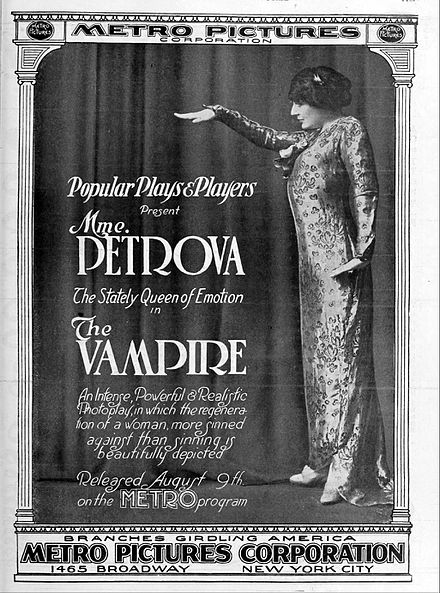
I wanted to see her 1915 film, The Vampire.  Given the date, you will have correctly guessed that it’s a silent movie.  It still survives and the only place it can apparently be found is on YouTube.  Before you run off and watch it, be aware that it’s not about a literal vampire, but rather “a woman of the vampire type.”  The current term is “vamp.”  The movie, which takes a feminist approach, is framed around Rudyard Kipling’s poem, “The Vampire.”  It runs for about an hour, which was pushing the envelope in those early days of cinema.  It tells the story of a happy, wealthy family broken apart by a “vamp.”  The husband receives a government appointment in Europe and his wife and daughter can’t follow for a month.  On the way over by ship, the vampire seduces him, after compelling her current love to shoot himself.  This isn’t a comedy.

The film doesn’t end happily—the statesman, aging prematurely, just can’t break the vampire’s hold on him.  Still, friends and family urge his wife to wait for him because divorce is wrong.  The film lingers on the suffering of the wife and on how much his young daughter misses her father.  The film quality is quite good for the time, although the YouTube version has been digitally restored.  So this isn’t a horror film, but watching it is a tribute to a woman who influenced filmmaking and then was summarily forgotten, largely because of her gender.  Alice Guy was the first woman to run her own movie studio.  Sadly, her husband left her and their children just three years after The Vampire.  Shortly after that Guy’s filmmaking career was over.  Fortunately for history, Guy has been rediscovered and has been receiving credit for her pioneering work.  Although The Vampire was about a dangerous woman, the reality is, and was, that patriarchy continues to ruin women’s lives.


First Stories

I won’t say more than that her first name was Tina.  She lived next door to us in the earliest boyhood home I can remember.  She was a few years older than my brothers and me and, according to my mother, grew into quite the delinquent.  She ended up in jail, I’m told.  Still, even in a childhood full of scarring memories, I remember Tina as being the first person who told me a scary story.  Funny how these things stick with you.  We lived in Franklin, Pennsylvania, a town on the edge of the woods.  Indeed, Venango County is largely wooded and populated by some of the most avid hunters I’ve ever seen.  There were woods across the street from our house, climbing one of those ubiquitous hills that make the area so beautiful.

There was a man in those woods, Tina told us, who’d been kidnapping small boys and cutting out their hearts.  She was telling it as the truth and well over half a century later I remember the fear that story instilled in me.  Of course, Mom told her to stop telling us scary stories.  I was only five or six at the time.  Maybe four.  My path to watching horror movies wasn’t straightforward.  We were a religious family, but taking care of three young boys and an ailing mother with no husband around eats up all your time.  Mom was content to let the television babysit us in the next room at times.  And as late monster boomers, we watched monster movies on Saturday afternoons.  They gave me a cozy feeling.  Things could be worse than not having a father.  Much worse.

After high school I gave up monsters for the Gospel.  Went to college to become a preacher.  I ended up teaching in a seminary and didn’t want my daughter to grow up scared, like I had done.  Then my world collapsed.  Fundamentalists fired me from my first and last full-time teaching position.  I dealt with it by watching horror films.  Perhaps I was reverting to childhood coping strategies.  Over the years, however, I never forgot that story that Tina told us when my brothers and I were little.  It is a scary world out there, and you’ve got to learn that one way or another.  Many people don’t understand my fascination with horror.  In times of trouble, however, we go back to those self-soothing practices that we associate with good feelings.  For some of us it was watching monster movies on Saturday afternoons and knowing things could be worse.  


Nun too Soon

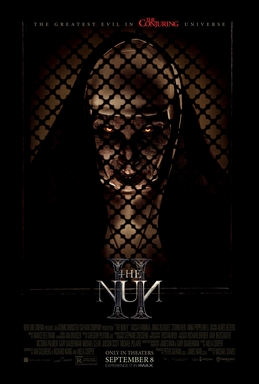
Following a horror franchise from the beginning is a rarity.  At least it is for me.  Now that I’ve seen The Nun II, I’m caught up on the Conjuring universe, for now.  I’ve written an article, still awaiting publication, on the Catholicism in this cinematic universe, and The Nun II has me wondering: how hard is it to find out the basics about Catholicism?  The movie is okay for big-budget horror, but not great.  The Catholicism in it feels like it’s imagined by writers who speculate on what it might be without ever, say, attending a mass to find out.  And the demon Valak isn’t exactly rank and file either.  The idea of using St. Lucy’s eyes as a relic was, however, pretty creepy.

So, after The Nun, Sr. Irene has gone to a convent in Italy.  A series of bizarre clerical deaths sweeps across Europe and all the Vatican can think to do is send the one young nun who’s faced this demon before.  No priest this time because Fr. Burke is dead, rather laconically stated.  Sister Debra sneaks along and the two nuns find themselves facing a demon that immolates priests because it can’t find a relic it wants that will make it even more powerful—the eyes of St. Lucy.  Said eyes are buried in a ruined chapel in a Catholic girls’ school in Aix-en-Provence.  This is the school where Frenchie (from The Nun) now works as a handyman.  We all know he was somehow possessed at the end of that film.  The girls’ school used to be a winery and Valak is defeated when the nuns consecrate a pool of wine that banishes the demon.

At this point in time, the Conjuring universe has grossed over two billion dollars.  All of the films are explicitly religion-based horror.  Putatively in a Catholic setting, they feel like Protestants trying to guess what Catholicism must be like.  At least they feel that way to me.  The Nun sequence in particular, has demons responding to defenses that would not, in a Catholic world, work.  As much as I may disagree on the theology, nuns can’t consecrate wine.  And it turns out that Sr. Irene is a descendant of St. Lucy, one of the virgin martyrs.  Although that title is sometimes given as an honorific, it does generally mean that such saints had no progeny.  Death by thurible is fairly clever, though.  Like all the films of the franchise, The Nun II is worth watching, but it fails to convince on the religion front.  It just doesn’t feel Catholic.