Reading Algorithm

I appreciate help.  I really do.  It’s easy to feel overwhelmed in this world and others offering to help out are welcome.  But you do have to wonder about algorithms.  They seem to lack human sympathy.  And perhaps the ability to count.  Every year I enter the Goodreads Reading Challenge.  I would read without it, of course, but having that extra pressure doesn’t hurt.  Because of my convoluted mental makeup, I try to get things I have to do done early.  That means I want to finish my reading challenge before I have to.  In my commuting days I read about 100 books per year.  When I stopped commuting I had to bring that number down by about half—frankly, I don’t know where the time went, but I do spend more awake time with my family, which is good.

So I’ve settled on setting my Goodreads goals at about 50-60 books per year.  I often exceed it, depending on how many big books, or ponderous academic tomes I read.  Lately I’ve set the goal at 55, which is just over a book a week.  That seems doable to me.  This year I achieved that goal in September, but that doesn’t stop me from reading, nosiree!  I’m currently somewhere near the 60 book mark and I’ll keep going.  Now the help I was referring to is this: Goodreads typically sends an encouraging email in October suggesting how to meet your goal.  My message showed, via tracker, that I’d already met my goal, but telling me I could still meet it with these suggested books.
The books suggested are fine, I’m sure.  And that this message was sent via some formula that I have no hope of being able to comprehend, I’m also sure.  An algorithm, however, doesn’t feel for you.  I’m relieved to have the goal behind me and to continue pressing on regardless.  I could use some help in getting the lawn mowed, should an algorithm like to apply.  I particularly resent having to do so while wearing a jacket and stocking cap.  It’s time for the grass to be settling down for its year-end nap, isn’t it?  Or maybe an algorithm could do my job for me.  I guess that’s not funny, because that fate has befallen many humans, I suppose.  Maybe the solution is simply to read more.  That’s not a bad thing, but I don’t need an algorithm to get me to do it.


Kings and Gods

Kong has never been my favorite monster.  Perhaps because it is more of a sad story than a scary one, and in movies of gigantic animals, there always seem to be scaling problems.  The monsters are only reacting to the circumstances in which they find themselves and humans prove to be the real problem.  In ways nearly impossible to conceive, less than a century ago films like the original King Kong shocked and stunned audiences.  Humans are such visual creatures and no similar spectacle had been seen before.  I recently watched the 1976 reboot for the first time.  I’d seen clips, of course, and kids in junior high were talking about it back when it came out.  For me it was more like “if you know the story already, why see another attempt to tell it?”

Visually, there is a lot of nice cinematography in the film.  We’re all used to CGI so the animatronic Kong isn’t really believable, but nevertheless, our emotions map onto his with the prolonged shots of the gorilla’s facial expressions.  That part was effectively done.  Much of the rest of the movie left too many questions for belief to be suspended.  The heartlessness of corporations was too real and perhaps the scariest part of the movie.  Watching any movie with explosions on the twin towers brings back a kind of post-traumatic 9-11 reaction.  Prolonged, nearly Russian-length, death scenes personally don’t do it for me.

The reason I was watching, however, was for the religious aspect.  This is underplayed, but the islanders clearly worship Kong and consider him a god.  (I did wonder what he ate since no giant fruits were shown, but the immense snake tells us not all was revealed.)  In one reflective moment on the oil tanker back home, Jack Prescott says that they’ve taken the islanders’ god and their society will fall apart.  Western enterprising does have much blood of this kind on its hands.  And no matter how it’s dressed up King Kong always appears to be a racist story.  Some critics say the 1976 version isn’t horror, but instead a kind of bizarre love story.  While I don’t think much thought went into the implications—it seems the movie was a showcase of state-of-the-art animation for the period (otherwise the long scenes of Kong changing faces and blowing on Dwan make little sense)—that accidentally play into tropes of gods falling in love with women.  Maybe there’s a reason I haven’t watched any of the other reboots.


No Donations

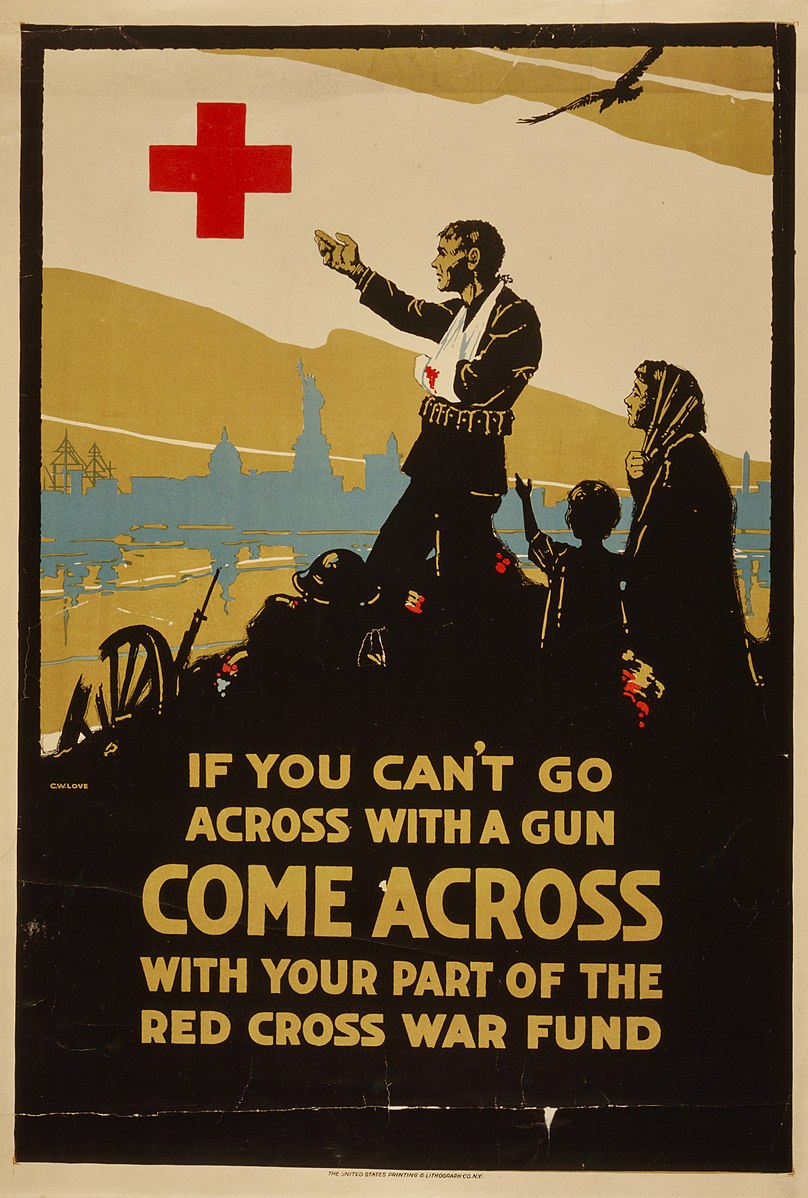
They’re after my blood.  In fact, they repeatedly call on my work phone asking for it.  But when I go in they won’t take it.  There are blood shortages, I know.  My wife and I used to be regular donors.  Then we moved to the United Kingdom for my doctorate.  Although largely vegetarian even then, Britain came to be under the “Mad Cow” disease scare just at that time.  Bovine spongiform encephalopathy seems to have been caused by adding filler from other animals to cattle feed.  Naturally vegetarian cattle—vegan as adults—were being fed animal by-products.  Anyone who lived in the United Kingdom during the height of the scare is banned from ever donating blood in the United States, no matter how severe the shortage.  That doesn’t mean they won’t continue to call and make you feel guilty for not donating.

Image credit: C. W. Love, public domain via Wikimedia Commons

Medical care is culture-specific sometimes.  We once knew a woman who was a medical doctor in Sweden but who could not practice medicine in the United States.  At least not without undergoing extensive medical retraining.  I think of wonderful organizations such as Doctors without Borders where medically trained people help out those in less developed nations.  Nations may be a necessity, but nationalism quickly leads to problems, many of them major.  I realize that mixing medical techniques can cause complications, but I wonder if sometimes we go too far.  And I often think about the medical problems caused by consuming too much meat.  Raising cattle and hogs, especially, leads to huge environmental problems.  There are better ways.

It’s been about five years now since I’ve been more or less fully vegan.  Eating options have expanded enormously in that time.  There are plenty of options for eating out, although most restaurant chains still seem to equate the practice with consuming animal products.  For me the process was gradual.  While living in Scotland in the late eighties to early nineties we cut most red meat from our diets.  When my daughter turned out to be a natural vegetarian, I joined her.  After several years living that way (over two decades now), I finally made the leap to being vegan.  Animals should have rights.  Nature can be cruel, I know.  Still, to exploit other species for our gain and their sacrifice bothers me.  I like to share.  I even like to donate blood.  I’m still asked to do it and am turned away when I show up at the door.  I can’t help but to think there’s a better way.


Forbidden Things

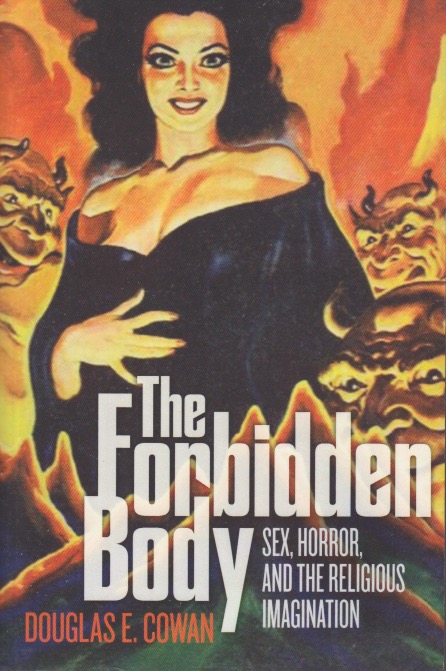
I owe Douglas Cowan a debt of gratitude.  Spending evenings at the American Academy of Religion and Society of Biblical Literature annual meeting curled up with his then new book, Sacred Terror, I was amazed.  Vaguely in the back of my mind I knew that film scholars were writing about horror, but I didn’t know that religion scholars even could.  Of course, later I discovered that Cowan had predecessors, as do we all, but that still didn’t change the fact that he opened my eyes to possibilities.  Being a slow reader with an unrelenting 925, I can’t keep up with any one author’s total output but I knew I’d need to read The Forbidden Body as soon as it was announced.  Subtitled Sex, Horror, and the Religious Imagination, it covers many aspects of what’s being called embodiment studies.  And there are, of course, monsters.

Where he finds the time to read so much and watch so much I can only guess.  This book covers a lot of territory that I can’t even begin to summarize here, but it goes without saying that Cowan’s many observations are worth paying attention to.  If I were to try to find a main theme I think it would be bodies out of place.  At least that what it seems to me.  Bodies out of place can mean many, many things.  Horror isn’t shy, of course, about showing you many of these.  As always, the unexpected part is religion.  Better, religious imagination.  I’ve been trying for years to articulate how religion and horror are related, and this is obviously something I haven’t been the only one pondering.  Cowan offers trenchant thoughts on this and even gives you some glimpses of unexpected monsters along the way.

Horror is often considered puerile, I know.  You get an image of a bunch of guys in business suits or military uniforms shaking your shoulders and saying “grow up!”  But what is it we’re growing up for?  To feed the monster.  So that those who are the monster can pamper their bodies with the luxuries everyone else works to provide.  Religion often serves to motivate those who are on the production end of this scale, but there is a truly Ottoian fear that compels us, lying not so very far beneath the surface.  Religion reaches out to those who encounter the monster.  And those people have bodies.  Cowan touches on many aspects of horror here from Corman to Lovecraft to Sade.  My response, perhaps appropriately, is that my head feels like it’s exploding.  I have so much yet to learn.


Past Knowing

It’s like watching a fall in a movie in slow motion.  You know you can’t really stop it, as much as you’d like to.  We see the collective world pieces moving into place for a third world war and thinking people worldwide are wondering why countries such as Italy and Sweden are electing hard right candidates.  Especially when Russia is invading countries at will.  I’m no politician and I resent having to be drawn into political topics, but at times you just have to say something.  Even if it won’t change anything.  Parts of the Bible are like that—witnesses simply wanting it to be noted.  Something seen, something said.

My family wasn’t political as I was growing up.  They pretty much just voted Republican, being in a rather Pennsyltuckyish county.  When I was nearing voting age I asked my mother about the political parties.  We’d learned about hawks and doves in school, and having been taught that Republicans tended to be those who started wars I wondered why Christians voted for them.  She really didn’t have an answer for me and I later came to realize that as a certain segment of Protestantism is actively attempting to bring about the second coming, this fits the plan.  One way to do so is by initiating wars—environmental degradation is another—because they believe it’s all going to end soon anyway.  Although Jesus advocated for peace, they choose war, ironically, to bring Jesus back.  That was the start of my journey to the Democratic party.  War serves no purpose.

In democracies worldwide right-wing parties are propagandizing heavily to urge nationalism.  Separatism.  Fear of the stranger.  Many in Russia believe Putin’s rhetoric that Ukraine is a dangerous threat to the largest country in the world.  China, the largest country in terms of population, feels threatened by the small island nation of Taiwan.  Borders around much of India are disputed.  The control of resources, in thrall to capitalism, makes people want to close borders and watch out for their own.  At least their own that are members of their party.  From my perspective it’s difficult to see a peaceful way out of this.  Even the world’s oldest democracy falls prey to the propaganda of a known swindler.  Human society is complex.  We have enough resources to meet the needs of all except the greedy, but it’s the greedy who run for office.  We have, it seems, forgotten the last century entirely.

Photo credit: Remember, public domain via Wikimedia Commons

Eclecticism

Eclectic.  An eclectic approach is experiential.  I don’t mean to be obscure here, but I was once an academic.  Let me try to spell this out a little more clearly.  You’re reading along in your academic study—perhaps it was assigned to you for a class, or perhaps you have unusual interests, or maybe you want a deeper treatment than you find in Barnes and Noble or on the internet.  In any case, what you’ll often find is academics like to glom onto a theoretician that they follow.  Applying Derrida to this, Lacan to that, and Bakhtin to the other.  In doing so they establish their mastery over complex theory, and earn their ticket into the academy.  You, the poor, curious reader, are left wading through explanations of the theory when what you really want is the content—the actual subject of the book.

My own work has been rightly accused of lacking theory.  Or, more precisely, not following a consistent theory.  It’s eclectic.  That’s because I believe in an experiential approach to research.  I trust my own experience.  Your experience is different, I know.  Trust it.  We learn things through experience.  Perhaps others were raised by parents who read and thought deeply and introduced their children to Deleuze (and perhaps Guattari as well), but most of us weren’t.  And some of us came to trust both raw logic and intense feeling.  We call it instinct in animals, but in people we expect more.  What’s wrong with being eclectic?  It seems to make sense.  If Foucault had it right, shouldn’t it be obvious to all of us?

What’s always amused me about this is that such theoreticians—and I don’t know how you become one without basing your work on your own experience—come and go like fashions.  Ricoeur was the big name a few years back and now I haven’t seen anybody writing about him for a couple of decades, at least in the fields I’m reading.  I tend to read primary material and think as deeply as I can on it.  Yes, I read others who write on the topic and sometimes I’m even quite taken by someone else’s approach.  Still, my experience tends, alas, toward the Baconian—an embarrassment for a vegan, I suppose—that of gathering information and seeing what makes sense of it.  I read the theoreticians from time-to-time and then I read those not classically considered experts.  We’re all in this knowledge game together.  Even Lévi-Strauss and his school.


After It’s News

We live our lives by the news cycle.  It tells us what to think about and worry about, often beyond our local, daily concerns.  And sometimes we forget about yesterday’s headliners.  If you’re curious about whatever became of actual Hurricane Ian, I can tell you.  He’s been hanging around here.  Oh, he’s a mere shadow of his former self, becoming just a low-pressure system sitting off the Atlantic coast between New York and Philadelphia.  And spinning, and spinning, and spinning.  Around here we haven’t seen the sun since last Thursday.  The rain has been intermittent, but yesterday it was pretty much all day and he’s set to continue dominating the skies here at least through today.  Your typical hurricane, if there is such a thing, just keeps moving until it reaches unpopulated areas and nobody cares any more.  This one has been a long-term guest.

With the first few days of lassitudinous rain we had maybe an inch.  Rainfall spat and sputtered and sprinkled.  Yesterday it began to really come down and as I write this it’s too dark to tell but I can hear it splashing on my windows.  The toadstools popping up in the yard are impressive.  As has been the wind and below average temperatures.  I’m wearing my winter-level protection and dodging raindrops on my morning jogs.  Some days I’ve had to delay them for the water.  Not too many other people are out taking their exercise, I notice.  The Weather Channel’s taken to calling it just a low-pressure system, but we’re on a first-name basis now.  Ian is still very much a thing.  At the end of “daylight” yesterday the rain gauge read about three inches.

The thing about these “unusual” storms is they’re becoming the norm.  Global warming has been affecting us for years now, even as we deny it exists.  Our summer around here was very hot and very dry.  The dry was okay by me, but the heat prevented any outdoor work or play for a good deal of the time.  Days when you’d stay inside and try your hardest not to move.  We had maybe one or two days of transitional weather then boom, straight to November.  The leaves around here are still mostly green although they’ve been starting to change more readily now that October’s arrived with December in it’s train.  Forecasters tell us, like Annie says, the sun will come out tomorrow.  Around here we sure hope that’s right.  I wonder what else is happening hidden behind the news?

Not Ian, but you get the picture

Subconscious Humor

It’s good to know your subconscious has a sense of humor.  What with all that’s going on in the world these days, God knows we could use a laugh or two.  At least a smirk now and then.  One of the less-anticipated aspects of becoming old and wise is disrupted sleep.  Our bodies did not evolve for the 925 schedule, and the “eight hours a night” trope is more naturally along a pattern of sleep for maybe four hours, get up for a while and get things done, then sleep for a few more hours, until dawn.  That doesn’t fit well at the office, so we try to cram all of our sleep into one unbroken stint.  When you’re young that’s often not a problem, at least in my experience.

Then you reach a certain age when, with no discernible change in habits, you have to visit the restroom in the middle of the night.  Modern people, of course, have a lot on their minds, so after that mid-night pee it’s difficult to get back to sleep.  For those of us who can’t break the long-term commuting habit, any waking after midnight is likely to be the end of a night’s sleep.  Once you get tired enough, however, you tend to overpower the full bladder and snooze on to the usual rising time.  (For some of us that’s earlier than it is for others, but that’s immaterial.)  This is where the subconscious starts to play its role as the comedian.

Mildly thalassophobic, I tend not to go out on very deep water, especially in small craft.  To be fair, I don’t live too close to the ocean and I don’t own a boat of any kind, so this often isn’t an issue.  One of my biggest traumas in college was meeting the “swim a length of the pool” requirement for graduation—I understand that’s now been abolished.  I nearly didn’t make it, but the last semester as a senior I had a private show—which must’ve been funny—for the swim coach.  So when I need to pee and I sleep through the middle of the night, I have deep water dreams.  I’m on a small boat in an ocean.  Sometimes I see paranormal geysers bursting from the surface and wonder what they are.  Then I wake up and dash for the bathroom.  Hey, it could be worse—my subconscious could find a humorless way of waking me.  Meanwhile, it probably wouldn’t hurt to take some adult swimming lessons.

All that water…

Sleepy Hollow West

You’ve got to admire those who are determined to be writers on their own terms.  As someone who’s tried and tried again to break into even indie presses, I know few established publishers will even consider fiction from someone who’s not already established.  As my regular readers know, I’ve been reading a lot about the Legend of Sleepy Hollow lately.  So I came across Austin Dragon’s Hollow Blood.  Part of a two-volume novel set, the story takes a creative approach while retaining several of the original characters, even having clever nods now and again to the wording in the original.  Although clearly self-published, Dragon is able to let his imagination go on this one.  Julian Crane, Ichabod’s nephew, is out to avenge his uncle’s death.

In Sleepy Hollow he confronts Brom Bones with the crime, but wrongly.  It turns out that the Marshal—there are elements of the old west in this too, with cowboys and showdowns—knows where Crane has settled and offers to take the nephew to him.  So unfolds a story that feels a bit more like a western than a horror story at points.  I don’t want to give away too much since Dragon, like most of those who make their living by writing, needs to move copies to stay solvent.  The thing is, Sleepy Hollow seems to be an evergreen subject.  America keeps coming back to it.  Many writers try to take it on as the basis for more modern reboots.  Of course, I have to read the second volume to find out how it really ends.

I can’t help but think that the internet has made it difficult for writers by allowing anyone to establish him or herself as one.  If you can build a fan base, you can make a living at it.  The publishing industry faces problems of its own, of course.  Paper shortages are a problem.  Not only the pandemic, but the assumption that ebooks were going to spell the death of print led paper mills to cut production.  Funny thing—print has been seeing a resurgence of interest.  Large media seems surprised, scratching its metaphoric head and saying “People like actual books—who knew?”  But I digress.  The simple tale of a love triangle in the 1790s with a ghost on the loose has spawned a great number of offspring.  Some published the traditional way, and others on a writer’s own terms.  It’s a story worth the retelling.


More Excuses

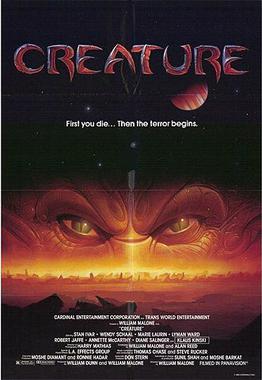
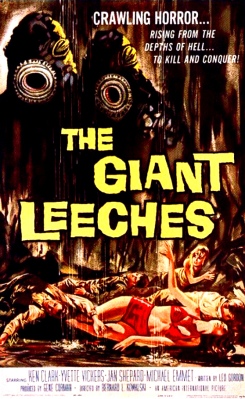
Perhaps it was my Shingrix-addled brain—but we all know that’s an excuse—I decided to watch Creature (1985) and Attack of the Giant Leeches (timeless) over the past couple of days.  The former was a decision made when not having the energy to read, I could still search Amazon Prime for “free to me.”  I was all set to start Attack of the Giant Leeches when I scrolled over Creature only to learn it would be free for only eight hours more.  I recalled, somewhere in the haze, that a movie called Creature was on my watch list, and since time was running out, I clicked play.  Clearly a knock-off of Alien, with even a Sigourney Weaver stand-in, it was one of the most badly written films I’d seen in a long time.  I was surprised to learn it’d had a theatrical release.

A crew stranded on Titan, one of Saturn’s moons, finds a creature—one that looks like a down market version of Ridley Scott’s nightmare—that feeds on unsuspecting astronauts.  Still, the surprises kept coming.  The impossibly pretty women and rugged men of the crew seemed unlikely.  And was that Klaus Kinski trying a move on the security officer that he wouldn’t have survived if he’d tried it on Sigourney?  And how was it even possible that this was nominated for the Best Horror Film of 1985 at the Saturn Awards?  Okay, granted 1985 wasn’t a banner year for horror, but Creature really doesn’t seem to hit the bill for “best of” category—but it was over 25 years after a classic.

Attack of the Giant Leeches is obviously the lesser of the two movies, but it falls into the category of “so bad it’s good.”  The leeches are clearly people in rubber suits, and the caricatures of the hooch-swillin’ swamp-dwellin’ lazy ole homeboys is just too good to pass up.  And the fact that it’s just over an hour long is a bonus when you’re having trouble keeping your eyes open.  Those black-and-white sci-fi horror films of the fifties sure take me back to more innocent times (not the fifties, and the film isn’t all that innocent).  Given that both movies were free on Prime, and given that my head was fuzzy from my vaccine, I counted this as a worthwhile effort at staying awake.  We seem to have come to a more sophisticated era, in many regards.  Such films can’t compete with their modern-day counterparts and even streaming companies are producing their own these days.  There’s something to those older films, however, and maybe it’s helped along by a shot in the arm.


Lost Day

There’s a continuity of life and we’re used to it with only small, regular interruptions, such as a night’s sleep.  Each day builds on the previous one with plans being fulfilled, projects attempted, and yes, work.  Then something happens to disrupt that and it’s like starting over again.  I imagine (and feel for), for instance, those who’ve lost everything to Hurricane Ian are going through it.  They are reassessing and rebuilding, even as around here we’re beginning to get some of its rain.  A break in continuity may be smaller, however, and on an individual scale.  I had, for example, my first Shingrix vaccine in January.  Never having reacted to any vaccine before I was completely caught off guard when the next day I couldn’t get out of bed.  But more than that, I knew this was a two-part vaccine, and I was going to face this again.

I kept putting it off.  I needed to have a day when continuity could be broken so that I could recover.  That’s always tricky because I’m busy all the time.  I’ve got a book manuscript under a December deadline and I have to work every weekday.  Yesterday I took a personal day and had Shingrix 2 after work on Thursday.  Yesterday was a lost day.  Although I knew this was an important vaccine, like the various Covid vaccines I’ve had, I wasn’t ready for the consequences.  With short periods of wakefulness, I slept until 1:30 in the afternoon, unable to do anything.  Feverish, I couldn’t read without falling back asleep.  Working on my book was out of the question.  Meanwhile, emails kept coming in, asking for this or that.

The lost day takes some time for recovery.  It’s not nearly so bad as those who’ve lost their homes and communities because of this massive storm that’s tapping its outer fringes on my windows right now.  Still, I have to try to remember where I left off.  Amazingly, after sleeping for some seventeen hours, I was nevertheless ready for bed at the usual time last night.  The nurse who gave me the vaccine assured me that it was better than having the actual disease.  I don’t doubt that.  Those I know who’ve had shingles warn that it’s nothing to mess with.  Still, I sit here slightly stunned this early Saturday morning, wondering where I left off before all of this began.  The continuity has been temporarily broken, and I lost a day in there.  I’d forgotten what it’s like to sit in a chilly room before sunrise with a tabula rasa before me.  But I do recall that I have a final manuscript due in a couple months.

Photo by Estée Janssens on Unsplash

Roman Mythology

A recent game of Redactle led to a family discussion of Roman mythology.  I had to flex some muscles unused since my last full semester at Rutgers, but I was pleased that the old learning is still there.  One of the first things people notice about Roman mythology is its lackluster nature.  Rather like current-day politicians, the Romans mostly lacked imagination when it comes to compelling stories.  Roman religion consisted largely of cult—that is the enacting of sacrifices and learning how to read omens.  They had no “Bible” and really no other collection of myths, apart from what they borrowed from the Greeks (who borrowed, in turn, much from Semitic mythology).  They mapped their various gods—some from the Etruscans—onto the Greek pantheon and made do with other peoples’ stories.

Rome’s native myths largely focused on their own history and human characters—again, the parallels with Republican sanitized American history are apt—but also deal with serious issues.  In the words of T. P. Wiseman, “How does well-meaning authority turn into murderous tyranny?”  (I resist footnoting blog posts, but this is from the preface of his book The Myths of Rome.)  Like modern politicians, they believed their origins were divine.  The gods had chosen them to be a superpower.  We might scratch our heads and ask ourselves where the Roman Empire is today, even as Italy elects hard-right leaders.  We learn nothing from history.  Nothing.

So let’s turn to mythology instead.  Or at least religion.  Roman religious writing was often kept secret—the purview of priests only.  Some of this survived into early Roman Catholic ideas about keeping Scripture to the priests.  Religious writings are dangerous if they get out there among hoi polloi (or “hot polo” as my autocorrect suggests).  Ironically, those of us sent off to specialized schools to learn this stuff are, in these days, generally ignored.  Roman officials were often anxious to know what oracles said.  Today televangelists and their ilk seem to be the ticket.  Anyone can be an expert if they talk loud enough.  And yet the Romans admired the Greek intellectual life.  The creativity with which they handled their gods.  There was much to be emulated there.  Roman Jupiter was the protector of the military (budget, one is prompted to write—forgive me if my Muse is a little unruly this morning).  And yet it was the Roman authorities who crucified Jesus.  We may indeed still learn something from Roman mythology.

Hebert James Draper, The Lament for Icarus, public domain via Wikimedia Commons

Opinion Piece

There comes a time, I hope, when the opinion of someone with over four-and-a-half decades of intensive reading experience, might matter.  I say this because I’m constantly struck by those whose opinions actually count, and how little they often are to be considered experts.  For example, I watch YouTubers young enough to be my children treated as experts.  A little probing sometimes shows that their qualifications are the ability to get people to look at them.  Click that like and share button.  If enough people do like and share, you can be an expert.  Or take opinion columns in newspapers.  I notice the headlines for some of these in the New York Times.  They are opinions only, and yet the prestige of one of the great American newspapers stands behind them.  These are opinions worth listening to.

The popularity contest is an old and venerable tradition.  I wasn’t popular in school and wasn’t voted “most likely to” anything.  Meanwhile, those chosen as the likely leaders and novelists and beauty-pageant stars generally don’t get too far along that road.  As Bruce Springsteen sagely noted, those “Glory Days” pretty much all end up back in high school.  But as Bowling for Soup observes, “High School Never Ends.”  We like to look at the confident, the well-adjusted, the narcissists.  Their sense of entitlement carries over into hoi polloi.  The quiet and self-reflective sometimes get noticed, particularly after they’re gone.  The Thomas Mertons and Thich Nhat Hanhs.  The household names, however, are those who loudly claim they should be heard.  Just because they think they should.

Another part of this complex equation is finding a subject that interests people.  In my case, I know lots of people are interested in horror, but I also know that there are many experts out there.  Ironically, I still have people ask me about ancient West Asian religions—this is a field where you need to be immersed to stay on top of what’s going on.  The books and articles you have to keep reading are dense and heavily footnoted.  The articles are located in journals not always easily found.  Don’t get me wrong—I still miss it.  Ironically, now that I can’t keep up people are starting to ask my opinions on it.  Perhaps the same will happen with horror and monsters, but long after I’m able to respond effectively.  Experts on social media learn to monetize their interests so they can spend full-time at it.  And that does, in fact, make them experts in the very specific field of being an expert.

Photo by Markus Winkler on Unsplash

The Daily Show

Long ago—over a dozen years now—I decided this blog would receive daily updates.  Some of the more successful blogs out there receive multiple daily updates, but I’m just one guy, and a working stiff at that.  When you do something every day a couple of contradictory things happen: one, you get better at it (if you’re a Gladwellian, it may take almost three decades, but the principle holds), and two, the quality varies.  I’ve long noticed this about daily ventures.  (I’ve also lately begun to realize that even daily shows take time out to refresh.)  I used to stay up to watch David Letterman (that seems impossible to believe in my current time warp).  When he was good he was very good, but when he wasn’t it was painful to watch.  You can’t be “on” every single day.  Emotions are funny that way.

Over the past year or so I’ve taken to occasionally binging on “Good Mythical Morning”—a YouTube daily show starring Rhett and Link.  These North Carolinians are inherently likable.  They’re a couple of guys who, in many ways, refuse to grow up.  They’re smart, and often funny.  And extremely popular.  Their channel has approaching 18 million subscribers.  They have off days, as do we all.  Sometimes I wake up feeling so contrary in the morning that I’m not sure I’m the same person who crawled into that bed only hours before.  Some days I don’t feel like writing a blog post.  On other days I feel like writing several.  What perhaps stands out to regular readers, if only one or two, is that some days you’re off.  So tragically human.  So wonderfully human.

I’ve often wondered if this is just a condition of life.  Pets, for example, have off days too.  I suppose the difference is that those committed to a daily show have put themselves out there so others can see them.  On one of those aptitude tests I took in high school the results suggested I should’ve been an entertainer.  Instead I took a religious and scholarly approach to things.  Maybe because I’m a middle child I always felt that nobody really paid attention to me.  So here I am, a baker’s dozen years out from writing daily on religion, ancient West Asian topics, books, and horror.  And sometimes current events, when I  feel like it.  If you’re taking the daily show route, you need to be aware that, despite the ennui, not every day will be the same.  Even someone as successful as Letterman knew that.


Hiding What?

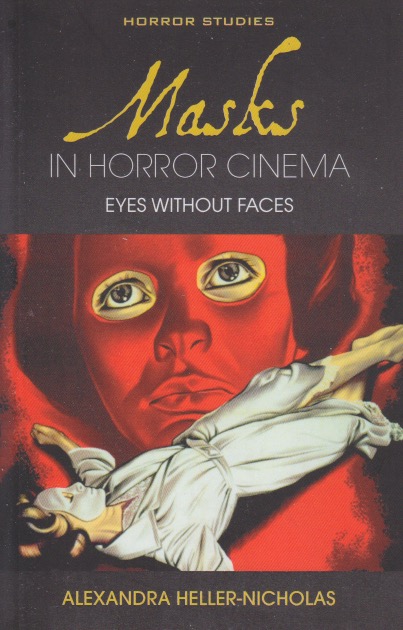
Who are we?  Do we really show ourselves to others, or do we wear masks?  That question applies to horror films as well as to everyday life.  Alexandra Heller-Nicholas addresses this directly in the former context in Masks in Horror Cinema: Eyes without Faces.  As I write about horror films, peer reviewers suggest these more technical studies as means of adding depth to my analysis.  Most of them are revised dissertations and retain the academic language that makes such documents difficult to read in places.  Still, they contain a lot of insight.  I learned a lot from Heller-Nicholas and I was particularly impressed that she took the “shamanic imagination” as her approach to the films she analyzes.  The ritual aspect makes good use of religion and horror connections.  It’s nice to see this catching on.

Masks are more than disguises.  Yes, there’s something theatrical to them and there’s a great deal of ritual to theater.  Ritual and religion aren’t identical, but they are clearly related.  Often masks are discussed as simply a way of hiding a killer’s face.  There’s quite a lot more to it.  This is where the academic analysis comes in.  We can’t explore it in detail in the brief context of this post, but there’s a whole book out there to read on it.  Heller-Nicholas doesn’t feel constrained to major movie releases.  I did that in Holy Horror because I supposed more people would be interested in reading about movies they’d actually seen (most of them anyway).  There are a lot more examples out there.  I’m learning about more all the time.

There are many different masks in horror.  This book looks at several, some metaphorical, but most literal, and what they convey.  Or conceal.  The fact is we mask ourselves for many reasons.  It’s kind of like when we dream—our subconscious seems to know more about who we are than our waking minds do, and we really don’t share our dreams with others.  The mask in horror isn’t worn just by killers.  When it is, however, it often has a shamanic effect, or, as Heller-Nicholas points out, a trickster aspect.  This is very much like how anthropologists approach shamans in traditional societies.  Religious specialists are often tricksters and they provide an important element in cultures that are otherwise beset by rules.  Rationality is important, but so is letting go of it once in a while.  Shamans get away with things the average person can’t.  And it is just one of many masks we wear all the time.