Amityville Revisited

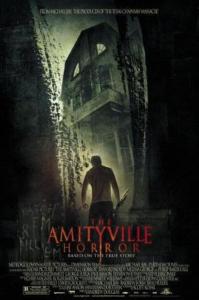
Remakes, standard wisdom holds, are seldom as good as the originals. When the original wasn’t great to begin with, the bar should be lower. Should be. I’ve been curious about the Lutz haunting in Amityville, having just read the book that started the phenomenon back in the late 1970s. I saw the movie first. That was several years ago now, but I do recall that even as horror movies go it had its failings. Some of that goes back to the book (presuming that anything happened)—nobody had a solid grip on whether this was a ghostly haunting or a demonic infestation. What the movie did do well is show how fragile family relationships can be, especially when under the pressures of supernatural supervision, not of the positive kind. Although, as is to be expected, the book was scarier.

Overcome by curiosity I finally watched the remake from 2005. Clearly I’m not the only one still curious about this alleged haunting, alleged hoax. I also have the alleged burden of looking for religion in horror. Only on this final count was it not disappointing. Well, that and in featuring burgeoning scream queen Chloë Grace Moretz. Although Father Callaway’s role is late in the film and brief, early on religious ideas are implicated. If the movie hadn’t tried so hard to be The Shining these themes might’ve been developed to good advantage. Instead it introduces Rev. Jeremiah Ketcham (also late in the film) as the first owner of the house in 1692 (did the real-estate agent’s mention of that date make you shiver?). Ketcham was a sadist to the Indians under his care, torturing them to death in the house. No time is left to explore the sinister minister’s motivation as the family implodes in its attempt to escape the house by boat.

As is frequently the case with the supernatural, we’ll likely never know what happened at the Amityville house. The story Jay Anson told is now generally classified as a novel. The preternatural can be judged neither in the courtroom nor the laboratory. The best that we can do is make celluloid adaptations to make some money on the deal. The DeFeo murders happened in living memory. The Lutzes left the house in a hurry shortly after purchasing it. Anson’s Indian “asylum” was never really there—and there were no such Native American practices in any case. What the remake left out was demons. Although the movie attempted other religious scares, the house just isn’t the same without them.

The Devil Made Me

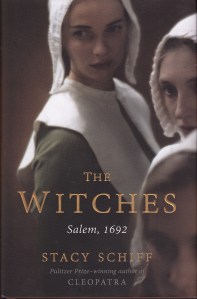
TheWitchesWitch-hunts, I suspect, will become all the rage again if a certain presidential candidate is elected. The fear of witches is not easily explained in a world driven by materialism, but certainly misogyny plays an unholy role in much of it. Stacy Schiff’s The Witches: Salem, 1692 has been selling well. Since my wife is one of the many descendants of the Towne family that suffered three witch accusations resulting in two executions (Rebecca Nurse, Mary Esty, and Sarah Cloyce) we read this book together. It is a detailed account of the year we went mad. A year when being different, especially not being Puritan, and not being male, was dangerous. Religious tolerance was not a gleam in the colonists’ eyes since religious freedom translated into not being forced into the government church, not allowing others the same privilege. Indeed, as Schiff points out, religious tolerance was considered by many to be a satanic idea. If ministers starved due to such freedom, it would be easy for Satan to take over. As it was, the Dark Prince seems to have done a pretty good job among the Puritans without such tolerance.

The idea of the Devil has been (and still is) the ultimate scapegoat. People in a capitalist society are naturally frustrated—surprisingly few see this—and frustration always seeks a reason for its own existence. That is patently clear at Salem: blame the Indians, blame the French, blame the Quakers, blame the women. Any and all may be agents of the Devil. Even the descriptions of the Lord of Darkness varied so much that, were he a human, no one could be quite sure who it was they saw. The Devil always takes the form of your enemy. All it takes is an influential clergy willing to push tense believers over the edge. Soon we begin building walls. Then we build gallows.

Religious tolerance has always been a frightening thought. Protestantism challenged a somewhat uniform Catholicism and the mite of a doubt burrowed deeply into peoples minds: is my religion the wrong one? Tolerating other religions means admitting that yours might be wrong. The logic that plays itself out is a terrifying one to some. Belief is never easily changed. States can’t stand dissenters. The only capital crime for which the federal government still executes citizens is treason. Treason sits uncomfortably on the other side of the coin whose obverse reads “tolerance.” You’d think that three centuries would be long enough to learn something. Unfortunately some lessons—often tragic ones for the powerless—have to be played out over and over before we start to comprehend that Satan can be anyone we want him to be.


More Witches

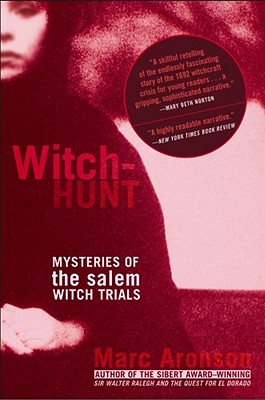
WitchHuntAronson It’s been some time since I’ve been to Salem. It’s been even longer since I’ve read Arthur Miller’s The Crucible. The events of 1692, however, continue to haunt me. I recently read Marc Aronson’s Witch-Hunt: Mysteries of the Salem Witch Trials. Intended for a young adult readership, Aronson’s book really isn’t proposing any new theories about why religious violence was perpetrated against the vulnerable, mostly female, pool of those living in a very superstitious society. It does, however, show some of the issues in sharp relief—more academic books sometimes cloud the issues with erudition. Historians will continue to debate what happened in Massachusetts at the end of the seventeenth century when the Enlightenment was getting underway and the explanatory value of science was overcoming the world of miracle and magic. Even with science on our side, however, adequate explanations of the sad social madness of Salem are still lacking.

As Aronson points out, there seems to have been a certain amount of greed involved as laws allowed the property of “witches” to be confiscated. Equally culpable are the learned clergy of the day, some of whom overrode their disinclination towards belief in witchcraft to hang a few women (and fewer men) for an imaginary crime. Lack of full historical documentation and the unrecorded lives of women often combine to raise many questions about Salem. It remains clear, however, that the outlook of the clergy influenced perceptions on the ground. Aronson suggests that Cotton Mather’s earlier accounts of Goodwife Glover of Boston—a woman executed as a witch without even her first name having been recorded—may have “inspired” similar violence among the population of Salem. When devils are suspected, the clergy are never far.

When the mania died down after a lethal year, the clergy, both Increase and Cotton Mather among them, recanted the easy execution of a few expendable women, and fewer, less expendable men, in Salem. Since we lack documentation, we will never know fully what was behind the witch-hunts, apart from misogyny and misperception.

Aronson ends his little book by asking us to consider modern terrorist hunts and the eerie similarities to the mindset of Salem. Listening to some media interviews, particularly on Fox, after the Boston Marathon bombings, we haven’t traveled so very far from Salem. In a world of high technology, where Satan is said to once again stroll the streets of Massachusetts, we have to wonder if the witch-hunts will ever truly end.


Lesson of Salem

I married a witch. I suppose I ought to clarify that a bit. My wife is descended from Rebecca Nurse’s brother Jacob. Rebecca Nurse was one of those unfortunately hanged as a witch in Salem, Massachusetts in 1692. My family has been spending the last couple of days touring Salem, seeking to get in touch with our heritage. Yesterday we had the rare opportunity to tour the home of Rebecca Nurse which, remarkably, still stands over 300 years after the tortured events of the late seventeenth century. Our tour guide was impressively knowledgeable about the witch hysteria. She noted that in the Puritan (Reformed) mindset, with no science to speak of, evil could only be explained by the Devil. If misfortune came, the Devil was to blame. Even after the “witches” were exonerated (too late to save 20 lives), it was understood that the Devil incited the girls to make their false claims against their ultimately and penultimately righteous neighbors. Without the Devil none of this made sense.

The Rebecca Nurse homestead

Salem was founded as a utopian community free to live out its Puritan religion. It was named after Jerusalem, a city of peace (!). As our guide noted, religious freedom was not the same as tolerance; the Puritans wanted the freedom to celebrate their own religion, but were extremely suspicious of all others. One of those hanged as a witch, George Jacobs, had nearly beaten a neighbor to death simply because he was a Quaker. Rebecca Nurse, however, at 72 years old, was no threat to anybody. She was a member of a Christian community that turned on her. Condemned for charges the nearly deaf woman could not even hear properly, she was hanged for consorting with a mythical Devil.

Rev. Parris's house, where the witch hysteria began

No doubt the religion of the Puritans was a harsh religion with a God nearly as unforgiving as that of Sweeny Todd. The problems occurred, however, when the law came into the hands of religious leaders. There is an allegory and a moral to this story. Today many of the tourist attractions in Salem focus on the need for true tolerance. They no doubt come closer to the spirit of the founder of Christianity than the Puritans ever did. As I stood looking over the hole in the ground that is all that remains of Rev. Parris’ parsonage—the very location the witch hysteria began as his daughter Betty started to act odd after hearing the stories of the slave Tituba—a profound sadness afflicted me. Twenty people died and many lost all their worldly possessions because of an uncontrolled mythology of a church convinced of its own righteousness. An allegory and moral for the twenty-first century indeed. Have we yet learned the lesson of Salem?