Leviathan’s Sibling

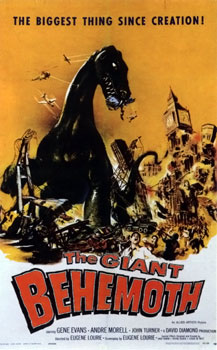
TheGiantBehemoth Formulaic to the point of plagiarism at times, 1950s science fiction movies often follow the deeply worn ruts left by countless forgettable monsters. One such film that I managed not to see until recently was the biblically entitled The Giant Behemoth. In a more biblically literate society the poster’s catchphrase “The Biggest Thing Since Creation!” may not have been necessary, even though leviathan’s lesser known companion stole the title this time. Of course the movie begins with stock footage of nuclear explosions, and although I’ve seen such renditions hundreds of times, they remain troubling to the core. Those 1950s that many consider so carefree were days of insidious freewheeling with the environment, days before human infatuation with the power over nature revealed its horrifying consequences. The behemoth, a sign of Yahweh’s great creativity in Job, here becomes the human-wrought agent of destruction.

Poor Tom Trevethan is blasted by the beast’s radioactive breath in a scene more fitting to Revelation than to Job. In the funeral scene, the priest somewhat insensitively reads a description of behemoth before Tom’s sole surviving family, his daughter Jean. So like the 1950s the minister then declares that the Bible gives comfort to those left behind, when the Lord said to Job, “Gird up thy loins like a man.” Indeed. Loin girding was a masculine activity in the days before Fruit of the Loom had been grown. Comfort for the woman comes in acting like a man. Yes, the 1950s considered the man the default model of human being. It says so in sacred writ. Genesis 3, to be exact.

When the scientists can’t figure out what killed the old man, along with thousands of fish, they ask Jean if her father said anything before he died. She tells them about behemoth. Being scientists, they have no idea what a mythical, biblical creature might be. Jean informs them, “It’s some prophecy from the Bible; it means some sort of great, monstrous beast.” Well, Job is technically not prophecy. Actually it’s not even untechnically prophecy either. In the 1950s, however, if it was biblical, it could be interpreted as prophecy. The real foretelling, though, is clearly atomic. Such films can easily be forgiven their biblical infelicity for the sake of their good intentions of reigning in human self-destructive behavior. In the end science destroys the biblical beast, but I’m left wondering if it isn’t more of a parable than a prophecy. I guess it’s time to gird up my loins and go find out.


Map is Territory

Far be it from me to challenge the established certitudes of the experts in academia, but I’ve been beginning to think maybe map is territory. This insight came to me from an unorthodox source (of course). I was watching War of the Colossal Beast over the weekend—among the corniest of corny 1950’s sci fi flicks. If you were born around the middle of the last century you already know the premise: a nuclear device has converted a man into a towering giant who resists all attempts to stop him or keep him under control. The reason that map and territory came to mind was that this 60-foot tall man (an apt companion for the 50-foot woman) could not be found by the authorities although he was terrorizing Los Angeles. Just as I was climbing on my high horse I realized that the problem they faced was communication. (And maybe they needed glasses.)

From the perspective of the twenty-first century and the vast network of instant communication (you can tweet your latest observation while on public transit, deep under the Hudson), map has become territory. There is nowhere left for the sixty-foot giant to hide. I am not the only one to speculate on the effect this shift will have on religion, but when we have become so intricately inter-connected, we seem to have squeezed the mystery out of life. Every trail has been blazed, every path has been trod. Old Ecclesiastes is laughing up his wizard’s sleeve. If a giant escapes among us its location will be texted across the territory second by nano-second. There is nowhere for us to hide either.

Our dependence on electronic media has changed part of the human race. It is easy to forget that in places not too distant, some of them even in the developed nations, there are human beings untouched by the revolution that has compressed map and territory. I have to wonder if their lives are better or worse for the ease that pervades our culture of flying fingers and ultra-dexterous thumbs. Avoiding the concept of the noble savage, I sense of kind of purity in the life free from the constant buzzing of 3G and 4G networks, wi-fi hotspots, and microwave towers disguised as trees. Theirs is a life where map is not territory, where being unplugged is natural and normal. It is a world where giants might hide in the night, and those who fear them may be all the more human for doing so.


Biblical Outlooks and Science Fiction

Alumni magazines depress me. Between my wife and I, we receive a half-dozen every month. I thumb through and see the cheery faces of classmates, most of whom I don’t know, who’ve gone on to great things – writing books, world travel, scientific breakthroughs. They’re not on the couch Saturday afternoons in New Jersey watching 1950’s sci-fi and wandering what went wrong. Especially bad is Bostonia, since I attended Boston University with many noteworthy individuals. Being forced from academia early in my career because of petty religious differences, I just want to bury my head and grab the remote. An article in this month’s BU shame-fest, however, pictured a professor, younger than myself, who joined the school of theology after I left. The title of the piece is “Biblical Sexuality.” Well, the connection with this blog couldn’t be more obvious.

Dr. Jennifer Knust is a professor of Christian Scriptures at BU who has written a couple of books on sexuality and the Bible. I’ve read widely on this topic in the Hebrew Bible, and was curious as to what the post-Jesus crowd was saying these days. The article specifically addresses homosexuality, but I did applaud one of Dr. Knust’s statements: “My main argument is that biblical texts do not speak with one voice.” Amen. Bravo. Goal! Our society is so imbued with the bibliolatry of the Religious Right that it is difficult for most Americans to understand that the Bible was written by many people over a few centuries and these people did not always share the same outlook. The Bible is an exercise in multiple voice-overs. Specific religions, as many denominations of Christianity testify, have harmonized these divergent voices into a coherent, if biblically untrue, theology. Some voices must be stifled so that others may dominate.

We live in a religiously plural world. There are about as many religions as there are believing people. We experience the world through our own lenses and within our own gray-matter. Our perspectives are uniquely our own. And yet religious leaders bend, worry, and force views closer to their own so that they might have a theological quorum, a consensus that one viewpoint is right. They silence the Bible’s divergent voices and claim they do not exist. I wish Dr. Knust well. She’s got the right perspective, in the opinion of my own weary gray-matter. And speaking of gray, where did I put the remote?