Late Night

If you lived through the seventies, Late Night with the Devil will take you back a bit.  It’s one of the more creative possession movies I’ve seen, but what really makes it stand out is the insider winks plentifully on offer.  Jack Delroy is a late-night variety show host wanting to top Carson.  His ratings have been up and down, and he decides to make his 1977 Halloween episode his ticket back into the game.  His guests that night include a psychic, a James Randi-like debunker, and a parapsychologist and her demonically possessed charge, Lilly.  A character resembling Anton LaVey, Lilly’s father, had raised her to be a child sacrifice to the demon Abraxas.  The broadcast even mentions Ed and Lorraine Warren, as well as The Exorcist.  Someone knows what the paranormal scene was like in the seventies.
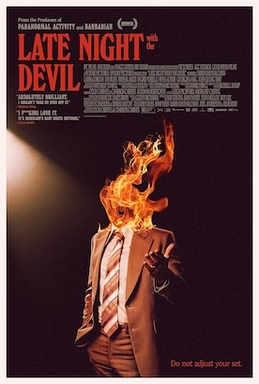
The psychic has authentic contact with what he believes is Delroy’s deceased wife and while the debunker, well, debunks him, the psychic nevertheless dies after a mysterious attack.  Delroy insists that the parapsychologist summon Lilly’s demon, while on stage.  The debunker claims that what the audience saw was a case of group hypnosis, but the demon finally attacks, killing everyone but Delroy and Lilly.  Toward the end the layers of claimed deception become so deep that it’s difficult to know, at first, how to interpret the ending.  Or whether you are supposed to “believe” the climatic demonic attack, of if you’re supposed to conclude that it was part of the mass hypnosis.  What is certain is that religion is front and center in this horror, but the demon ensures that in any case.

The taped pieces between segments of the show make it clear that this is all about ratings.  Indeed, Delroy sacrificed his wife’s health and life to try to break into the lead.  The real demon here is capitalism.  The desire to be on top has outweighed every other and hints are given throughout that Delroy isn’t as innocent as he pretends to be.  Still, the main thing is that the movie gets the paranormal seventies in America just about right.  The disturbing implication is that people are suggestible to the point of not being able to distinguish reality from manipulation.  That pall hangs over the entire movie plot as well as the ending.  This kind of meta critique isn’t intended to detract from what is really quite a good horror movie.  It is believable in the context of the world it devises, and that world includes demons.

Seventies

It’s pretty rare for me to be out on a week night.  Like a kid on a “school day” I’ve got to get up early the next morning.   And yawning a lot at work is bad form, even if nobody can see you.  I risked it recently, however, to meet with some colleagues from the Moravian orbit in Bethlehem.  As we talked, current projects came up, as they’ll do when doctorate-holders get together.  Demons are a conversation stopper, but I nevertheless asserted that our modern understanding of them derives directly from The Exorcist.  The insight isn’t mine—many people more knowledgable than yours truly have noted this.  One of my colleagues pointed out the parallel with The Godfather.  Before that movie the mafia was conceived by the public as a bunch of low-life thugs.  Afterward public perception shifted to classy, well-dressed connoisseurs who happen to be engaged in the business of violence and extortion.

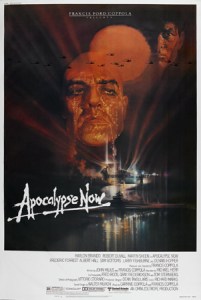
The insight, should I ever claim as much, was that these films were both from the early seventies.  They both had a transformative cultural impact.  Movies since the seventies have, of course, influenced lots of things but the breadth of that influence has diminished.  I noticed the same thing about scholarship.  Anyone in ancient West Asian (or “Near Eastern”) studies knows the work of William Foxwell Albright.  Yes, he had prominent students but after Albright things began to fracture and it is no longer possible for one scholar to dominate the field in the same way he did.  Albright died in the early seventies.  Just as I was getting over the bewilderment of being born into a strange world, patterns were changing.  The era of individual influence was ending.  Has there been a true Star Wars moment since the seventies?  A new Apocalypse Now?

You see, I felt like I had to make the case that The Exorcist held influence unrivaled by other demon movies.  We’re still too close to the seventies (Watergate, anyone?) to analyze them properly.  Barbara Tuchman suggested at least a quarter-century has to go by for the fog to start clearing.  Today there are famous people who have immense internet fame.  Once you talk to people—some of them my age—who don’t surf the web you’ll see that internet fame stretches only so far.  It was true even in the eighties; the ability to be the influential voice was passing away into a miasma of partial attention.  The smaller the world gets, the more circumscribed our circles of influence.  And thus it was that an evening among some Moravians brought a bit of clarity to my muddled daily thinking.


Casting the First Stone

I’m not overly nostalgic for a guy interested in ancient history. I tend to look at the more recent past as a via negativa for the young who might make a difference today. Very occasionally, however, aspects of society were handled better back in the 1960s and early 70s. One of the most obvious instances of a more sane society was the segregation of politics and religion. Prior to the rise of the “Religious Right” as a political machine the religious convictions, or lack thereof, of politicians played little role in their campaigns and American culture itself was much more open. A story from today’s MCT News Service illustrates this all too well.

In an article entitled “In S.C., religion colors gubernatorial race,” Gina Smith reports on the various religious slurs that now pass for political campaigning in that state. “Raghead” (for a former Sikh), Buddhist, Catholic, and “anti-Christian Jewish Democrats” are among the aspersions freely cast by those without the sin of a non-evangelical upbringing. As if only Fundamentalists are capable of making the right political decisions. As if Fundamentalists ever make the right political decisions. Fundamentalism is a blinding force on the human psyche, and those who are misled by religious leaders who claim unique access to the truth are to be seriously pitied. Conviction that those most like you are to be trusted most may be natural, but dogged belief that pristine morals accompany any religion is glaringly naïve.

The American capacity for belief in fantasy worlds is in the ascendant. No matter how many times Fundamentalists or Evangelical politicians are arrested or forced from office for the very sins they rant against, their overly forgiving constituencies come flocking back to them. Commit the sin of being born Sikh, Hindu, Buddhist, Muslim, Jewish, or Catholic and no quarter will ever be offered. No, I have no desire to go back to the 1960s, but I sure wish politics would.