Learning to Fly

“Be afraid.  Be very afraid.” This quote originates with David Cronenberg’s The Fly.  Of course, after watching the original, how could I not watch its successful remake?  I initially saw this one upon its 1986 release in a Boston theater.  I hadn’t seen it in some 35 years but some of the scenes were as fresh in my memory as if I’d seen it last year.  It’s safe to say that it made an impression on me.  Even usual critics of horror gave the film high marks.  Both it and its predecessor with the same title were quite successful in the financial department and became part of popular culture.  The remake ends without the philosophical statement of Vincent Price in the original, choosing despair instead.  I’ve never seen the sequel.
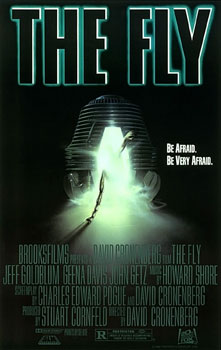
I picked this up as a used DVD many years ago.  Mainly I wanted to have it on hand in case the mood struck to see it again.  I did recall that, as a Cronenberg film, it was a gross-out of body horror.  So much so that it’s difficult to classify it as science fiction.  It, along with its near contemporary Alien, demonstrated that the fusion of the genres was possible.  Perhaps inevitable.  At the same time, movies, like most other media, have proliferated to the point that such standouts are rare.  Yes, there are still Academy Awards and Golden Globes, but who but a professional can see all the offerings out there?  It feels like we’ve moved beyond the time when a movie could define a generation.  But on a deeper level, that’s why The Fly is about.

We, on the far end from the white male oligarchs, are blending.  We’re no longer simply accepting what we’re told.  We’re becoming more global and more people are starting to break into the power structures.  Even if they sometimes transform if they do.  I saw a recent newspaper article about what to do with your second home, as in decorating it.  Second home?  The majority of us are having trouble up keeping our one home, and that’s if we’re even owners.  Society needs a telepod.  The end results may be messy, for sure, but we need to stop thinking in exclusive terms.  Cronenberg indicated back in the eighties that the movie was about disease and aging and letting those we love go.  That gives the film its poignancy, in a kafkaesque way.  At the same time it may be a teaching tool.  Yes, we can be afraid, very afraid, and still learn.

More Than Books

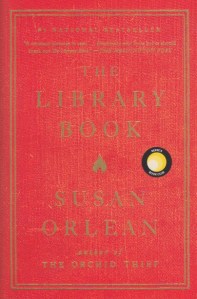
Careers.  A pandemic is no time to think about changing jobs unless you’re forced to, but I often wonder if I got it wrong.  No matter what my job was, I wanted it to be about books.  When I was considering ministry it was largely because of the Good Book, and I did a lot of reading of books about it.  Over time my mindset morphed to that of a professor and the book-lined study was my icon.  I admit I’m fixated at that stage.  Now I’m an editor.  Life would’ve been different if I’d become a librarian.  Susan Orlean’s The Library Book is a volume that opens up the cloistered lives of librarians and shows just how vital libraries remain.  I have to confess that before reading this I don’t recall ever having heard of the central Los Angeles library fire of 1986.  Now I can’t forget it.

More than just an account of the fire—although a suspect was arrested it still isn’t clear that he was guilty—this is a book about libraries.  An account of the fire alone would not have been so interesting.  Orlean tells us about this history of the Los Angeles Public Library and the importance of libraries around the world.  She introduces us to several librarians and gives us insight into why they became such and what it is they do.  Here’s a hint: it’s a lot more than re-shelving books.  And there’s the sad tale of an unsolved fire that destroyed millions of dollars’ worth of books.  Having had hundreds of books destroyed by water myself, some parts of this book were difficult to read.  Books are vulnerable, like butterflies they must be treated with care.  The idea of them burning, then being soaked, is distressing.

Like many people, I suspect, I began this book thinking libraries were on the way out.  The internet has changed things.  What I didn’t fully appreciate is that libraries have been evolving to keep up with the times.  And that they provide social services, such as a place out of the weather for the homeless.  I experienced this myself in Montclair, New Jersey.  When accompanying my wife there on Saturdays when she had to work, if I finished with the bookstores early I’d head to the library.  You could sit there for free.  I always have books with me, so I could read.  I could use their wifi for free.  Libraries, you see, are all about giving.  They give so much to the community.  Now that we’re living hermetically sealed lives, it might seem strange to think of libraries as places of social gathering.  And of course they’ll have books.  Orlean’s account makes me think perhaps my career has been off-track.  Perhaps I should’ve been a librarian.