Sudden Monoliths

Okay, so I’ve been captivated by the monoliths.  You know, the ones that even make the New York Times.  These artistic pieces show up, unexpectedly, and unexplainedly, around the world.  The trend began in 2020 in Utah, as far as anybody knows.  These shiny pillars are excellently meme-worthy and are darlings of the internet.  And their history goes back before 2020.  Even before Stanley Kubrick.  You see, most news stories point out that Kubrick’s 2001: A Space Odyssey—one of the most influential movies ever made—established the idea of monoliths as being alien beacons (a favorite kind of beacon).   People instantly know what a monolith symbolizes.  Or at least they think they do.  But monoliths have so, so much more to offer.

Perhaps the most famous monoliths in the world are found at Stonehenge.  Mysterious and beautiful, this monolithic ring has captured the imagination for generations.  When my wife and I lived in Scotland, we made a point of seeing as many stone circles as we could.  Way up in the Orkney Islands the Ring of Brodgar was probably the most impressive of them, owing to, in large part, its remoteness.  Standing next to these tall monoliths makes you realize how small people are but also what they can achieve when they cooperate.  While the UK may be better known for its monolith circles, even older ones appear elsewhere.  Rujm el-Hiri, for example, in Israel.  Although not a circle, the monolithic pillars at Göbekli Tepe should be rewriting history books.  Why the monolith?
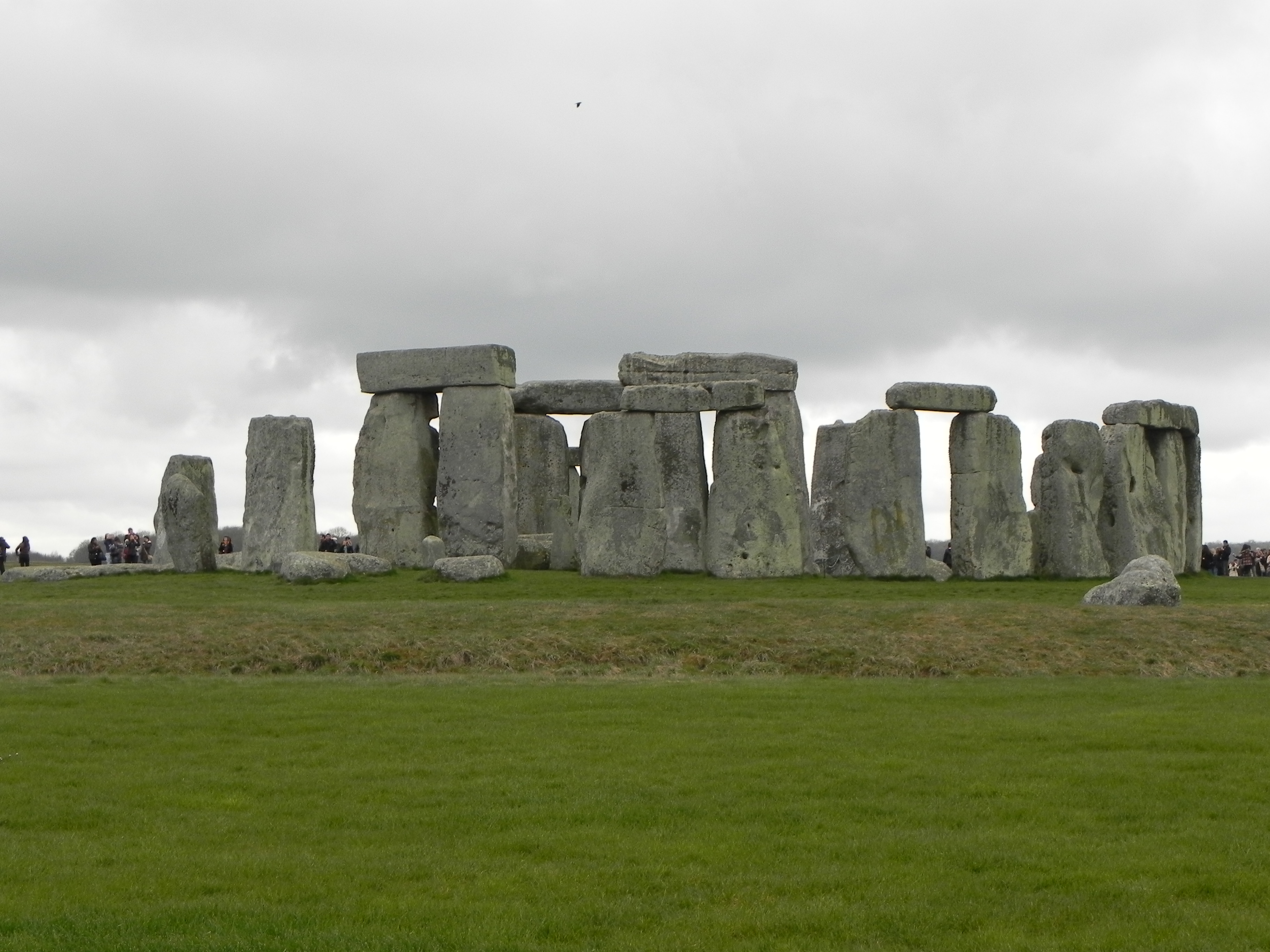
Freudians would point to Tuto Fela in Ethiopia or other phallic architecture, but my mind tends toward Rapa Nui, or Easter Island.  The human being tends to stand taller than wide.  Evolutionary biologists tell us that was to help us see over the tall grass of the savannah.  (And if you doubt grass gets that tall, visit my yard sometime in the summer.)  These monuments seem to symbolize more that the procreative architecture of male human anatomy.  They seem to point to our ability to see over the obstacles in our way.  They seem to say, when people are divided against each other the plains remain barren.  When they decide to work together, Stonehenge emerges.  I don’t know the motivations of these modern artists.  I do admire their ability to put these monoliths into remote locations without leaving evidence of how they did it.  I really appreciate those creatures that stand tall and have a spirit of cooperation, even if others just don’t see the point.


Hello, I’m Not In

I recently received two “out of office” replies to my own “out of office” message. Being a fan of futility in all forms, this struck me as a great paradigm for the modern age. Email has made vacation superfluous, of course. I was actually out of town moving my daughter back to college, so email was not high on my list of priorities. When I’ve tried to leave work without putting on a message explaining that I’m not there (I tend to respond to emails quickly for an editor, so I’m told) I’ve been politely informed that it is rude not to let people know you’re away. Or computers. My non-message prompted a non-messages from other vacationers’ email accounts, and when I returned, I had to read them as well as the original email that had received my impersonal reply. Both had sent their replies, despite their out of office messages. This is indeed a brave new world.

It is a world where human interaction is optional, at best. Our industry grinds away making devices and services that people will buy with electronic money sent over a network that no one really controls. And we think nothing of it. Business has blinded us to how meaningless humanity has become. Business runs for business’s sake. Even so, we’re asked to check our email when we’re on vacation, in case something important comes up. I used to think vacation was important. It is the sop we’re thrown for working jobs that lack the visceral appeal of growing our own food and relying upon ourselves. Thoreau on the web.

Benjamin_D._Maxham_-_Henry_David_Thoreau_-_Restored

Science fiction is the great predictor of where we might go. Most of it is completely fiction, or course, but some manages to catch glimpses of the truth. Skynet, or even the Matrix or Hal, have sent messages to us. Machines that think are devices we don’t understand. We haven’t even defined consciousness to a level that satisfies anyone. We know it because we feel it. Oh, I’m not really an alarmist about all that. I do wonder, however, where we are headed when technology races ahead while the humanities are disparaged. All those who emulate Spock seem to have forgotten that his appeal is that he’s half human. We build our aliens to specification. And they now pass polite greetings when they speed past each other on the cyber-highway with no laws.


Earthbound

Major news outlets have been raving over Interstellar, the new Christopher Nolan film. I’ve not seen it yet, and it hasn’t had the same kind of hype that Noah received earlier this year. It isn’t, after all, biblical. Still, the reviews for the movie borrow liberally from religious language. One of the obvious reasons is that the vastness, the incomprehensibility—I think I’m safe to say it here—the impossibility of space, almost demand such language. Ironically, it is considered unsophisticated to say similar things of religion, that fall-back for those of weak intellects who, well, believe the impossible. Whether science or religion, we are faced, when we look at interpretations of reality, with something we barely comprehend. Even by conservative measures, on the scale of the universe, we are somewhere around the level of a sub-atomic particle to an earth-sized universe. And yet, with great confidence, indeed, at times arrogance, we claim that we have it all figured out. God? Not possible. Science, less than a millennium old? We’ve got it all figured out. And we haven’t even stepped beyond our own satellite yet.

Having grown up in a rural setting, I was used to seeing stars at night. From a young age astronomy fascinated me. My high school, built during the era around Sputnik, had a working planetarium (and this was not an affluent community). I took astronomy as a junior elective and ran into my teacher at a weekend retreat for lay preachers. A man of science who looked at the universe and came away with wonder. On clear winter nights, away from the light pollution that has become my daily bread here in the orbit of New York City, I would shiver and look upward, knowing that I was reaching both the limits of what the earthbound could see, but also infinity at the same time. The vastness of space still weakens my knees. Even more than my age does naturally.

hs-2003-10-i-large_web

In at least one of the many interviews, Nolan admits to having been influenced by 2001: A Space Odyssey. It was the genesis of the believable space movies, giving Star Wars a jump start and we’ve been exploring deep space in our celluloid fantasies ever since. The constant in all of this is the humility of humanity. “Humility” derives from Latin humilis, literally, “on the ground.” It is no accident when the concept of divinity began to emerge that the human, or perhaps porto-human, gaze was cast upward. The gods, whatever else they might be, weren’t down here with us. They have access to up there. And even a scientist can get away with calling the sky “the heavens.” This journey of Interstellar began long before Kubrick, and we are flocking in numbers to see what the latest rendition might be. Wonder might just be what the doctor calls for on a dark night, when the hope of humanity could use a little humility.


Star Tracks

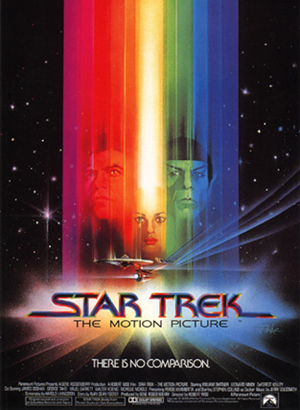
Star_Trek_The_Motion_Picture_posterLong ago in a galaxy far away—1979 in rural western Pennsylvania, to be precise—the local inhabitants were surprised to learn that James T. Kirk was now an admiral. Two years earlier Star Wars had thrilled us with special effects first mastered in 2001: A Space Odyssey but a more accessible plot. Robert Wise, who had not only given the world The Sound of Music, but also The Day the Earth Stood Still, took the helm for the new Star Trek: The Motion Picture. Star Trek geeks, of which crowd I do not count myself, hadn’t really taken their cliched role in the emerging high tech society, and CGI was still a few years off. Nevertheless, rumors in school had it that the movie featured a bald woman and had boldly gone where no man had gone before. The original crew was all there. So on a Friday night I dutifully made my way to the Drake Theater to watch and left saying, “is that all?” Star Wars was action-packed and fun, filled with archetypes and wise-cracking robots. Star Trek had Voyager 6, like E.T., trying to phone home. In a word, the movie was forgettable.

On a tour of the original Star Trek world, I finally sat down to watch The Motion Picture, with its grandly archaic-sounding name, last night. I shuddered to think I’d last seen it 35 years ago—that makes me as old as the crew was starting to look—but this time I was able to see things I hadn’t before. Spoiler alert! Voyager 6 is looking for God. The original Voyager 1 reached the end of our solar system a couple years back, but in 1979 there was no reason to suppose that we wouldn’t try again and again to reach out to parts unknown. We were rapidly become materialistic, and the universe could be a known quantity. Three centuries in the future, Voyager 6 is headed home, having been rebuilt into an unstoppable living machine. When the creator—humanity—doesn’t pick up the phone V’ger poises to wipe out the carbon-based infestation until it learns how to physically, biologically merge with a human being (cue the bald lady and otherwise superfluous Captain Decker). Lots of colorful lights and we can all go home.

Even now I can’t muster the courage to say the movie is profound, but it does touch on an issue that has only grown over time—we have voluntarily left our deities behind. In our rush to reduce the world to the least common denominator, we have pulled the plug on the cosmic phone. The Voyager program ran out of steam as the Cold War was heating up down here on earth and we were being told we were all just a bunch of atoms fooling around anyway. The machines, in the meantime, had come to believe. I probably won’t survive another 35 years to watch Star Trek: The Motion Picture again, but I do hope that in that time we may become more aware of our humanity. And I do hope that if someone divine does happen to call, that we’ll at least pick up the phone.


Room for One More

Room_237_(2012_film)

Conspiracy theories have a definite attraction. In a world where governments are more known for keeping secrets than for carrying out the will of the people, they are often easy enough to believe. Elected officials are, of course, human. Humans have recourse to prevarication from time to time, but we do expect that a corporation that takes its secular tithe from our income should be honest about its doings. So it is that I find Room 237 endlessly fascinating. Room 237 is a documentary about Stanley Kubrick’s The Shining. Winter is also an appropriate season to watch The Shining, so I took the ersatz experience of Room 237. This documentary, besides featuring some interesting conspiracies, also shows how religions may come to be.

Stanley Kubrick, as common knowledge goes, was a genius. In a day when movies are often pure escapism, much of it brainless, it might be surprising to consider a film-maker a literal genius, but anyone who’s watched one of Kubrick’s mature films is left in no doubt. The Shining, although based on the Stephen King novel, takes the story in very different directions, and there is much more going on in the film than first meets the eye. Room 237 interviews true Shining affectionados who find the “real” story line to be the genocide of Native Americans, the holocaust, a retelling of the minotaur myth, the faking of the filming of the moon landing, and a variety of other perceptions beyond the norm. Kubrick, known for the care he took in arranging every shot, clearly put subtexts into this film. What really caught my attention, however, was when one of the commentators said that he had his first real religious experience while watching 2001: A Space Odyssey.

2001 has always been one of my favorite movies. Simple and sometimes psychedelic, even with the novelization it is almost impossible to understand. With that haunting monolith, so like an outgrown iPhone, I found myself as a child believing in the evolution Kubrick suggested as a higher power led from ape to space in the instant of a bone toss. The majesty of that film that never lets humanity claim any true superiority still has the power to conjure nightmares that The Shining can’t. With the grand soundtrack of the opening of Also Sprach Zarathustra (himself the founder of a religion), I can understand how this might be a numinous experience. Movies function as modern myths, and, I contend, that is one reason that religious themes emerge so readily in great films. In Room 237 none of those interviewed considered any religious elements for The Shining, but no doubt, if an ape can walk on the moon, they’re there.


Let It Shine

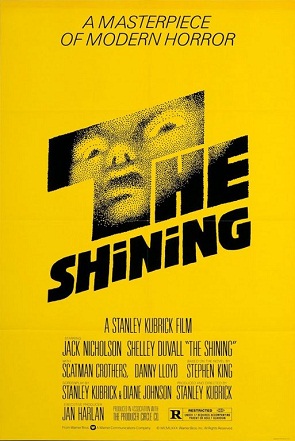
Stanley Kubrick was not the most prolific of movie makers, yet his efforts often create striking impressions. I saw 2001: A Space Odyssey at a young age, and it has remained one of my favorite films ever since. Although I’ve watched horror movies since my college years, I shied away from The Shining until about five years ago. By that point I’d seen enough clips and parodies to kind of know what to expect. Since finally viewing the original, it has become one of my most admired movies as well. Kubrick films may not be easily slotted into a genre, and The Shining is not a typical horror movie. There always seems to be something more going on in addition to the growing menace of Jack Torrance’s insanity. I’ve been hearing about Room 237 for a few months now, and I’m eager to see it. Room 237 is admittedly a movie about a movie, an exploration of how The Shining has inspired multiple interpretations of what most consider to be one of the scariest movies of all time.

The_Shining_poster

An article by Jay Kirk in the June edition of Harper’s Magazine examines this movie of a movie. Kirk is the cousin of Tim Kirk, the producer of Room 237, and offers a personal introspective of a mind under the spell of Kubrickian influence. The article, “The Shining Path: Room 237 and the Kubrick cult,” not surprisingly, keeps turning back to religion. It may be fallout from the Kirk cousins both being children of clergy, or it may be that effective horror films are, as I’ve maintained before, inherently religious. Even the meeting of the Kirk cousins takes place at Gaudi’s Sacred Family cathedral in Barcelona. It seems that there’s no way to get at The Shining without involving religion. Not that it’s a religious movie, but it may take some religion to understand it.

No doubt Stanley Kubrick was a deep man. Even those who try to interpret his movies end up adding a kind of hidden message of their own to the plethora of ideas he eloquently shot. I know nothing of Kubrick’s religious convictions, if any. Any film with the gravitas to inspire continuing hermeneutics over three decades after its release, however, will surely open itself to a kind of sanctification. The penultimate section of Kirk’s introspective focuses on Proverbs 3.5-8, a passage underlined in his grandmother’s Bible. To understand the genius behind The Shining, it seems, religion will have to be part of the discussion.