Kings and Gods

Kong has never been my favorite monster.  Perhaps because it is more of a sad story than a scary one, and in movies of gigantic animals, there always seem to be scaling problems.  The monsters are only reacting to the circumstances in which they find themselves and humans prove to be the real problem.  In ways nearly impossible to conceive, less than a century ago films like the original King Kong shocked and stunned audiences.  Humans are such visual creatures and no similar spectacle had been seen before.  I recently watched the 1976 reboot for the first time.  I’d seen clips, of course, and kids in junior high were talking about it back when it came out.  For me it was more like “if you know the story already, why see another attempt to tell it?”

Visually, there is a lot of nice cinematography in the film.  We’re all used to CGI so the animatronic Kong isn’t really believable, but nevertheless, our emotions map onto his with the prolonged shots of the gorilla’s facial expressions.  That part was effectively done.  Much of the rest of the movie left too many questions for belief to be suspended.  The heartlessness of corporations was too real and perhaps the scariest part of the movie.  Watching any movie with explosions on the twin towers brings back a kind of post-traumatic 9-11 reaction.  Prolonged, nearly Russian-length, death scenes personally don’t do it for me.

The reason I was watching, however, was for the religious aspect.  This is underplayed, but the islanders clearly worship Kong and consider him a god.  (I did wonder what he ate since no giant fruits were shown, but the immense snake tells us not all was revealed.)  In one reflective moment on the oil tanker back home, Jack Prescott says that they’ve taken the islanders’ god and their society will fall apart.  Western enterprising does have much blood of this kind on its hands.  And no matter how it’s dressed up King Kong always appears to be a racist story.  Some critics say the 1976 version isn’t horror, but instead a kind of bizarre love story.  While I don’t think much thought went into the implications—it seems the movie was a showcase of state-of-the-art animation for the period (otherwise the long scenes of Kong changing faces and blowing on Dwan make little sense)—that accidentally play into tropes of gods falling in love with women.  Maybe there’s a reason I haven’t watched any of the other reboots.

Still Evolving

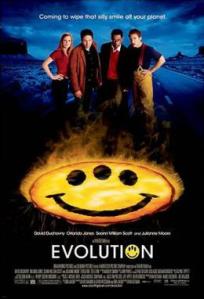
Evolution, the 2001 movie, I mean, is good escapism.  Thinking back on 2001, instead of a space oddessy, another piece of news—another national crisis, in fact, dominated.  The film kind of slumbered in the background until we could sort out what it meant to live in, ironically, an unsafe world.  That’s precisely what the movie was about.  I wasn’t thinking that when I recently pulled it off the shelf.  I was simply wanting some fantasy to relieve the daily pressure of living in stress mode.  Besides, it has some of the best alien monsters you could hope for in a comedic setting.  Soon, however, the parallels began to appear.  A source of contamination from outside.  A growing threat.  A government that doesn’t know what to do and that can’t admit its mistakes.  It all seemed eerily familiar.  Dr. Allison Reed is even from the CDC.

Life isn’t constant crisis.  Funnily enough, when Democrats are in office there seem to be far fewer of these large-scale troubles.  “There will be signs,” I guess, “in the sun, moon, and stars.”  The thing about signs is that we’ve left the reading of them up to Fundamentalists.  And Fundamentalists don’t believe in evolution.  Or science.  Or modernity.  Idealizing medieval thinking does come with a price tag.  So I reach for the remote.  While the government has lots of money that it spends on its own volition, the crisis grows.  The alien menace is set to spread across the country.  Although beginning in a different geographical location, all that red on the map sure looked familiar to me.  How little has changed in the last two decades.  Evolution came out before smartphones even evolved.

Meanwhile, practically unnoticed, the U.S. Navy has been saying UFOs are real.  The story, muted and subdued—we’ve got more immediate concerns, such as getting reelected—has been on major reputable media.  When they land on the White House lawn we’ll ask the aliens if they have respirators and masks aboard.  Preferably the kind with face-shields.  In the movie the monsters are aliens.  They’re like an infection, and even hazmat suits can’t keep you safe.  The solution, of course, isn’t fire-power, but a good shampooing.  Now I know you still can’t go to the salon in lots of places, but washing up at home seems to be pretty good advice.  We put the movie on for simple escapism, but there’s no escaping the fact that we now live in an alien environment.


Criticism Is Not Attack

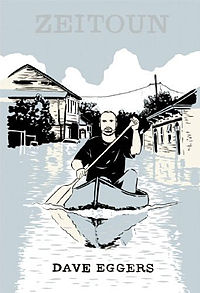
Each administration of George W. Bush was marked by a major disaster. 9-11 was followed four years later by Hurricane Katrina. The United States had received a one-two punch. I recently read Zeitoun by Dave Eggers. This is a book that should be read by every American, and it wouldn’t hurt others to read it too. This account follows the lives of a New Orleans family through the aftermath of Katrina. The main character, a tradesman named Abdulrahman Zeitoun, is a permanent resident of the United States from Syria. His wife Kathy, a convert to Islam, was American. When Katrina bore down on New Orleans, Kathy took their kids to safety with friends while Abdulrahman (known by many as Zeitoun) stayed in the city to look after the properties they owned. When the flooding had engulfed entire sections of the city, Zeitoun paddled about in a canoe, rescuing those he could, and even feeding abandoned dogs. Family and friends urged him to evacuate, but he felt he was doing good. Until he was arrested on his own property and imprisoned for being Syrian.

In a wrenching account based on interviews with Zeitoun and Kathy, Eggers describes how the US government quickly set up Guantanamo Bay-style prisons rather than attempting to rescue those stranded in their homes. Zeitoun was arrested and never informed of the charges, although he heard paramilitary guards armed with machine guns uttering “Taliban” and “al-Qaeda” at him. He watched as a mentally disabled man was pepper-sprayed by soldiers when he clearly couldn’t understand what they were commanding him to do. Despite having government issued ID and good standing as a business owner in New Orleans, Zeitoun was presumed guilty because of his profile: “Arabic” and Muslim. As Eggers reminds us, Homeland Security is now the administrative head of FEMA, and those that Homeland Security distrusts (all of us) are potential terrorists rather than citizens in need of help during times of disaster.

I grew up in a rather monochromatic part of the country, but as I traveled I met and befriended those of differing nationalities, including Syrians. Those considered “the others” by xenophobic bureaucrats are just as kind, loving, and good as those of us born under the sign of the cross with “white” skin. Zeitoun stands as an indictment of the jingoism that has come to be recognized as the only legitimate American citizenship. Zeitoun spent nearly a month in maximum security prison before being released after a makeshift trial, when no evidence existed that he’d done anything wrong. What has happened to the tired, the poor, the huddled masses yearning to breathe free? They’ve become the enemies of the state. I know, Katrina engendered extraordinary circumstances. Extraordinary circumstances, from a “Christian” view, however, demand extraordinary sympathy. Do the nation a favor. Before November, read Zeitoun.


Brave New Whirled

Today marks the triumph of capitalism. Having just finished reading Aldous Huxley’s Brave New World for the first time since my undergraduate days, I found it strangely appropriate and prescient. Huxley foresaw a bleak future where comfort and convenience outweighed concerns for truth and meaning. As the World Controller of Western Europe reveals to Mr. Savage, it was the Nine Year’s War that made people so docile that they would accept complete government control over their private lives. Read “9-11” for the Nine Year’s War, and he pretty much nailed it. Americans today put up with severely restricted freedoms because only the rich and powerful are truly free. We even have Huxley’s “feelies” – we just call it the TSA checkpoint at the airport.

“But I don’t want comfort. I want God, I want poetry, I want real danger, I want freedom, I want goodness. I want sin.” So says Mr. Savage shortly before his tragic end. The remainder of society – those willing to play along with the game, those willing to be anesthetized with the little perks the government throws their way – are already dead. “Let them eat cake.” We have our hedonistic day of shopping frenzy, looking forward to the soma of Christmas. We will comply despite the dehumanization the unemployed, the unwary traveler, the racially profiled, face every other day. As long as we have our electronic toys and the network into which they may be plugged, guide us o thou great Patriot Act. Freedom is not free. Orwell called it doublethink. Today it is doubleclick.

Novels have the capacity to say what libraries full of dusty dissertations cannot. Perhaps the future has not turned out quite the way Orwell or Huxley or Burgess predicted, but they were not far off. November has become the month of the novel. The Office of Letters and Light hosts National Novel Writing Month (NaNoWriMo for those in the know) each year to encourage others to find their creative voice. The challenge: write a 50,000-word novel fully in the month of November. I finished mine in just over two weeks. Perhaps someone who has the good fortune to break into the publishing world will once again sound that warning shot before society takes its next Huxleyian turn. But until then, anyone who says they don’t need a gramme or two of soma, well, they’re just plain lying.