Sickness unto Death

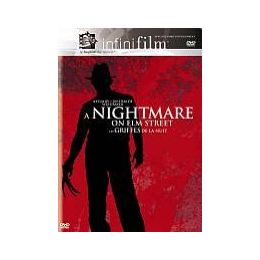
It’s like Nightmare on Elm Street, as my daughter suggested: if my laptop falls asleep, it dies. Actually, that only happens if it turns off. As much as I rail against technology, I have to admit that I get a little choked up thinking about it—my laptop has had its final reboot. Finally back home from a trip where my MacBook died in transit, the local Genius Bar genius told me the frank truth. The on-off switch has stopped working. He was able to take it in the back and get it started with a “hard reboot” and I can’t help but imagine that it involved tiny little defibrillator paddles and a techie with a trendy haircut shouting “Clear!” before jolting the little guy back to life. If it turns off again, though, they can’t guarantee that they’ll be able to bring it back to life. At five years it’s suffering the effects of old age. Planned obsolescence means that you shouldn’t get too close to your machine. Still, with all this talk of artificial intelligence, I wonder if we haven’t given this laptop life. It sits right on my lap every day. It has for five years. It keeps me warm in winter and too warm in summer. It knows my deepest thoughts.

Like Logan, however, it was only planned to live for a few years. Its crystal is flashing, and I’m getting kind of emotional. Yes, it’s been running slower and slower. Sometimes it doesn’t hear my commands. It takes its time waking up in the morning. Still, it has become like a friend. So when the disciples came to Jesus in a panic saying Lazarus was dying, he replied that the sickness was not unto death. Lazarus died nevertheless. And Jesus wept. I wonder if he would’ve felt the same about an old laptop. This machine has been with me through several jobs—it was purchased to help with my teaching at Rutgers, but it has kept me company on many long flights and lonely nights traveling for publishers and trying to remain sane when there was only a whiff of a wifi scent to latch onto. We’ve done a great deal together.

IMG_2398

It can be fixed, the genius said. I have to send it to the iHospital where a new switch will be installed. It will cost a lot of money and if it goes bad again, Apple won’t be able to replace the parts because they don’t keep them on hand all that long. The best solution—buy a new laptop. Spoken like a young man without a child in college. I’m dithering here. I can keep this computer running for a long time without shutting it down. Still, it’s borrowed time. The genius helping the next customer over said, “It’s not a matter of if a hard drive goes, it’s a matter of when.” We’re living on borrowed time. Our devices are meant to be tossed, but my gray matter understands things differently. I like my old laptop, and when Freddie Krueger comes for its soul, I know I’ll be wide awake.
Fear and Dissembling

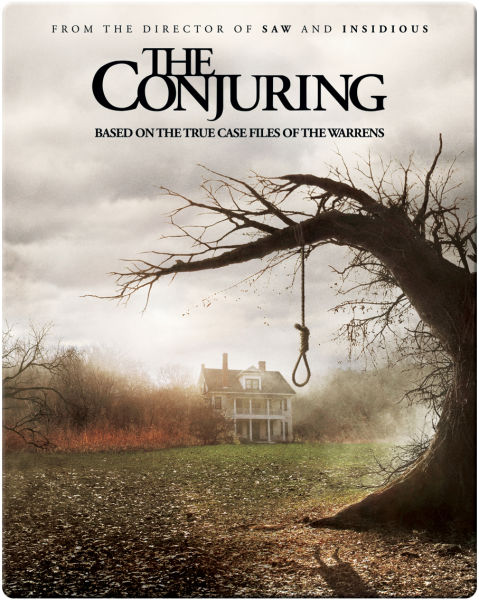
The ConjuringLast year, when The Conjuring was released, it quickly became one of the (if not the) top earning horror films of all time at the box office. Based on a “true case” of Ed and Lorraine Warren—real life paranormal investigators—the film is a demonic possession movie that ties in the Warren’s most notorious case of a haunted (or possessed) doll, with a haunting of the Perron family of Rhode Island. (The Warrens were also known as the investigators behind the Lutz family in the case of the “Amityville Horror,” showing their pedigree in the field.) Given that Halloween has been in the air, I decided to give it a viewing. As with most horror movies, the events have to be dramatized in order to fit cinematographic expectations. Apparently the Warrens did believe the Perron house was possessed by a witch. In the film this became somewhat personal as the dialogue tied her in with Mary Eastey, who was hanged as a witch at Salem (and who was a great-great (and a few more greats) aunt of my wife). Bringing this cheap shot into the film immediately made the remainder of it seem like fiction of a baser sort.

Witches may be standard Halloween fare, but when innocent women executed for the religious imagination are brought into it, justice demands separating fact from fiction. Writers of all sorts have toyed with the idea of real witches in Salem—it was a trope H. P. Lovecraft explored freely—but there is no pretense of misappropriation here. Lovecraft did not believe in witchcraft and made no attempt to present those tragically murdered as what the religious imagination made them out to be. The Conjuring could have done better here. It reminds me of Mr. Ullman having to drop the line about the Overlook Hotel being built on an Indian burial ground. Was that really necessary? (Well, Room 237 has those who suggest it is, in all fairness.) The actual past of oppressed peoples is scary enough without putting it behind horror entertainment.

A doctoral student in sociology interviewed me while I was at Boston University. She’d put an ad in the paper (there was no public internet those days) for students who watched horror movies. I was a bit surprised when I realized that I did. I had avoided the demonic ones, but I had been in the theatre the opening week of A Nightmare on Elm Street (on a date, no less) and things had grown from there. I recall my answer to her question of why I thought I did it: it is better to feel scared than to feel nothing at all. Thinking over the oppressed groups that have lived in fear, in reality, I have been reassessing that statement. What do you really know when you’re a student? As I’ve watched horror movies over the years, I have come to realize that the fantasy world they represent is an escape from a reality which, if viewed directly, may be far more scary than conjured ghosts.


Hard to Digest

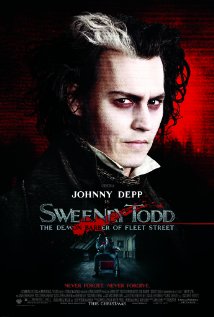
Sweeny Todd has never been one of my favorite shows, but the dark humor and gratuitous bloodshed made it seem somehow appropriate as a November movie after a hurricane. I’m referring to the Tim Burton movie, of course, and as I watched it this time I noticed a few religious themes that I had overlooked in previous viewings. The story is not complex: a barber is robbed of his young wife by a powerful establishment cad and determines that the time has come to exact his revenge. Along the way he rents a room from the hapless pie-maker Mrs. Lovett on Fleet Street and puts his murderous revenge to work supplying her with meat for her pies. The song where they hatch their nefarious plot, “A Little Priest,” is filled with innuendo and even a little social commentary. As the schemers look out at the crowds of London, several of their potential victims are mentioned as clergy.

When Todd asks Lovett if the priest is good she replies, “too good at least,” noting that its only fat where it sat. “Not as hearty as bishop,” nor “as bland as curate,” Todd observes. Mistaking a grocer for a vicar because it’s “thicker,” the duet eventually warble that the friar’s drier, but overall the clergy are “too coarse and too mealy.” Stephen Sondheim and Hugh Wheeler are not theologians, naturally, but it is noteworthy that the only role the clergy play in this film/musical, which is ultimately about social justice, is as fatty meat. When Benjamin Barker is wronged, the clergy are never mentioned as recourse or balance to a corrupt official. The church is simply establishment, a comfortable and expected part of the environment.

Johnny Depp portrays a mostly believable sociopath, interestingly reversing his first big screen role in Nightmare on Elm Street where he is the victim of a psychopath with razors for fingers. Edward Scissorhands, another step on the evolution from victim to perpetrator, found Depp with blades for fingers. In Sweeny Todd he declares with a straight razor held aloft, “at last my arm’s complete again!” The pattern here is a sad but familiar one. The victim who finds no redress in society adopts the role of the vigilante or the perpetuator of victimization. Who might step in to interrupt this cycle if not the clergy? But to return to “A Little Priest”: Todd observes that what the world terms business as usual is really one man eating another (this is, after all, patriarchal Victorian London). This may be the piece that at last makes sense of the puzzle. What is truly diabolical is not one man’s revenge, but the system that insists all play by the rules of genteel cannibalism while persistently calling it civilization.


Friday the Sixth

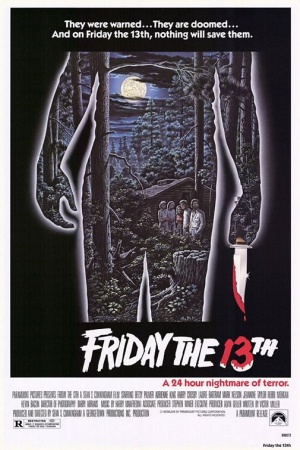
I tend to run behind on the movie front.  In some cases, decades behind.  I have never been a fan of slashers, although I did take a date to A Nightmare on Elm Street in the staid, dry town of Grove City while in college.  We broke up shortly after.  Still, I have a soft spot for “the classics,” and Friday the 13th has spun enough sequels to qualify.  “Jason” is a household name for the heartless serial killer, and the movie is set in New Jersey.  And it was hot outside and lazing on the couch trying not to stick to myself seemed about as much of a challenge as I could handle. Besides, a week from today is Friday the thirteenth. Now that I’ve finished with the excuses, here is a declarative sentence: I finally got around to watching Friday the 13th.  After many other films I’ve seen, I have to say that it didn’t really qualify as scary.  You know in advance that the counselors, by rote, must by killed in what are supposed to be shocking ways.  Shadowy corners and rainy woods and aluminum canoes are to be avoided, if the movie and its successors have taught us anything.  Nevertheless, the religion and scary film equation still applies.  And a strange kind of throwback to an unexpected classic (the literal kind).

The religious element comes in the form of the stock crazy local named Ralph.  Ralph warns the kids that they will die and says he’s been sent by God to warn them.  Of course they don’t listen.  If they had, there would have been no movie. As a child I was always offended by the caricature of the religious crazy, but I have come to see that this stock character is itself a symbol of fear.  Although ubiquitously laughed off, the person passionately driven by religion is indeed a potential danger to society.  In the days of my innocence we had little hard data upon which to hang such fears.  In the post-9/11 world it seems there are far too many sky-hooks for that purpose. Some of those sky-hooks are a little closer to the ground, but they inspire fear nonetheless. I’ve known all along that one of the reasons I watch scary movies is to give myself some advance warning of what might go wrong.  Not that it would help in any real way, but sometimes avoiding the shock by anticipating the worst seems like the only human thing to do.

What about the literal classic that I mentioned? Beowulf falls outside the Greco-Roman period, but is clearly a classic of English literature.  (Spoiler alert for anyone even more behind the times than me—) The only thing scarier than Grendel was, of course, Grendel’s mom.  So in Friday the 13th, the killing is done by Jason’s mom.  Like Grendel, Jason dwells underwater and surfaces to pull down his victim(s).  Like Grendel’s mother, Jason’s mother is decapitated by a sword (actually, a machete in the modern version), on the shore of the Crystal Lake.  After the mother’s death the child (Jason/Grendel) is resurrected.  Whether it was intentional or not, there is a lot going on here. The sacrificial mother is an inherently religious theme although many formal religions make it a male prerogative. The death of the mother brings the son back to life.  I wonder how Christianity might have differed if instead of three male deities, there had been a divine mother.  In such cases resurrection of the son comes only at a very steep price. Just like watching Friday the 13th on a hot summer night.


Monsters Are Due on Elm Street

November 1984. George Orwell’s dark vision had not fully emerged, but the veneer had worn off of the fairy-tale world promoted by the evangelical, free-market professors at Grove City College. As a blue-collar kid in a blue-blood institution, I was out of place. The campus was buzzing, however, about a new movie—A Nightmare on Elm Street—for which I finally plucked up the courage to ask a cute coed for a date. I’d never seen a slasher movie before, having sampled mostly traditional monster-flick fare as a child. I felt a sense of accomplishment since some of my college friends had to leave the theater for fear. On the big screen, with no previous knowledge of the plot, the film worked for me on many levels. Last night I decided to watch it again.

My first reaction was a sense of surprise at how much of the movie I still recalled with pristine clarity. For having been nearly thirty years ago, such clarity is a rare phenomenon for many details of life, often reserved for memories of early girlfriends. A second reaction was noticing how religion featured in the film. The girls skipping rope chant, “One, two, Freddy’s coming for you / Three, four, better lock your door / Five, six, grab your crucifix.” Indeed, the crucifix features in several scenes as an ineffectual weapon against Freddie Krueger. The days of defying vampires are over when your own subconscious turns on you. In one of the early chase sequences, Freddie, raising his infamous glove, says, “This is God!” Religion and its overarching concerns with death and suffering come together with horror in that one moment. The traditional power structures of religion have lost their power to defend the troubled teenagers. The only one well adjusted is, ironically, Johnny Depp’s Glen. Even he falls victim to the revenge sought by Krueger.

Surprisingly, the scene I had most trouble recalling was the end. I recollected the bright, hazy sunshine, but couldn’t remember how Wes Craven released his audience from the drama. Of course, there is no end. Freddie came back in countless sequels, none of which I ever watched. Although I wouldn’t know it at the time, Robert Englund based the screen presence of Freddie on Klaus Kinski’s Nosferatu in Werner Herzog’s classic remake of that silent gem. Freddie is the vampire that defies religious cures. Movie villains are among the most adept practitioners of resurrection on the silver screen. The occasional E.T., Neo, or Spock will come back from the dead, but those who repeatedly return are the denizens of our nightmares. As Orwell’s vision continues to unfold in subtle ways, 1984 looks like an age of innocence before the ineffectual god worshipped by the establishment became self-image, writ large, on Elm Street.