The Great Slumbering

Even in days of secular education—I am a product of public education throughout my childhood—Jonathan Edwards is a name that still retains recognition among many Americans. Perhaps best remembered for his sermon, “Sinners in the Hands of an Angry God,” Edwards thrived at a time when being a clergyman was a recognized path to success in this world as well as the next. Not that all ministers became famous, of course, but those with the inclination had access to books and time to study. They could write books and influence public policy. Indeed, Edwards was part of the “Great Awakening” that spread throughout the young United States, before its independence. George Whitefield had brought a showman’s sensibility to preaching, and people gathered to listen to roving reverends who brought their wisdom to new locations. In fact, revivals continue to this day—I had attended a few as a child—and they are largely responsible for the denominational map of American Protestantism even today. The “Second Great Awakening” brought Methodists and Baptists into the mainstream to stay.

The first major revivals, however, were fueled by a Calvinistic intensity. Having spent many of my educational years in schools established or supported by Presbyterians, I know their theology well. Judgment is important in the Reformed tradition. Indeed, without the element of threat, the heat is stolen from much of revivalism. Edwards’ sermon encapsulates so well the vital element of a theology that preached total depravity, unconditional election, limited atonement, irresistible grace, and perseverance of the saints. In other words, unless God has already selected you, you’re out of options. As Presbyterian teachers were eager to state, you should still try to live as if you were saved (“elect”), even if you were going to Hell because of, well, you know, an angry God. Campus rules at Grove City embodied that ethic in a real-time way.

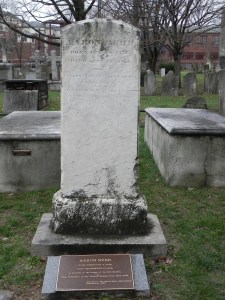
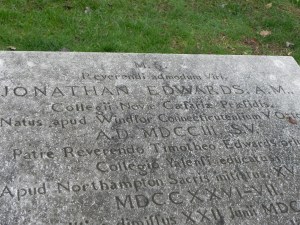
Jonathan Edwards went on to become president of Princeton University (the College of New Jersey, at that time). He died at about my age, having been inoculated for small pox—he was a believer in science—to demonstrate the value of the practice to students. He contracted the disease and died merely weeks later. Ironically, Edwards felt he was past his prime and had to be persuaded to take an academic job—somewhat of an extreme rarity today—and largely because his son-in-law, Aaron Burr, Sr., had recently died as the incumbent. Today, starting on the path to ministry is often a fast-track to job insecurity, popular derision, and poor earnings. For all that, it is difficult to be accepted in the ordination track without jumping through many hoops. So Jonathan Edwards came to rest in Princeton, New Jersey, as a famous, published, and highly respected man. A more different world then his in such a short time in the same location, is hard to imagine.
DSCN6140


Hamilton

Religion and politics. It’s difficult to get over the wisdom instilled in your earliest years, and I was one of those who learned that religion and politics always cause potential friction in polite conversation. They are both, however, very important to people and knowing how to communicate about them irenically is a sign of maturity. While I can’t afford Broadway shows, I have read reports about the brilliance of a couple shows that feature—what else?—religion and politics. “Book of Mormon” has continued to be a success in the theater district, and, starting this summer, “Hamilton” joined the ranks of most popular Broadway shows. A hip-hop-inspired version of the story of Alexander Hamilton, the show offers history to audiences traditionally just out for a good time. I haven’t seen the show, but on a recent long car ride, I listened to the soundtrack and I have to admit that I haven’t stopped thinking about it since. Part of the reason is the sadness of the story—the dual between Aaron Burr and Alexander Hamilton ended up with one of the “forgotten founding fathers” dead, and another cast forever as a criminal.

IMG_2652

Although my interest in history has defined my career (such as it is), I don’t pretend to know much about the revolutionary period. One of the reasons is that I’m more than a bit ashamed by the treatment of American Indians by the colonials. It is hard to celebrate when you feel like a criminal yourself. Another reason has been that ancient history has always captivated me, and events two-to-two-and-a-half centuries ago feel too recent. Nevertheless, I find myself in New Jersey where much of the Revolution played out: Washington crossing the Delaware, the Battle of Princeton, the Battle of Monmouth, and many other famous episodes. The British of that time enjoyed the power of empire—keeping others down so that the privileged might see themselves entitled. In the musical, King George has a role, in my mind, similar to Pontus Pilate in Jesus Christ Superstar.

I can’t help but think that what Lin-Manuel Miranda has offered in “Hamilton” is an extended kind of parable. The show is noted for its multi-ethnic cast in a story that was almost entirely, historically speaking, one of white privilege. Who can hear the songs swirling around the shooting of Hamilton and not think of the equally insane shooting of young African Americans who, like Hamilton, have no intention of causing harm? There are writers and poets and lovers who still try to find their place in a country that bathes the uber-rich with adoration and tax breaks and far too much power. “Hamilton” may, if people actually pay attention, turn out to be revolutionary. Politics and religion share that feature in common.


Thoughts in a Cemetery

DSCN6136

Being distinguished, indeed, getting noticed, is increasingly difficult to accomplish. When you read a lot of history, you realize that anyone who managed to write coherently in the past few centuries seldom had difficulty getting a publisher, for instance. The key to getting noticed was publishing books, or being lucky enough to have landed a highly visible job. I was reminded of this, and was given a slight inferiority complex, by a recent visit to the Nassau Presbyterian Church’s cemetery in Princeton. I’ve gone by this cemetery dozens of times, but only recently took the time to get out and explore.

DSCN6129

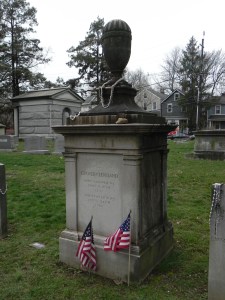
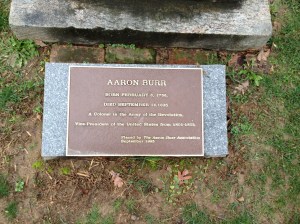
History buffs will know that Aaron Burr is buried there. Burr was from a family of privilege; his father Aaron Burr, Senior, was one of the founders of the College of New Jersey, better known by its current name of Princeton University. The vice-presidential Burr was also the grandson of Jonathan Edwards, who also rests in this very graveyard where one hopes God is somewhat more forgiving of sinners than rhetoric might suggest. Although he was the third Vice-President of the United States, Aaron Burr is now remembered for killing Alexander Hamilton in a duel not far from where my bus rumbles every workday. One kind of conflict exchanged for another. This odd and tragic duel ended Hamilton’s life and Burr’s career. As the bad boy “founding father” Burr has found a number of supporters posthumously. His grave is perhaps the most celebrated in Princeton. This despite the fact that President Grover Cleveland is only a few yards away.

DSCN6122

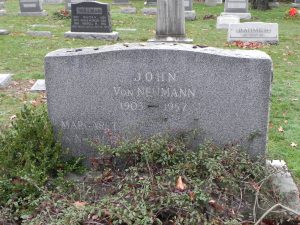
There are, however, more enlightened minds buried here as well. Being in the presence of Kurt Gödel and John von Neumann is a humbling experience. The presence of Albert Einstein, perhaps Princeton’s most famous resident, is, however, missed. Einstein was cremated and his ashes scattered at an undisclosed location. Standing in the cemetery in which so many of his compatriots rest on an overcast, damp December day, it felt like some slight compensation. Political power and ambition often lead to obscurity. I look to those who would be president and shudder. Here in this quiet cemetery, thinking of the common fate of us all, self-aggrandizement seems to be in such bad taste. Einstein, as so often, had it right. Those who are truly noteworthy seldom leave any traces in this world.

DSCN6123