Trial and Error

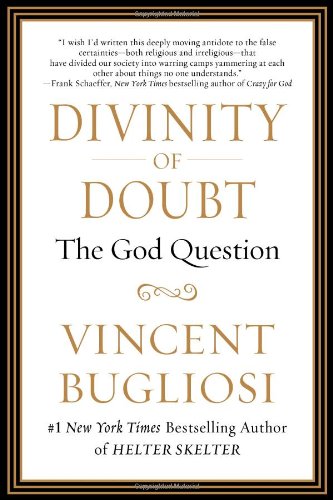
DivinityOfDoubtI’m not a fan of true crime. It seems that daily life has enough drama for me without reading about the truly dark aspects of human behavior. Nevertheless, I appreciate those who spend their life taking on perpetrators of evil. I haven’t read any of Vincent Buliosi’s true crime books, but I was curious about how a famous trial lawyer would treat the question of God. Bulgiosi’s recent book, Divinity of Doubt: The God Question, is a glimpse into an active, agile mind that is innately curious about the issue of the divine. Neither believer nor atheist, Bugliosi makes a strong case for agnosticism. He has no time for the nonsense of many religious beliefs, and like a lawyer, won’t let shoddy excuses such as “it’s a mystery” justify unacceptable answers. Many Christians (especially) would find his unrelenting logic a little distressing. If we accept reason, he fairly demonstrates, the God of traditional Christian design is not possible. Still, he acknowledges that religion has very positive aspects.

Before the angry atheists can begin laughing, however, Bugliosi turns his sharp mind to the arguments of Dawkins, Hitchens, and Harris to show how none of them really make a strong case for atheism either. He notes, as Dawkins does at one point, that proving the absence of God (or anything, for that matter) is not logically possible. There’s always the possibility that, beyond the edge of what you’re arguing, the object in question may lurk. Nevertheless, a strong case might conceivably be built, but Bugliosi declares that it hasn’t. Many atheists attack religion and think they’ve destroyed God. Not that Bugliosi is a friend of God. Indeed, to borrow a title from one of his nemeses, C. S. Lewis, he might have called his book God in the Dock.

Divinity of Doubt is one of those books that throws many questions open. Being an agnostic, of course, Bugliosi is fine with that. Although the book is enjoyable and thought-provoking, there are a few uneven parts. It is difficult to keep logical rigor at fever pitch continuously. Some, no doubt, will find his doubts about evolution puzzling. Others (or the same) may find his understanding of death a little under-developed. Nevertheless, it is refreshing to read a clearly thought-out account of how the proof and disproof of God are equally problematic. Some things you just can’t know. Don’t say that it’s a matter of faith, however; Bugliosi won’t let you get away with that. At times funny, written with verve and wit, this account keeps the reader moving along, even though most people will find something to seethe at along the way. Don’t let it lead you to crime, though, because you wouldn’t want Bugliosi on the prosecution against you.
Believe Eve

While NORAD has already begun to track Santa with DSP (Defense Support Program) satellites, and last-minute shoppers are being bombarded with Christmas carols to cinch out that extra dollar or two, it may be odd to consider the music Sine Nomine by Ralph Vaughan Williams. Better known as the music of the stirring hymn “For All the Saints,” Sine Nomine (“without name”) is some of the most inspiring music of the liturgical year. I remember a friend once leaning over after the hymn and whispering, “hard to believe it was written by an agnostic.” Vaughn Williams was an Anglican agnostic. At this time of year his piece “Hodie: A Christmas Cantana” may be heard in the households of anglophiles around the world. “Hodie” (“this day”) is an anthology of poems set to Vaughn Williams’ music. One of the poems, “The Oxen,” was written by Thomas Hardy. I really never paid much attention to it, until my wife pointed out the words and the liner notes by Alain Frogley on our CD of “Hodie.” Hardy’s poet recalls believing in his youth that oxen kneeling (as oxen do) was a reverential act on Christmas Eve. Now as an adult, the poet writes that if someone should invite him to see the kneeling beasts, “I should go with him in the gloom, hoping it might be so.” Frogley’s notes point out that Thomas Hardy, like Vaughn Williams, held a “complex agnosticism.” It is not the solid rejection of the divine that is all the rage these days, but a difficulty in believing something that is hard to let go. And Santa flies over Russia.

Faith can be a many faceted stone. We keep the myth of Santa Claus alive for our children, thinking it merely harmless fun. Then comes the moment of truth. Some prescient children at that point begin to extrapolate: what else have you been telling me that isn’t real? That the creator of an infinite, but expanding universe took time out of a busy schedule to be born in a cattle stall in Bethlehem two millennia ago? That a government might turn on its children and kill them rather than face a challenge to literal, kingly authority? That emissaries from the Middle East might come with rare and precious gifts? That Santa visits that homeless man I saw curled up on a corner of Seventh Avenue last night under a black umbrella as chilly rain pelted New York City? So much to believe!

Screen Shot 2013-12-24 at 6.59.21 AM

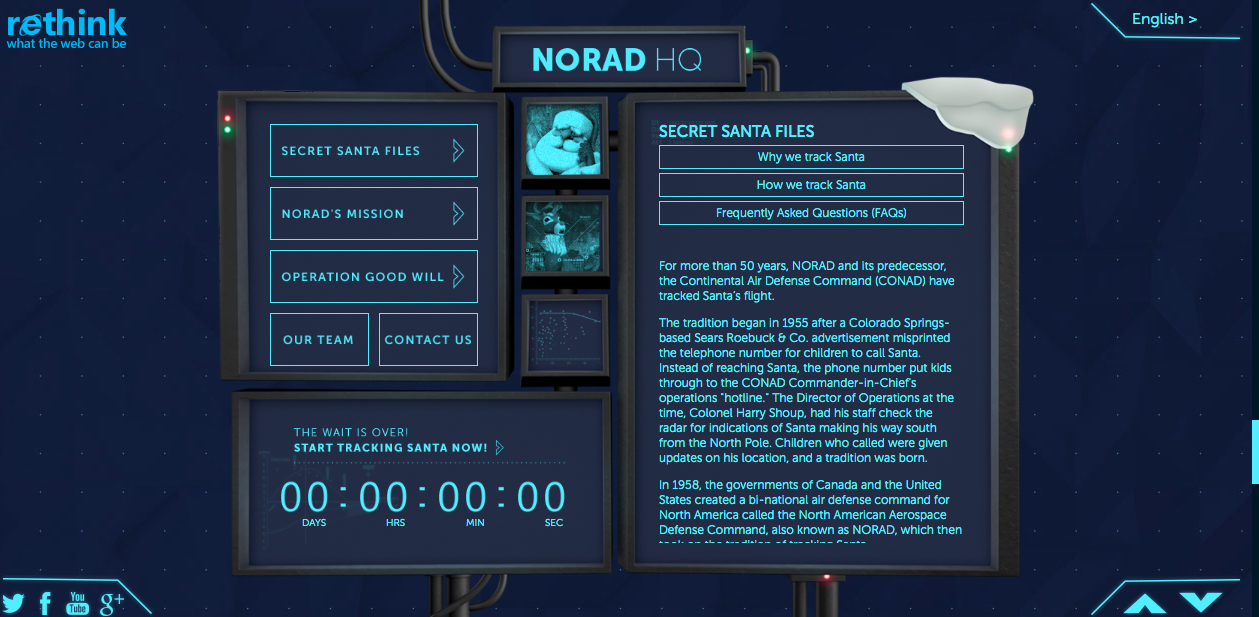
I once held a secure job in an anglophile seminary. The music of Vaughn Williams was often heard to echo through St Mary’s chapel, and many myths were propagated. Standing out under a frigid, clear Wisconsin night, it was almost possible to believe that Santa was up there somewhere, being tracked by North American Aerospace Defense Command. Yes, the oxen would be kneeling on such a night. This morning before dawn, I glanced at NORAD’s page. I saw the words “Secret Santa Files” and my mind flew to NSA. A government that keeps track of our personal emails and private phone calls even holds secret files on fictional characters whose motive nobody ever questions. Truth in advertising indeed. So, on this Christmas Eve, I imagine myself out among the free range cattle and sheep of first century Judea and there I happen upon two shivering artists in the dark, huddled around a campfire while others claim they hear angels singing. Vaughn Williams and Hardy exchange knowing glances, and Herod prepares to roar his decree from his one-percenter throne.


Who’s to Say?

Stereotypes are so easy to fall into. Having been “typecast” myself, early in my career as a “seminary professor” and a “conservative”—neither of which matched my mental outlook at all—I eventually had to abandon higher education as a career option. Why did I take a job that didn’t fit? If you’re asking that question, obviously you missed the 1990s. It was a brutal time to be looking for a job; there was this recession… wait a minute. What decade was I writing about again? In any case, many people will always remember me in the various roles I’ve played as I sought to actualize my ideal career. It is always interesting to see how others break out of their expected roles into new venues. Penn Jillette of Penn & Teller has established a reputation for speaking his mind. To those with limited experience, such as myself, he is stereotyped as a “magician,” more specifically, a “bad boy magician” who gives away the secrets of the guild. To find out that he is a writer was a kind of epiphany.

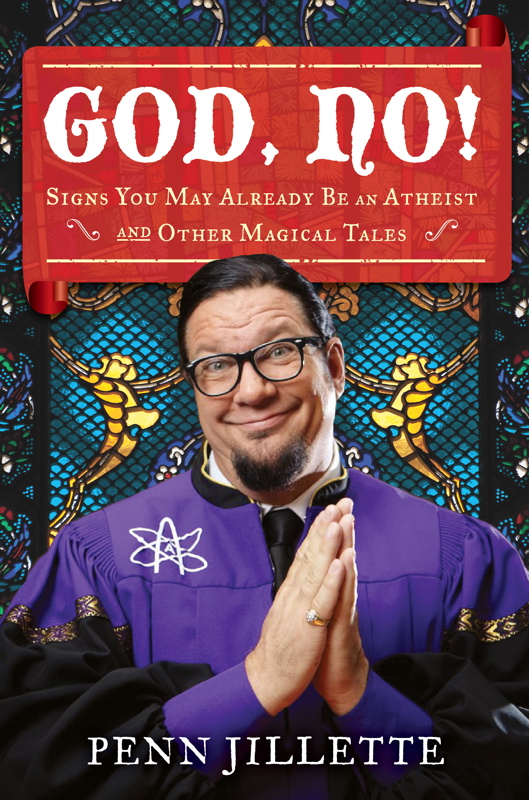
I read his new memoir/confession, God, No! this past week. I’ve always been cognizant of the strangeness of a world where someone may speak authoritatively on the basis of star status, but Americans love their performers. I’ve enjoyed the Penn & Teller acts I’ve seen on television, and after reading Penn’s book, I think I would like him in person. I can’t agree with him much of the time, but his honesty and good moral sense are very winning. I seriously cannot remember the last time I read a book that made me snort out loud with laughter or try to sink even lower on public transit so the polite person sitting next to me would not be able to see all the profanity on the pages before me. The book itself very loosely follows the Ten Commandments, which, surprisingly, the author largely agrees with in principle. The essays are all over the place, but the libertarian spirit is difficult not to admire. His appreciation of rational explanations for the world is admirable.

Probably the most difficult point of agreement for me, however, is his definition of an atheist as anyone who do not know if God exists. He does have a chapter lambasting agnostics, but as a stickler (as much as anyone in religious studies can be a stickler about anything) for definitions, it is useful to distinguish atheism and agnosticism. Saying one does not know is not the same as declaring one is certain. Since the existence of God can be neither proven nor disproven, those who say God does not exist believe that assertion. Those who say God exists also believe their assertion. Objective knowledge, in our current state, is not possible. I had to agree, in the final chapter, that faith causes most of the problems we find associated with religion, but I’m afraid faith is a huge part of the human condition. God, No! is not for everyone. Those who read it will, nevertheless, find an author as convinced as any evangelist that he’s right. And if they are honest, they will have to admit to having laughed along the way.