Down to the Sea in Ships

On the final day of our Charleston odyssey we toured the USS Yorktown, an aircraft carrier dry-docked at Point Pleasant.  One of my uncles served on the Yorktown between the Korean and Vietnam wars and was able to show us around.  What really struck me, as often does with military matters, is just how advanced our engineering is when it comes to war.  The aircraft carrier was invented to meet a belligerent need: to convey aircraft close enough to other nations to support air strikes against “targets” there.  These targets consist of living, breathing human beings, at least in part.  But the technical problems, where I’d rather focus this post, were formidable.  How do you land a plane moving at 200 miles per hour on a moving ship with limited runway?  And how do you do it without tearing the plane apart from the sudden deceleration?

Carriers have steel cables stretched across the landing strip.  A tail hook on the plane, or later jet, would catch a cable, wound several times below deck to increase the ratio of force (as with a pulley), to add enough play to stop a plane without the forward motion tearing it apart.  Five cables stretched across the deck and the ideal was to catch the third one for an optimal landing.  Each landing (which could take place 30 seconds apart) was filmed and analyzed for improvements.  Listening to the technical nature of all this, and knowing that such things had been invented some eighty years ago, made me wonder, yet again, at how creative human beings are.  And made me ponder why so much of our creativity goes toward war machines.  Just think of the problems we could solve if we all worked together!  Instead, Putin covets Ukraine, Trump covets everything, and we fall in line behind them.

I’ve written on such topics before.  I took a self-tour of the USS Midway while in San Diego as part of a business trip back in 2014.  The tech there was perhaps a bit more advanced as this was a nuclear carrier.  Standing on this deck, however, thinking how this one ship costs more than I will earn with a lifetime of education and employment, leaves me a bit reflective.  Those who push for wars are often those on their knees praying for the second coming.  The rest of us, content with the first coming, think how the message of love and peace seems to have been swallowed by a whale.  But this ship is larger than any whale, and, I’m told, much, much more expensive.

Only Midway

Unlike some employers, my current one sees the wisdom in arriving early for a major conference. The American Academy of Religion and Society of Biblical Literature is meeting in San Diego this year, and for those of us in the New York area, it’s about as long a flight as you can have in the lower 48. Having arrived in good time, and not knowing much to do in San Diego (I don’t know of any famous writers from this area whose childhood homes I might haunt), I ended up walking to the USS Midway. I’ve never been on an aircraft carrier before, and, on the eve of a religion conference, it was a strangely moving experience. Maybe it was the recognition that I was standing on a floating city on which many people had died in various wars. Perhaps it was the fact that this was a massive piece of machinery designed for its destructive potential. Or it might have been the sheer determination that appeared in every placard: this was a cause we had to win.

No doubt, the Second World War was a just cause. The force of destruction had to stop and the aircraft carriers that enabled the war effort were a huge feature in the “Pacific theater.” Staring at these massive jets, the finest technology of their day, I knew that our greatest efforts had been poured into violence. These were not mere deterrents. Yes, people had died here, but those launched from these decks also killed. War makes claims that way. As I pondered these sobering thoughts, I came to the chapel. Obviously I had to see. An eerie recording of “Eternal Father, Strong to Save” came over the speakers as I walked in. Yes, those on a warship are in peril on the sea. If they are successful, others will have died.

IMG_1797

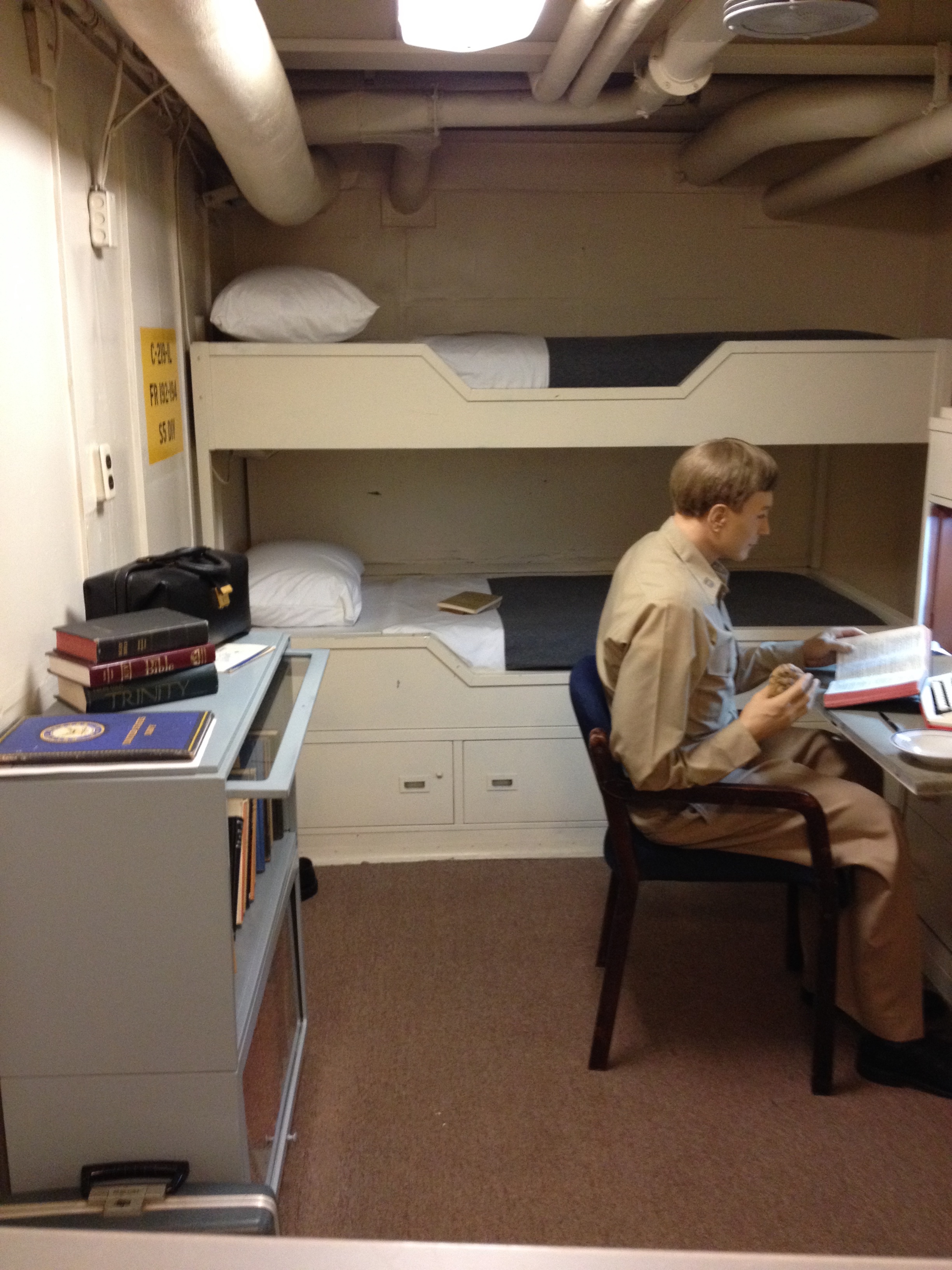
A little further along the corridor (or is it “hatchway”?), I came upon the chaplain’s room, along with my first Bibles of the trip. (I knew they would be here.) A mannequin of the chaplain, cookie in one hand, Bible in the other, sat, apparently, preparing a sermon. What does one say to those going to war? God is on our side, obviously. But what more? The Bible does not forbid warfare. It was a way of life in the centuries during which it was composed. We like to think we may have advanced since then. But as I prepared to exit back onto deck in the warm California air, I passed a display of aircraft carriers past and present. More sophisticated, more deadly weapons continue to be built. And in this day of nones, I wonder who their chaplain might be.