Strange Chemistry

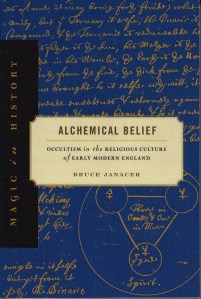
AlchemicalBeliefOne of the many antiquated beliefs that have been left behind over the centuries is alchemy. Today we tend to think that anyone who supposed natural substances could have been transmuted into others must have been naïve at best, or credulous at least. Bruce Janacek’s Alchemical Belief: Occultism in the Religious Culture of Early Modern England sheds light on the wider worldview of the alchemists. Some of them, anyway. Firstly, it is quite clear that many adepts of alchemy were very intelligent people. We easily forget that in addition to rewriting the laws of physics, Sir Isaac Newton practiced alchemy throughout his adult life. There’s something incredibly beguiling about the idea of an underlying unity of materials. Today atomic theory has answered that unity, perhaps a little too well. And that bring up the second important insight in Jancek’s book: alchemists often had an ulterior motive.

Early modern alchemists (think of those emerging from the wake of the Reformation, and you won’t be far wrong) often had a religious motivation for their work. Alchemy isn’t just turning base metals into gold—that’s just its most spectacular claim. Janacek points out that several alchemists were also attempting to prove the legitimacy of Christian theology through their explorations. Concepts as strange as the Trinity, or even the divisions of Christianity itself that were happening in the shadow of Luther, indicated to ordered minds that theological truth must be a unity. That unity, once found in alchemy, would naturally apply to the world of the church. The church, after all, can’t defy the very laws of the universe, can it? These early scientists accepted that there might also be a mystical element involved. Some rejected that aspect, but felt that the basic ideas of alchemy itself were sound.

Like dinosaurs, alchemy pretty much went extinct with the onset of the empirical method. Also like dinosaurs, it survived into the new age, transmuted in form. Alchemy was one of the ancestors of that bane of college students everywhere: chemistry. We tend to forget that astrology laid the groundwork for astronomy and creation (not quite an “ism” in those days) led to the study of biology. Religious ideas underlie much of what led to modern science. Religion, after all, indulges the curiosity of humankind. We are allowed (in the best instances) to let our minds range where they will. Later on theology, or some such device, will rein them in, but until such a time the psyche is free to explore. And build systems. And offer explanations. The alchemy comes when all of this is taken from the hands of natural philosophers and put into the laboratory only. And the rest of us await pronouncements from above of what might be real, or not.

Magic Faith

MakingWe all like to believe we don’t believe in magic. In this day of sophisticated materialism, the idea that unseen forces might work upon the world seems terribly naive and not a little embarrassing. Randall Styers’s Making Magic: Religion, Magic, and Science in the Modern World has been on my reading list for a few years now. Not so much a history of magical thought, Styers offers a history of thought about thought on magic. There are several takeaways from a study like this. One is that magic and science share common ancestors. In fact, some theorists trace the origins of science to magical thought. The height of alchemy was also the period when experimental analysis of the natural world was blossoming. There was a mysterious sense to what we now think of as impassive particles whirling around for no particular reason. Making Magic makes clear that we can’t divorce developed thinking from magical outlooks. In many ways it is difficult to distinguish religion from magic.

Not that Styers advocates magical thought. He does, however, invite us to think about it. Another takeaway from this study is that magic, when described by religious writers, is a foil. Magic is used to show how the unenlightened think about things. Those of us here in the true light would never think such backward thoughts. Indeed, magic, as Styers makes clear, often served as a kind of social control. Lower classes think magic works wonders. The upper classes know that power lies in exploitation. Magic, in other words, can’t be divorced from politics. Those in the know would only encourage magical belief to continue. Invisible forces indeed.

Magic as a regulatory force is indeed the thesis with which Styers is working. The difference between prayer and magic is somewhat effaced when closely examined. Religious belief is seen as benefiting society while magic is for selfish benefits. I do wonder, however, where the modern magical religions, such as some branches of Wicca, would fit into this scheme. They also seek the good of society. Magic need not be selfish. Making Magic is concerned with the analysis of magic by scholars who’ve shown a surprising interest in the topic. It doesn’t really address those of today who, after finding the atomic world strangely vacuous, have turned to magic to re-enchant a world grown dull and dry. Whatever one may say about magic, it still exists, and its believers are among us. Our world with its solemn, feelingless answers could, at times, use a little such conjuring.


Gnostic Agnostic

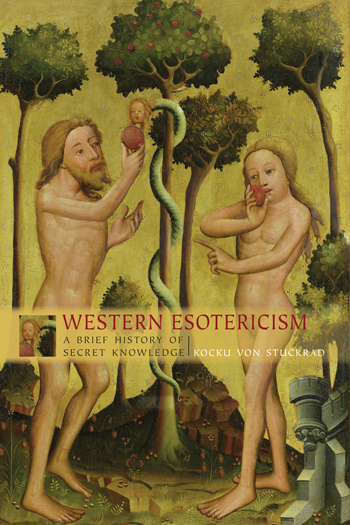
ACU-Stuckrad-WesternEsotericism-COVER.indd Hidden knowledge is sweet. Belief in it is very old. Kocku von Stuckrad’s Western Esotericism: A Brief History of Secret Knowledge offers its own kind of hidden knowledge—well, it’s not so much hidden as it is simply ignored—that even science owes a debt of gratitude to the draw of the esoteric. We are trained to treat such “New Age” ideas with contempt from our tender years, and we are assured that the light of reason has dispelled the gloom of occluded wisdom. Von Stuckrad, however, clearly demonstrates that the desire to explain our world streams from the same font as the belief that a larger, if hidden, reality lies behind what our senses perceive. Such ideas originate in antiquity and continue in various forms up to the present. The impetus to explain it all shows in Galileo’s belief in astrology as well as astronomy and Newton’s fascination with alchemy as well as calculus. Great minds have always been willing to be stretched.

In more recent, and self-assured, days vocal spokes-folk have declared a single way of knowing, and it is empirical and imperial all at the same time. That which cannot be explained rationally cannot be explained at all. Still, our experience of life often suggests otherwise. Sometimes it feels as if science overuses the coincidence excuse, and maybe there is something more going on. The esoteric, without fail, has been assigned to the category of religious thought because, in the current paradigm, the only real opponent to science is religion. If it’s irrational, it must be religious.

Ironically, von Stuckrad’s research demonstrates that the culture that led us to science, in many ways, has its basis in esoteric beliefs. That gnawing suspicion that not everything is explained by numbers and experiments has been with us since the days of Gobekli Tepe, the pyramids, and Stonehenge. Each of these monuments (and many others besides) were astounding feats of engineering—and engineering is applied science—while all being profoundly religious. Science in the service of the unknown. Such complexity need not be considered naive; even scientists can be subject to religious ways of thinking. Von Stuckrad does not advocate esotericism in his book; he merely documents it and treats it non-judgmentally. There is perhaps a hidden lesson here for all of us as well. Instead of declaring a single heavyweight champion of all the world, perhaps true wisdom lies in being fully human with all its complexity and contradictions.