Six-Hundred and Sixty-Six

I have to confess to never having read a biography of Aleister Crowley.  I’ve known of him since I was a teenager, however, since you can’t read very much about esoteric stuff without running into his name once in a while.  Crowley was famous for starting the religion called Thelema, revitalizing interest in magick (the additional “k” was to distinguish it from stage magic), and for generally being a bad boy.  In fact, he declared himself the “wickedest man on earth” and liked to be called “the Beast” and loved the number 666.  It was the latter point that caught my attention recently.  In pop culture, 666 really only took off after The Omen.  (Movies often dictate, or at least inform, our religion.)  Crowley, who lived much earlier than the film, saw the marketability of 666 and I wondered how it caught his attention.
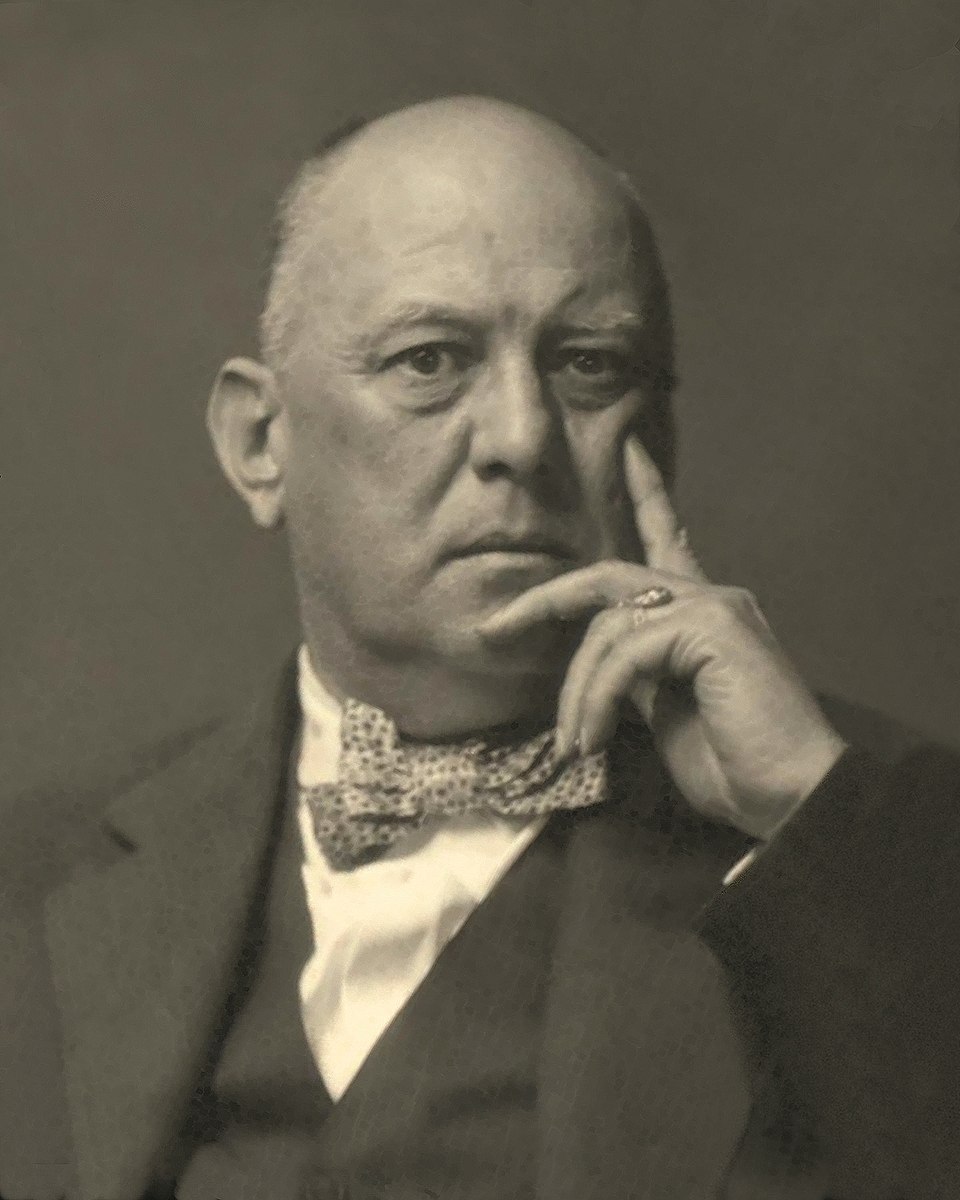
Aleister Crowley, public domain via Wikimedia Commons

As I recently posted, the end of the world as we know it is a fairly modern construct.  I happened to be reading about Crowley recently and learned that he was raised in the Plymouth Brethren tradition.  (They don’t loudly claim him as a native son, for some reason.)  He is probably the most famous of the Brethren, across all walks of life.  He even earned a place on the cover of Sgt. Pepper’s Lonely Hearts Club Band.  The Plymouth Brethren were massively influenced by John Nelson Darby, the inventor of dispensationalism.  Dispensationalism is the fairly new Christian belief that time can be divided into ages, or “dispensations,” during which God has a plan already mapped out.  He apparently waited for Darby before letting the rest of the world in on this secret.

Things about Crowley then began to make a little more sense.  His choice to name himself after Darby’s preoccupations adds up.  I haven’t read any biographies so this may be old news, well known among scholars of esoterica.  It nevertheless bears pondering because the religion we teach our kids may have unexpected consequences.  Crowley rejected the Brethren (whose moral predilections were not to his liking, especially as a hot-blooded young man) but the religion influenced him nevertheless.  I wonder if the teachings Crowley received as a child encouraged him to become, in his own mind, the opposite.  Crowley wasn’t “the Beast.”  His precepts included “love is the law” (granted, his version of love was a touch earthier than Christians with whom he’d be raised, but still), not a bad start for an ethical system.  Even the wickedest man on earth believed in the power of love, even if his religion introduced him to 666.
Pentagrams

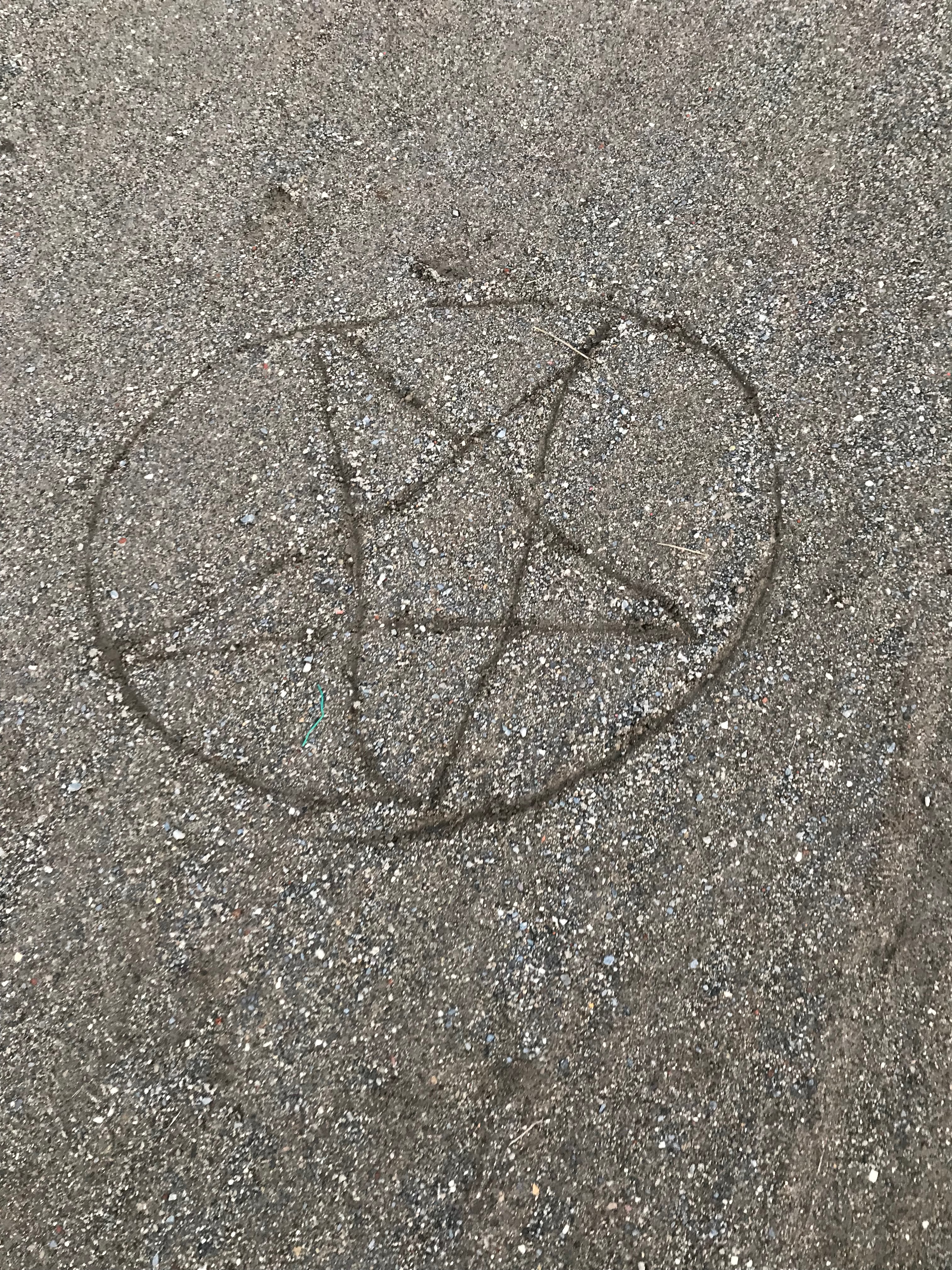
Not to dwell on Satanism, but the morning after my last post on the topic, while out on my morning jog, I came across a pentagram incised in the pea gravel of the bike path.  Then another.  Lest there was any lingering doubt that this had to do with the local school’s Satan club, a few feet further along a 666 appeared.  None of this was there the day before and, given that folks my age are too busy to be out scraping sigels in the sand, I suspect that it might’ve been someone younger.   Dare I say, school-aged.  Protesting or promoting I couldn’t tell.  As I jogged, I fell to thinking about pentagrams.  They’re not inherently evil and actually have an interesting history.  For most of that history it was morally neutral, if not a positive sign.

In the 1800s, during Romanticism’s heyday, it was supposed that an inverted pentagram—one with two points up instead of one at the top—was a sign of evil.  It was also in the 1800s that the contemporary king of outrage, Aleister Crowley, began what would eventually morph into modern Wicca.  Crowley liked to refer to himself as “the wickedest man on earth,” at least among his friends.  The upside-down pentagram was seen to represent a goat’s head, and if you’ve read my book you’ll know that some groups have long associated goats with demons.  Ironically, during the Nixon Administration the Grand Old Party began to use inverted pentagrams on their elephant logo.  Evangelicals who otherwise object to this “Satanic” symbol seem quite okay with it branding their political party.  Truth in advertising, I guess.

The thing about symbols is that they only have the power we give them.  The five points of a star symbol match well the pentagonal symmetry that we often see in nature: sea stars, sand dollars, strawberry flowers, and eucalyptus seed pods.  It’s pleasing to the eye for creatures with five fingers and five toes.  There’s a rightness about it, even if it doesn’t look a thing like the stars in the sky.  Is it Satanic?  No, only to those who believe it to be so.  Are there Satanists trying to take over public schools?  No.  That doesn’t mean people don’t think they aren’t.  (That last sentence is all tied up in nots, I guess.)  Symbols, by their nature, contain the meaning we assign to them.  They say to me that kids pay attention to what adults do,  so if we act grown-up perhaps—just perhaps—they will aspire to do the same.


Magic Tricks

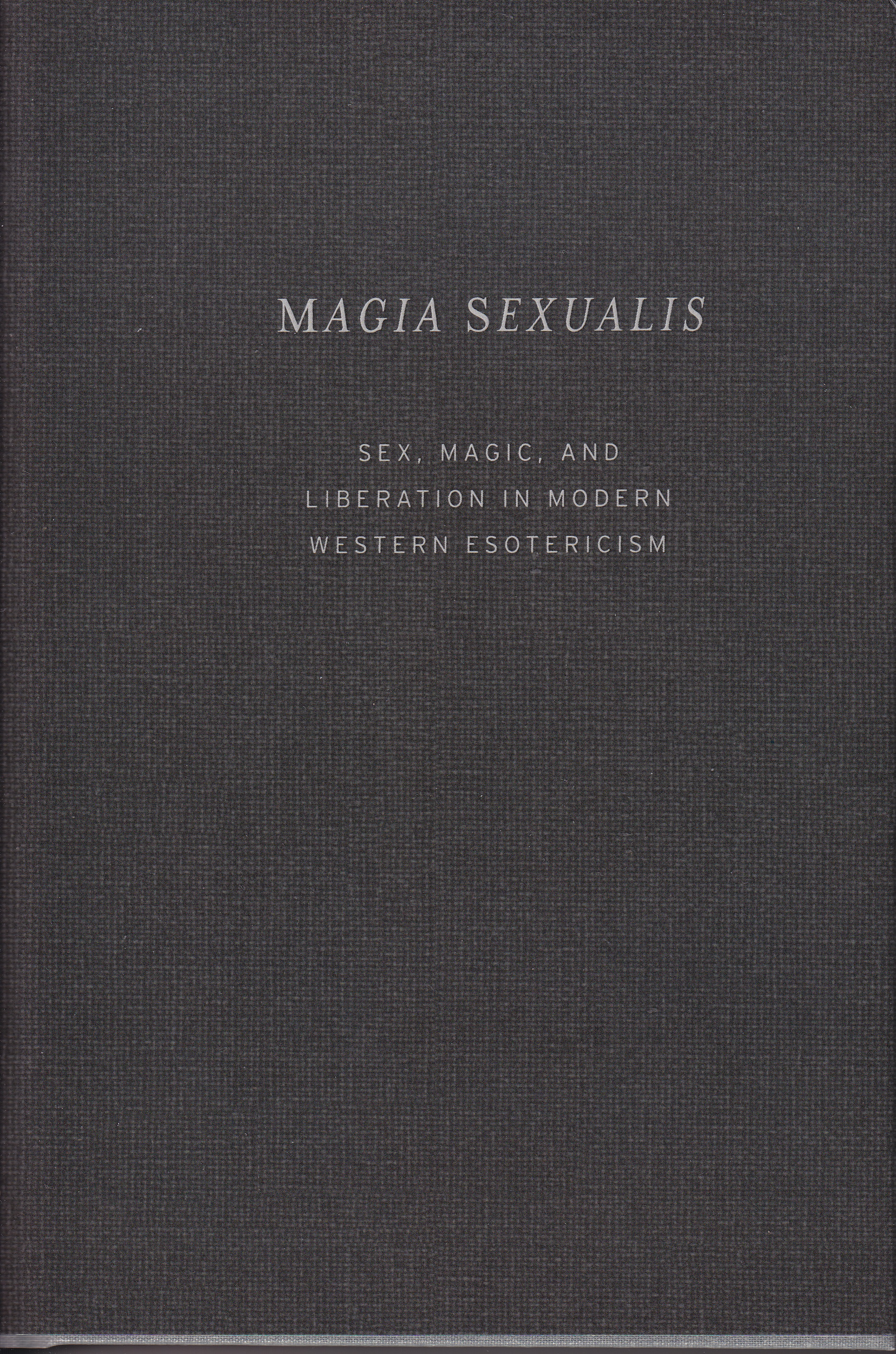
Magia SexualisTo a scholar who has spent many years studying ancient religions, new religions hold a strange appeal.  After all, we are trained to look at obscure texts from forgotten cultures and to decipher the mute clues they have left behind.  New religions have the benefit of being (generally) documented in ways that ancient religions aren’t, and often exist in societies more literate than those of the remote past.  Finding out about them may be easier, but understanding them may be just as difficult.  In my research on magic, I was led to Hugh B. Urban’s Magia Sexualis: Sex, Magic, and Liberation in Modern Western Esotericism.  I’ve always found Urban’s work engaging, and since this book is one of the few academic studies to investigate magic seriously, I was eager to see what he had to say.  As usual, I wasn’t disappointed.
 
Sex magic is frequently at the heart of magical beliefs.  Urban shows that this has been the case from ancient times.  Those of us who’ve studied ancient Syrian, Egyptian, Mesopotamian, or Aramaean religions aren’t surprised by this.  Those cultures inhabited a world pummeled by magic, and it doesn’t take a genius to figure out that sex might have had something to do with it.  The majority of Urban’s book, however, concerns figures starting in the nineteenth century who introduced new religious forms of sexual magic into the occult circles of their times.  Focusing on a specific practitioner in each chapter, he brings us up to the present with some familiar, or often less familiar, names.  Magic, by its very conception, is a religious idea.  Even if some of the more notorious modern magicians such as Aleister Crowley and Anton LaVey took religion in a darker direction, it was still religion.  The founding of Wicca by Gerald Gardner naturally receives some attention.
 
As Urban notes from the beginning, sex magic is not a topic for titillation.  It involves some transgressive, but also original thought about something that is so basically human that we all know about it even if we won’t discuss it.  And the dark practitioners have seemingly exhausted the vaults of extremism regarding sexuality that even a straight-laced, nay even Presbyterian, culture may find itself with no further options.  Where does one go when the foulest of profanities has been executed?  Certainly not back to the beginning, for we’ve come too far for that.  The postmodern world deconstructs itself leaving us to wonder if there can be any magic left at all.  It is no wonder, I should venture, that Harry Potter was gathering steam even as Urban wrote his book.  Magic will, by its nature, always find a way.