
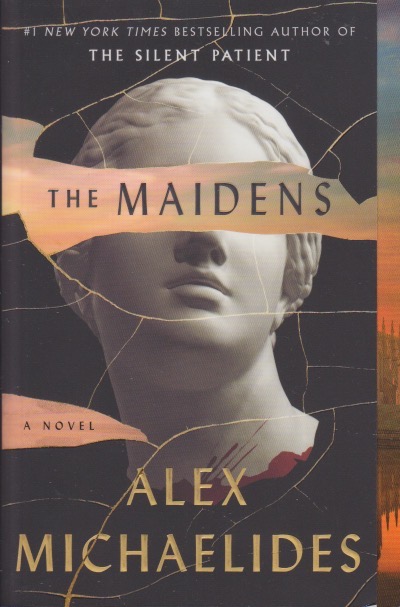
In an effort not to give too much away, I’ll try to give only the bare bones and some impressions. The Maidens, by Alex Michaelides, is considered a dark academia novel. It revolves around a series of murders in Cambridge and the informal investigations by a psychologist (Mariana), whose niece attends St. Christopher’s College. There is, not surprisingly, a lot of psychological tension. It’s also a good illustration of the human condition—our psychology can often be disrupted by those closest to us. We’re a complex lot. The whole story is also set against the backdrop of classic Greek tragedies. Mariana is half Greek herself, living in England. She’s also a widow and, although not a minor, a woman without parents or siblings. As a psychologist, she tries to help others sort out their lives.
Perhaps some of us are born prone to trauma through some combination of naiveté, innocence, and neurodivergence. It’s well known that what simply rolls off one person will traumatize another. People sometimes comment that it’s surprising that I watch horror, but the fact is that it’s generally removed from my personal traumas. Looking back over some sixty years, I see quite a lot of trauma and I empathize with Michaelides’ characters who experienced such deficits, some of them without even knowing it. This really stood out to me while reading the novel. With the exception of some of the maidens, just about everybody is hurting. Who are these eponymous maidens? A group of students who have coalesced around an American professor of ancient literature. And they’re also the ones who tend to get bumped off.
This is a book that moves along. Part of the reason is that it has short chapters, something I’ve come to appreciate over my life as things get busier and busier. Long chapters can be a challenge. A novel I read recently had no chapters at all (but at least there were scattered extra-spaces between collections of paragraphs). But what really keeps the pages turning is the story. Michaelides is very good at misdirection, which is why I didn’t describe the plot in any detail. You have to read it to see how things unfold and I don’t want to spoil that for anyone. A literary murder-mystery, it has no speculative elements, apart from a few coincidences. It does, for at least some readers, have quite an impact. For me, it influenced my thought process for the rest of the day after I finished it. At that, with all the books I read, is pretty rare.
 Steve A. Wiggins