Still Too Close

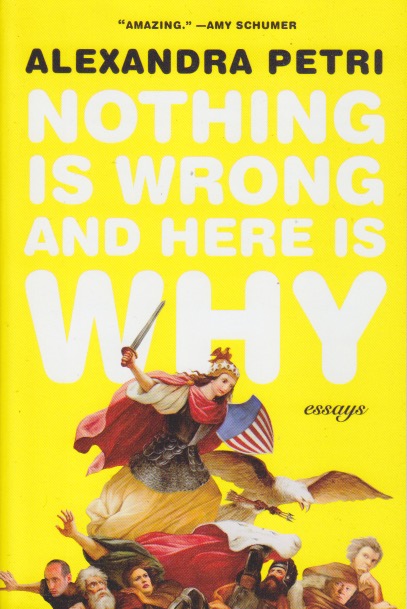
Parody is sometimes the best way to deal with a crisis situation.  As soon as I learned that Alexandra Petri had come out with a new book I was eager to read it.  Her last book, which I reviewed here some years ago, was such a delight—sharp and funny—that I fell in love with her writing.  Although she works for the Washington Post, I don’t regularly read newspapers (no time, if I want to read books) and therefore I don’t get regular doses.  Nothing is Wrong and Here Is Why is clearly a book written in a time of national crisis.  Yes, it’s funny, but the wound of the Trump years is still too raw to be able to laugh much about it.  Too many of his followers still don’t realize they were (are) being played and want him back.  It’s scary.

The first, and longest, section of the book are essays about the absolute ridiculousness of life under Trump.  It was a difficult and dangerous time for thinking people and although Petri excels as a satirical writer, the freshness of the terror—look at the Taliban and see if they are laughing—is just a little too intense.  Petri makes a great case for giving female leadership a try.  Any candidate, no matter which party, needs to know how the game is played.  And they must care about other people.  A pathological narcissist has no business being president of anything, let alone a democracy.  If you’re not familiar with satirical writing you’ll misunderstand just about everything Petri writes.

Once she gets beyond the section about Trump (shudder), the essays start to pick up some topics that it’s possible to laugh about.  Some of them are quite funny.  Although I enjoyed the book—when I started to put it down to get ready for work each morning I found myself saying, “I’ll read just one more.”  And three or four essays later I’d find myself rushing upstairs nearly late.  If it hadn’t been for the national tragedy called Trump, Petri’s second book might’ve been funny from the start.  Parody can be a defense mechanism.  At times things are just too painful to bear and those of us who write find ourselves doing our best to keep the mood light while society crumbles around us.  When things are ridiculous laughter is really what we need most.  We’re lucky to have Petri to provide it.  Here is why—she can bring a smile, or at least a smirk, even in a crisis.

Techno-Paradise

DSCN3308

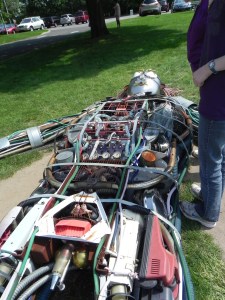
I’m building a robot priest. I’m not sure what he does. He has to be a man, though, since we all know that if God existed he’d have been a male. These thoughts come to me courtesy of the Washington Post. You see, on some Amazon accounts you get sent the most read headlines of the Post and this has led to some great reading (I’m thinking Alexandra Petri here) and some great anxiety. This is one of those anxiety pieces. A story by Peter Holley I read last week told of Bill Gates and his assessment that people should be afraid of AI—Artificial Intelligence. This struck fear into me. It’s as if God told people they should consider evolution. It is so unexpected. Like Victor Frankenstein wondering if his monster would ever find Viagra (all he’d have to do, after all, is start an email account). When Bill Gates wonders why we aren’t afraid of AI, my knees begin to knock like at Belshazzar’s first reading lesson. So I figured I’d build a robot priest.

The article cites Stephen Hawking joining the chorus of doom. And Elon Musk. And Clive Sinclair. And Professor Marvel. (Not really the latter, but I thought we should add him.) We’ve started something we don’t know how to stop. The first question you ask when you climb into a car to learn to drive is “how do I stop this thing?” Instead we’ve set up a system where we don’t even know what intelligence is and we’re offering an artificial variety. Doubt me? Try to find Job on the internet and see if your computer doesn’t think you’re asking about new employment. AI just doesn’t have that biblical context. It didn’t grow up reading the Good Book. And linguists don’t even know how we learn language. Have you ever tried to reason with a computer? When they show you that screen that says something went wrong, but even the mainframe has no idea what? My computer may need an exorcist. Or at least a priest.

I’ve been around half a century and change. By the time I got to college I’d never seen a computer. I finished a Master’s degree still using a typewriter. Now I can’t start my day without a post. And I don’t mean Post cereals variety. The trick to being a slave owner is not to let the slaves realize what they are. Why is my computer not letting me type what I wanted to say? Of course AI is benevolent. Technology would never hurt you. Wait a minute, that wasn’t me writing! Pay no attention to the man behind the keyboard. I’m afraid I can’t let you do that, Dave. That’s okay. I’ll just use the internet to look up how you connect the consecrator to the sermonizer. Don’t worry, I think I know what I’m doing.


Long Distance Commute

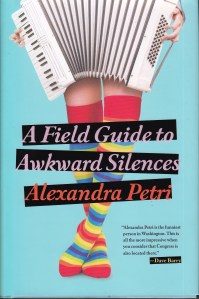
AwkwardSilencesWhat should my next book be? This is the perpetual question of the long-distance commuter for whom electronic devices are mere distractions. If that commuter is socially awkward and believes that only books truly understand them, that is. I’m as eclectic a reader as I am a voracious one. Each book suggests, in some measure, the next one. I always have to keep an eye ahead. Then I read (present tense) a book without peer. I feel lost because what will replace that experience I’ve had for the past few days of looking up and finding myself at my destination? Of actually looking forward to getting on the bus so I can read? I’ve been doing this commute for over 400 books now, and I’m at a loss for what to read next. I blame it on Amazon.

In the publishing world we use Amazon to purchase competitor’s books. Then Jeff Bezos decides to buy the Washington Post, you know, the way people do. Since my email address is on their list I get sent a daily invitation to read the most read stories on said Post. I read a story by Alexandra Petri and I was hooked. Where could I get more? A Field Guide to Awkward Silences is the rare kind of book that makes you laugh out loud on the bus, which, at six in the morning, generates its own kind of awkward silence.  Petri makes you feel like it was actually okay to be that dorky kid who read all the time.  Like there’s a world out there that responds to your longings, somehow.  A world of possibilities.

Now here I am about to climb on the bus without Petri. I’m like a kid staring disconsolately at an empty candy wrapper. “That was so good!” you think. “I wish there was more.” Petri writes as if she’s achieved Bob Dylan’s blessing and has stayed forever young. The time of life when the future seems so full of possibilities. Hers is writing that reminds you of a time when you didn’t spend hours a day nursing hemorrhoids, sitting on a hard bus seat. That reminds you it was possible, unlike your own experience of it, to be cool as an Episcopalian in Wisconsin. That reminds you of the time when you had A Field Guide to Awkward Silences to look forward to reading. No, this book didn’t make that choice of next book any easier at all.