Hitchcock’s Freud

When you can’t have horror, Hitchcock will sometimes do.  Having seen most of the big classics, Marnie came to the top of our list, and I found it had some triggers.  I suspect that’s true for those who have experienced childhood trauma and who sometimes do things as an adult without knowing why.  At least that’s what I took away from it.  To discuss this will require spoilers, so if you’re behind on your Hitchcock you might want to catch up first.  Here goes.  Marnie’s mother was a prostitute who turned to religion.  The reason is that one night during a storm young Marnie was frightened and one of her mother’s clients tried to comfort her.  Supposing he was molesting her daughter, she attacked him and when he hurt her, young Marie killed him.  All of this was repressed in her memory and now, as an adult, Marnie is a kleptomaniac who has the many phobias that that night impressed upon her.
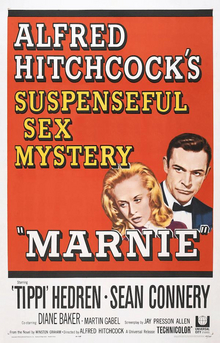
Then along comes Mark.  Although he knows Marnie is a thief, he falls in love with her.  From a wealthy family, he’s influential enough to get charges against her dismissed, which he does once they marry.  He tries to unravel why Marnie won’t sleep with him, why she can’t stand red, why thunderstorms terrify her.  In a very Freudian move, he recognizes that her relationship with her mother is the key.  Hiring a private investigator, he discovers what happened to Marnie as a child and then takes her to confront her mother.  Marnie has never felt her mother’s love, but she didn’t remember the incident and didn’t know that her mother took the murder rap for her and subsequently distanced herself from her daughter.

I have to admit that I found this more disturbing than most Hitchcock films I’ve seen.  The ending, which I revealed in the first paragraph, brought quite a few of my own childhood issues to the surface.  Parents try to do the best they can, at least most of the time, but we damage our children psychologically, generally unintentionally.  And trauma in your youngest years never leaves you.  I can mask and pretend—that’s the way you survive in this world—but a number of my experiences as a pre-teen affect me every day, whether I realize it or not.  Where I choose to sit in a room.  How I respond to unexpected events or sudden changes.  Why I immediately have to know what that noise is and where it came from.  These are all part of the legacy my childhood left me.  I think Marnie would understand.


Not a Peep

Time changes everything.  Peeping Tom, which has been on my list for some years, was castigated when it was released in 1960.  Now it’s considered a classic.  Indeed, it’s frequently discussed in books analyzing horror films, and it had a bit of influence on Alfred Hitchcock.  Films like this must be watched as period pieces, of course, but there’s so much psychology here to unpack that I wonder if it’s used in mental health courses.  Mark Lewis is a loner who inherited a spacious London house from his father.  He lets out the downstairs rooms but keeps to himself upstairs.  One of the reasons is that he realizes that he’s mentally unstable.  He’s a serial killer, in fact.  His young downstairs neighbor takes a shine to him and he reveals, via film, that his father tormented him as a child to film his fear reactions.

As an adult, Mark works in the film industry.  He also kills women while filming them to capture their fear reactions—taking his father’s work a step further.  Although shy, he is charming enough to others.  When he sees a fear reaction, however, he feels compelled to murder.  The neighbor downstairs doesn’t suspect him, but her ocularly challenged mother does.  Thinking back over it, many moments reminded me of a racier version of Hitch.  Racy because Mark picks up money on the side by taking boudoir photographs that the local news shop sells to certain customers.  This is a creepy film and perhaps the creepiest scene is where a local girl, well underage, comes into the news shop to buy a candy bar just after the owner sells an older man a pornography book.  We don’t like to admit that such things could happen.

There is so much going on in this movie that it’s clear, at least to me, why it has garnered such acclaim.  I spent the first twenty minutes or so wondering whether I should really be watching, but as I stayed with it I couldn’t look away (which is one of the very self-reflective issues that the film addresses).  The analyses I’ve read never really went into detail regarding the plot, so there were plenty of places where I wondered what would happen next.  The pacing is more in keeping with the turn of the sixties, but the mind work seems ahead of its time.  Some call it a precursor to slashers, but it doesn’t linger on the actual bloodshed (which is minimal, considering).  It does take its time to make you think while you watch.  And somehow it makes viewers complicit, it feels, with what they’ve seen.


Flights of Horror

I’m never quite sure where to put him. Alfred Hitchcock, that is. Part of the problem is that “horror” is a very slippery genre. Most people classify much of Hitchcock’s work in the “thriller” genre, wanting to avoid the disrespectful older cousin, horror. I recently rewatched The Birds, a movie I first saw in college. You see, Hitchcock is an auteur demanding respect (never mind that many horror directors are highly educated and sophisticated). Even dainty colleges like Grove City considered him worthy of students’ attention. But while watching the extras it became clear that other horror directors considered The Birds horror, or, as they put it, Hitchcock’s monster movie. With its famously ambiguous ending, the film is still a frightening experience. And yet we consider it safe, because it’s Hitchcock.

I think about this quite a lot.  Even in Holy Horror I wondered whether including Psycho was fair game.  There’s no doubt that the remake is horror, and Robert Bloch, the author, was a horror writer and friend of H. P. Lovecraft.  But Psycho is Hitchcock.  Doesn’t that make it more respectable than mere horror?  Horror is often defined as being, or having, monsters.  That’s a bit simplistic in my book, but it is workable.  Pirates of the Caribbean movies all have monsters in them, but they’re blockbuster adventures.  Have the monsters deserted horror?  Or maybe is it that we have an ill-fitting genre title that we just don’t know what to do with?

The Birds is a scary movie.  Animals mass and attack, with the intent to kill.  Daphne du Maurier wasn’t really considered a horror writer, but her books and stories were adapted into horror films.  Like Hitchcock, she’s often considered above mere horror.  It seems that we’re being a bit dishonest here.  Why are we so afraid of horror?  The category, I mean.  Perhaps because the slashers—which Psycho kinda initiated—gave horror a bad rap.  Too much blood.  But there’s blood in The Birds.  Is it the mindless desire to kill?  Just ask the residents of Bodega Bay after the fire broke out.  It seems we have a real prejudice on our hands.  Horror grew up on the wrong side of the tracks and there’s nothing that can be done to make it respectable.  Horror fans object to recent attempts to call certain films “elevated horror” or “intelligent horror.”  Those who use terms like this sometimes imply that the rest of it is, well, for the birds.  It’s time, perhaps, for a new category.


High Places

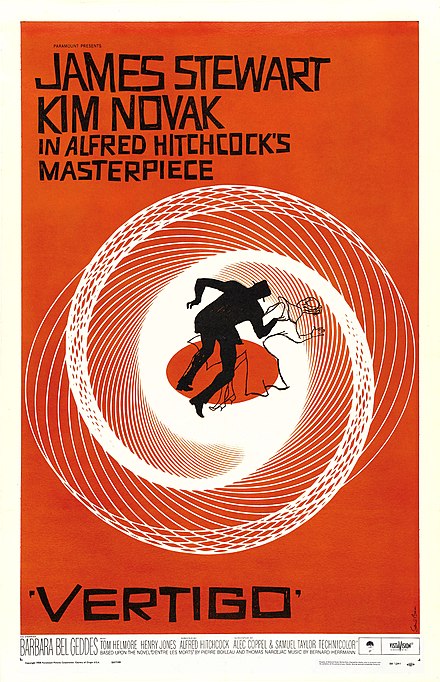
Among the many phobias I experience is acrophobia—the fear of heights.  I’ve had episodes of vertigo and they never really leave me in the mood to reflect upon them.  And yet, Alfred Hitchcock’s Vertigo is a classic I’d never seen and about which I knew nothing.  Well, very little.  I knew that Jimmy Stewart’s character suffered from vertigo and that Mel Brooks had done a spoof called High Anxiety.  Hitchcock wasn’t a horror auteur, although he gave the world The Birds and Psycho.  He’s often cast in the “thriller” or “mystery” category, but these things all blend into one another and someone of Hitchcock’s interests might be placed in different genres, depending on who’s doing the placing.  So my wife and I watched Vertigo, not knowing what to expect.

The first thing is it was longer than expected, especially given the deliberately slow pacing.  The story, in case you’re behind too, involves a guy looking for a way to murder his wife to get her money.  It involves a convoluted plot of finding a near double of his wife—whom he seems to love (but not as much as money), to trick Scotty (Stewart) into thinking that she committed suicide while he was helpless with vertigo.  Even when the reveal finally came, I scratched my head a bit trying to figure out why all the elaborate trickery was necessary.  It was, of course, based on a novel that might explain things a bit more thoroughly.  But movies are about visuals and Vertigo is full of those.  Lots of green.  A dolly zoom (a film first).  Even some animation.

Although there’s murder and fear—and even an accidental death because of a nun (not the Nun)—it seldom nudges north of drama.  It’s one of those movies that has gained in reputation since its initial appraisals.  Much of this has to do, it seems to me, with its visuals and subtlety.  (Film critics seem to love those.)  Of course, Psycho was still two years away, and The Birds five.  I’m no Hitchcock connoisseur by any stretch.  Indeed, my life has tended to be bits and pieces of this and that.  (It takes a far larger following than I have to be able to opine on any subject and have people take you seriously.)  Vertigo is, however, one of Hitchcock’s better-known films.  Well enough known to have had a spoof made of it.  And to have drawn me in to a movie themed on something I legitimately fear.


Dangerous Fiction

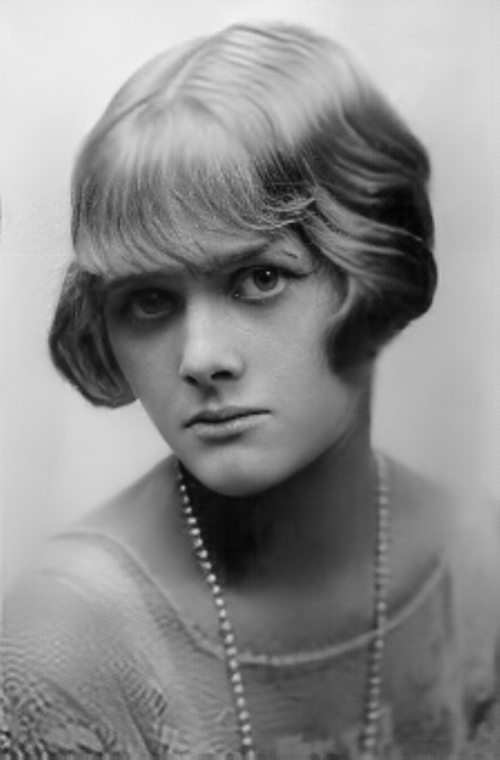
At the suggestion of a friend, I recently watched the documentary Daphne du Maurier in Rebecca’s Footsteps.  I confess I haven’t read much of du Maurier’s work, yet.  From a family fairly well off, du Maurier, perhaps unusually for a writer, found early success and was able to make a living from writing.  Like many authors she valued her time alone, but also had basic human needs.  In keeping with her gothic sensibilities, she fell in love multiple times, both with men and women.  And she lived in that kind of fantasy world that fiction writers often inhabit.  For some reason I had it in my head that she had died young, many years ago.  It was somewhat surprising to learn that she lived until I was 26.  I can make the legitimate excuse that I didn’t grow up in a literate family, though.  I learned about du Maurier from my wife.

Copyright released photo, author unknown; via Wikimedia Commons

That doesn’t mean, however, that I didn’t know her works.  I first saw Alfred Hitchcock’s The Birds when I was in college.  In those days I hadn’t yet learned to pay attention to who the writer of a film was.  That intimate interplay between written literature and film easily ties me into celluloid knots.  My wife is a Hitchcock fan and together we watched some of his earlier du Maurier adaptations, such as Jamaica Inn.  Then she introduced me to Rebecca, du Maurier’s early and best-known novel.  We watched the Hitchcock rendition.  The documentary makes the point that du Maurier’s life, in some ways, played out that novel.  Writing can be a dangerous business, especially fiction.

My own most recent book, on The Wicker Man, which I hope will see the light of day, brought me back into du Maurier’s orbit.  The Wicker Man was, of course, nearly disowned by the studio that had sponsored it (British Lion).  Half-hearted about the effort, they made it a B movie, showing it after Don’t Look Now, a film I admit that I’ve never seen.  I learned from watching this documentary that this was yet another du Maurier story.  I’ve read one or two of her short pieces—they aren’t commonly found in American bookstores, although I see them whenever I visit England—and clearly I need to read more.  That brings up, however, the age-old dilemma: should I try to read the story before I see the movie?  I think I know what du Maurier’s answer would have been, and I think it wise to follow her advice.


Bird Land

Since I like to blog about books, my usual reading practice is to stick with a book once I start it.  This can be problematic for short story collections because often there’s one in particular I want to read.  Somewhat embarrassed about it, I have to confess that sometimes it’s because I saw the movie first.  So it was with Daphne du Maurier’s “The Birds.”  Du Maurier, the daughter of a father who also wrote horror, caught Alfred Hitchcock’s attention.  Several of his movies were based on her works.  Not all of them can be called horror—a genre that’s difficult to pin down—but they deal with gothic and thriller themes that had an appeal for Hitch.  In fact some analysts date the modern horror film to the period initiated by this iconic director.

I have a collection of du Maurier’s short stories, written in the day when 50 pages counted as a short story rather than “product” that could be “exploited” in various formats.  (Today it’s not easy to find literary magazines that will publish anything over 3,000 words, or roughly 10–12 pages.)  In any case, “The Birds” is an immersive tale.  The movie is quite different, of course, set in America with a cast of characters that can only be described as, well, Hitchcockian.  Du Maurier’s vision is much closer to the claustrophobic pandemic mindset.  A single English family, poor, tenant farmers, far from the centers of commerce, must figure out how to survive the bird attacks on their own.  The suddenly angry birds attack their hovel in time with the tides (they live near the coast) so the family has to gather supplies between attacks and try to last another night of pecking and clawing.

The story is quite effective.  Reading it suggests the importance of self-reliance and willingness to accept a changed reality on its own terms.  No explanation is given for the birds’ change of attitude.  Human intervention in the environment is supposed but how would a simple family living of the fringes of the fabric woven by the wealthy know?  Forced to react, they try to keep the kids calm while knowing, at some level, this can never end well.  The movie maintains the ambiguous ending, which is probably what makes it so scary.  Corvid or covid, there are things out there that drive us into our homes where we must shelter in place.  Although I didn’t read the whole book, this choice of story seems strangely apt for the current circumstances.


All Things Being Equinox

The weather around here has been appropriately gloomy for the autumnal equinox.  Although Hurricane Florence gave us a day of rain, the heavy clouds have been part of a pattern that has held largely since May.  Given the gray skies, we opted to watch Alfred Hitchcock’s The Birds last night.  My wife isn’t a horror fan, but she does like Hitch.  We’ve watched The Birds together many times, but this is the first time since I wrote Holy Horror.  I was somewhat surprised to recall how much Scripture plays into the script.  This is mostly due to a drunken doomsday sayer in the diner.  After the attack on the school kids of Bodega Bay, he declares that it’s the end of the world and begins citing the Bible.  He’s there for comic relief, but the way the movie ends he could be right.

When I was writing Holy Horror I had a few moments of panic myself.  Had I found all the horror films with the Bible in them?  Could anyone do so (without an academic job and perhaps a grant to take time off to watch movies)?  I eventually realized that I was merely providing a sample in that analysis.  Several weeks after I submitted the manuscript I watched The Blair Witch Project.  There was the Bible.  The same thing happened last night under a glowering late September sky.  The Birds has the Bible.  Two weeks ago I saw The Nun; well, that one’s almost cheating.  But you get the picture—the Good Book appears rather frequently in horror.  That’s what inspired me to write the book in the first place.

Now that nights are longer, and cooler, the grass has somewhat poignantly relinquished its aggressive summer growth.  Most of the ailanthus trees have been cut down (I must be part lumberjack).  My outside hours are limited not only by work but by the fading light.  In the words of the sage, “winter’s tuning up.”  We moved to a house we saw in the spring as days were lengthening.  Now we’ve come to the dividing line that will slowly leech the light from our evening skies.  I suspect that as I go back and watch some of my old favorites again I’ll discover something I already knew.  The Bible and horror belong together because both are means of coping with the darkness.  Call it puerile if you will, but there is something profound about this connection.  It just has to be dark for you to see it.


A Kind of Happening

The roofers were here.  One of the things you learn only after laying down a ton of money is that those selling a house like to withhold information.  Moving during one of the rainiest summers in history, we naturally discovered leaks.  And so the roofers are here, like noisy angels banging above my head.  Given the orientation of our house, their access is outside the window of my work office.  I figured it was an opportunity to learn.  As the old shingles came raining down, however, I couldn’t help thinking of M. Night Shyamalan’s The Happening.  One of his more disappointing efforts, this horror film involved a memorable scene of mass suicide where people jumped off of a high building one after another.  Maybe other people would think of other comparisons, but the falling debris brought the film to mind in my case.

It’s a matter of framing, I suppose.  I’ve watched enough horror that it has become a framing device.  This is true although it has literally been months since I’ve seen a horror film.  (Moving proved to be its own kind of nightmare and one day I suspect we’ll be unpacked enough to watch movies again.)  Instead of losing the frame of reference, however, I find it intact.  If you spend long enough with Poe, he gets under your skin.  And changing states to M. Night Shyamalan’s eastern Pennsylvania might have something to do with it.  This is Bucks County territory, after all.  Another frame of reference, mediated by media.

As I watch the old shingles drop, I realize the window through which I’m witnessing this is another frame.  Like a camera lens, it limits my view.  At times it can be like Hitchcock’s Rear Window, seeing neighbors at their daily business.   Indulge me. For nearly the past five years I worked in a cubicle with no view of any windows whatsoever.  I was completely cut off from the outside.  (Which, for those of you who’ll admit to having seen The Happening, might not have been an entirely bad thing.)  Now that I have a window—my own framing device—I realize some of what I’d been missing.  At Routledge I had a window, but at such a level that the Manhattan outside seemed artificial.  You couldn’t see individuals down on the street.  The entire wall was a window—too much of a frame.  Gorgias Press involved working in a windowless room as well.  I’m professional enough not to let the falling material or the pounding distract me much.  There’s work to do because there are bills to pay.  And horror films prepared me for that as well.  It’s the ultimate framing device.


Birds of a Fang Suck Together

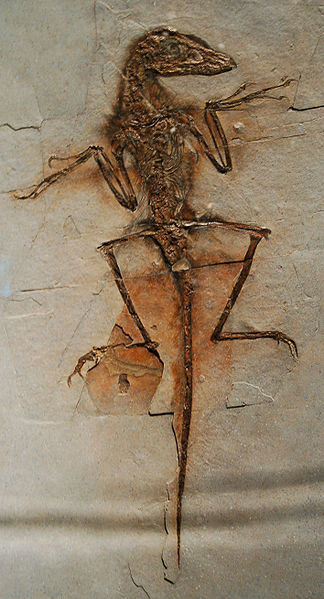
It reads like a cross between a Hitchcock movie and a Lovecraft story — paleontologists have unearthed a fanged bird fossil from the Cretaceous Era. Despite the cartoonish images this news flashes into my head, the startling find also suggests that this turkey-sized predator was also venomous. The first known ancestor to the avian family that used poison to immobilize its victims. A venomous bird.

Don’t let the cherubic Sinornithosaurus fool you! (From Wiki Commons)

Martin Luther is rumored to have said that you can’t prevent birds from flying over your head, (but you can prevent them from nesting in your hair). This new discovery suggests that there might be poisonous birds hovering around out there. And of course, Creationists must make room on the ark for this extraordinary creature. Since all critters, according to Genesis, were on the ark, our Sinornithosaurus must have lurked in some dark corner. I wonder how old Noah classified them — were they nestled among the birds or were they roaming about in the dinosaur wing? These toothy pterosaur wannabes were closely related to the velociraptors and microraptors that once served as the tetrapod mosquitoes of the Cretaceous Park world, stealth biters who’d glide down upon you undetected. The Creationists railing against transitional forms are scratching their theologically inclined heads.

I welcome the discovery like an early holiday gift. Although no one will ever see a living poisonous reptilian turkey soaring down from a Cretaceous canopy, we can all wonder and imagine. Fangs bared, venom dripping, it drops into our comfortable world and makes us reconsider. Apparently poisonous birds did not make the evolutionary cut, but I, for one, will be keeping a closer eye on the sky when I’m out in the woods or jogging around town early in the morning.


For the Love of Aqhat

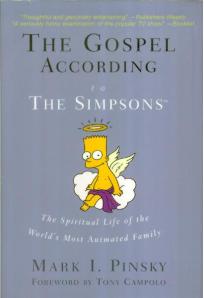
It seems that a new season of The Simpsons is upon us. With the release of season twelve on DVD last week, recession-ridden families everywhere are piling up on their couches to be entertained. Initially I had a hard time accepting The Simpsons; I had seen too many failed adult cartoons to give me much encouragement that this would be something worth wasting my time on. Surprisingly, it became clear after just a couple of seasons that The Simpsons was witty, smart, and surprisingly ethical. This final point was so pronounced that Mark Pinsky wrote a book focusing on it entitled The Gospel According to The Simpsons (Westminster John Knox, 2001). As to be expected in a book with a foreword by Tony Campolo, it was a little devious, but still retained a kind of sugar coating. Nevertheless, I found the book worth reading.

Bart after the birds?

Bart after the birds?

The Simpsons frequently pokes fun at all of us who take ourselves too seriously. Most of the time it is evident that the writers have done their homework as well, pulling in sometimes obscure references to classical or biblical literature. Recently while watching the episode entitled “Bart the Mother” I was struck by an ancient theme which was surely accidental. In the episode, Bart, trying to prove himself to the neighborhood bully, shoots a mother bird with a b-b gun. Guilt immediately sets in and Bart is haunted by his cold-blooded act. In a dream he sees a bird tribunal doling out the punishment for his crime — having his face pecked off. I’m sure this owes more to Hitchcock than to Ugarit, but I can’t help shaking the idea that the scene is somehow informed by the Epic of Aqhat. In one of Ugarit’s classic stories, Aqhat is given a divine bow that is coveted by the goddess Anat. When he won’t relinquish it, Anat has Aqhat pecked to death by raptors, “twice upon the noggin, thrice upon the ear!” Ugarit remains shrouded in cultural obscurity, so no easy cultural reference can point to it. Everyone has seen Hitchcock’s The Birds.

The story of Aqhat, although sadly broken, is a classic of ancient literature. So much more to pity is that it remains nearly as unknown today as it was while buried under the ground for three and a half thousand years. A colleague of mine approached Penguin a few years back trying to pitch the idea that they sell a translation of the Ugaritic texts in their classics series. They flatly turned him down on the basis of “no public interest.” If the publishers won’t put these world heritage classics out there, how will there ever be interest generated? Perhaps those of us bitten by the Ugaritic bug simply circulate in circles too small to have any impact on what the world thinks. Beyond a few souvenir-hawking vendors in Syria and a few crusty scholars sheltered away in dusty academic libraries, nobody knows the story. It seems that Aqhat’s fate is equally grim — pecked to death by birds and completely forgotten because the story just doesn’t possess sales potential.