Reflecting Spirituality

I always find undergoing anesthesia a spiritual experience.  It’s too bad the the prep for things like colonoscopies is so stressful that it’s difficult to appreciate the fasting and how it changes your perceptions.  This is followed by the delicious blackness of a complete loss of consciousness.  If death’s like this we have nothing to fear.  I’ve written about this before, but chemical sleep is not like nighttime sleep.  You hear the anesthesiologist say, “You’re going to sleep now.”  Then you wake up, disoriented because no time has passed.  I blinked a few times, saw my wife’s coat on the wall, and thought it was a nurse.  I started to say “Stop, I’m waking up!”  But then I focused on my wife and wondered why they’d let her into the procedure room.  “Are they done already?”  I asked.  Where had I been for the last hour?

Spiritual experiences are sometimes only seen in retrospect.  They jar us out of ordinary time into an alternative time.  It doesn’t make up for the nasty taste of prep medicine, or the unpleasantness associated with it, but emptying yourself is a spiritual practice.  I need to try to remember that next time around.  I know people who are afraid of anesthesia.  I’ve only had it three or four times—oral surgeries, and my first such procedure as this—but there’s something mystical about it.  I don’t use drugs (never have) so perhaps I’m a neophyte, but looking back on the experience I know that something extraordinary happened.  Coming out of it is coming into a new world that is somehow strangely the same as the one I left.

Religion has always, at least partially, been about altered states of perception.  Organized religion succeeds in making it rote, but those who experience the naked phenomenon never forget it.  Anesthesia is, I know, potentially dangerous.  It so like a light being switched off that I’m always left in awe of it.  Mystical experiences are rare, which is one of the things that makes them so valuable.  I’ve had them—widely spaced—since childhood.  Sometimes it’s evident in the moment, but often some reflection is necessary.  I suppose few people look forward to any kind of surgical procedure, but there can be benefits beyond the physical health that we hope will result.  That’s the way spiritual events often take place.  Perhaps advanced practitioners (not always clergy) can bring them about intentionally, but any of us might recognize them afterwards, upon reflection.


Spiritual Alterations

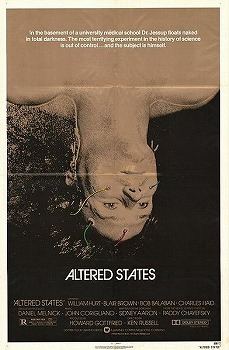
I’d been meaning to watch Altered States for quite a few years.  I suspect the reason (it’s been long enough that I can’t recall for sure) is that I knew it had a story line tied in with religion.  The tale follows Edward Jessup, a psychopathologist, who is attempting to understand schizophrenia.  He’s particularly taken by the religious nature of some schizophrenic delusions, and he uses sensory deprivation on himself to trigger something similar.  A trip among tribal Mexicans leads him to a psychoactive substance that he decides to combine with sensory deprivation to enhance the effects.  Along the way he explains to his girlfriend, and eventual wife, that his father was religious but died a horrible death.  He therefore became irreligious but his altered states of consciousness are often full of images from Revelation.

While the Bible theme eventually gives way to biological regression to pre-Homo sapiens, one of Jessup’s experiences has him coming to his dying father again and dropping a Bible on him which turns into the veil of St. Veronica on his face, which he then rips off and throws, flaming, to the floor.  Another instance of the Bible in horror, the film also uses crucifixes and hellish images to demonstrate the religious nature of these alternative states.  Jessup’s goal is to regress to the original thought, to encounter, as he puts it “God.”  This desire, combined with the potent Mexican drug, transforms him physically, and, in the end, emotionally.  Instead of being dissociated from his wife (whom he is planning to divorce), he realizes that love is the only thing that can save him from the terror of his experiences.

This is some profound stuff.  Paced like a movie from 1980, it has a quality not unlike 2001: A Space Odyssey.  The message seems to be sound—the need for encountering the “divine” ends up convincing Jessup (that may autocorrect keeps changing to “Jesus”) that love is really what it’s all about.  The transformation scenes, while not shown in the detail of An American Werewolf in London, are nevertheless convincing enough.  It’s a rare movie that treats religion respectfully.  Here Ivy-League scientists are motivated to understand it.  In real life, alternative states of consciousness are quite real, if poorly understood.  They’ve been part of religious practice from the beginning and are a far cry from sitting in the pew and singing anodyne hymns week after week.  The more movies I see, the more it seems that a sequel to Holy Horror will be necessary some day.  


Real Dreaming

I keep odd hours. Although we don’t live far from New York City, as the pigeon flies, public transit sets the schedule for my day. (I’m merely writing as a representative here, since I know others keep my hours as well.) Since I’m usually waking up around 3 a.m., I have to go to bed pretty early. One night recently I turned in around 8:00 p.m. and fell into a fitful sleep. When I awoke three hours later, it was as if my gray matter were a thunderhead. Ideas, worries, and memories flashing like lightning. Concerned, I watched the clock since I knew it was a work day. When three rolled around with no more sleep I hoped it would be like one of those rare days of interrupted rest when my conscious mind does just fine. Would it function that way on just three hours of sleep?

This incident brought home to me once again the mystery of consciousness. I had a meeting in New York I couldn’t miss that day, but by mid-morning (in real-people time) I was seeing things that weren’t there—an almost Trumpian dissociation from reality. Then I’d snap back to awareness and realize my mind was drifting off to steal some of the sleep it refused during the hours of darkness. Using the usual tricks I stayed awake for the workday and even for the bus ride home, with only brief momentary lapses where what had been reality had stopped making sense. Consciousness, it seems, functions best with a well-rested brain. A good night’s sleep put me back to normal the next day.

Reflecting back over that previous 24 hours, I thought how surreal they’d felt. Not to put too fine a point on it, but they were like an altered state of consciousness. Religions, some claim, began because of such altered states. They are strange and powerful. And fairly universal—almost everyone experiences them from time to time, whether by sleep deprivation, controlled substance use, or prayer and meditation. Even knowing the cause (going to bed with a lot on your mind when you have to wake early, for example) doesn’t change just how real the experience feels. This is one of the reasons that rationality doesn’t explain all of experience. In the same brain there are Jekyll and Hyde aspects to consciousness, interchanging with each other every few hours. As the movie Inception underscored, you don’t remember how you entered the dream. You’re just there. And when that world intrudes on the conscious, rationally ordered territory of wakefulness, the questions can become quite religious. Unless, of course, I’m still dreaming.


Addicted to Heaven

I once wrote a scene—please don’t look for it; it’s never been published—in which a character awakes after attending a concert the night before. In my own life this kind of thing is very, very rare. Even when I had a full-time job in the relatively inexpensive Midwest, shows in Milwaukee were a bit out of our range for regular consumption. Here on the East Coast you have to scrimp and save to pull it off once in an every great while. In the scene I wrote, the character awoke wondering why the world looked so different the morning after. I’ve been pondering that because of my own recent Broadway experience, and a realization came to me. Such events involve an altered state of consciousness.

For all of science’s dowdy physicalism, there are very few practitioners who’d deny that altered states of consciousness exist. Nearly everyone experiences them. Perhaps the most common form is the dream. We know it’s not real, but most of us have had one or two that we just can’t shake. Upon awaking, going to work, dealing with the drudgery of everyday, we come home still feeling as if the preceding daylight hours were somehow less than real. Shows, some movies, and meaningful music can all induce alternate states of consciousness. Perhaps rare these days, but so can religious services. Such states continue after the event ends, and cushion our harsh reentry to “reality” with pleasant reminders that there’s something better somewhere else. Historically these moments have been highly valued. More so than even money. They’re addictive.

Attempts to induce such alternate brain chemistry through drugs are now a national crisis. One draw of opioids is their ability to bring on such altered states of consciousness. Our experience informs us that such things must exist, and they are likely behind the very idea of Heaven itself. The cost for altered states of consciousness is, of course, daily life. As physical beings we could not and cannot survive in a perpetual state of bliss. What is truly sad is that physicalism has convinced many that such alternative states are “not real.” Materialism leads, so often, to misery. The tendrils of altered states, however, interweave themselves among the synapses of our gray matter, sparking just often enough to make us realize that yes, those transcendent moments were just as real—if not more real—than this illusory world we daily inhabit. My character, awaking the morning after, was learning something she already knew to be true. Even if it was only fiction.