Out of Season

Scary Stories To Tell in the Dark, by Alvin Schwartz, has been a fixture since the early eighties.  I was a bit too old for Scholastic at the time, but my daughter had a copy that I read recently.  I heard about the 2019 film before it came out (and I’m having trouble believing it was all the way back before the pandemic).  It’s more of a Halloween movie and since it features young actors it had translated to a “kids’ movie” in my head.  I suppose the PG-13 rating contributed to that.  Sill, it turns out that it’s a proper horror film, but not too scary.  The story is partially by Guillermo del Toro, so I had some idea of what to expect.  I’m glad I watched it, even though the right season is still months away.  Therapy is welcome any time of year.
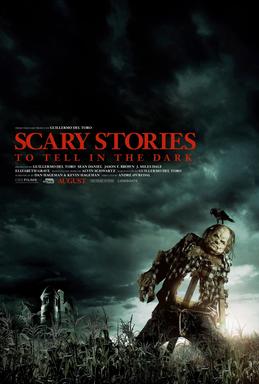
Anthology films often don’t work well, and this one manages to avoid that by constructing an overarching narrative.  The teens, visiting a haunted house on Halloween night, find a book by a hidden family member who’d hanged herself but who was rumored to tell stories to those who ask.  The book, written in blood, writes new stories featuring each of the kids, telling their bizarre deaths.  Since there are six main kids there are six main subplots and some of them are quite effective.  Scarecrows aren’t like the kind you find in Oz.  And two of the good kids end up missing while this is played off against the Vietnam War (it’s set in 1968).  One of the characters has been drafted and is being shipped off to the war as the film ends.  Since the final girls (there are two) are committed to finding the lost kids, a sequel seems inevitable.

The setting of fictional Mill Valley is a Pennsylvania town, and it’s nice to see my home state getting some attention outside M. Night Shyamalan movies.  I’ve always felt there was more creepy potential here than has been explored.  And autumn is generally beautiful in the commonwealth.  Although I watched the movie out of season (while it was free to do so on Amazon Prime), it has landed on my list of films to watch in October.  It manages to get that feel right and I know that come the autumn I’ll have a hankering for that sensation.  It’s not really that scary, but it manages to be worth an adult’s time and attention.  And it makes me want to read the book again.  And horror can work for therapy, even when it’s starting to get hot outside.

More Scary Stories

There might be a disconnect.  As a child the stories I had read to me were either Bible stories (Archway Books) or wholesome Easy Readers.  I think that was pretty typical in the sixties.  We didn’t have a lot of money but an abundance of respect for the Bible, so the former by far predominated in my literary experience.  As any kid will do, I thought this was normal.  There was a stir in the kids’ world two decades later, in the eighties, when Alvin Schwartz began compiling scary folklore and retelling it for children.  His Scary Stories to Tell in the Dark series has been challenged or banned from the start.  Most parents don’t want to admit that their kids like scary tales.  We didn’t direct our daughter’s reading much when she was old enough to pick Scholastic Books, and one time she wanted Scary Stories.

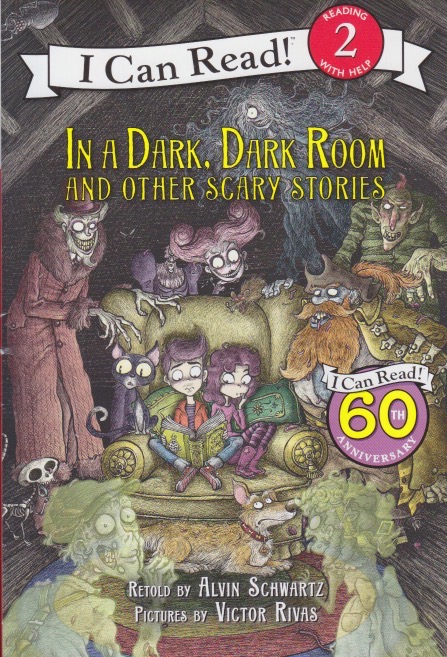
We were a bit shocked, not by that, but when a relative got us started on Roald Dahl.  His somewhat macabre children’s books were fine.  One of them, however—and I can’t recall the title—it’s packed away in the attic—was stories for older kids and it was so gruesome that I had difficulty making it through.  Not for me, but thinking about it from the perspective of a young child.  I recently had cause to read In a Dark, Dark Room and Other Scary Stories, again by Schwartz.  The copy I read wasn’t an original edition, but had illustrations, in color, by Victor Rivas.  I tried to think how scary such tales must be for kids who don’t know them already.  These illustrations were humorous, which helps, and tended toward Victorian or Edwardian style. Encountering such ideas for the first time, however, could leave an impression.

We tend to find olden times scarier than our own, it seems.  Partially this is correct, I suppose.  Science has helped us delay the inevitable by ameliorating many things that were formerly deadly.  At the same time it has helped those interested in such things to develop even deadlier weapons.  Mass shootings have become more common, to be mingled with the quotidian horrors of daily life.  Ghost stories hardly seem to be the most scary thing anymore.  I don’t know the answer to when kids are psychologically ready for scary things.  I still recall our neighbor—she was a few years older than we were—telling my brothers and me scary “true” stories that happened in the woods just across the street.  Those were in the “innocent” days before printed ghost stories for kids, but they gave me nightmares even so.  It was, however, the machinations of “Bible believers” that led me back to horror as an adult.  It’s kind of a disconnect.