Reading Early America

Reading about Washington Irving is reading about early America.  And reading about early America is to read about what’s happening in politics today.  One thing that’s very clear, even among the founders of this nation, is the fear that politicians like those we have today would arise.  You see, nothing like America had happened before—a nation deciding to govern itself without a king or queen.  A democracy.  The founders weren’t blind to human weakness, however.  They repeatedly warned against what we now have—a two-party system (which will naturally deeply divide a people) that backs ambitious, wealthy individuals who crave power rather than the good of the country.  Instead of bravery, we elect cowards who dodged the draft because of their personal wealth, and then called veterans “losers” when they’re elected.

There’s some comfort in this long view, however.  The fear we all constantly feel is nothing new.  From 1776 onward, those who were architects and analysts of this republic have warned that we’re always on the brink.  Reading about such things at the same time as reading about the history of Russia is enlightening.  Russia was a monarchy.  It’s sometimes hard to remember that it has only been a hundred and five years since the Romanov family was executed and “rule by the people” became the norm in that nation.  That Mikhail Gorbachev was the first leader of post-Soviet Russia and that was only less than 25 years ago.  We are all part of history.  And history is very old.

America only works as long as those who lead it are dedicated to the nation, not to themselves.  What is the sense of a nation if not putting the needs of others on the same level, or even above, your own?  Sacrificial thinking is behind what used to be called “servant leadership.”  Instead, we tend to see those who find out how to game the system rising to the top through money, grift, or high self-regard.  And when multiple nations have such people in leadership roles we find ourselves in the situation that we face in the twenty-first century.  But we faced it also in the twentieth century.  And in the nineteenth.  People, it seems, do not change.  Monarchs, through no right other than extreme wealth, rule nations.  The idea never dies.  The thought that wealth equates with worth is a poison to all political systems.  This is something you learn by reading about early America.  Today’s an election day.  If you support democracy, make time to get out and vote.


Devil’s Workshop

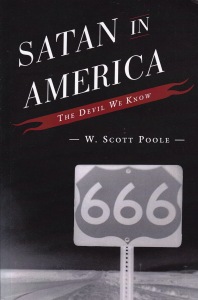
SatanInAmerSome of us prefer taking our monsters neat. With Old Scratch, however, we have a slippery, protean beast. This is amply demonstrated in W. Scott Poole’s Satan in America: The Devil We Know. Not only the Devil, but vampires, demons, and the human minions known as Satanists and witches populate this study of American culture. The Dark Lord is difficult to pin down. This is true even concerning his obscure biblical origins. As I’ve noted before, there is no Devil in the Hebrew Bible. By the time of the Gospels he’s alive and well and on planet earth. Or at least what passed for planet earth in those days. Tempter, father of lies, prince of the power of the air—he was a pretty ambitious fellow, seeking like a lion those he might devour. Those were early days, however, and Poole focuses specifically on his development in American culture. It is, as he shows, a rich culture indeed.

Beginning with the colonial era, with the Matherses, Jonathan Edwards, and their ilk, and bringing the figure up through fairly contemporary times, Poole shows us how the Devil defines America, in many ways. Please don’t misunderstand; Poole does not say America is evil or Satanic, only that our culture has had an undying fascination with Satan. Not everyone agrees, of course, with who he is or how to interpret him. Although theologians have largely left the Devil in the dust, polls tend to show about half of the American population believes in the Beast (yet another character in the mixed martini of evil Poole serves up), or more properly, Satan. It really might help to have a diabolical score card here: is the Antichrist the Devil? Is he the same as the Beast? What about demons? As a child I was taught there is only one Devil, but lots and lots of demons. Legions of them, in fact. There can be only one morning star, one Lucifer.

One thing we can say for certain about Satan, at least in the context of Poole’s study, is that he is evil. Not that some haven’t had sympathy for him. Popular culture has helped to keep the character alive. Sometimes comically, sometimes with dead seriousness, novelists, cartoonists, film-makers, and playwrights come time and time again to the font of the inexplicable evil we all seem to sense, in some sense, exists. The evidence is all around us. Whether conceived as an external agent of supernatural origin, or as some inborn tendency for—at least some—committing atrocity, we do have to explain evil. Satan has been a convenient way of doing so for centuries. But, as Poole intimates, it might be a defense mechanism. Perhaps we need to take a closer look at ourselves. Perhaps trumping our exceptionalism in the face of a world in need is a symptom that requires a serious exorcism.