American Revolution

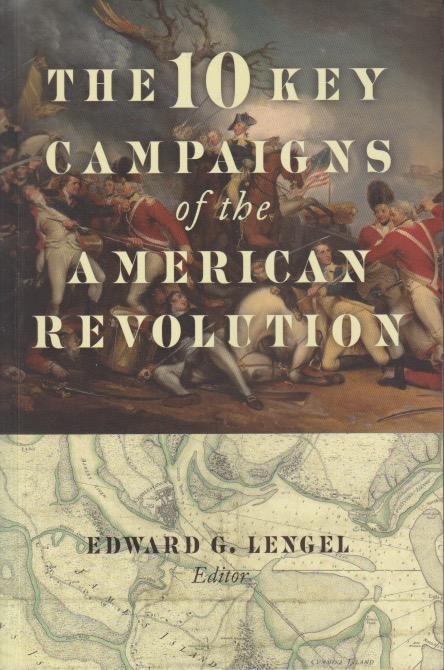
In these days when America seems to be a nation purely for purposes of stoking Trump’s ego, and the Supreme Court agrees that’s our purpose, many of us are looking for some sense of balance.  I think that was behind, at least subtly, our family trip to Valley Forge this summer.  It was there that we purchased The 10 Key Campaigns of the American Revolution, edited by Edward G. L’Engel.  Now, I’m no fan of reading about wars; I’ve always believed that “rational” beings could come up with better ways of resolving differences.  Some guys like to fight, I know.  And in the case of American liberty we had a king who only wanted to use America for his personal glory.  Wait.  What?  In any case, I would not likely read a book about war, but I feel I need to find some connection to the country that existed before 2016.

My wife and I read this book together.  It is an edited collection, which means that the chapters are uneven.  Some military historians like to get down to the details whereas I prefer a wider sweep.  Nevertheless, as a whole the book gives a pretty good sweep of what happened during those revolutionary years.  Starting with Lexington and Concord, prior to the Declaration of Independence, and moving through the campaign to take Quebec, the loss of New York City, the battles of Trenton and Princeton, Ticonderoga and Saratoga, Philadelphia, Monmouth, the battles in and around Charleston, and finally, Yorktown, the essays give an idea of the breadth of the fighting.  The authors also make the point that this was a civil war, the first of at least two in this country.

Americans have, until the internet, learned to get along with those who are very different.  Now we hang out in clusters of those like us and hate everyone else.  That’s one of the reasons why, living many years in New Jersey, that we unplugged and got out to see these sites.  I visited Lexington when I lived in Boston, and we visited the scene of the battles at Princeton and Monmouth, as well as Washington’s Crossing, when we were in Jersey.  We’ve been to New York City and Philadelphia, of course, but these cities have changed much, showing what can happen when people cooperate instead of being divided against each other.  The same is true of Charleston, which we visited a couple years back.  Although not my favorite book of this year, strangely this one gave me hope.  Maybe America can overcome this present crisis as well.

America the Religious

One of the truths that doctoral work teaches you is that if you look closely at something, minute differences appear.  Those interested in historical subjects write up syntheses that cover over many of these minute differences until somewhat of a false impression might occur.  Consider Puritan New England.  The image is a familiar one to the American imagination.  Rigid, pious, fearful church-goers predominated.  Stern, often acerbic, ministers were voices of authority.  But in actual fact, maybe a third of those eligible to be so in Puritan New England were church members.  Many lived in remote locations and used folk traditions (what the church would condemn as “witchcraft”) to meet their spiritual needs.  This was DIY religion.  And yet, the overall picture is of an uptight, strict, Calvinistic world.  That’s only part of the story.

Controlling the narrative is a powerful thing.  For example, the religious right has often flouted the idea that America was very religious from the beginning.  The “falling away” from the church is only the result of modernism.  Before that, they claim, pretty much everybody was religious.  This is patently untrue.  But if the narrative is believed, it becomes powerful.  Historians face a dilemma here.  Not every single little detail can be written about anything.  If you read a history of, say, the United States, do you think everything is in those thousand pages?  No, not by a long shot.  Entire books written about a single individual don’t cover everything.  The temptation is to present an approximation that covers the general trends.  Those of us who study religious history have an extra hurdle—what people say they believe and what they actually believe might be quite different.

Demographic studies that show only a third of New Englanders were church members indicates that two-thirds of the story remained untold.  The city on a hill may have been an ideal, but most of the people lived in the valley.  People prefer a happy story, of course.  That’s natural enough.  When we look for facts sometimes the story can grow a little confused.  Shrink that history of the US down to a single state and it’s still unwieldy.  Even a single city.  Choices have to be made and approaches have to be decided.  What really happened?  You can bet your bottom dollar that it was a lot more complex than any history book indicates.  People prefer mythological national narratives to naturalistic ones.  When we buy into simple materialism we often mistake our mythic past for a factual one.


Coming to History

Perhaps because I was a critical thinker at a young age, or maybe because I’ve always been insistent on fairness, I never took an interest in American history.  I cast my eyes back further, wondering how we got to where we are.  Such looking backward would lead to my doctorate.  Now, however, I’m interested.  I’d pay better attention to American history in school, were I now required to attend.  I’ve known about Kenneth C. DavisA Nation Rising since shortly after it was published.  My family listened to part of the recorded version when long car trips were more common.  Remembering what we’d heard, I eventually purchased the print book as well—I’m a fan of print and always will be, I’m afraid.  I only resort to ebooks when there’s no other option.

In any case, what drew me to these Untold Tales from America’s Hidden History was the information about early revivals.  Particularly those of George Whitefield.  Now, I’d learned about Whitefield in seminary (it was in United Methodist history, as it happens), but I hadn’t realized that he was America’s first superstar entertainer.  People flocked to hear him preach and he even caught the attention and friendship of Benjamin Franklin.  It’s estimated that Whitefield reached an audience of about 10 million hearers, and this was back in the eighteenth century.  He also preached in England and since the American population was just over 2 million in those days, it means he was enormously popular over here.  It was Davis’ book, not a seminary class, that made me aware of the fact.

Having grown up in one of the original thirteen colonies—Pennsylvania was a state by then; I’m not that old—you’d think I might’ve been more interested.  George Washington was in western Pennsylvania at least a time or two, and I even found a Civil War coat button poking out of the ground in our backyard once.  Nevertheless, it took adulthood, and perhaps the recognition of just how fragile our democracy is, to kickstart my interest.  Davis’ book is good for those who are interested in the lesser-known aspects of American heritage.  We aren’t always the good guys, though.  This isn’t the heavy-duty history that totters with facts and figures.  Really, it’s a set of fascinating vignettes of many people mostly forgotten these days.  And like most American histories, it shows that our political troubles today are nothing new.