Eye Eye

When trying to be conscientious about not spending too much money on movies there’s always the risk of seeing something cheap.  In the case of The Eye Creatures, not only was it cheap, but it was also a throw-back to childhood.  I remember seeing this one in my younger years, and, not yet old enough to be critical, loving the costumes.  Rewatching it as an adult, where some critical faculties remain, reveals it to be a bad movie.  Poorly written, poorly acted, and poorly financed, it ticks all the boxes.  It’s actually a remake of an earlier American International Pictures film, and AIP wasn’t known for its lush budgets.  To be fair, the film is supposed to be a sci-fi horror comedy, but the comedy isn’t that good.  The unintentional gaffs are.
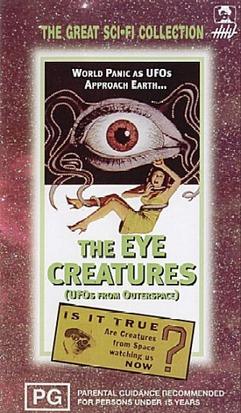
So, the Air Force is concerned about keeping flying saucers secret.  When an “unfriendly” one lands where the teens all go parking, the Air Force investigates while the eponymous eye creatures terrorize the local kids.  Specifically, they seem bent on revenge against Stan Keyton and his girl, because they ran over one of the creatures.  Keyton gets arrested for manslaughter because the creatures substitute the body of a drifter they killed for the corpse of their own comrade.  The police don’t believe in aliens, of course, and the Air Force denies everything.  Keyton and gal decide, after discovering the the eye creatures explode when exposed to light, to round up the necking kids and wipe out the aliens with their headlights.  They figure nobody will believe them anyway.

Some movie monsters stick with you for decades.  The eye creatures are one example of this.  Simply seeing the movie title reminded me of them, although the only plot point I could remember was that they exploded in the light.  I didn’t recall all the voyeuristic watching of teens making out that the Air Force officers did.  Or the tedious revisiting of the Old Man Bailey character.  One of schlockmeister Larry Buchanan’s films, it was released the same year as his other cheap childhood favorite, Zontar, Thing from Venus.  As much as people like to make fun of makers of such cheap movies, Buchanan gained recognition in the New York Times (as have other makers of schlock such as Roger Corman and William Castle), so there is something to these movies.  For one thing, those of us who grew up in the sixties remember them.  And, if we also remain cheap, we can see them again as adults, and relive a bit of cinematic history.
Terrible Comedy

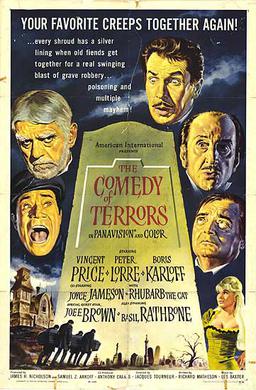
Frankly, I expected better.  The Comedy of Terrors seemed to have a lot going for it.  With my current interests in American International (AIP), Vincent Price, Jacques Tourneur, and Richard Matheson, watching it for free was a no brainer.  And I mean, no brainer.  Maybe it lacked the Roger Corman touch.  The premise is cute enough, bring together horror icons and have them take the mickey out of Shakespeare’s Comedy of Errors.  Peter Lorre and Boris Karloff join Price and Matheson scripts generally don’t disappoint.  Tourneur had a string of great horror movies behind him.  But the magic just isn’t there.  Comedy horror, or horror comedy, is difficult to pull off well.  Particularly if it’s deliberate.  What Young Frankenstein got right just went wrong in Comedy.

All of this makes me more conscious of just how impressive a great movie is.  With so many moving parts, films leave plenty of gaps where things can go awry.  The vast majority of movies perish with little notice, of course.  Success—earning more than it cost you (still waiting for that with my writing)—comes to some, and that’s what has me vexed here.  Tourneur was a talented director.  The actors all had proven themselves repeatedly.  Matheson brought life to so many horror and sci-fi movies and television shows.  Even AIP had a number of hits after starting out as notorious for their low-budget approach.  The jokes in Comedy aren’t funny and the horror’s not scary.  Some have opined that the sarcasm is spot-on, but it didn’t seem so to me.  There’s even some disagreement as to whether the film earned its budget back or not.

Horror movies come in all stripes.  And spots.  Even solids.  Comedy horror isn’t my favorite, but some of the gems of the genre (Rocky Horror Picture Show, Gremlins, Shaun of the Dead, Ghostbusters) show that the combination can work but ought to serve as cautionary tales.  (Both Ghostbusters 2 and Gremlins 2 failed to capture the magic of their forebears.)  If everything falls together just fine, step back and bask in wonder.  Trying too hard (of which I’ve been accused) sometimes doesn’t work while you’re attempting to be funny.  It’s pretty clear that Nicholson and Arkoff thought bringing all of this talent together was a recipe for success.  Of course, there are plenty of moving parts and a director, or even a producer, is entitled to a blunder or two.  I like a good laugh as much as the next guy, and after seeing this flick I could use one.


An Interesting Prize

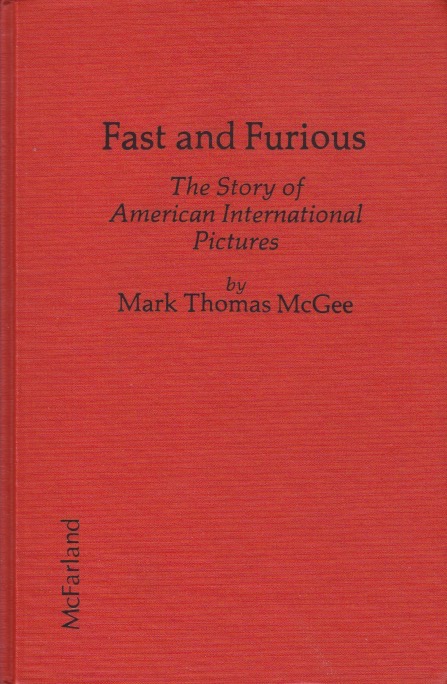
If you’re born without it, you get by any way that you can.  Capital, that is.  Those of us who inherit nothing but active minds don’t stand a chance, really.  Without connections or the cash to draw others in, we tend to be scrappy.  And cheap.  This is probably the reason I’m drawn to characters like Ed Wood, and those who started American International Pictures.  I get the sense that Mark Thomas McGee must be an interesting guy.  After all, he met some of his idols when he was young.  Fast and Furious: The Story of American International Pictures is available in a second edition, I know, but I tend to find first editions fresher.  They say what’s really on an author’s mind.  Besides, used books have their own charm.

Although American International Pictures (AIP) was early on known for fast shooting schedules and cheap effects, it eventually started to earn some mainstream respectability before the company being acquired by Filmways.  Along the way they engaged some famous champions of cheap, such as Roger Corman.  A number of films discussed in this book were part of my childhood.  And as someone who’s always had to live cheaply (I just don’t comprehend finance), I found this an extremely hopeful book.  Some of these folks never became famous in the lifetimes, but they left a legacy.  And that’s a worthy goal.  I suspect that for those of us who can’t break into mainstream publishing, blogging is about building a legacy.  What some of us want, however, is to appear in print.

And I mean in print.  The book is an object.  I bought this one used.  I sometimes find interesting things in used books.  The former owner of this one (a McFarland hardcover!) carefully glued postcards of AIP movie posters to the covers and endsheets.  They didn’t put their name in it, but they (in pencil) ticked off the movies, presumably that they’d seen, from the filmography.  This is a person after my own heart.  I tend not to write in most books anymore, realizing that someday someone will probably sell them and, hey, it’s hard enough to make money in the book business.  But this personalization is something you can’t find in an ebook.  No, a book is meant to be held and loved.  This one clearly was.  As publishers chase more and more after electronic and audio books (the latter of which are also electronic) and learning moves from reading to watching, we’re losing something.  They’re called books, and they bear their own meaning.