Christian Nationalisms

Ongoing analysis of the Capitol Riots continues as footage of the event is scrutinized.  Although the press is puzzled, those who study religion—underfunded and ignored in the academy—aren’t really surprised.  A recent story from the Associated Press explores how Christian Nationalism, one of the most dangerous forces in the United States, played a large role in the event.  Christian Nationalism is one example of what I call weaponized religion.  As someone who’s spent over four decades studying religion minutely, it’s pretty clear when religion begins to slip its moorings and is becoming radicalized.  Generally it begins when adherents refuse to hear any views but their own.  They believe their version of their religion is the only “one, true faith” and this gives them the mandate to attack any who believe differently.  In the case of Christianity it’s very difficult to see what any of this has to do with a carpenter from Nazareth.

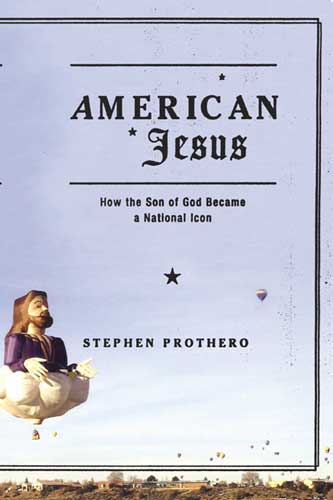
Indeed, evangelical Christians themselves are exploring what is now being called “Republican Jesus.”  This Jesus isn’t the one from the Good Book.  Far from it.  No humble shepherd saying “turn the other cheek” fits this image.  Long ago I read Stephen Prothero’s American Jesus.  In it he analyzed how the American appropriation of the Jewish rabbi became a muscular, masculine fighter.  Not the kind of guy who’d let Roman authorities nail him to a cross.  And certainly not a softie who would favor outcasts, women, and children over the rich and powerful.  This image of Jesus, who draws a hard line on certain trigger issues, is as patently false as any reconstruction can be.  And yet it drives unruly mobs into the halls of power.  Universities, meanwhile, cut religion departments.

Photo credit: David Shankbone, via Wikimedia Commons

I don’t pretend to be a prophet, but this issue isn’t going away.  Our culture has long harbored the myth of America as the “new Israel.”  The leaders of Christian Nationalism are organized and they have a clear agenda to take over the country.  Like other serious issues that don’t have to do with making money, it’s simply overlooked as irrelevant.  When the mainstream media gets a glimpse at what’s been going on in such groups, it always seems surprised.  The kind of elitism that divorces itself from the everyday simply can’t be informed of what’s actually happening.  Religion is a very powerful driving force.  It motivates many far more than money does.  We see it plainly when it becomes weaponized.  By then, however, it could be too late.


Jesus Lets Himself Go

Leonardo da Vinci's Last Supper


Carpentry is hard work, as Jesus must have known. The occasions when I head to the basement and chew through wood with an electric saw and nail boards together through pre-drilled pilot holes always leave me feeling like I’ve burned a few calories. Not to mention walking everywhere. No Hondas, Volkswagens, or Smart Cars in those days. A guy could sure build up an appetite. My wife pointed me to Newsweek’s blog this week, where a story about the portion sizes portrayed in paintings of the last supper over the past millennium is posted. The conclusion drawn: the food servings have continued to escalate in size as food production and acquisition have become easier.

This is not so surprising, given that what people value is what they portray in art. As I’ve mentioned before, Stephen Prothero, in his book American Jesus, demonstrates that portraits of Jesus reflect the self-perception of the society in which they are produced. Few attempt to make a life-like representation, largely because no one knows what Jesus might have looked like.

Jesus as an ordinary guy

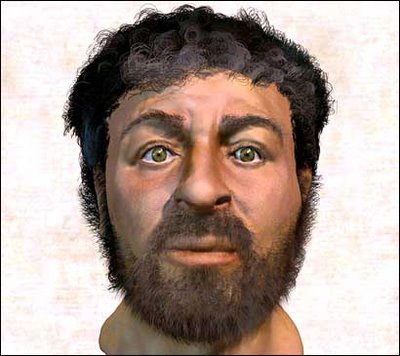
A few years back, Richard Neave, a retired medical artist from the University of Manchester reconstructed, based on forensic research, what he believes Jesus likely looked like. The portrait is not handsome, and to be fair, not based on the actual skull of Jesus which has been missing for a couple of millennia. I used to ask my students in Intro to Christianity what difference it would make if Jesus was not good-looking. They tended to react strongly – particularly those of Christian disposition – there was an inherent blasphemy in suggesting that Jesus might not have been drop-dead handsome.

Now, if we gently push his chair back into that fateful table one more time, we might wonder how an overweight Jesus might appeal to those who struggle with weight issues. More of him to go around, as the saying goes. I’ve viewed much religious art in my time, but I’ve never seen a love-handled Jesus, let alone a chunky savior. And perhaps that is the biggest miracle of all, given that he eats more each passing year.


Saint John, Elton, That Is

“I think Jesus was a compassionate, super-intelligent gay man who understood human problems. On the cross, he forgave the people who crucified him. Jesus wanted us to be loving and forgiving. I don’t know what makes people so cruel. Try being a gay woman in the Middle East — you’re as good as dead.” According to Parade.com, this was Elton John’s take on Christianity. I find the comments endearing in a naïve sort of way. They further demonstrate how people construct their gods in their own images. Compassionate? No question. Super-intelligent? Well, maybe. He certainly was creative, witty, and above average in intellectual celerity. Gay? Not likely. Not for doctrinal reasons, but simply for cultural ones. “Gay” as a lifestyle simply did not exist in the first century. The Bible maintains a steely silence on any aspect of Jesus’ sexual life, so we can never know. Perhaps it’s a case of “don’t ask, don’t tell”? Understood human problems? Bingo! Yahtzee! That is, I believe, what Jesus was all about. In my humble opinion, Elton hit that one dead on.

The crafting of Jesus into our own form is a major aspect of Stephen Prothero’s American Jesus. A fascinating romp through a bizarre collection of made-over Jesuses, Prothero’s book should be required reading for anyone interested in civil religion or Thucydides. Even a religion prof from my alma mater, however, didn’t fully convince me that anybody really understands who Jesus was. Such is the way with all truly great individuals.

Unlike some commentators who are clearly upset by Elton John’s summation of Christianity’s founder, I am a bit more circumspect about it. No one has cornered the market on Jesus. As hard as various Christianities have tried, Jesus still emerges in divergent forms to diverse individuals and populations. From Superstar to “super-intelligent gay man,” there is no doubt that Jesus left an eternal imprint on the human population of this planet and that those who believe in him will always portray him in their own image.