American Revolution

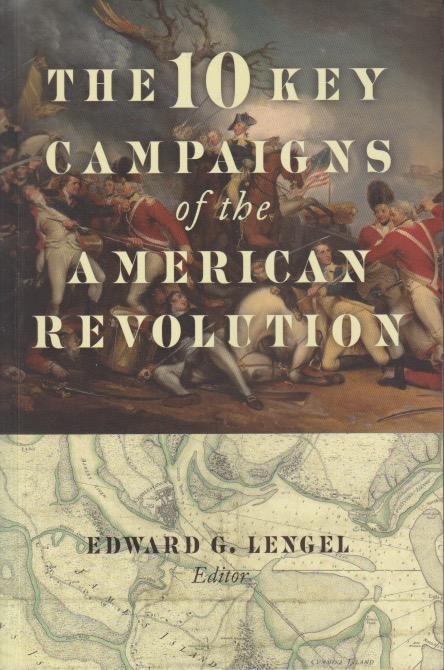
In these days when America seems to be a nation purely for purposes of stoking Trump’s ego, and the Supreme Court agrees that’s our purpose, many of us are looking for some sense of balance.  I think that was behind, at least subtly, our family trip to Valley Forge this summer.  It was there that we purchased The 10 Key Campaigns of the American Revolution, edited by Edward G. L’Engel.  Now, I’m no fan of reading about wars; I’ve always believed that “rational” beings could come up with better ways of resolving differences.  Some guys like to fight, I know.  And in the case of American liberty we had a king who only wanted to use America for his personal glory.  Wait.  What?  In any case, I would not likely read a book about war, but I feel I need to find some connection to the country that existed before 2016.

My wife and I read this book together.  It is an edited collection, which means that the chapters are uneven.  Some military historians like to get down to the details whereas I prefer a wider sweep.  Nevertheless, as a whole the book gives a pretty good sweep of what happened during those revolutionary years.  Starting with Lexington and Concord, prior to the Declaration of Independence, and moving through the campaign to take Quebec, the loss of New York City, the battles of Trenton and Princeton, Ticonderoga and Saratoga, Philadelphia, Monmouth, the battles in and around Charleston, and finally, Yorktown, the essays give an idea of the breadth of the fighting.  The authors also make the point that this was a civil war, the first of at least two in this country.

Americans have, until the internet, learned to get along with those who are very different.  Now we hang out in clusters of those like us and hate everyone else.  That’s one of the reasons why, living many years in New Jersey, that we unplugged and got out to see these sites.  I visited Lexington when I lived in Boston, and we visited the scene of the battles at Princeton and Monmouth, as well as Washington’s Crossing, when we were in Jersey.  We’ve been to New York City and Philadelphia, of course, but these cities have changed much, showing what can happen when people cooperate instead of being divided against each other.  The same is true of Charleston, which we visited a couple years back.  Although not my favorite book of this year, strangely this one gave me hope.  Maybe America can overcome this present crisis as well.

The Valley

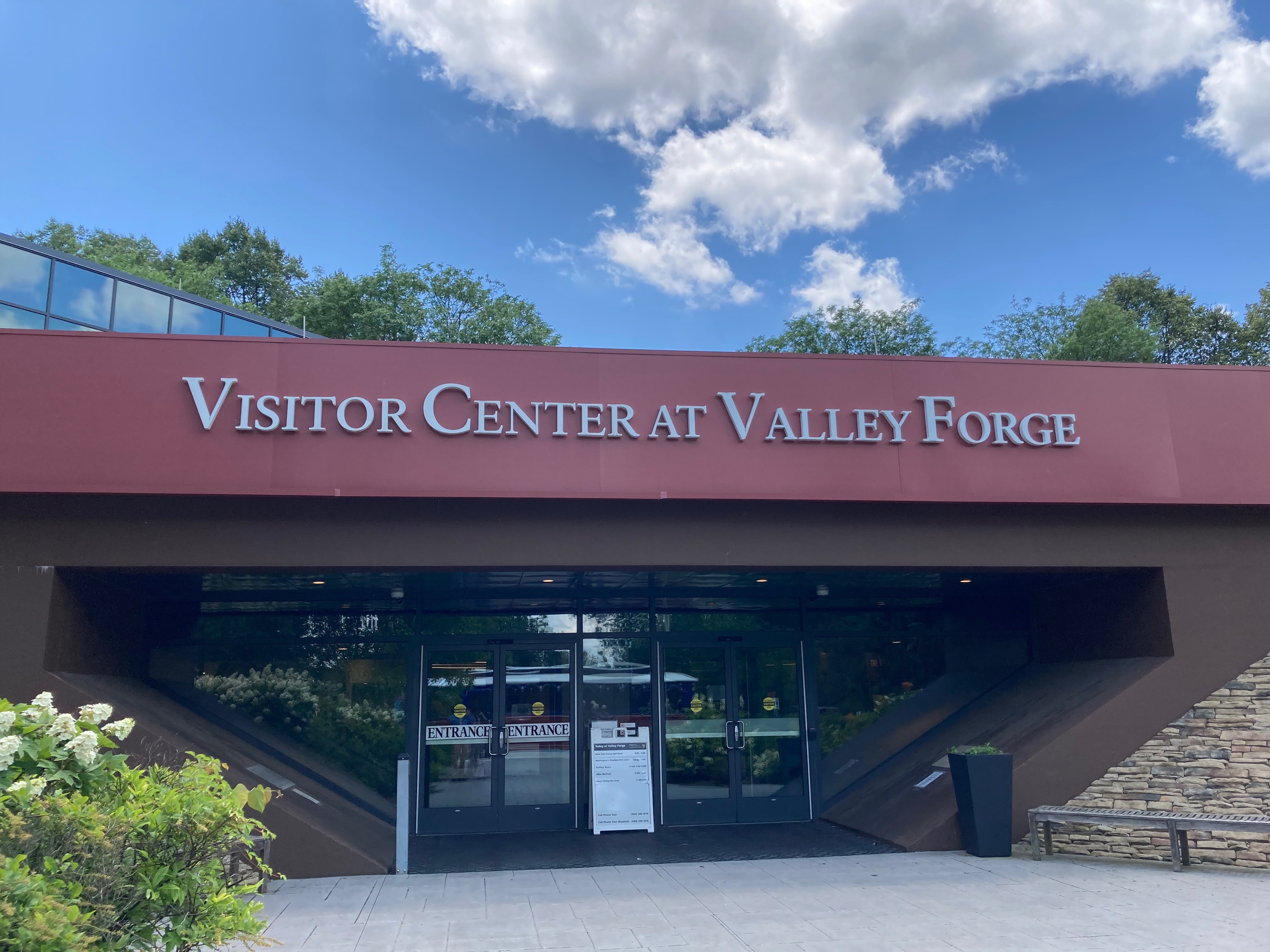
Juneteenth seemed a good day to get to Valley Forge.  With all the nonsense going on in the White House, we need to be reminded what this country was founded on and for.  I like to think that we weren’t the only ones there yesterday for that reason.  In fact, in the gift shop I found a book titled America’s Last King.  By the time we left it was sold out.  Like many Americans, I suppose, I only had a vague idea why Valley Forge was important for our young country.  We took a tour that helped explain it.  A tour that some in Washington ought be be required to take.  Valley Forge was a winter encampment—the third in the War of Independence.  George Washington had just suffered two defeats and the British had taken Philadelphia.  His poorly provisioned army set up winter headquarters in this strategically secure hill country.  Inadequately clothed, barely fed, many dying, they planned how to keep their efforts to survive alive.

What happened that winter of 1777–1778 at Valley Forge that kept the United States alive depended on two things, both brought by immigrants.  Let me say that again, in case ICE is having trouble hearing—immigrants saved America.  The young country was in very real danger of defeat.  What turned the tide was an alliance with France (the name Lafayette still looms large here in the east) and the help of Baron Friedrich von Steuben, a Prussian.  Without these foreigners, America would never have survived to become great.  Oh, and Mr. Kennedy, Washington ordered vaccinations at Valley Forge to prevent so many of his troops from dying from small pox, an inconvenient truth.  What emerged from Valley Forge that winter was a more organized, healthier United States Army that would go on to defeat the British so that we could be free two and a half centuries later.

I needed Valley Forge.  Although it was a hot day and the roads are paved, I needed to be reminded what it felt like to be proud to be an American.  Juneteenth is to commemorate the end of slavery.  History shows that many in Washington’s army were of African descent.  It seems that DC has forgotten what America is and what we were fighting for all those many years ago.  It wasn’t to exclude those who were different.  No, it was to pull together to survive.  Our would-be king spends his idle days planning military parades in his honor.  The US Army was born in Valley Forge.  And as an American with ancestors here from Washington’s day on, I really needed that visit to remind me of how America became great.


Hamilton

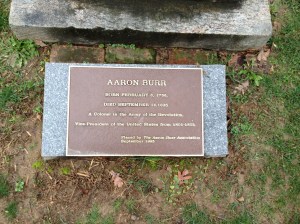
Religion and politics. It’s difficult to get over the wisdom instilled in your earliest years, and I was one of those who learned that religion and politics always cause potential friction in polite conversation. They are both, however, very important to people and knowing how to communicate about them irenically is a sign of maturity. While I can’t afford Broadway shows, I have read reports about the brilliance of a couple shows that feature—what else?—religion and politics. “Book of Mormon” has continued to be a success in the theater district, and, starting this summer, “Hamilton” joined the ranks of most popular Broadway shows. A hip-hop-inspired version of the story of Alexander Hamilton, the show offers history to audiences traditionally just out for a good time. I haven’t seen the show, but on a recent long car ride, I listened to the soundtrack and I have to admit that I haven’t stopped thinking about it since. Part of the reason is the sadness of the story—the dual between Aaron Burr and Alexander Hamilton ended up with one of the “forgotten founding fathers” dead, and another cast forever as a criminal.

IMG_2652

Although my interest in history has defined my career (such as it is), I don’t pretend to know much about the revolutionary period. One of the reasons is that I’m more than a bit ashamed by the treatment of American Indians by the colonials. It is hard to celebrate when you feel like a criminal yourself. Another reason has been that ancient history has always captivated me, and events two-to-two-and-a-half centuries ago feel too recent. Nevertheless, I find myself in New Jersey where much of the Revolution played out: Washington crossing the Delaware, the Battle of Princeton, the Battle of Monmouth, and many other famous episodes. The British of that time enjoyed the power of empire—keeping others down so that the privileged might see themselves entitled. In the musical, King George has a role, in my mind, similar to Pontus Pilate in Jesus Christ Superstar.

I can’t help but think that what Lin-Manuel Miranda has offered in “Hamilton” is an extended kind of parable. The show is noted for its multi-ethnic cast in a story that was almost entirely, historically speaking, one of white privilege. Who can hear the songs swirling around the shooting of Hamilton and not think of the equally insane shooting of young African Americans who, like Hamilton, have no intention of causing harm? There are writers and poets and lovers who still try to find their place in a country that bathes the uber-rich with adoration and tax breaks and far too much power. “Hamilton” may, if people actually pay attention, turn out to be revolutionary. Politics and religion share that feature in common.