Which Witch Where?

I like to think of myself as a kind critic.  I’ve been on the pointy end enough to know how it feels when those who don’t like my work are unkind.  I’ll try to find a nice way of saying Witches of Amityville, or Witches of Amityville Academy, must’ve been shot on a very modest budget.  It must’ve been written by someone who’s still working hard to master the craft.  And the actors are continuing to improve as the director gets better at that role.  Why did I watch it?  Amazon Prime gives it four stars.  The incongruity of Amityville and witches suggested it might be a bad movie, and in that regard it did not disappoint.  So what’s going on here?

There’s a witch academy in Amityville.  Although all the cars have steering wheels on the right, everyone speaks with American accents, apart from a couple of characters.  The interior shots, however, are also pretty British for the most part.  There does seem to be some awareness that Amityville is in the new world.  In any case, said academy is run by an evil coven that is seeking to release the demon Botis.  To do so they have to sacrifice college-age women (and no, it’s not that kind of movie).  One of their intended sacrifices escapes and is found by three white witch sisters who also live in Amityville.  They decide to train this young woman who, as it turns out, is a very powerful witch.  Problem is, the director of the academy can’t release the demon without sacrificing this particular victim.  So she kidnaps her back.  The three good witches burst on the scene, actually more like just walk on, and prevent the sacrifice.  The bad witch kills herself and releases the demon, but the young witch is so powerful that she destroys him.  In the end the witches must go to Salem.

What’s not to like?  Some of us, day by day, year by year, work to improve our writing skills.  We write stories that incorporate whatever ability we’ve managed to scrape together.  And we struggle to find publishers.  I like bad movies because they are a great place to find hope.  The world’s a big place.  Even the entertainment industry is large enough to absorb movies produced by Amazon, Hulu, and Netflix, among others, including the big studios.  They’ve got to be looking for content, right?  Those of us who channel our creativity towards writing, and who keep trying to get it published, have a chance, don’t we?  What’s the harm in believing in the power of magic?

Straining Credulity

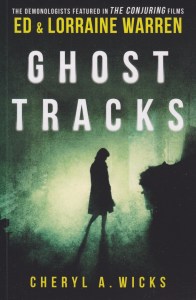
Ed and Lorraine Warren aren’t easy to figure out.  I realize that for someone who holds an actual doctorate from a bona fide, internationally recognized research university this might be something strange to say.  That’s because the standard academic response is simple dismissal.  Ed, at least, was known to have stretched the truth from time to time, but that’s not the same as never having reported weird things that actually happened.  This is why I’ve long advocated academics at least looking at the evidence—rare though it may be—before the simple hand-waving dismissal.  Part of the problem is that the Warrens’ books were written by credulous followers who don’t question things nearly enough.  Ghost Tracks, by Cheryl A. Wicks, may be the last of this strange genre of hortatory, biographical accounts “by” the Warrens written while Ed was still alive.

Skepticism is very important.  But so is listening to people.  What I find compelling is that similar weirdness—frequently dismissed out of hand—has been recorded throughout the length and breadth of history and across the entire globe.  The problem is that many of these things fall outside current scientific means of testing.  While perhaps not widely known, very reputable universities quietly explore these possibilities with actual science.  Part of the problem of the Warrens, as well as various other “ghost hunters” is that they use scientific equipment and think that makes them scientists.  It doesn’t.  Science requires deep engagement and many years of strenuous study.  And yes, skepticism has to be part of it.  The thing the Warrens have to offer is that they realize(d) that when science does engage the supernatural interesting things emerge.

Sensationalism, however, is the slave of capitalism.  Books sell better when they make extraordinary claims and declare they’re based on true events.  Trying to make a living investigating the paranormal led the Warrens, it seems, to tip the balance a little too far in the way of credulity.  Some of the stories in Ghost Tracks are more believable than others.  Some are just plain frustrating.  Ed’s interview with George Lutz (of Amityville fame), for example, is full of dropped balls.  A good question receives an intriguing answer only to have the subject immediately switched by the interviewer.  Even just a little skepticism and a follow-up question would have done scads to improve the believability of the story.  This is something a scientist would have known.  Someone as smart as Sir Arthur Conan Doyle, although his Sherlock Holmes generally found  ratiocination led to physical explanations, believed in the supernatural.  If only his Holmes might’ve been brought to this discussion we might possibly have learned something.


Amityville

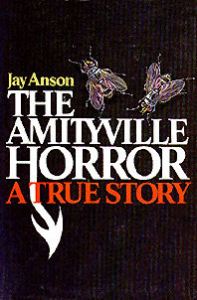
Surely one of the most controversial haunting stories of my own lifetime was that which came to be known as The Amityville Horror. After the tragic deaths of the DeFeo family in 1974, the next occupants of the fatal house, the Lutz family, claimed to have experienced 28 days of terror before moving out in the middle of winter and taking no belongings with them. Their story, written by Jay Anson, became a sensational bestseller. Published just four years after the unexpected cinematic success of The Exorcist, a movie was quickly signed and it was all the talk of my high school before I was quite at the stage of watching real horror films. By the time I got around to seeing the DVD, the tropes were so well known that it wasn’t really that scary. I realized that I had never read the book.

Whether you find Anson’s account scary or not probably depends on your level of belief in demons. Although he concludes his book with the suggestion that a combination of ghosts and a demon plagued the Lutzes and their priest, the focus of the narrative is clearly on the demonic. Fr. Mancuso suffers because the demon wants to keep him out of the house. The multiplication of flies, the constant waking up just after 3:00 a.m., and the smell of excrement all point to demonic activity. The book does have its share of historical inaccuracies and embellishments. It has been declared a complete hoax by some while others claim that at least some of what was described in the book happened to the blended family that called it home for less than a month. If you don’t accept demons, there’s little here to frighten you beyond a couple of benign ghosts.

As with any story claiming supernatural activity, we’ll never really know what happened. The Amityville Horror is often classified as a novel now. Our minds are conditioned to reject anything so terribly out of the ordinary that it is difficult to accept what you’re reading. The DeFeo family was undoubtedly murdered in the house by one of their own. The Lutz family did buy and then abandon the house in fairly short order for such an expensive purchase. There was a priest involved. The question marks hover about the supernatural elements, as they generally do. These are the ghosts and demons of the rational world which we inhabit. We safely confine them to fiction. Then we sleep at night with the lights left on.


More Conjuring

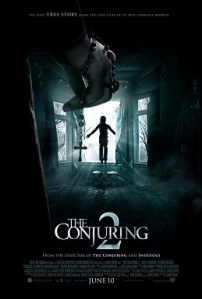
Among the most revered traditions of the horror film is the sequel. Originally a financially driven feature, sequels have now become an expectation among fans. And although in general we prefer to appeal to our higher cultural aspirations, many horror movies do remarkably well at the box office. I’m not much of a sequel-watcher, but sometimes in my effort to understand the close connection between religion and horror, I succumb. So it was I watched The Conjuring 2. As with the formula for the initial movie, cases actually investigated by Ed and Lorraine Warren are brought together with exaggerated special effects and demonic entities. Starting out in Amityville, the demon Valak is introduced. It later appears as the source of the Enfield poltergeist.

In real life controversy never strayed far from the Warrens and their investigations. Amityville and Enfield have both been implicated as hoaxes. The Hodgson girls, just like the Fox sisters in upstate New York, confessed to some faking, and, of course once that dam has been breeched, there’s no stopping the flood to follow. Nevertheless, such incidents make for good horror film fare. In the case of The Conjuring 2, bringing a named demon into the mix keeps the religious pot roiling. Ironically, the demon takes the form of a nun. This character is a complete departure from both the Amityville and Enfield of record, although demonic influences were posited for both cases. Valak appears to go back to The Lesser Key of Solomon, a grimoire familiar to watchers of the now departed Sleepy Hollow.

Even with the hoax light cast on the “based on a true story” tagline, The Conjuring is well on its way to spawning a cinematic universe. Annabelle was a spinoff, and Annabelle: Creation scored high marks this summer. The success of The Conjuring 2 has led to work on The Nun, scheduled out next year. There’s talk of a third Conjuring film as well. As religion becomes less obvious in the traditional forms of weekly worship gatherings, it crops up more in other areas of culture. Don’t get me wrong—there’s plenty of secular horror as well. What does stand out is that when religion knocks at that creaking door of horror, nobody’s especially surprised. The Conjuring 2’s climax is quickly resolved once the demon’s name is remembered. The fallen angel is banished, not so much back to Hell as to another sequel. Eternal life is, after all, a religious idea as well.