
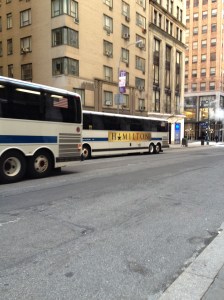
Tom Petty must’ve been a commuter. On a winter’s morning after switching to Daylight Saving Time, waiting is the indeed the hardest part. For a bus, that is. In the dark. The saving grace is that humans are rule-makers. Before I even began commuting into New York I’d been instructed in the etiquette. Those who get there first leave some kind of avatar—a briefcase, an umbrella, a lunch box—in their place in line and then sit in their cars. Being the paranoid sort, and also thinking myself tough, I’ve always just stood at my place as the chill wind finds its way down my collar and then buffets me almost off of my feet. With the time-change, however, I decided to do like the commuters do. I walked out to the line of objects to find one widely separated from the others. Being a law-abider, I put my lunch down after the errant water bottle.
“Hey,” a stranger called me on my way back to my car. “Somebody just left that water bottle—you should move your bag up next to the backpack.” Thanking him, I did so. Not only was this person I didn’t know watching me in the dark, but he was also keeping the rules. Indeed, when the bus crested the hill and commuters lined up next to their possessions, the water bottle remained unclaimed. It was still there fourteen hours later when I got off the returning bus. Now, I’m not a big fan of anarchy, but this incident demonstrates just how inclined we are toward civil behavior. There’s no bus stop police force to ensure nobody jumps line. Even at the Port Authority waiting in the queue at the end of the day the rules are mostly self-governing. Those who don’t obey are scolded by their peers and generally comply.
There’s a natural sort of ethic among those who catch the bus before 5 a.m. We’ve all been awake earlier than nature would seem to dictate. We’re in a dark, isolated location outside town. We look out for one another, realizing that any one of us might easily lose our place in line should the rules break down. I was struck by the kindness of this caliginous stranger. Or perhaps it was just his love of order. Had my representation been out of place, other commuters might’ve grown confused. The system might’ve broken down. The last thing anyone wants is chaos before cock-crow. I decided to interpret it as kindness, however, as I made my way back to my car to put on Tom Petty to face the hardest part.
 Steve A. Wiggins