Swing Low

The 1970s were a rare era.  On the cusp of the electronic revolution, we grew up with many old fashioned notions about how things were done and what was possible.  It was a period dominated by both interest in the paranormal and by Hal Lindsey’s Late, Great, Planet Earth, looking for the end of the world.  I was sent scampering to the strange documentary Chariots of the Gods by Gary Rhodes’ Weirdumentary.  I honestly can’t recall whether I saw it growing up.  I know I read Erich van Däniken’s book on which it’s based.  As a kid with little exposure to a truly educated community, I was swayed by the book and that makes me think I may have begged to have been taken to the Drake Theater in Oil City to see the film.  Watching it as an adult, however, is truly an odd experience.
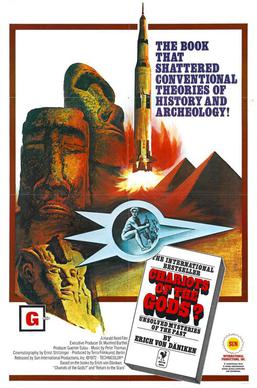
First of all, it’s freely available on multiple streaming services.  All you have to put up with is commercials and, since it’s not a high-demand movie, there aren’t that many of them.  The film, done by a German director and voiced over in English, begins by suggesting religious writings worldwide tell of wisdom from above.  People have always, I expect, felt that there is something divine about the sky.  We still get that impression from our experience of the weather.  The documentary makes the suggestion that Elijah’s fiery chariot was more technologically advanced than supposed.  Same with Ezekiel.  But then it sets out on a worldwide tour of ancient monumental building, stressing how such simple folk could never have built these things all on their own.  Although this doesn’t stand up to scrutiny, there’s nevertheless something compelling about it.

Among the more interesting items are some of the ancient rock carvings.  Without the written context, however, jumping to the conclusion that these were astronauts is foolhardy.  There are legitimate mysteries of history.  We don’t know who built certain structures, or why.  Our own modern fragile skyscrapers raise the same question.  People seem to be compelled to do such things simply because we can.  We don’t need aliens to help us with them.  Placing all of these mysteries together and suggesting a single solution is so 1970s.  Breaking things down and study of them by experts yields quite different results.  No less fascinating, but perhaps with feet more solidly on the ground.  This documentary is a strange period piece of a time I remember well.  And one from which, it seems, an even stranger culture has grown.

Come Sail Oy Vey

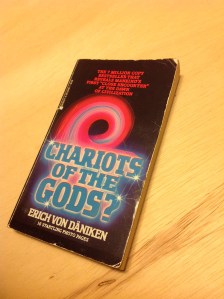
Nothing says unorthodox like a headline that reads “Smart Jews? Thank the Extraterrestrials.” Breaking Israel News ran the story recently and, being constitutionally unable to pass up anything so strange, I had to take a look. The article, by Adam Eliyahu Berkowitz, is really just a half-century retrospective of Erich von Däniken’s Chariots of the Gods?. I remember fifty years ago—not well, mind you, I was only three—but even when I was a teenager and the book had its second (of many ordinal) gasp(s), and a movie came out. People, even those not traditionally labeled as “crazy,” flocked to theaters to see it. The book went through multiple printings. The era of “ancient astronauts” was born. Von Däniken, it seems, is alive and if not exactly kicking, still making people uncomfortable.

IMG_0038

In this news story von Däniken suggests that Jews are more intelligent because of their alien DNA. Don’t quote me on this, but I’m pretty sure that was the plot line of the X-Files season 10. Isn’t Fox Mulder Jewish? Maybe I’m getting myself mixed up in some kind of plot here. I have to admit, however, to having a touch of nostalgia for Chariots of the Gods?. There was a kind of innocence to it. Nobody seemed to be inseminating anyone else, or stealing babies. It was good, clean fun.

Something bothers me, however, about the assertion that aliens are, indirectly perhaps, responsible for holy writ. I remember thinking through the implications of this idea (already floated four decades ago) that God might be more Captain Kirk than Jesus Christ. It is inherently disturbing. Especially when von Däniken says in the interview that the Jews are the chosen people, but they just got the chooser wrong. ET instead of I AM. The really interesting part is that ancient astronauts have become a somewhat accepted cultural trope. I don’t know whether they were there or not (I wasn’t around at the time), but they sure do make Saturday afternoons much more interesting. One wish I hold is that people writing about this old idea might find a new opening bit. Ezekiel seeing the wheel has been done to death. Surely a bit of creative thought might suggest a new, undiscovered ancient truth.


Alien Deities

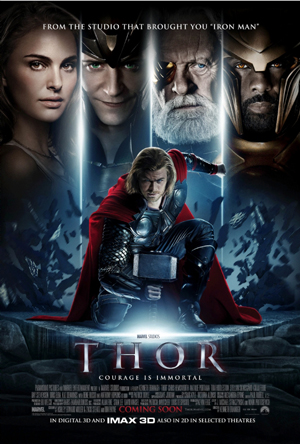
What with The Avengers making such a big pre-summer splash this year and all, I decided to refresh my memory and watch Thor again this weekend. In many ways it is a very impressive movie—very loud in the theater last year, and necessarily quieter in our apartment over the weekend. Often when I see a movie on the big screen I can’t keep track of all that is said or implied, especially when there’s so much action going on. Of course, Thor is an unusual hero in the Marvel Universe, being a god. Being supernatural is not limited to deities in that universe, but the other mutants are the results of science: the Hulk and his gamma rays, Captain America’s experimental treatment, and Iron Man’s good, old-fashioned engineering. They are modified humans. Thor comes from a different place. Upon rewatching the movie, the line about the Norse gods as beings from another dimension worshipped as gods came through loud and clear. Jane Foster comes to believe in the ancient alien hypothesis.

As a solution to the lack of omnipotence on the part of the gods, casting Thor and Loki into the role of aliens serves comic-book universes very well. In reality there are well-meaning and serious people who believe that any entity recognized as a god by human religions might have been a space traveler mistaken for divine. This is an idea I first encountered in Erich von Däniken’s Chariots of the Gods? (Hey, I couldn’t help it—I grew up in the seventies!) The world has enough high strangeness without von Däniken’s hypotheses, but in the case of Thor we have a fictional realm that explains how heroes gain their strength. The same could be postulated, I suppose, for Superman, but then, he never commanded a formal cult in antiquity.

Beyond the theological conundrum, Thor also participates in the nearly universal theme of resurrection. Realizing that his arrogance has led to the troubles of the human race, Thor faces the Destroyer (a creature with origins in the Hebrew Bible and Israelite mythology) and willingly lays down his life. This is generally the prerequisite for resurrection in any effective mythology. Of course, Thor returns and, like any good savior, rescues the world. Setting the story in New Mexico only assists in reasserting the mysterious events at Roswell where, like in the movie, something strange fell from the sky. In this subtext the feds rush in and commandeer the data, for people are not capable of making the correct decision. Yet, they leave the god behind. Marvel Studios has been rightly praised for its mastery of the genre. For those willing to look deeply, even Thor has its social commentary.