What People Like

It must be like showing up at a party wearing a flashy shirt that somebody else is also wearing.  Embarrassing, no?  A few years back I read Brian Jay Jones’ biography of Washington Irving.  As you may know, I recently finished Andrew Burstein’s.  The two were published within a year of each other, but both after a seven-decade gap in such biographies.  I suspect the renewed interest in Irving sprang up in the surge of public interest after Tim Burton’s Sleepy Hollow appeared.  Movies have power.  Books, especially big books, take a long time to write.  I don’t know if Jones and Burstein were aware of each other’s efforts or not.  Both are quite good, but they do stand as a testament to how fame can be fleeting.  Irving is infrequently taken as a genius writer today but he started more than one big thing.

What I’m particularly interested in is how Burton’s film seems to have kickstarted a new millennium interest in this old story.  I recently had a discussion with a couple of folks who felt that movies were too manipulative to be enjoyable.  Of course, nobody forces you to watch a movie, but I have found that they are powerful ways of influencing people.  And society.  Movies have been one of the more impactful forms of fiction media, spawning ideas that can change society.  Indeed, they may be modern mythology.  I wouldn’t yet make that exalted claim for Sleepy Hollow, but for those who follow such things, it has influenced the way we look at things.  And we can learn something from paying attention to them.

The Headless Horseman Pursuing Ichabod Crane by John Quidor

I suspect that is one of the perennial mistakes of higher education.  Assuming that something is popular means that it shouldn’t be worthy of scholarly attention.  If we want to understand what it means to be human, rather than just raping and plundering our planet until we choke it to death, we need to consider what it is that appeals to people.  What are the Classics if not the popular literature of antiquity, dating back to the time before most people could read?  What do we lose by trying to understand what motivates others?  There are those who spend their money on such things, after all.  Consider game developers.  They rake in the money because that’s what people like to do.  We don’t mind being manipulated, as long as we do so voluntarily.  We’ve wandered away from Irving at this party, but it does seem that Burton’s movie kickstarted our interest in America’s early wit again.  We ignore what interests hoi polloi at our peril.
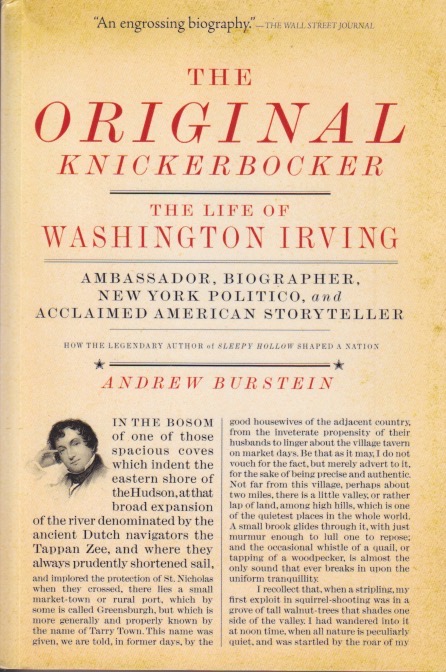

Knickerbocker

Washington Irving is one of those people with an outsized influence on American history who nevertheless has become ignored.  He met nearly every US president from Jefferson through Franklin Pierce, and what’s more, most of them knew who he was.  Sometimes decried as a less-than-original writing talent, Irving nevertheless led a remarkable life and through it all, treated others with respect and gentility.  He’s also a bit of a mystery.  All of this is captured quite well in Andrew Burstein’s biography, The Original Knickerbocker.  Burstein does go off on some diversions from time to time, but most of them are quite interesting.  One of the facts that astounded me was just how many early American political leaders were writers.

I don’t mean wealthy individuals hiring ghost writers to praise them in their “autobiographies,” but actual writers.  Fiction and all.  These were, pardon the period phrase, “men of letters.”  Writing was a way of not only influencing people, but of improving one’s mind.  Some of these individuals became presidents, others cabinet ministers, or foreign diplomats.  Once his literary star ascended, Irving could get struggling writers a government post by a letter sent to the chief executive.  It was a different day than that in which we live.

In my mind, Irving also stands out in that his fame came early and his later writings, while perhaps selling better, never eclipsed his early fame.  And honestly, never reached his earlier shine.  It began with his satirical History of New York.  This book established him as a wit and a gifted writer.  Since his family ran a secure business, Irving was able to travel without working for several years and didn’t produce his next book for another decade.  The Sketch Book of Geoffrey Crayon, Gent. may not be known to many today, but two of its sketches are still told and retold.  One is “Rip Van Winkle” and the other is “The Legend of Sleepy Hollow.”  This book also helped to establish the American celebration of Christmas, something begun in his History.  Although he would write many more books, he’s still best remembered for two short stories from his second.

Burstein takes his cues in this biography from “Rip Van Winkle.”  This particular story is kind of a parable of Irving’s life.  Irving couldn’t know this, of course, having published the story when he was about 36.  His subsequent books sold well enough, and apart from a stint as American minister to Spain, he was able to make his living through his pen.  There’s quite a lot in Burstein’s treatment that I’ll come back to, I’m sure.  But for the moment, it left me feeling as if I’d met a great, if struggling, writer in person.