Anneliese or Emily?

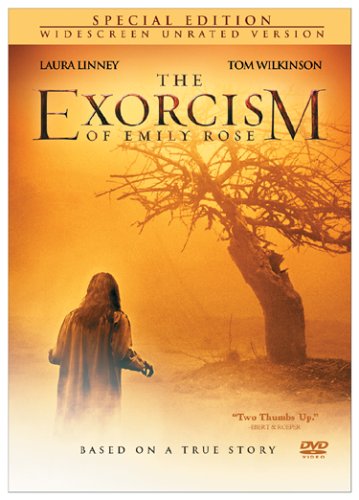
If it weren’t for the movie The Exorcism of Emily Rose, the name of Anneliese Michel would undoubtedly be less recognized than it is. Probably the first exorcism movie since The Exorcist to move the genre in a new direction, Emily Rose was based on the real life case of Anneliese Michel. There were significant differences between film and reality, however. Michel was from Bavaria, and she died at the age of 23 rather than being an American teenager like Emily. The story caught media attention because it was discovered that Michel had died after an extensive, months-long exorcism. Charges were made and the priests and Anneliese’s parents were found guilty of negligent homicide. The movie plays the whole thing out in the courtroom with flashbacks of the possession.

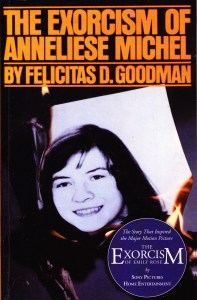
The book which led to the film was The Exorcism of Anneliese Michel, by Felicitas D. Goodman. Goodman, who died in 2005, was a rare academic who wasn’t afraid to address the supernatural. Trained as a linguist, she had years of anthropological fieldwork experience and a medical background. She was also not dismissive of religious experiences. Naturally, this makes her suspect among academics, but her treatment of Michel’s case is both sympathetic and masterful. After narrating events pieced together from court records, diaries, tapes of the exorcism, and information supplied by some of those involved, she offers her own hypothesis of what actually happened. Anneliese Michel was a religious girl caught up in a religious altered state of consciousness that was treated scientifically by drugs. The result was fatal.

Throughout history, and even today, shamanistic persons exist. Whereas in tribal cultures they tend to become prominent, in the “developed world” they are often quite hidden. They experience what Goodman calls religious states of altered consciousness, and are sometimes misdiagnosed as requiring chemical healing. There have been many thoroughly documented cases where such individuals do “impossible” things. The rationalistic world has no place for them, however, for like capitalism, materialism takes no prisoners. Religion is part of who we are. Human beings do have spiritual needs. Such needs can be placated by other means at times, and we can continue to believe that everything in this universe is made of atoms, or super-strings, or quarks. Or we can perhaps admit that theres’s much we do not know. Goodman admits that her solution is an educated guess, but it does put all the pieces together rather nicely. And she doesn’t declare unilaterally whether demons are physical or not. In the case of Anneliese Michel, however, they were undeniably real.
Unseen Worlds

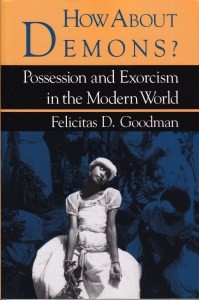
howaboutdemonsA few weeks ago I wrote about re-watching The Exorcism of Emily Rose. In anticipation of the inauguration I was in the midst of a spate of possession movies. I watched several others, including The Rite and The Possession. This got me thinking I should read Felicitas D. Goodman’s book How About Demons? Possession and Exorcism in the Modern World. Goodman was an anthropologist who’d done fieldwork among groups that practiced possession—keep in mind that many religions believe in good spirits as well as evil ones. Her book is one of the few that takes the larger picture seriously. Many writers simply dismiss the “demon haunted world” as naive and superstitious, but Goodman makes the point that possession is a real phenomenon and we don’t know the cause of it. Indeed, it’s impossible to say with certainty what the agency is because spiritual causes can’t be studied empirically. That said, science deeply informs her analysis.

I’ve observed people speaking in tongues before. It’s an uncanny experience. No matter what you decide the origin might be, it’s strange and not a little unsettling. It’s related to possession, as Goodman shows. So is multiple personality syndrome. Unlike most scientists, however, she doesn’t make the unwarranted leap that since these are all related they’re all the same. Speaking in tongues is usually considered a good thing while demonic possession is not. Interestingly, recordings of glossolalia—speaking in tongues—show the same pattern globally. This indicates that whatever it is, it originates biologically from human brains in a mostly predictable way. Many world religions allow for possession by good spirits or gods and alternate states of consciousness are accessible by learning how to reach them. Anyone can do it, but some have the gift of doing so easily. Those who do overlap with the pool of the possessed.

As the White House shows, we like simple answers. Possession, however, is a complex phenomenon. Throughout, Goodman refuses to equate it simply with the physical manifestations that have been observed and recorded. She was a true scientist. Reductionism is related to our love of simple explanations. I wanted to read How About Demons? because it contains one of the few serious academic studies of the case of Anneliese Michel, the young woman on whom The Exorcism of Emily Rose is based. I was expecting, since this is an academic treatment, that the cause would be nailed down simply and efficiently. I was pleasantly surprised when it wasn’t. Well before the movie Goodman interviewed those involved in the case and wrote an entire book on it. Although she clearly believed in science to explain our world, as this book demonstrates, she didn’t give it more explanatory power than it actually has. In a complex world we need as many subtle minds as we can get.


Gods and Demons

In ancient times people were sometimes possessed by gods. They were called “prophets” and they gained a breed of knowledge hidden from most other people. Demons were believed to exist, but they did not possess people. Instead, demons were used as explanations for misfortune, whether malevolently premeditated or not. Demons reflect, in today’s society, the concept of pure evil. Fr. Vincent Lampert, one of America’s 24 official exorcists, visited Montclair State last night to discuss evil, and according to the New Jersey Star-Ledger, he believes evil is a reflex of how people treat one another more often than a “figure with the hooves and horns.” No doubt there is a public fascination with demons, but few people understand their religious pedigree or what other explanations may be used to categorize them. According to the paper, Italy claims 300 exorcists – demonstrating that demons show culturally determined characteristics.

The 2005 movie The Exorcism of Emily Rose, lays out how science and religion differ on the issue of the demonic. Anneliese Michel, a young German woman, died in 1976 after being subjected to a prolonged treatment of exorcism. Her story was the “inspiration” for the film, and it raises the question of the reality of the demonic in the physical world. Fr. Lampert is more circumspect, noting that real life exorcisms are not as dramatic as those shown in the movies. He does, however, recall having seen a person levitate, but not during an exorcism. The human behavior he’s seen while on duty may all be readily explained by mundane physical and mental phenomena.

What does seem certain in all of this is that demons are not the behooved and behorned antagonists of films like Constantine or countless other graphic-novelesque portrayals of evil. Their Pan-based characteristics hearken back to the days when Christianity had to make plain its dismissal of foreign gods. In the ancient world hooves and horns were symbols of strength generally associated with powerful, if sometimes capricious, deities. In other words, what were one culture’s gods have become another culture’s demons. Movie makers understand the simultaneous revulsion and draw of the demonic character, but it seems that Fr. Lampert strives for a more balanced perspective. Evil has many faces, and most of them do not conform to Hollywood standards. Perhaps if all religions were respected demons would lose their power to torment and people would learn to get along with each other.