
For a long time I resisted seeing it. Partially I wasn’t sure if it was any good and partially—mainly—it was because of spoilers. Annihilation came out in 2018, just as I was reading Jeff VanderMeer’s novel upon which the movie was based. I will always remember this because I worked in a cubicle where I couldn’t see my fellow workers and the woman in the next cube was a bit of a chatterbox. She and one of her coworkers had seen the movie and began discussing, somewhat loudly, what’d happened. I was in the middle of the book at the time and didn’t want any spoilers. I’d never actually met the woman in the next cube and I couldn’t go over and tell her to stop talking about the film because one of the reasons we watch movies is to talk to one another about them. (Mostly I do this online.)
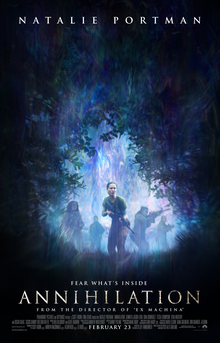
Enough time has passed, and a different woman at work, remotely, suggested I see it. I don’t know why the movie did so poorly at the box office. The director, Alex Garland, has said he didn’t reread the book as he was making the film because he wanted it to be impressions of the novel rather than strictly based on it. Even as I watched, I recalled some of what I read back in 2018. I’ll try to limit spoilers here, but if I’m talking too loudly you can just click away (and, hopefully, come back after you’ve seen it.) It begins when a mysterious “shimmer” appears after a meteorite strike in Florida. Those who enter the shimmer never come out. A team of women scientists are sent in, wondering if gender might make a difference. One of them, Lena, volunteers because her husband did make it out and almost immediately went into a coma.
A sci-fi horror movie, I wonder if it underperformed at the box office because it stars women. The tension builds between them as they try to figure out what’s going on within the shimmer. Species have mutated rapidly and the predatory animals are pretty frightening. The threat, as in VanderMeer’s novel, is ecological. The ending, I’ll say, is quite different from the book because it was intentionally written as a trilogy and the director wanted to resolve the tension in a single film before reading the other two (which I still haven’t done). The end result is thoughtful and tense. The acting is good and the effects are stunning. I’d class it with Arrival as an intellectual exploration of what it means to be part of a universe we barely begin to understand. And kudos for having women lead the way.

 Steve A. Wiggins